

Picture a token’s page on a price tracker. Twenty-four-hour volume: $500 million. It looks like a market with real crowds and real money.
Now open the order book and add up the buy and sell orders sitting near the current price. You find about $200,000.
Divide the first number by the second and you get 2,500. For that volume to be real, the visible book would have to be filled and refilled 2,500 times in a single day. Markets don’t normally work that way.
Volume is a receipt, depth is a shelf
The mismatch comes down to what each number measures.
Volume counts what has already traded. It is a receipt, and receipts can be padded.
Depth counts the orders waiting at prices close to the market, usually within 1% or 2%. It shows how much you could buy or sell right now without moving the price. Think of it as the stock on the shelf.
A shop that claims to sell $500 million of goods a day but keeps $200,000 of stock on its shelves has a problem with its story. Either something strange is happening behind the counter, or the sales figure isn’t what it seems.
How big is “normal”?
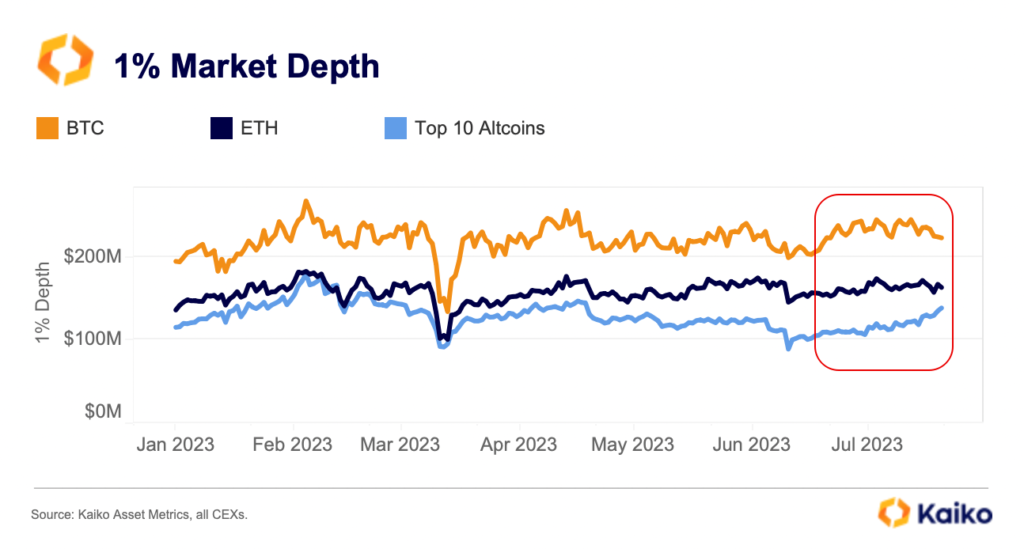
Real depth looks very different from $200,000.
Kaiko, the market-data firm, measures 1% depth across exchanges. It found that the top ten altcoins by market cap carried about $162 million in aggregated 1% depth, a 38% rise over the 2023 average. Those are the biggest altcoins on the market. For Bitcoin, Kaiko tracked $539 million in 2% depth across 33 centralized exchanges in February 2024, a level that still sat well below the $800 million-plus seen before FTX collapsed.
Set our mystery token beside them. Its $200k is roughly 0.12% of the depth of the entire top-ten altcoin group. Yet it claims a trading day that rivals the giants.
Where volume and depth split apart
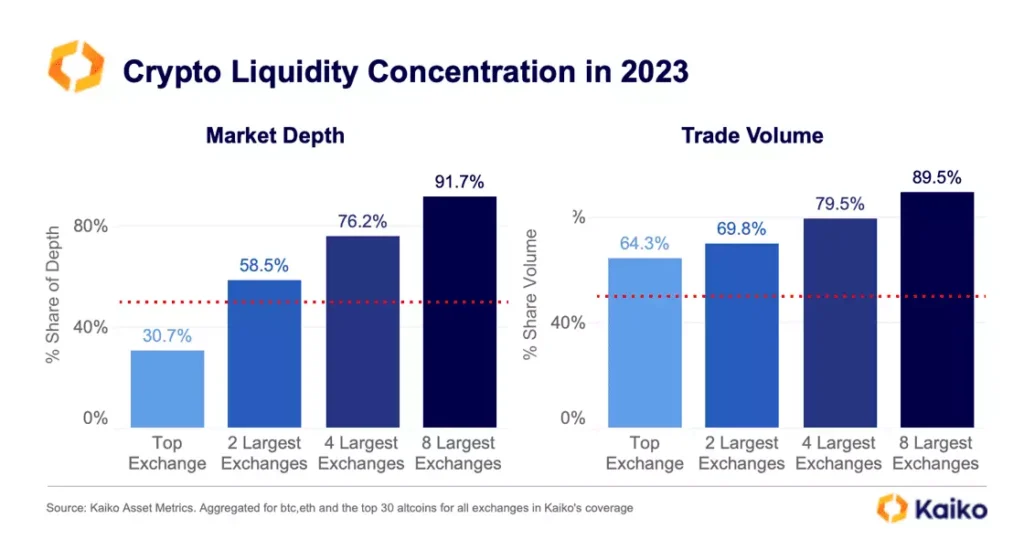
Kaiko’s liquidity concentration work shows how uneven these two numbers can be. In 2023, Binance accounted for 30.7% of global market depth but 64.3% of global trade volume. Even at the world’s biggest exchange, volume ran at about double its share of depth.
Smaller, offshore venues tilt the picture further. Kaiko also found that offshore exchanges now hold 69% of total altcoin liquidity, up from 55% in early 2022. Liquidity is pooling in fewer places, which leaves small tokens on small venues with very little real support.
The hidden culprit: fake volume
There are innocent explanations for a gap between volume and depth. Market makers pull orders in volatile moments, and perpetual futures volume can swamp the spot book. But the most common suspect is wash trading, where the same party buys and sells to itself to look busy.
The research on how widespread this is should give any reader pause:
- A study of 29 exchanges, published in Management Science by Cornell, Newcastle and Tsinghua researchers, found that wash trading averaged more than 70% of reported volume on unregulated exchanges.
- In the weakest group of exchanges, the same research found wash trades were close to 80% of total volume.
- A Forbes review of 157 exchanges concluded that more than half of all reported trading volume is likely fake or non-economic. For the less regulated exchanges in that study, about $217 billion of claimed volume shrank to roughly $89 billion of true volume.
Apply that logic to our token. Even if 70% of the $500 million were fake, $150 million of “real” volume would still be about 750 times the visible depth. The gap shrinks but doesn’t disappear. Something is still off.
It happens on-chain too
Decentralized markets have the same problem. Chainalysis estimated that wash trading on select blockchains reached up to $2.57 billion in 2024, and 4.52% of newly launched tokens showed patterns linked to pump-and-dump schemes.
The liquidity side of those schemes is telling. In Chainalysis’s data, nearly 90% of decentralized exchange pools suspected of pump-and-dumps were rugged by the address that created the pool. “Rugged” means the creator pulled the liquidity out and left holders unable to sell.
Chainalysis’s earlier work found that in any given month of 2023, fewer than 14% of launched tokens managed more than $300 of DEX liquidity the following month. Most tokens never build a real market at all.
Why trackers are catching on
Data providers know raw volume can’t be trusted on its own. Coinpaprika, for one, notes that its exchange confidence score includes a market depth to volume ratio, and a score drops when volume surges much faster than liquidity. Pulling in depth alongside volume is becoming standard practice for anyone serious about checking a market.
Why this matters
You can’t trade volume. You can only trade what the order book will fill. If you buy a token on the strength of a big volume number, the exit door may be much narrower than it looks, and a sell order of modest size can push the price sharply lower. A quick look at depth near the market price takes a minute and can save you from a bad entry or a worse exit.

Dan is a seasoned crypto writer for Blockchaindose who got his start in the space back in 2019. Over the past four years, he’s built a solid grasp of how the industry moves, focusing heavily on DeFi, NFTs, GameFi, and promising new projects.
Off the clock, you’ll usually find him buried in a good book or kicking back with a movie. His blend of hands-on market experience and straightforward commentary makes him a clear, trusted voice across the platform.