

Every crypto exchange loves to quote one number: total 24-hour volume. It is the figure on the front page, in the rankings, and in the press release. But that number blends together two very different kinds of trading. These are spot and perpetual trading.
Spot trading is the simple kind. You pay money, you receive coins, and you own them. Perpetual futures, or “perps,” are the leveraged kind. You never own the coin. You bet on its price, often with borrowed money, and you can hold the bet forever, hence “perpetual.”
The gap between those two kinds of volume, and how that gap changes from one exchange to the next, is one of the least discussed numbers in crypto. Yet it says more about who is steering the market than any headline total.
How big is the gap?
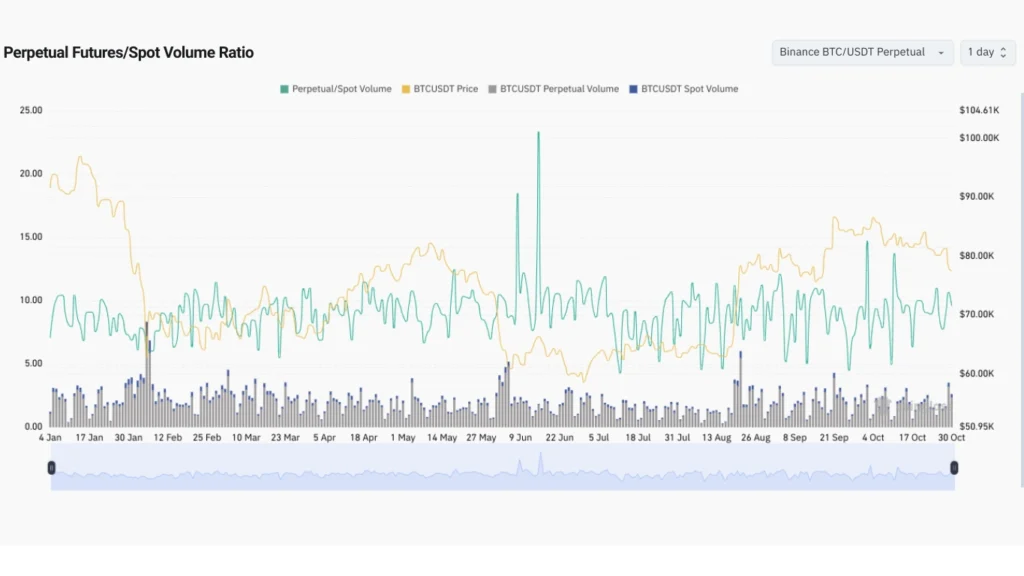
Start with the whole market. CryptoQuant reported that exchanges handled more than $79 trillion in 2025, of which spot was $18.6 trillion and perpetual futures were $61.8 trillion. That is roughly $3.30 of perp trading for every $1 of spot.
In 2026 the gap got wider. CoinGlass’s Q1 report put derivatives volume at $18.63 trillion against $1.94 trillion for spot, a ratio of about 9.6 to 1. CryptoRank’s data for Q2 showed centralized-exchange futures at $15.7 trillion and spot at $3 trillion, which is still more than five to one.
Here is the twist that makes this stat easy to miss: spot is not just smaller, it is shrinking faster. CryptoRank found Q2 spot volume fell 18.9% from Q1, the weakest quarter in two years. Futures volume fell too, but by about 11%.
Glassnode’s own spot-to-futures ratio tells the same story. Its recent readings for BTC sit around 0.15 and for ETH around 0.16. Anything below 1 means futures dominate. At 0.15, futures are about six to seven times bigger than spot.
The record that made headlines
The sharpest example came in August 2026, on the world’s biggest exchange. CryptoQuant data showed Binance’s Bitcoin futures-to-spot volume ratio hit a record 7.82. On a single day, roughly $57.82 billion traded in Bitcoin futures on Binance, against only $6.08 billion in spot.
The timing matters. Bitcoin was trading near $64,000, roughly half its October 2025 peak above $126,000, and CryptoQuant’s own analysts said spot demand had been fading for months. So the market was leaning on leveraged trading while real buying was drying up.
And the leverage itself was smaller than before. Binance’s Bitcoin open interest, the total value of open bets, stood at about $24.5 billion in early August, down from more than $44 billion in October 2025, according to CoinGlass.
Not every exchange looks the same
This is where the “hidden” part comes in. Look at the exchanges one by one and the picture changes a lot.
CertiK’s first-half 2026 review gives a clear example. Binance handled about $1.76 trillion in spot and $9.24 trillion in futures, roughly 5 to 1. OKX did about $4.15 trillion in futures but only $314.6 billion in spot, more than 13 to 1. Bybit’s spot volume was $397.8 billion, a fraction of what a futures-first venue of its size trades in derivatives.
Then there is Coinbase, which posted $329.5 billion in spot volume, close to OKX’s spot figure. In that same CertiK dataset, Coinbase does not appear in the futures series at all. It is essentially a spot venue, which is why its volume looks so different from rivals.
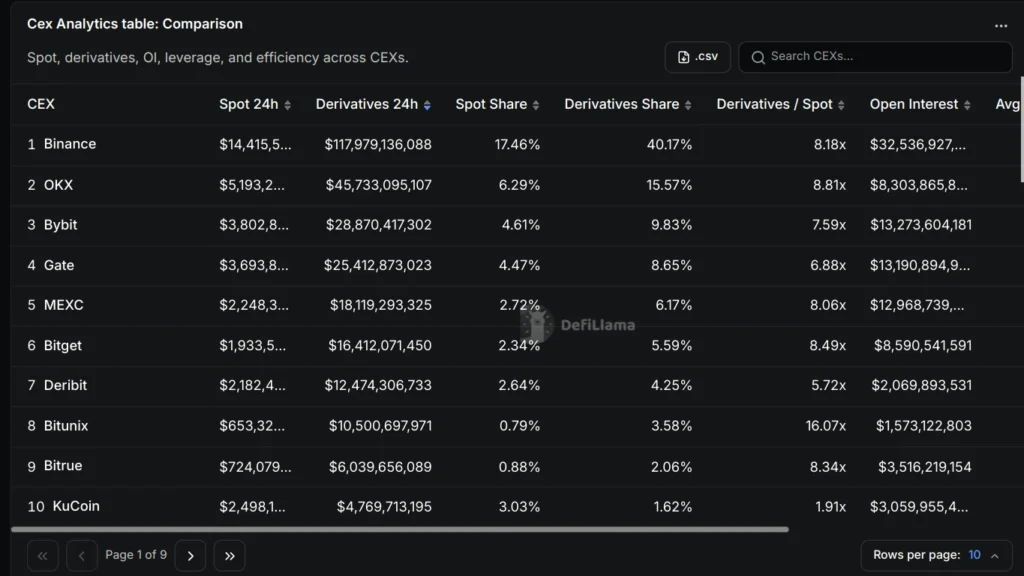
DefiLlama’s exchange dashboard shows the split even more starkly. It flags Kraken as a top-10 spot exchange that barely registers in derivatives. At the other end, MEXC and Weex show large derivatives activity with comparatively thin spot trading.
So two exchanges with similar “total volume” can be completely different businesses. One is a place where people buy and hold coins. The other is a casino for leveraged bets.
The pressure test: July 2026
A fair test of any claim is to ask when it fails. If spot-versus-perp divergence simply meant “leverage is booming,” you would expect perp volume to be soaring along with the gap.
July 2026 shows it is not that simple. CEX perpetual volume fell to $4 trillion, the lowest since December 2023, according to MetaEra citing market data. Spot fell too: CoinGlass numbers showed daily spot volume dropping from $17.8 billion to $13.6 billion over the month, a decline of 23.6%.
CryptoRank’s July recap found every major trading segment shrank, with spot at a two-year low. Crypto.com lost 46% of its spot volume and Bybit lost 43%.
In other words, the gap widened mostly because spot fell off a cliff, not because leverage exploded. That is an important correction to the lazy version of the story. A big ratio can mean “too much speculation” or it can mean “too few buyers.” Right now it is closer to the second.
Is a high ratio always bad?
No, and the data backs that up. Perps are the cheapest way to hedge. Analysts quoted in coverage of the Binance record noted that spot Bitcoin is increasingly held as a hedge against futures positions, which inflates futures volume without any new bullish bets. CertiK also cautions that the ratio alone does not rank an exchange’s safety or quality; it needs to be read alongside open interest, reserves, and product mix.
There is also a structural reason the ratio keeps climbing. Newer products live almost entirely in perps. In June 2026, perpetuals made up 98.5% of all trading volume in crypto’s tokenized stock and commodity products. Decentralized perp exchanges now handle roughly 10% of all perpetual trading, up from about 2% two years earlier. So some of the gap is just a growing menu of products that have no spot version.
What the pattern really says
Put it together and the story is simple. Futures have been bigger than spot for years, and that is normal. What has changed is that spot is weakening faster than futures, and that the mix differs sharply by exchange. A venue with a ratio near 5 to 1 is behaving very differently from one at 13 to 1.
The warning sign is not a high ratio on its own. It is a high ratio paired with rising open interest and falling spot volume, because that means price is being pushed by borrowed money rather than real buyers.
Why the spot versus perpetual divergence matters
When spot trading is thin and futures are thick, prices can move on leverage alone, and forced liquidations can turn a small dip into a crash. CryptoQuant’s analysts made exactly this point after the October 2025 crash: a market driven by futures is mechanically more fragile. Checking the spot-versus-perp split for the exchange you use takes a minute, and it tells you whether a move has real buyers behind it.

Dan is a seasoned crypto writer for Blockchaindose who got his start in the space back in 2019. Over the past four years, he’s built a solid grasp of how the industry moves, focusing heavily on DeFi, NFTs, GameFi, and promising new projects.
Off the clock, you’ll usually find him buried in a good book or kicking back with a movie. His blend of hands-on market experience and straightforward commentary makes him a clear, trusted voice across the platform.