
NFT bridge security is the difference between cross-chain interoperability and a system vulnerable to multimillion-dollar theft. Bridges have become the central infrastructure connecting every NFT marketplace and chain, and attackers have noticed: bridge exploits are now among the largest thefts in crypto history, and a single mistake in key management can lead to the loss of a project’s funds in minutes.
Key Takeaways
- Bridge hacks accounted for roughly $2 billion stolen in 2022 alone – 69% of all DeFi losses that year – making bridges the single most targeted category of crypto infrastructure.
- Burn/Mint is structurally safer than Lock/Mint because it eliminates the giant vault of locked assets that becomes an irresistible target, though most projects still choose Lock/Mint to preserve the original NFT intact.
- Compromised keys, not smart contract bugs, are now the dominant failure mode – Ronin ($624M), Harmony ($100M), and Humanity Protocol ($36M) were all key or validator compromises, not code exploits.
- An audit is necessary but not sufficient – Wormhole, Nomad, and Ronin had all been audited before they were hacked; scope, bytecode verification, and what happens after the audit matter as much as the audit itself.
- Multisig plus timelock is the baseline, not the ceiling – a high-threshold multisig without a timelock still failed at Humanity Protocol in 2026, because a compromised majority of signers could execute instantly.
This guide covers the minimum security standards an NFT bridge needs, how to properly evaluate an audit rather than just trusting the badge, the admin key practices that distinguish secure projects from those that become examples of security failure, and what both builders and everyday users should check before trusting a bridge with real value.
Why NFT Bridge Security Is the Industry’s Biggest Blind Spot
According to Chainalysis’s 2022 bridge security report, roughly $2 billion was stolen across 13 separate cross-chain bridge hacks in 2022 alone, accounting for 69% of all funds stolen from DeFi that year. The pattern repeats because the underlying economics never change: a bridge that custodies assets – whether locked in a vault contract or represented by admin keys with upgrade power – concentrates value into a single point that a successful attacker can drain in one transaction. This is true whether the assets are fungible tokens or NFT smart contracts, and the fundamentals covered in this guide apply to both, though NFT bridges carry an added wrinkle: unique on-chain metadata and provenance history that a naive bridge design can silently lose or corrupt in transit.
Various relevant incidents demonstrate this: Poly Network lost roughly $611 million in August 2021 to an access-control flaw that let the attacker redirect the keeper role to their own address; Wormhole lost $320 million in February 2022 to a signature-verification bug; Nomad lost roughly $190 million in August 2022 after a routine upgrade broke its message-verification logic, letting anyone replay a single valid message to drain funds repeatedly. Each was a different root cause – which is precisely the point: bridge security is not one problem to solve once, it is several independent failure categories that all need separate defenses.
Minimum Security Standards in NFT Bridge Logic
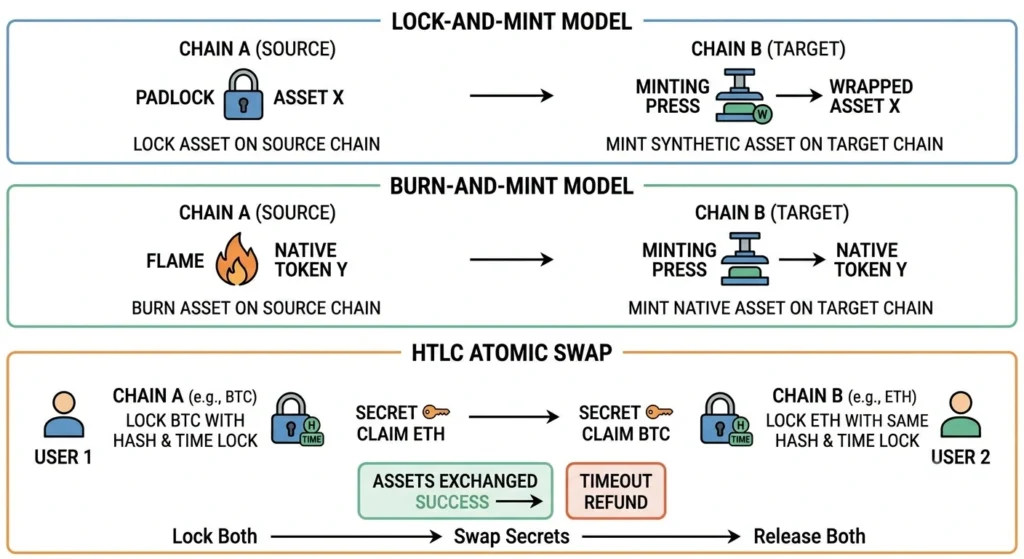
The most basic principle any bridge must respect: the asset must cease to exist, or be locked in an unbreakable way, on the source chain before it appears on the destination chain. Without this guarantee, a cross-chain double-spend is possible by design, not just by bug.
Locking and Issuance Models
|
Model |
Description |
Main risk |
|
Lock / Mint |
The original NFT is locked in a vault contract on the source chain; a wrapped version is minted on the destination chain. Returning burns the wrapped token and releases the original. |
If an attacker takes control of the vault – via a compromised admin key or a contract bug – they can drain everything locked inside it. |
|
Burn / Mint |
The original NFT is destroyed on the source chain and a native equivalent is created on the destination chain. Reversing burns the native token and regenerates the original. |
Requires a reliable regeneration mechanism – unique on-chain metadata or history must be faithfully reconstructed. |
|
Atomic swaps (HTLC) |
Both parties lock an asset; the swap completes atomically if a shared secret is revealed before a deadline. |
Not scalable for generic NFTs without a matching or auction layer – impractical for mass bridges. |
By design, Burn/Mint is the structurally safer model, because it eliminates the giant vault that turns into a honeypot in the first place. Many projects still choose Lock/Mint anyway, because it preserves the original NFT intact rather than requiring a regeneration process. If you choose Lock/Mint, the vault needs the smallest possible attack surface: no upgrade functions if avoidable, no ability to withdraw NFTs outside the verified return path, and mandatory timelocks on any privileged action.
Verifying the Source Event on the Destination Chain
A bridge needs a consensus mechanism to confirm that a lock or burn event actually happened before it mints or releases on the other side. This involves the key decentralization trade-offs:
- External oracles / relayers (Chainlink CCIP, Wormhole’s guardian network) – a set of validators observes both chains and signs the message. A high signature threshold mitigates collusion but introduces an attack vector if validators can be bribed or their signing contract has a bug.
- On-chain light clients – implement a light client of the source chain directly on the destination contract, verifying block headers and Merkle proofs. The most trustless option, and the model behind ecosystems built for cross-chain interoperability like Cosmos IBC – but costly in gas and complex to maintain.
- “Optimistic” verification (the Nomad model, now considered unsafe after its hack) – anyone can propose a message and a dispute period opens. Without an extremely robust incentive and watchtower scheme, this model is prone to major, immediate failures.
Practical recommendation: if a light client is not feasible, choose a validator system with real economic accountability (staking with slashing) and combine it with dynamic rate limiting that caps the maximum value able to flow through the bridge within a time window.
Additional Protections Every NFT Bridge Needs
- Replay protection. Every cross-chain message needs a unique nonce per address/chain so an attacker cannot replay an already-processed transaction – the exact gap Nomad’s exploit ran through.
- Dynamic rate limiting. A configurable cap on total value or NFT count transferable within an hour, auto-pausing the bridge if exceeded – this alone limits how much an active exploit can drain before someone notices.
- Emergency pause. A role capable of immediately stopping all movement, held by a multisig with a timelock – never a single externally owned account.
- Function segregation. The contract that emits a message, the one that verifies it, and the one that custodies funds should be logically separated wherever possible.
Code Audits: The Standard and How to Actually Evaluate One
An external smart contract audit is not a guarantee seal, but it remains the most rigorous tool available for catching vulnerabilities before deployment – it reviews business logic line by line, applies knowledge of attack patterns most teams have never encountered, and produces a public report ranking findings by severity. But the badge does not guarantee security: Wormhole, Nomad, and Ronin had all been audited before they were hacked. The failures usually sit in what was not audited – a later upgrade, an off-chain relayer, a multisig configuration – or in architectural flaws no line-by-line contract review would ever catch.
How to Evaluate an Audit as a Builder or Investor
- Firm reputation and track record. Has the firm audited top-tier protocols? A well-known name is not synonymous with infallibility, but it does indicate a standardized process.
- Exact scope. The report must specify which files and commits were audited. If a hack traced back to a component outside the stated scope – a proxy upgrade never reviewed, for instance – the audit provided no real protection. Demand that scope covers the vault/handler/wrapped-token contracts, the message-verification contracts, the timelock and multisig interfaces, and any external oracle or validator dependency.
- Resolved vs. remaining findings. A transparent report lists every issue and its current status. Unresolved critical findings, or ones mitigated only by “we trust the multisig,” are a red flag.
- On-chain bytecode verification. The deployed contract address must correspond exactly to the audited source code, verifiable on a block explorer. If the team ships a different version than what was audited, the audit is worthless.
- Formal vs. manual verification. Formal verification tools (Certora, Act, K) can mathematically prove specific properties – “the total locked never exceeds the total minted,” for example. Ask whether they were used and request the specification rules.
For non-technical investors, the simplest filter still works: if a bridge does not publish its full audit report – and instead shows a generic checkmark badge – that is sufficient reason not to deposit funds. Real audits run dozens of pages and are never hidden.
Secure Management of Admin Keys
Compromised keys, not clever smart contract logic, are now the dominant way bridges actually fail. The clearest recent case: in June 2026, Humanity Protocol lost roughly $36 million after an employee’s laptop was compromised via a phishing email, exposing the private keys behind its Gnosis Safe multisigs. The attacker controlled three of six signer keys on Ethereum and three of five on BNB Chain – enough to meet the signing threshold – and used them to seize ProxyAdmin control and push a malicious contract upgrade that drained and minted hundreds of millions of H tokens. Every transaction carried a valid signature. The contracts behaved exactly as written; the failure was entirely in who controlled the keys, and the fact that no timelock existed to give the team a window to catch the malicious upgrade before it executed. Post-incident analysis singled this out as the dominant 2026 DeFi failure pattern: compromised accounts have overtaken smart contract logic bugs as the leading cause of losses by incident count.
A similarly instructive — and often misdescribed — case is Ronin. It is sometimes summarized online as “an inside job,” which is not entirely accurate: forensic analysis attributes the Ronin Bridge’s $624 million loss to a fake job offer sent to a Sky Mavis employee, containing a malicious document that compromised their device and exposed validator keys, giving the attacker control of five of the bridge’s nine validators – enough to approve fraudulent withdrawals. That is social engineering targeting an unwitting employee, not a malicious insider, but the practical lesson is identical to Humanity Protocol’s: an org’s security is only as strong as its least-suspecting team member’s inbox, and no smart contract audit defends against that.
The Antidote: Multisig, Timelock, and Progressive Decentralization
- High-threshold multisig. Use Gnosis Safe or an equivalent on each chain, with a threshold of at least 3-of-5 or 4-of-7 depending on value custodied. Signers should be distinct individuals with hardware wallets, no mutual dependency, and geographically distributed key storage.
- Separation of critical roles. Do not assign every privilege to the same address – split Owner/ProxyAdmin (can upgrade contracts), Pauser (can only halt the bridge), Fee collector (withdraws fees but never touches the vault), and Vault operator into distinct roles.
- Mandatory timelocks. A 48-72 hour delay on any contract upgrade or critical parameter change gives the community a reaction window if a multisig is compromised – the exact control missing at Humanity Protocol. Some protocols add a veto guardian able to cancel a scheduled transaction during the delay.
- Hardware wallets, always. All admin signatures should come from isolated devices. For automated relayer signing, use an HSM with strict policies – never plain keys in a config file, and never on a general-purpose employee laptop.
- Progressive decentralization. The long-term goal is a bridge that does not depend on human keys for daily operation, only for rare upgrades – with those upgrades eventually gated by algorithmic, ZK-verified rules rather than a standing set of signers who can be individually targeted.
Trusted vs. Trustless Bridges: Understanding the Underlying Risk
A trusted (custodial) bridge has a central entity custody the real assets and issue a representative token elsewhere – wBTC is the classic example, and an NFT equivalent would be a marketplace or custodian holding NFTs and issuing a voucher. The risks are counterparty risk (if the custodian is hacked, goes bankrupt, or turns malicious, the underlying asset is gone), censorship (a central entity can freeze or confiscate funds unilaterally), and direct regulatory exposure.
A trustless bridge rests security on smart contracts and a decentralized validator/relayer network instead – no single party holds the funds, the rules live in code and cryptography. Not risk-free: smart contract risk remains just as lethal without a human custodian, a small validator set can still collude or have its keys stolen, and a bug in a signature-verification library — as happened to Wormhole via a deprecated Solana function — can be just as catastrophic as any custodial failure.
Most serious protocols in 2026 land on a hybrid, “trust-minimized” model: staked validators with slashing, timelocked upgrades, and the ability for anyone to run the relayer role if they present a correct proof. As a builder, the obligation is transparency about which trust assumptions your bridge actually operates under – never selling a system that depends on a five-person multisig as “trustless.”
Practical Advice for Users Moving Assets Across a Bridge
Everything above targets builders and auditors, but users moving real assets across a bridge today – not evaluating one in the abstract – have their own simpler risk calculus. The most consistent advice from experienced bridge users: the risk is not really in the bridging transaction itself, it is in how long you hold the bridged (wrapped) asset afterward. A wrapped token’s value is a claim on the bridge’s continued solvency — if the bridge is exploited after you bridge but before you exit into a native asset or a different protocol, that claim can become worthless even though your original transaction was executed correctly. The practical habit this suggests: treat a bridge as a quick transfer method, not as a place to hold value, and convert out of wrapped assets into native tokens or diversified positions promptly rather than holding them in a bridged form indefinitely.
- Avoid moving large amounts in a single transaction when a smaller test transfer is practical – it costs a little more in fees but limits exposure if something is wrong.
- Use established bridges with a real audit and incident history over newer, unaudited ones chasing yield or lower fees – track record is one of the few signals an everyday user can actually verify.
- Verify contract addresses carefully before approving any transaction — address-poisoning and fake bridge front-ends are a common way users lose funds with the underlying bridge protocol itself never being touched.
None of this eliminates bridge risk entirely — every cross-chain system carries some trust assumption, and even careful users are occasionally affected by a fast-moving exploit. But minimizing time-at-risk and sizing transactions sensibly is the most effective action an ordinary user can control.
NFT Bridge Security Checklist
Before launching an NFT bridge – or trusting funds to one – verify it meets at least the following:
- Burn/Mint or Lock/Mint logic with a minimal-attack-surface vault.
- A cross-chain verification mechanism that is audited and carries real economic accountability.
- Anti-replay protection, dynamic rate limiting, and an emergency pause.
- A full security audit with explicit scope and on-chain bytecode verification.
- Admin keys managed via multisig, hardware wallets, separated roles, and a mandatory timelock.
- A stated progressive-decentralization plan for administrative powers.
- Full transparency about the trust model – custodial, trustless, or hybrid.
Building a secure bridge is not a one-time achievement; it is an ongoing process of monitoring, attack simulation, and defensive updates. The next time a bridge advertises millions in TVL, the useful question is not “how much is locked” but “how many of these requirements are met” — because in each incident described in this guide, the missing requirement corresponds to the vulnerability through which the funds were stolen.
FAQ
What is the safest NFT bridge model – Lock/Mint or Burn/Mint?
Burn/Mint is structurally safer because it removes the large vault of locked assets that attackers target. Most projects still use Lock/Mint anyway because it preserves the original NFT rather than requiring a regeneration mechanism for unique metadata – the trade-off is a security cost for a UX and provenance benefit.
Why do bridges keep getting hacked even after being audited?
Because audits review a fixed scope at a fixed point in time. Wormhole, Nomad, and Ronin were all audited before they were exploited – the failures came from components outside the audited scope, later upgrades, or compromised keys rather than bugs a code review would catch.
Are private key compromises more common than smart contract bugs now?
Yes, as of 2026 reporting – compromised admin or validator keys have overtaken smart contract logic bugs as the leading cause of DeFi and bridge losses by incident count, with Humanity Protocol’s $36 million loss and Ronin’s $624 million loss both tracing to compromised individuals rather than contract vulnerabilities.
What is the single most important defense against a Humanity Protocol-style key compromise?
A mandatory timelock on upgrades and privileged actions. Humanity Protocol had a multisig but no timelock, so a compromised signing majority could execute a malicious upgrade instantly with no window for the team to notice and intervene.
How long should I hold a wrapped/bridged NFT or token before it is “safe”?
There is no fixed safe duration, but the practical guidance from experienced users is directional: minimize the time spent holding a wrapped asset rather than treating a bridge as a place to park value. Bridging quickly and exiting into a native asset promptly limits your exposure window if the bridge is exploited after your transaction.
Is a trustless bridge automatically safer than a custodial one?
Not automatically. Trustless bridges remove a central custodian but still carry smart contract risk and validator-collusion risk – both can be just as lethal as a custodian failure. The right question is not “trusted vs. trustless” alone, but what specific assumptions the chosen model actually relies on.

Isai Alexei is a journalist and financial analyst covering cryptocurrency markets and traditional securities for Blockchaindose. He has spent ten years analyzing digital assets, trading activity, and market structure.