
Algorithmic stablecoins were designed to maintain a stable value without depending entirely on traditional reserves. They use supply adjustments, arbitrage, and market incentives to keep their prices close to $1. The idea was to create decentralized money without relying on banks or holding large amounts of cash equivalents. TerraUSD’s collapse in 2022 exposed how quickly these mechanisms can fail when confidence and liquidity disappear, raising questions about whether newer designs have solved the weaknesses of their predecessors.
Key takeaways
- Algorithmic stablecoins rely on supply adjustments, arbitrage, and incentives to maintain their peg.
- TerraUSD exposed how declining confidence can accelerate a stablecoin collapse.
- Newer models rely more on collateral, derivatives, and hedging.
- Maintaining stability during market stress remains a major challenge for algorithmic stablecoins.
What Are Algorithmic Stablecoins?
Definition
Algorithmic stablecoins are cryptocurrencies designed to maintain a target value, usually $1, through automated supply adjustments or market incentives rather than conventional reserves sufficient to redeem every token. When their price moves away from the peg, the protocol encourages users to buy, sell, mint, or burn tokens to correct the deviation.
Unlike reserve-backed stablecoins such as USDT and USDC, which depend on assets held by an issuer, algorithmic models rely more heavily on market behavior and the economic incentives built into their systems. Some adjust token supply directly, others use a second token to absorb volatility, while newer designs combine collateral with derivatives or hedging mechanisms. The term therefore covers several different models, with very different risk profiles.
How Algorithmic Stablecoins Maintain Their Peg
Algorithmic stablecoins use different mechanisms depending on their design, but their common objective is to restore the price whenever it moves away from its target.

1. Supply Expansion and Contraction
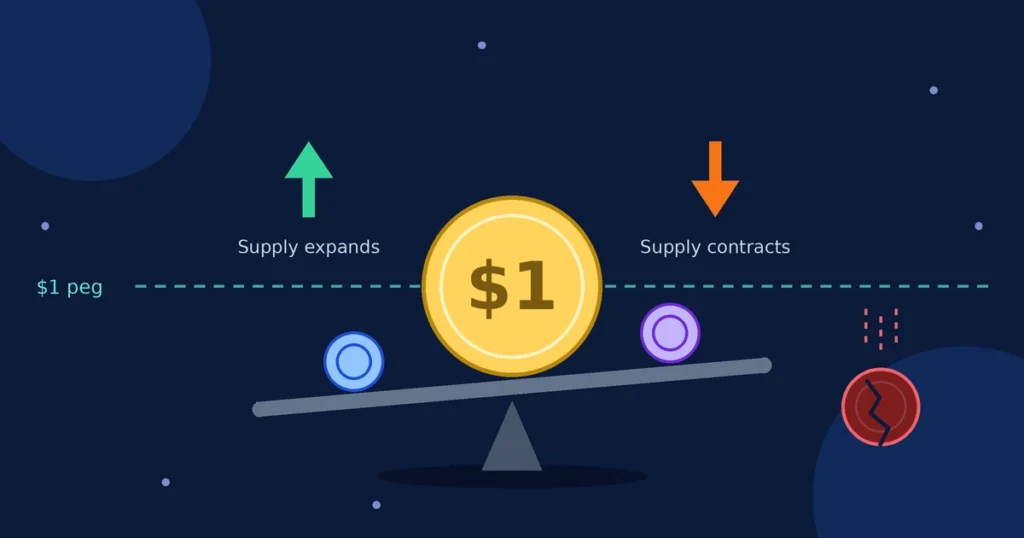
Some stablecoins adjust their circulating supply based on market prices. When demand pushes the price above its target, the system may increase token supply. When the price falls below the target, it may reduce supply or incentivize users to remove tokens from circulation.
The mechanism is designed to create an inverse relationship between supply and price. Increasing supply is intended to reduce upward price pressure, while reducing supply is intended to support the price when demand weakens.
real World example
Ampleforth (AMPL) is an example of this approach. Its protocol adjusts token balances through rebasing, increasing or decreasing the number of tokens held in wallets according to price deviations. Rather than guaranteeing that each token always trades at $1, AMPL changes the quantity of tokens users hold to bring its market price toward its target.
This distinction is important because a reduction in token quantity does not automatically mean a holder loses their proportionate share of the network. Rebasing adjusts balances proportionally, meaning holders retain their relative ownership percentage unless their holdings change through trading or other activity.
2. Dual-Token Mechanisms
Another design uses two separate tokens. One attempts to maintain a stable value, while the other absorbs volatility and supports the stabilization mechanism.
When the stablecoin trades below $1, the system may allow users to burn stablecoins in exchange for a dollar’s worth of the secondary token. When the stablecoin trades above $1, users may be able to burn the secondary token to create new stablecoins.
These conversions are intended to create arbitrage opportunities. Traders have an incentive to buy discounted stablecoins and redeem them for value, or create new stablecoins when the market price exceeds the peg.
REAL World example
TerraUSD (UST) used this model with LUNA. Its mechanism relied on the market value of LUNA to absorb redemptions and help maintain UST’s dollar peg. However, the mechanism depended on LUNA retaining enough value and market demand to support the process.
3. Arbitrage and Market Incentives
Algorithmic stablecoins also depend on arbitrageurs, traders who attempt to profit when a token moves away from its target price.
Worked example
For example, if a stablecoin trades at $0.98, an arbitrageur may purchase it at a discount and redeem it for $1 worth of another asset through the protocol, assuming the mechanism is functioning and redemption is available. This creates buying pressure on the discounted token and can help push its price back toward $1.
If the stablecoin trades above $1, traders may be incentivized to create additional tokens and sell them at a premium, increasing supply and pushing the price down.
When this works?
These mechanisms work when market participants believe the stablecoin can recover and when there is enough liquidity to execute the trades. Arbitrage cannot guarantee stability if confidence collapses, the secondary asset loses value, or the market no longer has sufficient buyers.
The State of Algorithmic Stablecoins Today
The stablecoin market remains dominated by tokens that rely on fiat reserves or other forms of backing rather than purely algorithmic stabilization.
According to DeFiLlama, the total stablecoin market capitalization stood at approximately $279.82 billion on November 27, 2026. USDT accounted for roughly $173.6 billion, while USDC held approximately $69.2 billion. Ethena’s USDe was around $4.92 billion, making it one of the largest stablecoin designs using crypto collateral and hedging mechanisms rather than a conventional fiat-reserve model.
These figures highlight how concentrated the stablecoin market remains. USDT and USDC alone represent the overwhelming majority of the market, while other designs compete for a much smaller share.
What The Data Shows
The market data also creates an important limitation for analyzing algorithmic stablecoins. There is no universally agreed classification separating purely algorithmic stablecoins from synthetic dollars, crypto-collateralized stablecoins, and hybrid models. As a result, the market capitalization of algorithmic stablecoins cannot be accurately calculated by simply adding together every token that uses some form of algorithmic stabilization.
The industry’s direction is nevertheless visible. Stablecoin designs increasingly rely on collateral, hedging, liquidity mechanisms, and other financial structures rather than attempting to maintain a peg through supply adjustments alone.
TerraUSD and the Collapse of Algorithmic Confidence
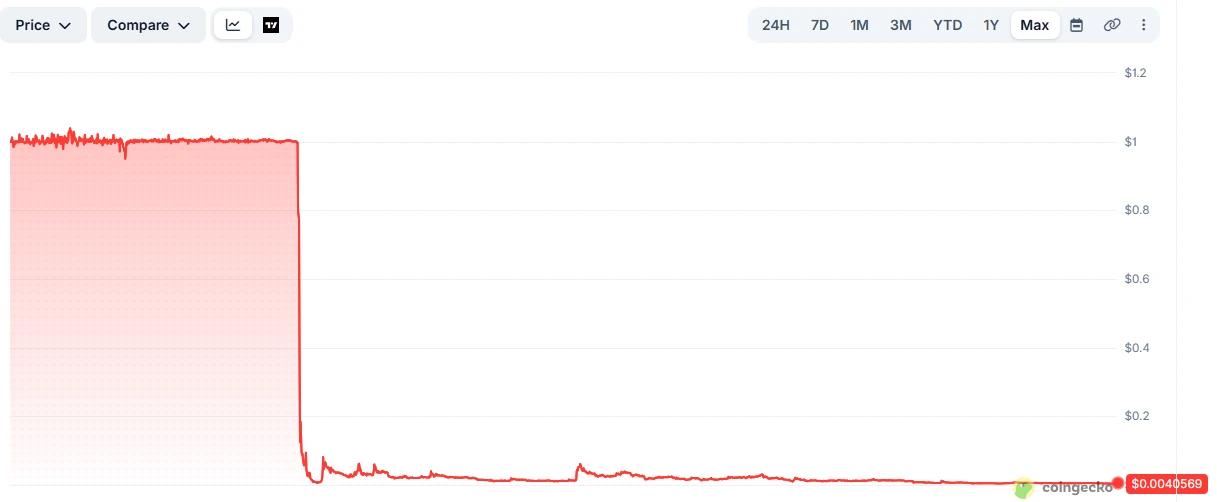
TerraUSD was one of the most prominent algorithmic stablecoins before its collapse in May 2022. It attempted to maintain a $1 peg through an exchange mechanism involving its sister token LUNA rather than traditional dollar reserves.
The mechanism allowed users to exchange 1 UST for $1 worth of LUNA and vice versa. When UST traded below $1, users could buy discounted UST, burn it through the protocol, and receive $1 worth of LUNA. The incentive was intended to reduce UST supply and push its price back toward the dollar. When UST traded above $1, users could burn LUNA to mint new UST, increasing supply.
The mechanism depended on LUNA maintaining enough market value to absorb UST redemptions. As long as demand for UST remained strong and LUNA retained its value, the system could operate. But when confidence weakened, the relationship became a source of instability.
How the Terra Collapse Unfolded
May 2022: a stabilization mechanism turned into a feedback loop
The Trigger
On May 7, 2022, UST faced heavy selling pressure after liquidity was withdrawn from Curve pools. The peg briefly recovered, but confidence was damaged and withdrawals from Anchor, Terra’s lending protocol, accelerated.
Why Anchor Mattered
Anchor offered yields close to 20%, and about $16 billion of the roughly $18 billion UST supply was deposited there at its peak. Those returns drove demand for UST but depended on subsidies from Terra’s yield reserves rather than organic income.
The Death Spiral
- UST lost its dollar peg.
- Holders rushed to redeem.
- The system issued more LUNA to absorb redemptions.
- Rising LUNA supply pushed its price down.
- Falling LUNA value weakened the peg mechanism.
- More holders lost confidence, speeding up the collapse.
The Damage
Research from the Federal Reserve and NBER shows the ecosystem collapsed within days, wiping out roughly $60 billion across UST and LUNA.
The Core Lesson
Terra’s failure wasn’t just an algorithm malfunction. The system could create more LUNA but couldn’t create demand for it, and its stability relied on an asset exposed to the same crisis it was meant to absorb.
Terra Wasn’t the First Warning
Terra was the largest algorithmic stablecoin failure, but it wasn’t the first to show how these mechanisms break under pressure.
Iron Finance and TITAN (June 2021)
Iron Finance’s IRON stablecoin was partially backed by USDC and partially by its native token, TITAN. Its stability depended on TITAN holding its market value.
What Went Wrong
- Selling pressure on TITAN intensified.
- TITAN’s price collapsed, weakening IRON’s backing.
- Confidence in IRON deteriorated.
- Redemptions and further selling accelerated the collapse.
The Shared Weakness
Both IRON and Terra relied on a volatile token to absorb pressure. When that token lost value, the peg mechanism failed with it.
What the Fed Found
The Federal Reserve’s analysis identified vulnerabilities in IRON’s stabilization and redemption mechanics. It showed that partial collateralization alone doesn’t guarantee stability.
What IRON and Terra Had in Common
| Project | Stabilization Design | What Failed |
|---|---|---|
| IRON/TITAN (2021) | Partial USDC collateral combined with TITAN | TITAN’s collapse weakened the backing and accelerated redemptions |
| TerraUST/LUNA (2022) | Arbitrage between UST and LUNA | LUNA issuance expanded as UST holders exited, destroying confidence in both tokens |
Both systems relied on a volatile token or market mechanism to absorb pressure. When the value of that mechanism weakened, the stablecoin’s ability to maintain its peg weakened with it.
The common lesson is that a stablecoin’s stabilization mechanism cannot be evaluated in isolation. Its ability to withstand a crisis depends on the liquidity, market value, and confidence surrounding the assets and incentives that support it.
What Happened to Algorithmic Stablecoins After Terra?
Terra’s collapse changed how the industry approached stablecoin design. The original idea of maintaining a dollar peg through purely algorithmic supply management became harder to defend after a system with billions of dollars in value failed so quickly.
Newer projects still use automated stabilization mechanisms, but many rely on collateral, derivatives, hedging, and market liquidity. These models may reduce some risks associated with unbacked algorithmic stablecoins, but they introduce different dependencies.
Ampleforth (AMPL)
Ampleforth uses an elastic supply model rather than conventional dollar redemption. Its protocol adjusts token quantities held by users through rebasing, expanding or contracting supply based on price deviations.
AMPL does not promise that each token will always trade at exactly $1. Instead, it adjusts the number of tokens users hold to bring the price toward its target, which is tied to an inflation-adjusted dollar.
This makes AMPL fundamentally different from a fiat-backed stablecoin. The system shifts demand volatility from price to token supply, but market prices can still fluctuate around the target.
AMPL demonstrates that algorithmic monetary designs remain active, even if they don’t offer the same price stability users expect from conventional stablecoins.
Ethena USDe
Ethena’s USDe represents a different approach. Rather than relying on a purely unbacked algorithmic mechanism, it uses crypto assets and corresponding short derivatives positions to hedge price exposure.
The protocol attempts to maintain dollar stability through delta hedging, mint-and-redeem mechanisms, and arbitrage. The value of the underlying collateral is offset by short positions, allowing the system to create a synthetic dollar without depending entirely on traditional banking reserves.
However, this design introduces its own risks, including funding-rate changes, exchange and custody exposure, liquidity constraints, collateral fluctuations, and counterparty risks associated with derivatives markets.
USDe is therefore better understood as a synthetic, delta-hedged dollar than as a purely algorithmic stablecoin like the original UST.
Curve crvUSD
Curve’s crvUSD uses crypto collateral and automated mechanisms to manage loans and liquidation exposure. Its LLAMMA system gradually adjusts collateral exposure through price bands, attempting to make liquidations less abrupt than conventional liquidation systems.
The system includes collateralized borrowing, automated market-making mechanisms, price oracles, monetary policy, and PegKeepers that help stabilize the peg.
crvUSD is not an uncollateralized algorithmic stablecoin. It relies on collateral and financial mechanisms to manage stability, which places it in a different category from the original Terra design.
Why Algorithmic Stablecoins Still Struggle
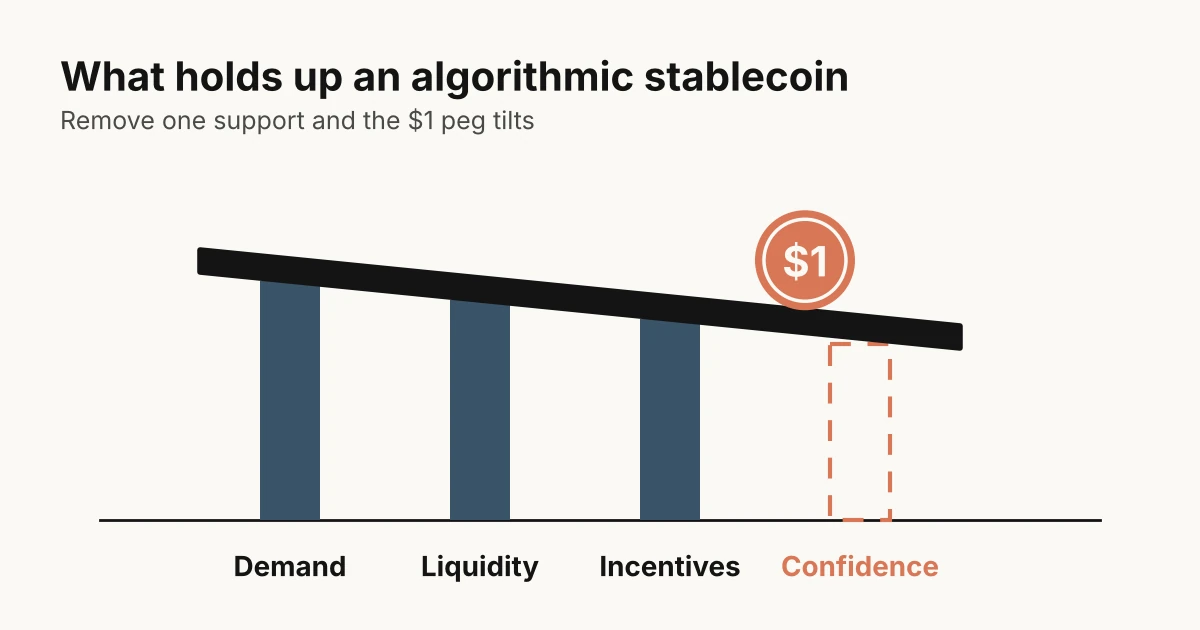
Despite different designs, algorithmic stablecoins continue to face several fundamental challenges.
1. Confidence Is Difficult to Program
Algorithms can execute predefined rules, but they cannot force market participants to believe in a token’s value. When confidence weakens, holders may sell faster than the stabilization mechanism can respond.
2. Liquidity Can Disappear During a Crisis
Arbitrage depends on market liquidity. If pools become depleted, trading becomes expensive, or redemption mechanisms cannot absorb demand, the incentives intended to restore the peg may become ineffective.
3. Stabilization Can Create Additional Selling Pressure
Some mechanisms rely on issuing additional tokens to absorb redemptions. When the backing token is already declining, increasing its supply can intensify selling pressure rather than restore confidence.
4. Newer Models Introduce Different Risks
Collateralized and synthetic stablecoins may reduce reliance on purely algorithmic demand, but they introduce exposure to liquidation, derivatives markets, funding rates, counterparties, custodians, and collateral prices.
The risks have changed, but they haven’t disappeared.
My Perspective on Algorithmic Stablecoins
I find the idea behind algorithmic stablecoins interesting, but honestly, I don’t think they are necessary. Stablecoins are supposed to protect value, and I wouldn’t trust an algorithmic model with my savings when better-established alternatives already exist. Decentralization is appealing, but it means little if the mechanism cannot hold up under pressure. Algorithmic stablecoins may be worth experimenting with, but I see little reason to use them to store money I cannot afford to lose.
1. Can algorithmic stablecoins recover their peg after losing market confidence?
Yes, but recovery depends on liquidity, market demand, and confidence in the stabilization mechanism. If these disappear, restoring the peg becomes increasingly difficult.
What happens to holders if an algorithmic stablecoin’s backing token becomes worthless?
Holders may face severe losses as the backing token loses value and the mechanism can no longer support redemptions or restore the peg.
Why do algorithmic stablecoins struggle to compete with USDT and USDC?
USDT and USDC benefit from reserve-backed models, stronger market liquidity, and wider adoption, making them more attractive to users seeking price stability.
Can an algorithmic stablecoin survive a bank run without external liquidity?
It is possible in theory, but a sudden wave of selling can overwhelm its stabilization mechanism. Without sufficient liquidity or demand, maintaining the peg becomes extremely difficult.

Muhammad Mubashir is a crypto enthusiast who has been in the Web3 space since 2019 and writing content for major industry platforms since 2024. They specialize in blockchain architecture, Layer 1/2 solutions, NFTs, DeFi, and Web3 technologies, and enjoy gaming in their free time.