


Most people who trades/uses Ethereum see blockchain transactions as fairly straightforward. You submit a transaction, the network processes it, and the result is recorded on the blockchain. But there is more going on behind the scenes than most traders/users realize. Before transactions are included in a confirmed block, the order in which they are processed can create opportunities for certain participants to earn a profit.
This is where “Maximal Extractable Value (MEV)” comes in to play.
MEV refers to the extra value that can be captured by changing the order of transactions, including certain transactions, or leaving others out of a block. It has become an important part of Ethereum’s financial ecosystem, especially with the growth of decentralized exchanges, lending platforms, and other DeFi applications.
For everyday Ethereum users, this can have noticeable consequences. A trader might receive fewer tokens than expected, end up paying a worse price than anticipated, or unknowingly become part of a strategy that generates profits for someone else.
To really understand MEV, it is important to look beyond the transactions displayed on a blockchain explorer. You also need to understand how transactions compete to get included in a block, how automated searchers spot profitable opportunities, and how block builders and validators influence the order in which transactions are processed.
What MEV Actually Means and Why Transaction Order Matters
The term Maximal Extractable Value originally emerged from research into Ethereum’s transaction-ordering system. It was initially called Miner Extractable Value because miners controlled which transactions entered a block and the order in which they were processed. Ethereum’s transition from Proof of Work to Proof of Stake changed that structure. Validators now take responsibility for proposing blocks, but the economic opportunities created by transaction ordering remains the same.
Ethereum’s official documentation defines MEV as the value that can be extracted from block production beyond standard block rewards and gas fees by including, excluding, or changing the order of transactions.
To understand why this is important is to look at how Ethereum transactions work.
Explanation
When someone submits a transaction, it does not immediately become part of the blockchain. It first needs to reach the network and wait for inclusion in a block. Transactions waiting to be processed are commonly associated with the mempool, a collection of pending transactions that network participants can observe. This waiting period creates an opportunity.
Suppose a trader wants to purchase a large amount of ETH through a decentralized exchange. The transaction may be visible before it is confirmed. A bot monitoring the network can identify the trade, estimate its impact on the market price, and determine whether changing the order of transactions could generate a profit.
The bot does not need to control Ethereum or hack the exchange. It only needs to identify an opportunity and arrange for its transactions to execute in a favorable position. This is the central idea behind MEV. However, not every profitable transaction-ordering strategy is an attack. Some strategies help decentralized markets function more efficiently, while others take advantage of ordinary users.
The Participants Behind Ethereum’s MEV Economy
MEV is not generated by a single group. It involves several participants with different responsibilities, and understanding their relationship explains how the profits move through the Ethereum ecosystem.
Searchers
Searchers are usually the first participants to identify profitable opportunities. They operate automated software that continuously examines blockchain activity, decentralized exchange prices, lending positions, and pending transactions.
Their primary objective is to find situations where transaction execution can generate a profit.
For example, an ETH trading pair might offer a slightly different price on two decentralized exchanges. A searcher can detect the difference, calculate the expected trading costs, and submit transactions designed to purchase ETH on the cheaper exchange and sell it on the more expensive one.
Searchers compete with each other because the same opportunity is often visible to multiple bots. Identifying an opportunity is therefore only part of the process. Executing it before the other searchers is equally important.
Block builders
Block builders are specialized entities responsible for collecting transactions and deciding how to arrange them inside a proposed block. They receive transactions from different sources, including public mempools and private transaction channels. They can also receive transaction bundles from searchers.
After receiving these transactions the builders then use algorithms and simulations to determine which combination and ordering of transactions offers the most profitable block. Their objective is not necessarily to prioritize transactions according to when they were submitted. Instead, they compete to construct valuable blocks and offer bids to validators.
Validators
Validators are responsible for proposing blocks and helping secure Ethereum through its Proof of Stake consensus mechanism.
They can receive competing block proposals through MEV infrastructure and select a valid proposal offering an attractive payment. This allows them to capture part of the value generated by MEV without necessarily operating their own searcher bots or building blocks themselves.
Relays
Relays act as communication intermediaries between builders and validators. They receive proposed blocks and check their validity after that they pass relevant bids to the validators.
This arrangement helps keep block contents private until the validator commits to proposing a particular block. However, relays also introduce a layer of trust and infrastructure dependence into the process.
Together, these participants form an economic supply chain. Searchers identify opportunities, builders organize profitable transactions, relays facilitate communication, and validators receive payments for proposing blocks.
Flow chart of the process
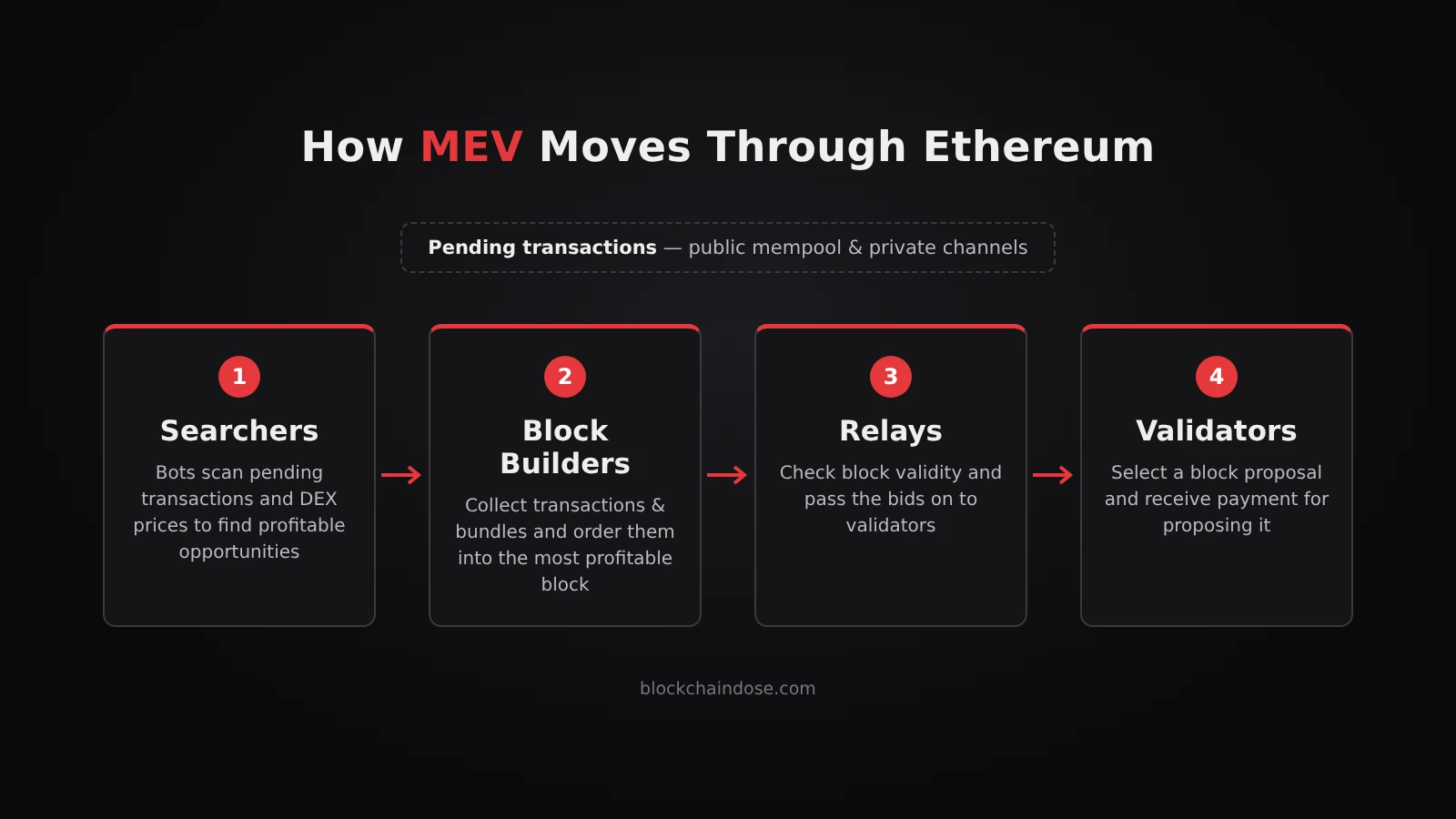
How MEV Bots Generate Profits Through Transaction Ordering
There are several ways to extract MEV from Ethereum transactions. Some are based on differences between market prices, while others rely on predicting how a large transaction will affect liquidity.
Three strategies are particularly important: arbitrage, front-running, and sandwich attacks.
DEX arbitrage: Profiting from price differences
Decentralized exchanges do not always display identical prices for the same token. Differences can appear because of trading volume, available liquidity, and the speed at which prices adjust.
Consider a hypothetical example.
ETH is trading at $3,000 on one decentralized exchange and $3,020 on another. A searcher identifies the difference and buys ETH from the cheaper market before selling it on the more expensive one.
The $200 is not the final profit. The searcher must still account for gas fees, exchange fees, price movements, and any additional execution costs.
| Transaction | Amount |
|---|---|
| ETH purchased | 10 ETH |
| Purchase Price | $3,000 |
| Total Purchase Cost | $30,000 |
| Selling Price | $3,020 |
| Total Selling Price | 30,200 |
| Gross Profit | $200 |
| Execution Costs | $70 |
| Net Profit | $130 |
If the total costs reach $70, the searcher’s net profit falls to $130.
This example illustrates why execution speed is crucial, Other searchers can identify the same opportunity and attempt to capture it first. A transaction that was profitable when submitted might become unprofitable before execution.
Arbitrage is also not necessarily harmful to traders. By correcting price differences between exchanges, arbitrageurs help keep decentralized markets aligned.
Front-running: Getting ahead of another transaction
Front-running occurs when a participant places a transaction ahead of another transaction to benefit from the expected market movement.
Hypothetical Scenario
Imagine a trader submits an order to purchase a token. A bot detects the pending transaction and calculates that the purchase could push the token’s price higher.
The bot then attempts to buy the token before the trader’s order is executed. If successful, the bot acquires the asset at a lower price. Once the original trader’s purchase moves the market upward, the bot can sell its position at a higher price and gain profits depending on the size of the position.
Disadvantage of Front Running
Front-running is not always successful, here is why
- The original transaction may fail before execution
- Another bot may execute first, leaving no room for the other one.
- The market may move in an unexpected direction.
However, the ability to observe pending transactions gives searchers an advantage that ordinary traders don’t have.
Sandwich attacks: Profiting from both sides of a trade
Sandwich attacks are among the most recognizable examples of harmful MEV.
They involve placing one transaction before a victim’s trade and another immediately after it. The victim’s transaction is effectively positioned between the attacker’s two transactions. That’s why it is known as a Sandwich attack.
Hypothetical Scenario:
Consider a trader who wants to purchase a large quantity of a token through an automated market maker.
A bot detects the pending order and estimates that it will increase the token’s price. It then buys the token before the trader’s transaction, pushing the price upward. The trader’s purchase executes at a worse price because the available liquidity has changed.
Immediately afterward, the bot sells its previously purchased tokens, taking advantage of the higher price created by the combined trading activity.
The whole sequence looks like this:
- Front-run: At first, the bot buys the token before the victim’s transaction.
- Victim transaction: Then, the trader’s order executes at a less favorable price.
- Back-run: After that, the bot sells the token after the victim’s transaction.
The bot’s profit comes from the difference between its purchase and selling prices, after accounting for transaction fees and execution costs.
The victim does not necessarily lose their entire investment. Instead, they receive a worse execution price than they would have received without the attack.
This distinction is important because sandwich attacks can remain difficult to recognize from the user’s perspective. The transaction may still appear successful on the blockchain explorer, even though the trader received a less favorable execution.
A Quick Comparison Table For MEV Strategies
| Mev Strategy | How it Works | Potential Impact |
|---|---|---|
| Dex arbitrage | It Exploits price differences between exchanges | It Helps to align market prices |
| Front-running | It works by placing a transaction ahead of another trader/bot | It can worsen execution prices for ordinary traders |
| Sandwich attack | Places transactions before and after a victim’s trade | It potentially increases trading costs for ordinary traders |
Conclusion
MEV has become an important part of Ethereum’s financial infrastructure, even though most ordinary users rarely think about it when interacting with decentralized applications. Behind a seemingly simple token swap, automated searchers, block builders, relays, and validators may all be competing to capture value from transaction ordering.
Some of this activity supports DeFi by correcting price differences and keeping lending markets functional. Other strategies, particularly sandwich attacks, create unnecessary costs for traders who have little understanding of what is happening behind the scenes. As block-building infrastructure becomes more specialized, Ethereum will need to ensure that competition remains open and that ordinary users are not consistently disadvantaged by the same system that helps its financial applications operate.
Disclaimer: This article is for educational and informational purposes only and does not constitute any financial or investment advice. Readers should do their own research before making any financial decisions.
Q1:Can MEV bots steal cryptocurrency directly from my Ethereum wallet?
No. MEV bots generally do not gain access to your wallet or private keys. They exploit
transaction-ordering opportunities that can affect the execution price of your trades.
Q2:Can a failed Ethereum transaction still cost me money because of MEV?
Yes. If a transaction is included in a block but fails during execution, you may still have
to pay gas fees for the computational resources used.
Q3:Why can’t Ethereum simply prevent MEV bots from operating?
MEV is closely connected to Ethereum’s open transaction system. Completely
eliminating it would require significant changes to how transactions are submitted,
selected, and processed.
Q4:Does MEV affect Ethereum only, or can it happen on other blockchains too?
MEV is not exclusive to Ethereum. Other blockchains with decentralized exchanges,
lending protocols, and transaction-ordering mechanisms can also experience MEV
activity.
Q5:Can ordinary Ethereum users earn money from MEV?
Yes. Anyone with the technical knowledge and resources to develop searcher software
can attempt to identify profitable opportunities. However, intense competition, execution
costs, and failed transactions make consistent profits difficult to achieve.

Muhammad Mubashir is a crypto enthusiast who has been in the Web3 space since 2019 and writing content for major industry platforms since 2024. They specialize in blockchain architecture, Layer 1/2 solutions, NFTs, DeFi, and Web3 technologies, and enjoy gaming in their free time.