


Crypto prediction markets reached a new stage on October 9, 2026, when Decrypt, citing CNBC, reported Blockchain.com’s applications to the Commodity Futures Trading Commission (CFTC) for a designated contract market (DCM) license and a futures commission merchant (FCM) registration.
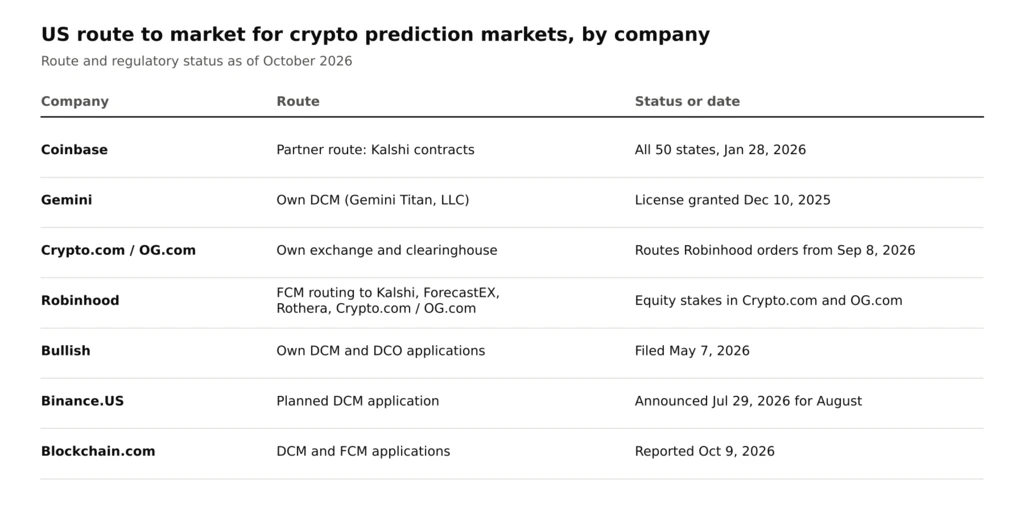
Blockchain.com has offered event contracts to international customers through a Polymarket partnership since early 2026, and the two licenses would let the company run crypto prediction markets and crypto derivatives in-house for US retail and institutional customers. Coinbase, Gemini, Crypto.com and Robinhood already distribute crypto prediction markets in the United States, and Binance.US and Bullish have announced CFTC applications.
Exchanges that apply for a DCM license
Among crypto prediction markets entrants, Gemini Titan, LLC received a DCM license from the CFTC on December 10, 2025, after an application filed on March 10, 2020, and the company plans to explore crypto futures, options and perpetual contracts for US customers. Bullish submitted DCM and derivatives clearing organization (DCO) applications on May 7, 2026.
Binance.US CEO Steve Gregory told the Rare Evo conference in Las Vegas on July 29 the exchange would apply for a DCM license in August to launch its own platform for crypto prediction markets, and every applicant must satisfy the CFTC’s 23 core principles, which cover system safeguards, recordkeeping and conflicts of interest.
CNBC counted Blockchain.com among 11 companies with DCM filings in 2026 and reported the CFTC approved six new DCMs over the year. An FCM registration, which firms obtain through the National Futures Association, allows a company to process derivatives trades and hold client funds, and a DCM license allows an operator to list event contracts on its own exchange.
Exchanges that route orders to licensed venues
Coinbase opened crypto prediction markets to users in all 50 US states on January 28, 2026, with Kalshi supplying every contract at launch across politics, sports, entertainment, culture and economic indicators. Users trade from $1 in USD or USDC inside the interface holding their crypto, equity and cash balances.
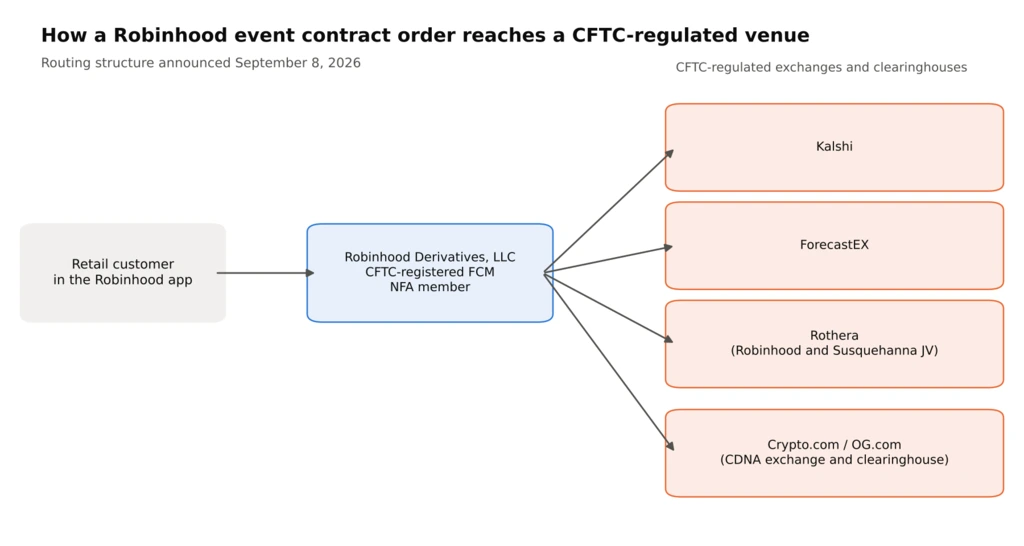
Robinhood began routing selected football contracts on September 8, 2026 to the CFTC-regulated exchange and clearinghouse of Crypto.com, which operates OG.com. The stakes follow the valuation of Citadel Securities’ July investment, which priced Crypto.com at $20 billion, and a $5 billion valuation for OG.com. Robinhood Derivatives, LLC, a CFTC-registered FCM, also sends orders to Kalshi, ForecastEX and Rothera, a joint venture with Susquehanna International Group.
Both companies plan equity-linked perpetual futures pending regulatory clearance. Robinhood reported 13.6 billion event contracts traded in the second quarter of 2026 and more than 45 billion contracts since launch, including over 30 billion in 2026 through August. Event contract revenue at Robinhood rose more than tenfold year over year to $156 million in the second quarter, and crypto trading revenue fell 38%.
Trading volume across crypto prediction markets
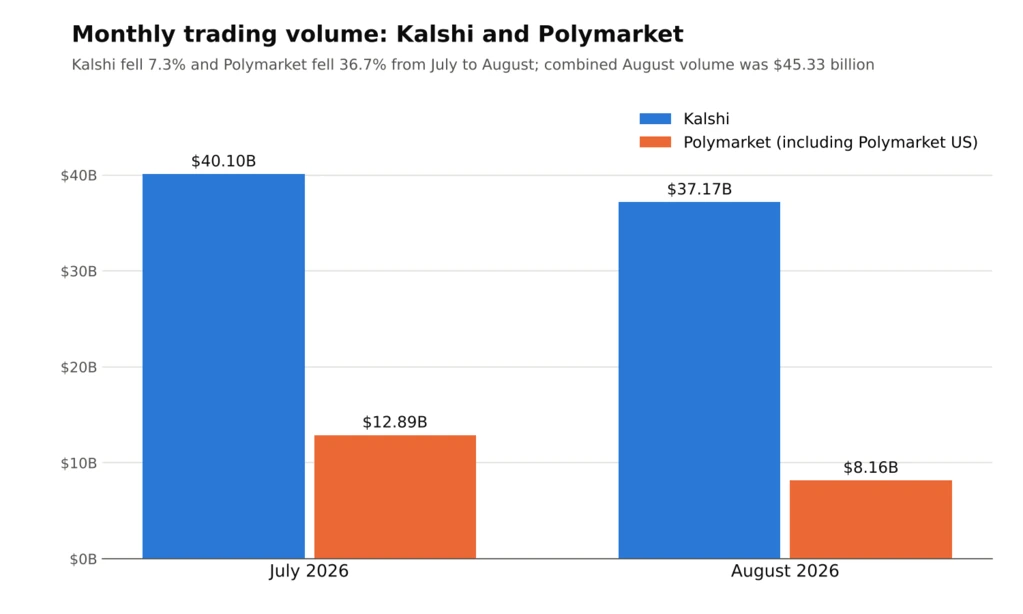
Combined volume on Kalshi, Polymarket and Polymarket US reached $45.33 billion in August 2026, down 14.5% from July and the first monthly decline in a year. Kalshi processed $37.17 billion, a 7.3% drop from $40.1 billion, and Polymarket including Polymarket US processed $8.16 billion, a 36.7% drop from $12.89 billion. The World Cup, which ran from June 11 to July 19, lifted the summer totals, and May volume stood at $25.66 billion.
Trackers record volume for crypto prediction markets in notional dollars, counting each contract at its $1 face value, which differs from the money traders pay. The ShiftMarkets September brief, built on DeFiRate data, lists $77.7 billion across tracked venues, with Kalshi at $60.7 billion, Polymarket US at $8.8 billion and Polymarket’s international exchange at $4.6 billion.
The brief attributes Kalshi’s 78% share to retail flow routed from Robinhood, Coinbase, Webull and Moomoo, and its totals do not compare directly with The Block’s August figures.
Blockchain settlement behind crypto prediction markets
Polymarket runs on the Polygon network and uses USDC as collateral, and the UMA oracle reports real-world outcomes through a challenge window in which token holders propose and dispute results.
Each market issues Yes and No contracts paying $1 if the event occurs and $0 if it does not, and prices between 0 and 100 cents read as implied probabilities. Blockchain.com also offers perpetual futures powered by the Hyperliquid decentralized exchange outside the United States.
Michigan agreement with Coinbase
State enforcement reaches crypto prediction markets in Michigan, where the Michigan Gaming Control Board announced on October 7, 2026 an agreement under which Coinbase Financial Markets will stop offering sports-related event contracts to Michigan customers and close remaining open positions by 12:00 a.m. Eastern on October 10.
The agreement covers contracts traded on KalshiEX and other designated contract markets, and the state will not take enforcement action while the Sixth Circuit appeals proceed. A federal court denied Coinbase’s request for a preliminary injunction in August, and the Coinbase appeal remains stayed pending appeals involving Robinhood, Polymarket and Kalshi.
Michigan describes the products as unlicensed sports wagering sold as federally regulated prediction markets, and the stipulation leaves open whether a state may regulate CFTC-registered event contracts as gambling.
The agreement follows a nearly identical one with Robinhood Derivatives and a state-court preliminary injunction against KalshiEX. Attorney General Dana Nessel said the state intends to bring all sports betting into compliance with the law, whether by agreement or court order.
Court rulings and CFTC rulemaking
The CFTC sued Arizona, Connecticut and Illinois on April 2, 2026, and the Third Circuit ruled on April 6 in KalshiEX LLC v. Flaherty, affirming a preliminary injunction against New Jersey’s enforcement. The divided panel found Kalshi likely to prevail because the contracts qualify as swaps under the Commodity Exchange Act, which preempts New Jersey’s gambling laws as applied, while Judge Jane R. Roth dissented.
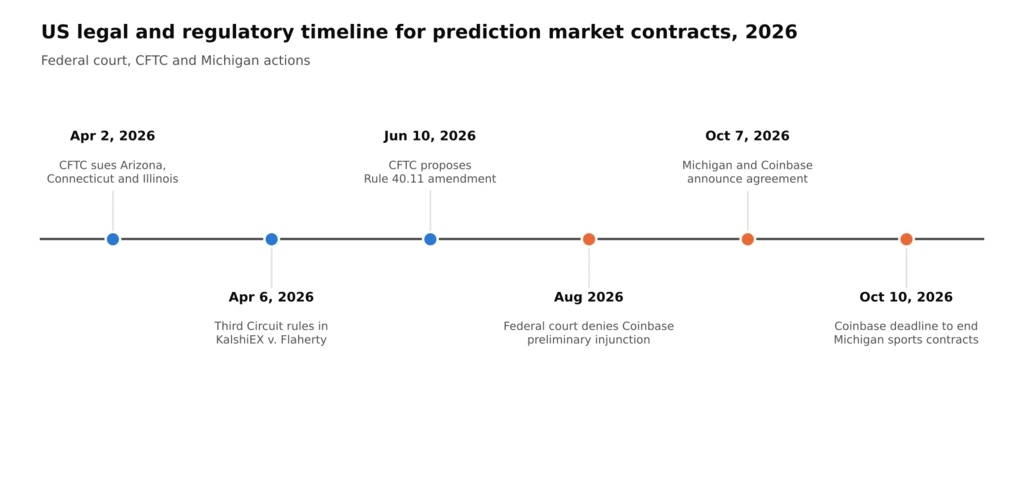
On June 10, 2026, the CFTC proposed an amendment to Rule 40.11 replacing categorical bans with contract-by-contract public-interest reviews for the event contracts DCMs list, including contracts offered by crypto prediction markets operators.
The proposal defines gaming as an activity people pursue for recreation, governed by rules, with outcomes depending on luck, skill or athletic ability. Sports contracts would generally pass review, while contracts on player injuries, officiating decisions, discrete plays and games below the collegiate level would likely fail.

Isai Alexei is a journalist and financial analyst covering cryptocurrency markets and traditional securities for Blockchaindose. He has spent ten years analyzing digital assets, trading activity, and market structure.