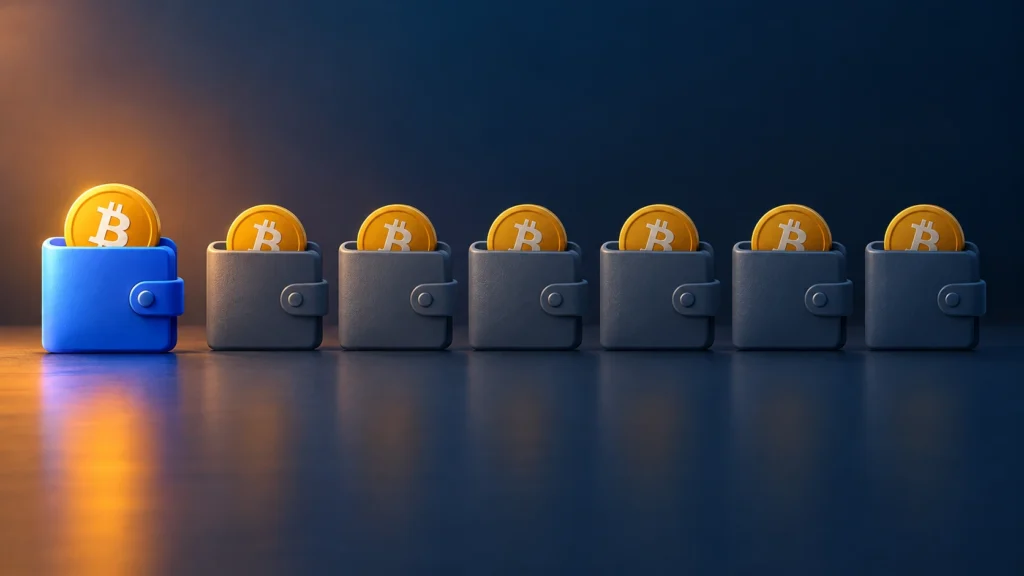

Bitcoin has more than 46 million addresses holding at least a dollar’s worth of coins, so it feels like a network owned by everyone. Yet, if you look at who holds the biggest piles, the picture changes quickly. Bitcoin ownership is highly concentrated. The claim holds up, but only if you are careful about what is being counted.
The hidden stat: 86 addresses, about 14% of supply
The number most people miss comes from River’s holder breakdown. Four addresses each hold between 100,000 and 1,000,000 BTC, and together they hold 639,536 BTC. The next 82 largest holders, each with 10,000 to 100,000 BTC, hold another 2,161,039 BTC. That is 86 addresses controlling roughly 14% of all the bitcoin there will ever be.
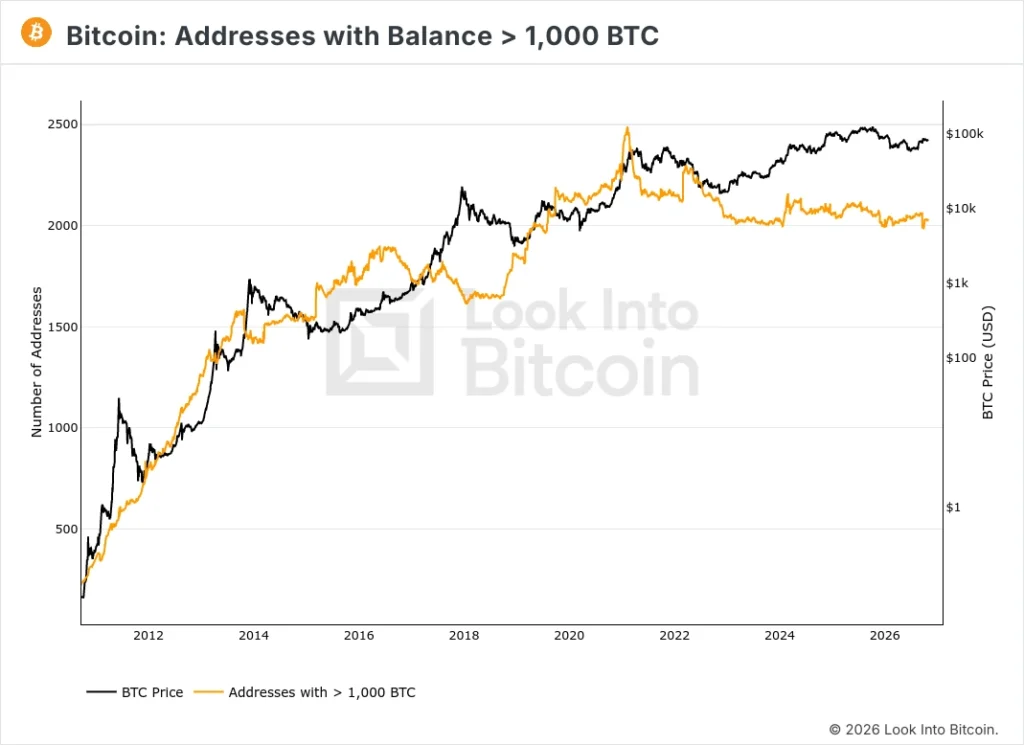
Arkham Intelligence data from May 2026 tells a similar story. The top 1,000 addresses hold over 3 million BTC, more than 15% of supply, and the top ten entities hold over 25% of the 21 million cap.
These are not 86 billionaires. Many of the biggest addresses belong to exchanges and custodians holding coins for customers. Arkham puts exchange custody at about 12% of all bitcoin. So the first honest answer to “who owns bitcoin?” is: a lot of it sits with a few custodians, on behalf of many people.
Claim 1: Five holders control 70% of tracked bitcoin
It is true, but the scope matters. CorpStacking tracks 235 companies, funds and governments, which together hold 3,083,039 BTC, worth about $246.4 billion on October 26, 2026. Within that group, the top five hold 2,153,723 BTC, or 69.9%:
- Strategy: 848,517 BTC
- BlackRock’s IBIT: 806,038 BTC
- U.S. government: 198,000 BTC
- Fidelity’s FBTC: 175,890 BTC
- Grayscale’s GBTC: 125,278 BTC
Strategy alone holds 28% of that tracked pool. It also holds about 4% of bitcoin’s maximum supply of 21 million.
The catch: this is 70% of a tracked group, not 70% of all bitcoin. Three million coins is roughly 15% of the total, so the headline describes the institutional corner of the market, not the whole market.
Claim 2: Strategy dominates corporate bitcoin
This one holds up on every dataset we checked. Glassnode’s company treasury chart, built from CoinGecko data, showed Strategy at 762,099 BTC out of about 1.19 million held by tracked companies on March 23, 2026. That is roughly 64%. A later August 2026 snapshot put Strategy near 69% of listed-company bitcoin.
The second tier is small by comparison. Glassnode listed MARA near 54,000 BTC, XXI near 43,500 and Metaplanet near 35,000. Together, hundreds of other companies hold only a fraction of what one firm holds.
Claim 3: ETFs are the new giants
U.S. spot bitcoin ETFs held about 1.293 million BTC on October 8, roughly $107 billion at $82,606 per coin. BlackRock’s IBIT alone accounts for about half of that market, according to analyst summaries from April 2026.
There is a second concentration inside this one. One report found that more than 80% of U.S. spot ETF assets sit in custody at Coinbase. The owners are millions of investors, but the coins sit with a handful of funds and one dominant custodian.
Where the thesis gets weaker
A fair read of the data also has to cover what weakens the claim.
Addresses are not people. One investor can spread coins across many wallets. Satoshi Nakamoto’s roughly 1.1 million BTC, about 5.5% of supply by Arkham’s May 2026 estimate, is reportedly spread across around 20,000 addresses, so it never shows up as one big holder. That means address rankings can understate concentration in some cases and overstate it in others, such as exchange wallets that serve millions of users.
Government totals do not agree. CorpStacking lists the U.S. government at 198,000 BTC. BitcoinTreasuries lists 328,372 BTC. The gap comes from how seized and legally contested coins are treated. Arkham puts all governments combined at about 305,000 BTC, or 1.5% of supply.
The 30% corporate drop is about price, not coin sales. The IMF reported that public-company bitcoin holdings fell by more than 30% in dollar terms, to about $126 billion, largely because the price fell. It does not mean companies sold 30% of their coins. About 91% of corporate holdings sit with U.S. firms.
Tracker totals differ. CorpStacking counts 3.08 million BTC. BitcoinTreasuries’ broader five-category count reached about 4.22 million BTC because it includes customer balances held at funds and exchanges.
Lost coins change the math. Glassnode and Chainalysis data, widely cited since 2020, suggest around 3.7 million BTC, close to 20% of mined supply, may be permanently lost. If that is right, the coins that can actually trade are fewer than 21 million suggests, and each large holder controls a bigger share of the usable supply.
The whales are still buying
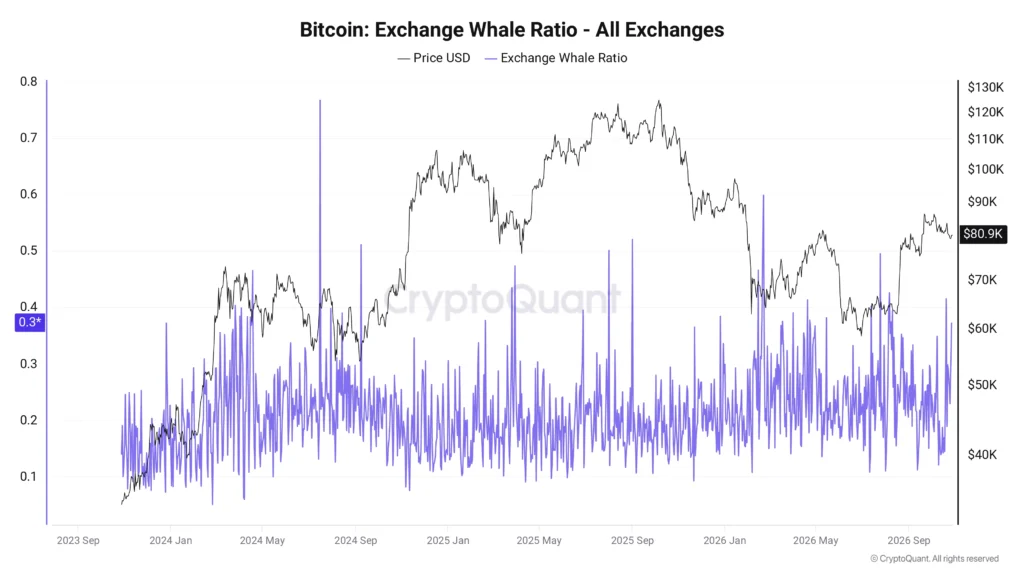
On-chain data points the same way. CryptoQuant data reported in October 2026 showed holders with 1,000 to 10,000 BTC reaching 3.03 million BTC, the highest since November 2025, after a low near 2.87 million in December 2025. CryptoQuant’s whale series excludes ETFs, exchanges and treasury companies, so it should not be added to the ETF and corporate figures above. It is a separate group.
Santiment data cited in the research notes shows wallets holding 10 to 10,000 BTC added about 110,000 BTC in a month, the sharpest sustained accumulation of 2026, while exchange supply sat near 6.5% of circulating supply in early October. Less bitcoin on exchanges means less ready supply, which can make prices more sensitive when large holders move.
There is a counterpoint worth noting: more than 9,200 BTC left ETFs over two days around October 22 before inflows returned. Concentration is not a one-way street.
Why it matters
When so much bitcoin sits with a few funds, firms and custodians, their decisions can move the market. A large ETF redemption wave or a forced sale by a heavily leveraged treasury company can hit the price harder than ordinary trading would. Concentration also means a few legal and regulatory decisions reach a large share of supply at once. Knowing who holds the coins, and how reliable each tracker is, helps you tell a real signal from a headline.

Dan is a seasoned crypto writer for Blockchaindose who got his start in the space back in 2019. Over the past four years, he’s built a solid grasp of how the industry moves, focusing heavily on DeFi, NFTs, GameFi, and promising new projects.
Off the clock, you’ll usually find him buried in a good book or kicking back with a movie. His blend of hands-on market experience and straightforward commentary makes him a clear, trusted voice across the platform.