

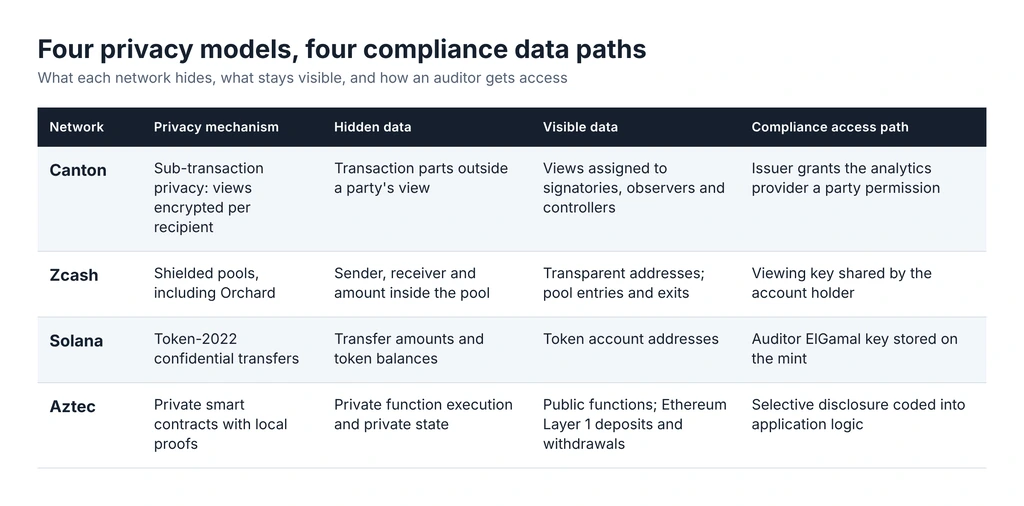
Privacy blockchains are moving from niche payment networks to settlement infrastructure for banks, exchanges and tokenization platforms, and each design exposes a different slice of transaction data to compliance teams. Canton, Zcash, Solana and Aztec apply four distinct cryptographic and permission models, so a blockchain monitoring workflow built around Bitcoin or Ethereum addresses needs changes before it covers any of them.
Teams monitoring privacy blockchains face regulatory deadlines and security incidents in 2026. The Financial Action Task Force (FATF) published its Seventh Targeted Update on 16 July 2026, the EU Anti-Money Laundering Regulation applies from 10 July 2027, and flaws found in Zcash, Solana and Aztec showed how an error inside a private system can stay undetectable.
Canton Limits Transaction Views to Entitled Parties
Among privacy blockchains, Canton documents its approach as sub-transaction privacy, in which the protocol splits a transaction into views, encrypts each view for its recipients and delivers only the views each participant may see.
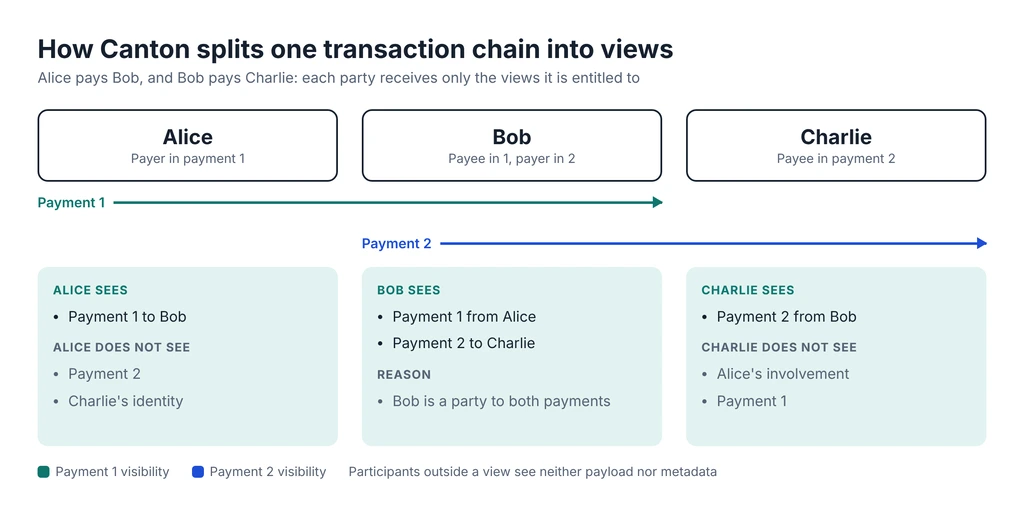
Visibility on Canton follows contract roles: a signatory always sees a contract and its events, an observer sees it because the contract declares the party as one, and a controller sees the choices it can exercise. A compliance provider needs an explicit permission from the asset issuer, because transaction details reach only entitled participants instead of every node.
Canton’s documentation also warns about divulgence, which occurs when a party learns about a contract through a transaction using it, so issuers must trace the contracts each transaction fetches before granting access.
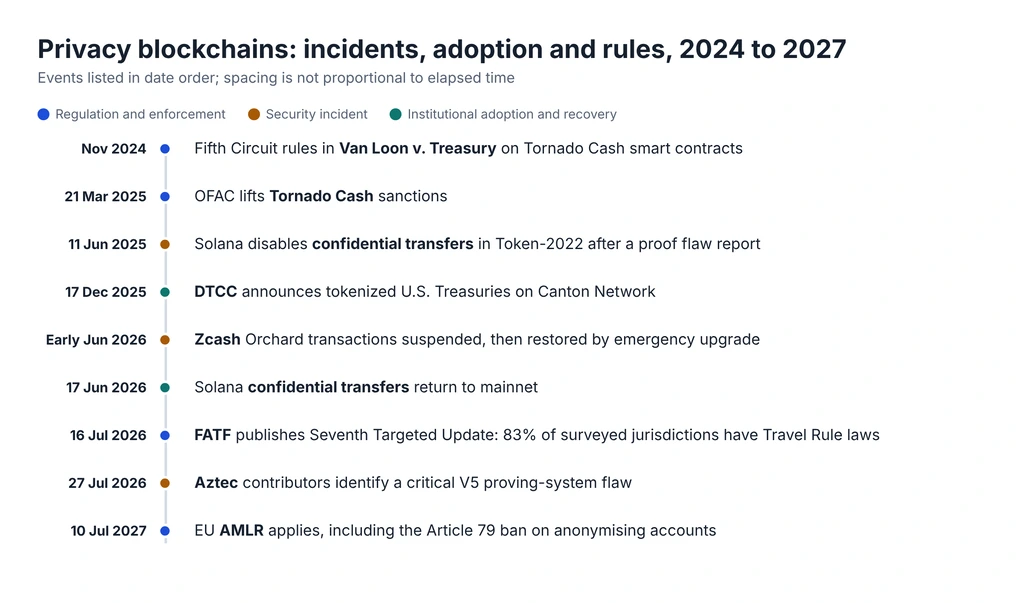
Institutional demand for privacy blockchains has a concrete example: on 17 December 2025, DTCC announced plans to issue tokenized securities on Canton Network, starting with U.S. Treasuries held in its custody, after the SEC approved a three-year pilot the previous week.
Zcash and Solana Expose Different Data Fields
Zcash Shielded Pools and Viewing Keys
Zcash operates transparent and shielded address types on one chain, and the Orchard shielded pool encrypts sender, receiver and amount while transparent addresses publish values as Bitcoin does. A viewing key lets its holder decrypt shielded activity without spending authority, so an account holder can give an auditor or regulator read access to selected accounts. Transfers between transparent addresses and shielded pools stay visible at the pool boundary, where the transparent address and the amount crossing it are public.
AI-assisted security audits uncovered flaws in two privacy blockchains during 2026, starting with Zcash. Researcher Taylor Hornby found a four-year-old forgery bug in the Orchard circuit with help from Anthropic’s Claude Opus 4.8, and developers suspended Orchard transactions in early June before an emergency upgrade restored them. The Zcash Foundation reported no evidence of exploitation and no unauthorized value creation.
Solana Confidential Transfers and the Auditor Key
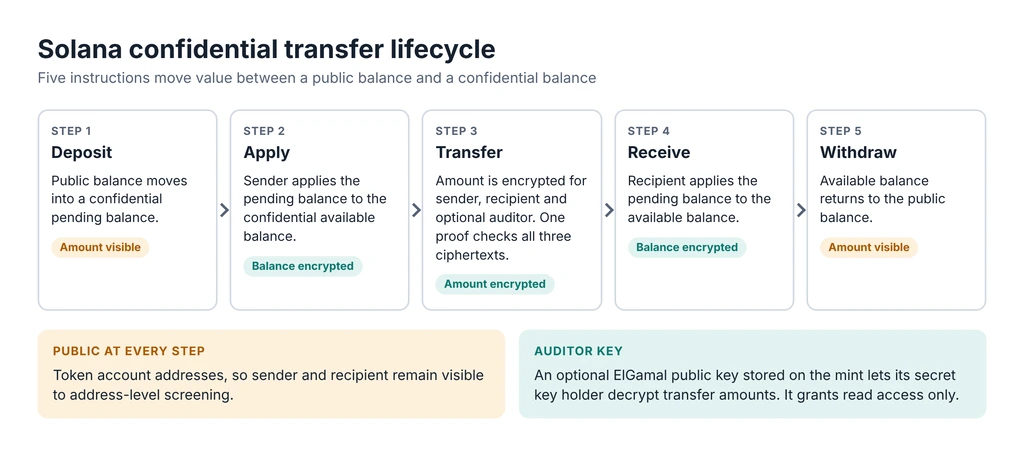
Solana’s Token-2022 confidential transfers hide transfer amounts and token balances, while token account addresses stay public. A mint can store an auditor ElGamal public key; each transfer carries the amount encrypted for sender, recipient and auditor, and the proof verifies all three ciphertexts contain the same amount. The auditor key grants read access only and cannot authorize transfers. Rotating the key applies to future transfers, so issuers must retain earlier secret keys for historical access.
Researcher suneal_eth of zksecurity reported a flaw in the ZK ElGamal Proof program on 10 June 2025: a component missing from a hash in a Fiat-Shamir transcript allowed forged proofs, with unlimited minting or draining of confidential balances as possible outcomes. Solana disabled confidential transfers in Token-2022 on 11 June and the proof program on 19 June 2025, reporting no known exploit. Confidential transfers returned to mainnet on 17 June 2026 at 21:10 UTC.
Aztec Moves Execution Off the Public Ledger
Aztec runs private functions on the user’s device and generates zero-knowledge proofs locally, while public functions execute on the network, and one contract can combine both. The Alpha network targets about one transaction per second with roughly six-second blocks. Deposits and withdrawals through Ethereum Layer 1 contracts stay public, which gives analysts a view of value entering and leaving the system.
On 27 July 2026, Aztec contributors identified a critical vulnerability in the V5 Alpha proving system through internal AI-assisted auditing: an attacker may construct a proof passing verification for a transaction the network should reject. Contributors said they cannot determine whether anyone exploited the flaw and advised treating V5 funds and applications as exposed until incident response finishes, with circuit updates planned for V6.
Regulators Apply Existing Rules to Privacy Blockchains
FATF Travel Rule Coverage
FATF’s Seventh Targeted Update on virtual assets reports 83% of surveyed jurisdictions with Travel Rule legislation, up from 73% in 2025. Travel Rule data exchange between providers applies whether a transfer settles on a public chain or on privacy blockchains. The update also states most identified on-chain illicit activity involves stablecoins, which circulate on public chains where blockchain monitoring tools already operate.
EU AMLR Article 79
Article 79 of Regulation (EU) 2024/1624 bars credit institutions, financial institutions and crypto-asset service providers from keeping accounts allowing anonymisation of the account holder or increased obfuscation of transactions, including through anonymity-enhancing coins. Holders of existing anonymous accounts must undergo customer due diligence before using them. For providers serving customers on privacy blockchains, the provision refers to anonymity-enhancing coins generically and names no asset.
Tornado Cash Precedent
OFAC sanctioned Tornado Cash on 8 August 2022, naming a decentralized application and roughly 40 wallet addresses. In November 2024, the Fifth Circuit reversed the district court in Van Loon v. Treasury and held Tornado Cash’s immutable smart contracts outside the definition of property under IEEPA. OFAC lifted the sanctions on 21 March 2025, citing novel legal and policy issues.
Monitoring Controls for Privacy Blockchains
Screening policies for privacy blockchains start with the boundary events of each network: shielding and unshielding transactions on Zcash, deposits and withdrawals through Ethereum Layer 1 contracts on Aztec, and deposits into and withdrawals from confidential balances on Solana. Each event leaves a public record, so risk scoring continues while the interior of the system stays encrypted.
Access agreements should name the key holder, the rotation procedure and the retention period. A Solana issuer rotating its auditor key keeps earlier secret keys, a Zcash auditor needs a viewing key from each account holder, and a Canton issuer registers the analytics provider as a party with visibility on the asset.
Incident runbooks for privacy blockchains need triggers for protocol-level flaws. Zcash reported no evidence of exploitation, Solana reported no known exploit and Aztec could not determine whether anyone exploited its flaw, so policies should define when an institution pauses transfers, freezes related exposure and files reports with its supervisor.
Vendor reviews for privacy blockchains should request from each blockchain analytics provider a coverage statement listing supported networks and the events labeled on each one, including pool entries, bridge transfers and confidential balance withdrawals.
Frequently asked questions
What are privacy blockchains?
Privacy blockchains are networks that hide part of each transaction from the public ledger. Canton encrypts transaction views for each party, Zcash uses shielded pools, Solana encrypts amounts in confidential transfers, and Aztec runs private functions on the user’s device. Each model exposes different data, so address-based blockchain monitoring needs adjustments.
Can compliance teams monitor privacy blockchains?
Compliance teams monitor privacy blockchains through public boundary events and key-based access. Zcash shows transparent addresses and pool entries and exits, Solana keeps token account addresses public, Aztec shows Ethereum Layer 1 deposits and withdrawals, and Canton grants visibility through party permissions from the asset issuer.
What is the difference between a Zcash viewing key and a Solana auditor key?
A Zcash viewing key lets its holder decrypt shielded activity without spending authority. A Solana auditor key is an ElGamal public key stored on the token mint, and its secret key holder decrypts transfer amounts without authorizing transfers. Rotating the Solana key affects future transfers only, so issuers keep earlier secret keys.
Which regulations apply to privacy blockchains?
FATF’s Seventh Targeted Update, published on 16 July 2026, reports Travel Rule legislation in 83% of surveyed jurisdictions. EU AMLR Article 79 bars credit institutions, financial institutions and crypto-asset service providers from keeping accounts allowing anonymisation, including through anonymity-enhancing coins, and applies from 10 July 2027. The text names no asset.
Have privacy blockchains had security flaws?
Solana, Zcash and Aztec each disclosed flaws. Researchers reported a flaw in Solana’s ZK ElGamal Proof program on 10 June 2025, and confidential transfers returned to mainnet on 17 June 2026. Zcash suspended Orchard transactions in early June 2026 and reported no evidence of exploitation. Aztec identified a critical V5 flaw on 27 July 2026 and cannot determine whether anyone exploited it.