

EVM equivalence vs EVM compatibility describes two ways a blockchain can support the Ethereum Virtual Machine (EVM), which executes smart contracts and applies state transitions on Ethereum. The EVM runs as a stack machine with 256-bit words, and gas measures the computational effort of each operation. Rollups and alternative layer 1 networks adopt one of the two approaches to reach developers and applications already running on Ethereum.
EVM compatibility means a network executes contracts written in Solidity or Vyper while running on a different underlying architecture. The network may change block times, consensus rules or fee structures to meet performance goals. EVM equivalence sets a stricter standard: the network complies with the Ethereum Yellow Paper and reproduces the execution environment of Ethereum mainnet.
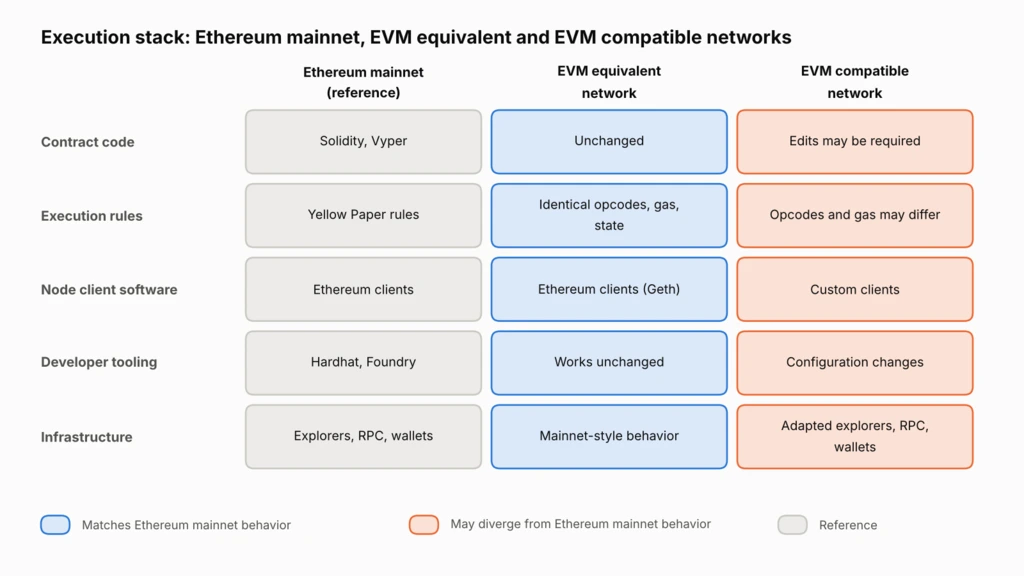
State handling, transaction processing and tool interaction match mainnet behavior, so existing applications and infrastructure run without code changes. Developers classify a network under EVM equivalence vs EVM compatibility by testing whether unmodified Ethereum contracts and tools run on it.
How EVM Compatible Networks Execute Contracts
In the EVM equivalence vs EVM compatibility comparison, an EVM compatible network interprets Ethereum bytecode inside a custom execution environment running its own consensus model and node client software. Developers write contracts in familiar languages, yet deployment on a compatible layer 1 or layer 2 often requires adjustments to code or configuration. Opcodes and gas calculations may behave differently from mainnet, so the network translates standard EVM instructions into operations its architecture executes efficiently.
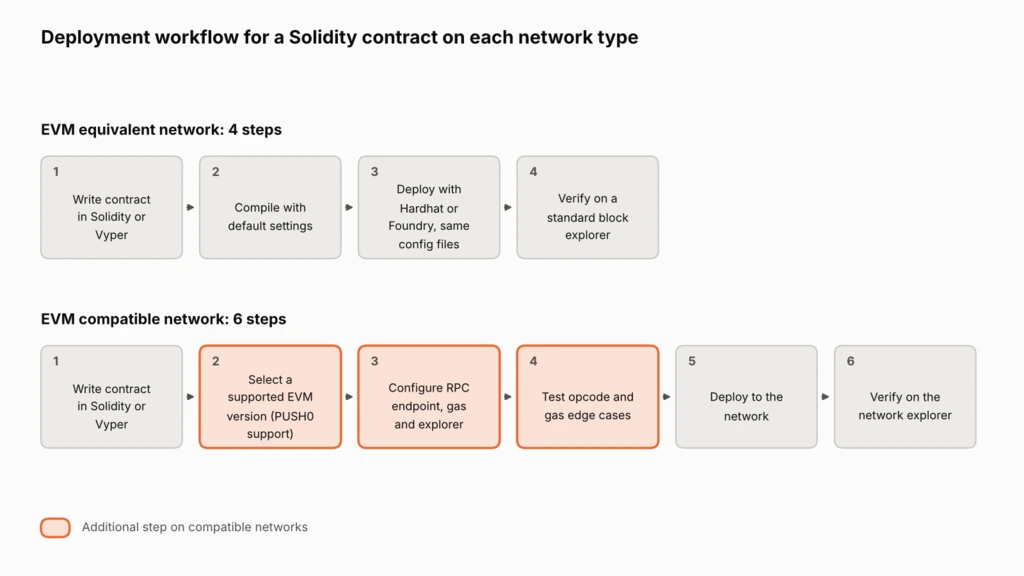
Solidity 0.8.20 sets Shanghai as the default EVM version, which makes the compiler emit the PUSH0 opcode from EIP-3855 to push the constant 0 onto the stack. Chains without PUSH0 support reject the resulting bytecode until developers select an earlier EVM version. Compatible chains build or adapt block explorers, wallet integrations, RPC endpoints and node software, which adds configuration work for each network.
How EVM Equivalent Rollups Replicate Ethereum
An EVM equivalent network adopts the exact specification of the Ethereum protocol instead of translating Ethereum code. It processes opcodes, calculates gas and manages state transitions as mainnet does. Optimism defined the standard as complete compliance with the Ethereum Yellow Paper, and its rollup runs Geth, an Ethereum execution client written in Go, so execution logic stays aligned with the base layer. Zero-knowledge rollups with zkEVM designs follow the model to inherit the security and operational standards of Ethereum.
Optimistic rollups post transaction batches to Ethereum without validity proofs and treat them as correct unless a participant submits a fraud proof during the challenge period. A successful challenge re-executes the disputed transactions and penalizes the sequencer, and withdrawals to Ethereum wait roughly seven days. Running the same execution rules as Ethereum lets the dispute process replay transactions without a separate reimplementation of the EVM.
Identical behavior lets developers reuse Hardhat and Foundry projects, deployment scripts, debuggers, block explorers and auditing software without modification. The translation layer disappears, and a deployment on an equivalent rollup resembles a mainnet deployment with the throughput of a rollup architecture. Teams estimate the effort behind EVM equivalence vs EVM compatibility by counting the configuration changes each network requires.
Developer Experience, Security and Performance Trade-Offs
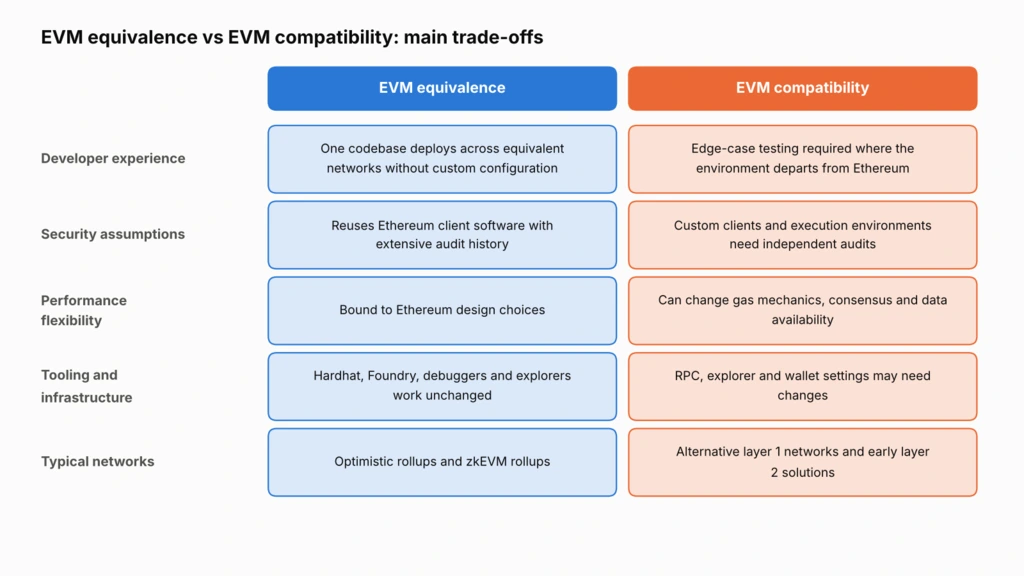
Developer experience shows the EVM equivalence vs EVM compatibility gap first, because teams deploy one codebase across several equivalent networks and skip custom configuration. Compatible networks require edge-case testing wherever the custom environment departs from Ethereum behavior, including gas accounting, precompiles and RPC responses.
Security assumptions change across the EVM equivalence vs EVM compatibility split, because equivalent networks reuse Geth and other Ethereum client software with extensive audit history and leave execution logic unchanged. Compatible networks run custom node clients and execution environments, which introduce new codebases for auditors to review independently. A customized architecture can contain vulnerabilities absent from Ethereum, and each modified component extends the audit scope.
Performance flexibility favors compatibility: a compatible network can lower fees by changing gas mechanics, adopt consensus mechanisms with fast finality or redesign data availability. An equivalent network keeps Ethereum design choices and forgoes some performance gains.
Networks Using Each Approach
Production networks show EVM equivalence vs EVM compatibility across layer 1 and layer 2 designs. BNB Smart Chain combines Proof of Staked Authority with Byzantine fault tolerant finality, and BNB Chain reports a finality time near 7.5 seconds. Polygon PoS operates as an EVM compatible proof-of-stake sidechain with the Heimdall and Bor components, and the Avalanche C-Chain executes contracts under the Snowman consensus protocol.
Optimism introduced the equivalence standard for its optimistic rollup, and Metis positions its rollup as EVM equivalent. Both networks let Ethereum developers deploy existing contracts and reuse tooling without code changes.
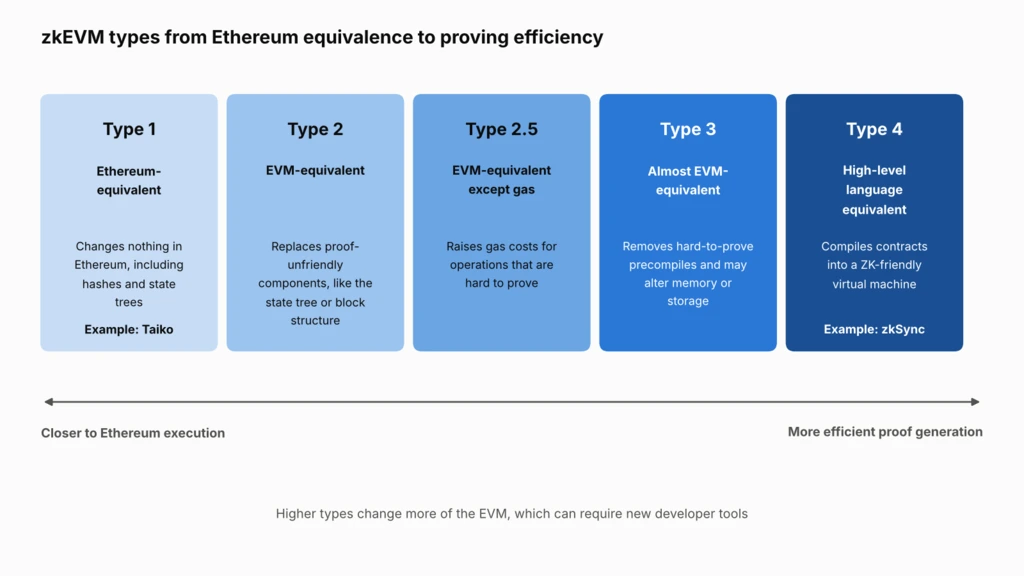
zkEVM designs apply EVM equivalence vs EVM compatibility as a range of types based on how much of Ethereum they change to make proofs efficient. Type 1 systems like Taiko change nothing, including hashes and state trees, and Type 4 systems like zkSync compile high-level language code into a ZK-friendly virtual machine. Scroll and Linea develop zkEVMs targeting Ethereum-level execution equivalence, and most zkEVM projects started closer to Type 3 or Type 2.5 with plans to move toward Types 1 and 2.
Oracles and Cross-Chain Messaging Across EVM Networks
Smart contracts under EVM equivalence vs EVM compatibility need offchain data and cross-chain communication, and the EVM provides neither. Chainlink Data Feeds supply asset prices, reserves and net asset value through decentralized oracle networks, which aggregate values from many sources and publish them onchain. L2 sequencer uptime feeds let rollup applications check sequencer status before they execute sensitive logic.
The Chainlink Runtime Environment (CRE) coordinates onchain applications with external APIs and data sources across EVM networks. Developers write workflows in Go or TypeScript, and a trigger like a cron schedule, an HTTP request or an onchain event starts each workflow. A decentralized oracle network executes every step and reaches consensus on each result.
The Cross-Chain Interoperability Protocol (CCIP) moves messages and tokens between chains, including an EVM equivalent layer 2 and an EVM compatible layer 1. Token pools apply rate limits on EVM chains, and each message follows a defined lifecycle from send to delivery.
Choosing Between EVM Equivalence vs EVM Compatibility for Multichain Deployment
Application requirements decide the EVM equivalence vs EVM compatibility choice, and a lending protocol using audited Ethereum contracts benefits from equivalence by deploying identical bytecode on tested client software. A game or payments application with low-fee and fast-finality requirements can accept the added testing and configuration of a compatible chain.
Both architectures serve different requirements, so rollups and layer 1 networks continue to adopt each. Teams deploying to several networks maintain per-chain test suites, set explicit compiler targets and share infrastructure for data and messaging. Applying EVM equivalence vs EVM compatibility as a deployment criterion lets teams estimate engineering effort, audit scope and operating cost before they commit to a network.
Frequently asked questions
What is the difference between EVM equivalence and EVM compatibility?
EVM equivalence means a network reproduces the Ethereum execution environment and follows the Ethereum Yellow Paper, so existing contracts, tools and infrastructure run unchanged. EVM compatibility means a network executes Solidity or Vyper contracts on a different architecture, which can change opcodes, gas calculations, consensus rules or fee structures and can require code or configuration adjustments.
Why does a Solidity contract fail to deploy on some EVM compatible chains?
Solidity 0.8.20 targets the Shanghai EVM version by default, and the compiler emits the PUSH0 opcode. Chains without PUSH0 support reject the bytecode, and the deployment fails. Developers fix the error by selecting an earlier EVM version in the compiler settings and recompiling the contract.
Is every zkEVM EVM equivalent?
Not every zkEVM is EVM equivalent, because zkEVM designs range from Type 1 to Type 4. Type 1 systems like Taiko change nothing in Ethereum, Type 3 systems remove hard-to-prove precompiles, and Type 4 systems like zkSync compile high-level language code into a ZK-friendly virtual machine. Most zkEVM projects started near Type 3 or Type 2.5 and plan to move toward Types 1 and 2.
Does EVM equivalence guarantee the security of a rollup?
Equivalence lowers the risk of custom execution code, because the rollup reuses audited Ethereum client software, but rollup security also depends on the proof system. Optimistic rollups post batches without validity proofs, treat them as correct unless a participant submits a fraud proof during the challenge period, and rely on at least one honest node. Withdrawals to Ethereum wait roughly seven days.
Which checks should a team run before deploying to an EVM compatible network?
Teams set a supported EVM version in the compiler, test gas accounting and precompile behavior, configure the RPC endpoint and block explorer, confirm wallet support and review the audit status of the custom node client. A Foundry or Hardhat test suite per chain catches edge cases where the network departs from Ethereum behavior.