
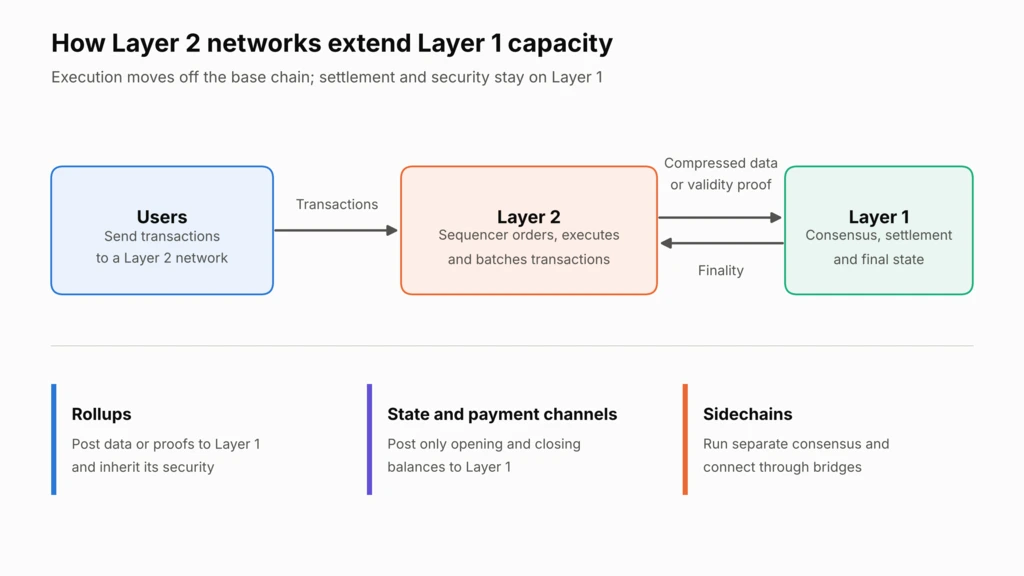
Blockchain scalability sets the number of transactions a network confirms per second and the fees users pay, and developers address the limit on two fronts: protocol upgrades on Layer 1 and separate Layer 2 networks. Bitcoin, Ethereum and Solana operate as Layer 1 blockchains, validating every transaction through consensus without a central operator. Layer 2 protocols process transactions away from the base chain and report the results to Layer 1, which improves blockchain scalability and lowers fees.
Layer 1 Consensus and Cryptography Secure Every Transaction
Each Layer 1 network replaces the central validator of a traditional database with a consensus mechanism where independent participants confirm transactions. Bitcoin relies on Proof-of-Work, Ethereum on Proof-of-Stake, and both pay participants in digital currency for honest verification. Ethereum runs smart contracts on the Ethereum Virtual Machine, while Solana pursues high throughput and low latency as another route to blockchain scalability.
Asymmetric key cryptography keeps a ledger readable by every node, because a user signs each transaction with a private key. A public key, derived from the private key through a non-reversible algorithm, sends and receives funds.
Replicated Ledgers and Forks Limit Layer 1 Throughput
Every node stores a full copy of the distributed ledger, and each new block links to the preceding block. A client who broadcasts a transaction waits for data synchronization across nodes before the write completes, which limits blockchain scalability through higher latency than a centralized database.
Replication also produces forks, situations in which nodes hold different versions of the chain. A soft fork stays backward compatible and lets nodes without the latest protocol upgrade keep processing transactions, whereas a hard fork breaks compatibility and obliges every node to upgrade.
Bitcoin resolves a split between two competing chains through the longest-chain rule, which adopts whichever chain grows longer. If Node A and Node B mine a block simultaneously, the chain divides into Chain A and Chain B, and each node treats its own chain as the longest. A block mined by Node C extends one chain, the network adopts it, and the transactions of the shorter fork return to the queue.
Block Size, Proof-of-Stake and Sharding Raise Layer 1 Capacity
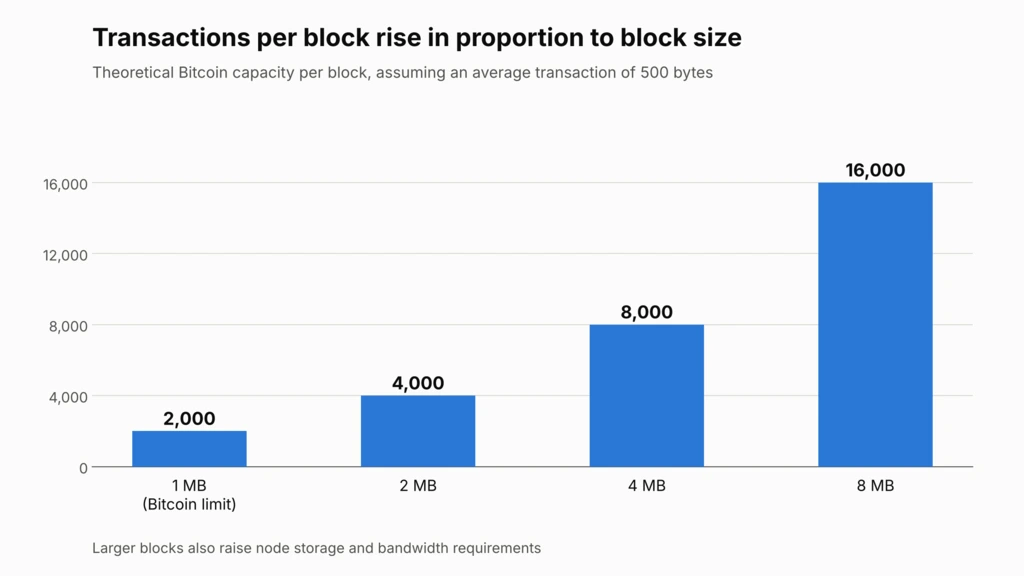
Transaction surges push users into a waiting pool, where each request waits for a miner. Larger blocks raise blockchain scalability directly: Bitcoin’s 1 MB block limit holds about 2,000 transactions, and an 8 MB limit would hold 16,000, an eightfold gain in throughput.
Ethereum replaced the energy-intensive Proof-of-Work with Proof-of-Stake in September 2022, which validates transactions more efficiently. Sharding improves blockchain scalability by splitting the blockchain into smaller shards and processing transactions in parallel: a Bitcoin node executes every transaction, while a node in a sharded network stores and processes only the data of its shard. Ethereum’s current roadmap applies the partition idea to rollup data through danksharding, which lets the main chain accept more rollup data per block.
Rollups Execute Transactions Off-Chain and Settle on Layer 1
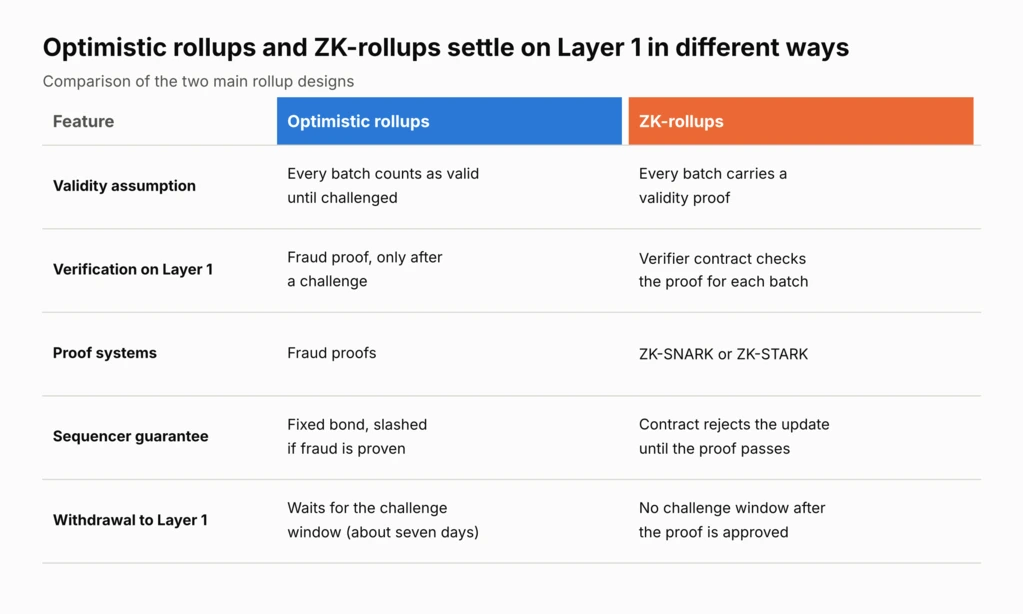
Rollups bundle many transactions into one Layer 1 transaction, execute them off-chain and send the data back to the base chain for consensus, which improves blockchain scalability through higher transaction throughput. Optimistic rollups assume every Layer 2 transaction is valid. Sequencers stake a fixed bond, batch the transactions, compress the data and submit the batch to Ethereum as calldata, which lowers data costs.
A fraud-proof mechanism gives observers a fixed window to challenge each batch. When a challenge succeeds, the contract rejects the block and penalizes the stake of the sequencer. Withdrawals to Layer 1 wait for the window to close, which typically takes about seven days.
Smart contracts on Layer 1 store the rollup blocks and keep the Merkle root of the rollup state. When a sequencer submits a compressed batch, the contract compares the previous state hash with the stored hash and, when both match, replaces the stored hash with the post-state hash. Verification starts only after a challenge.
Zero-Knowledge Proofs Replace the Challenge Window
ZK-rollups also batch and execute transactions off-chain, but the sequencer attaches a validity proof to every batch instead of leaving the batch open to challenge. The sequencer checks sender and receiver states and balances, debits senders, credits receivers and builds Merkle trees from the batch. The rollup contract on Layer 1 holds the state root and the batch root, and it rejects every update until a verifier contract accepts the proof.
The proof confirms the off-chain state changes without disclosing them and without forcing Layer 1 to re-execute the transactions. In a basic example, a prover shows y equals x² + z + 1 for the public values x = 1 and y = 4 while keeping the secret value z hidden.
Rollup operators choose between two non-interactive proof systems, ZK-SNARK and ZK-STARK, which verify state changes without disclosing secret data. SNARKs produce smaller proofs but depend on a trusted setup, whereas STARKs skip the setup and produce larger proofs with higher verification costs on Ethereum. ZK-rollups extend blockchain scalability by shortening withdrawals: once the verifier contract approves the proof, funds move from Layer 2 to Layer 1 without a challenge window.
State and Payment Channels Post Only Opening and Closing Balances
Payment channels let two participants exchange funds off-chain after both deposit money into an on-chain smart contract. Participants send unlimited transactions up to the locked amount with low latency and fees, sign the final balances at closing, and let the contract update their accounts on Layer 1.
State channels extend payment channels to the tracking of general state transitions. The deposit works as a bond, and a participant who acts maliciously loses it. Every update requires the signature of all participants, and at closing the contract verifies the signatures and distributes the funds according to the final account states.
Sidechains and Bridges Operate With Independent Security
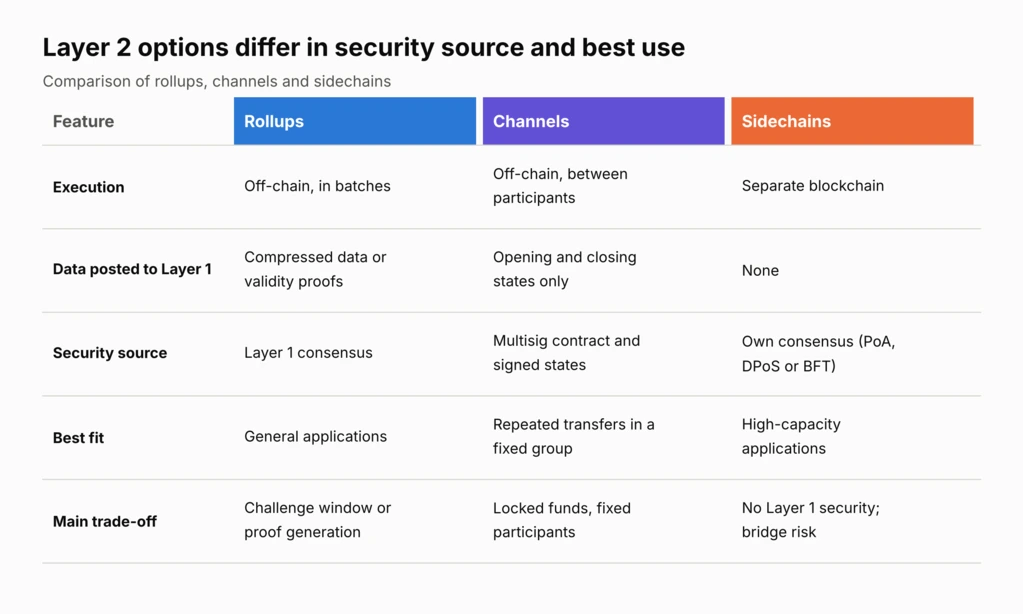
Sidechains run as separate blockchains in parallel to Layer 1 and select their own consensus algorithm, for example Proof of Authority, Delegated Proof of Stake or Byzantine Fault Tolerance. Operators increase block size and shorten block time to raise blockchain scalability, but larger blocks raise the hardware requirements of full nodes, which can erode decentralization. Unlike rollups, sidechains do not inherit Layer 1 security, which attaches independent security assumptions to their blockchain scalability gains.
Assets stay inside the issuing blockchain, and a blockchain bridge connects a sidechain with Layer 1. Bridges deploy smart contracts on both networks, and a two-way peg locks the asset on the origin chain and mints an equivalent amount on the target chain. Attackers have targeted signing keys and flaws in contract logic, which makes bridge design central to sidechain security.
Workload and Security Needs Decide the Layer 2 Choice
Developers match each Layer 2 option to the workload: rollups suit general applications requiring Layer 1 security, channels suit repeated transfers between a fixed group of participants, and sidechains suit applications willing to accept independent security in exchange for higher capacity. Base-chain upgrades combined with Layer 2 execution define current blockchain scalability.
FAQ
What is the difference between Layer 1 and Layer 2 in blockchain?
Layer 1 networks like Bitcoin, Ethereum and Solana run consensus, validate transactions and store the ledger. Layer 2 networks execute transactions away from the base chain and send the results back to Layer 1. Rollups and channels inherit Layer 1 security, while sidechains rely on their own consensus.
How do optimistic rollups and ZK-rollups differ?
Optimistic rollups treat every batch as valid and open a challenge window of about seven days, during which any observer can submit a fraud proof. ZK-rollups attach a validity proof to each batch, and a verifier contract on Layer 1 checks the proof before accepting the update, which removes the challenge window.
Why do optimistic rollup withdrawals take about a week?
Withdrawals to Layer 1 wait for the challenge window to close, because a fraud proof can still reverse a batch until the window ends. Liquidity providers can pay users sooner in exchange for a fee. ZK-rollups skip the wait because the verifier contract approves each proof on submission.
Are sidechains as secure as rollups?
No. Rollups post data or proofs to Layer 1 and inherit its security. Sidechains run their own consensus, such as Proof of Authority, Delegated Proof of Stake or Byzantine Fault Tolerance, so users depend on the sidechain validators and on the bridge contracts. Attackers have targeted bridge signing keys and flaws in contract logic.
When do payment channels and state channels work better than rollups?
Channels suit repeated transfers between a fixed group of participants. Participants deposit funds in a smart contract, exchange signed updates off-chain with low latency and fees, and post only the opening and closing states to Layer 1. Open networks with many changing users need rollups, because every channel update requires the signature of all participants.
This page is for educational purposes only and is not financial, investment or tax advice. Crypto assets are volatile and you can lose all of the money you invest.