
Loss-versus-rebalancing (LVR) costs a representative Ethereum liquidity position 471 basis points per year at Ethereum’s 12-second slot, and a jump-diffusion model of the reference price shows 125 basis points of the loss persist at any block speed. The result challenges the standard case for shorter blocks, which argues faster block production shrinks arbitrage profits against constant-product pools toward zero.
How Loss-Versus-Rebalancing Drains Liquidity Providers
Liquidity providers (LPs) on automated market makers (AMMs) quote prices updated only when a block settles. When the external price moves, arbitrageurs trade against the stale pool price and capture the gap, and the LP absorbs the loss. Milionis, Moallemi, Roughgarden and Zhang formalized the cost in 2022 as loss-versus-rebalancing, the difference between an LP’s return and a portfolio rebalanced continuously at market prices.
Under geometric Brownian motion, a constant-product pool without fees loses value at a rate of σ²V/8, where σ is volatility and V is pool value, regardless of block time. Adding swap fees and random block arrivals changes the result: arbitrage pays only when the price gap exceeds the fee band, and the probability of a profitable block falls as block time shrinks. Between blocks the pool price stays frozen while the external price moves, so the gap between them persists, and each block trades only when the gap exceeds the fee and moves the pool to the edge of the band.
Jump Risk Splits the Loss Into Two Channels
Crypto prices depart from geometric Brownian motion: Bitcoin jumps on about 58% of trading days and Ethereum on about 32%, based on tick data from seven exchanges between April 2019 and September 2021. A jump opens a price gap in a single step, and the next block clears the whole gap whatever its duration.
Modeling the reference price as a Merton jump-diffusion, the loss-versus-rebalancing rate divides into a diffusion channel and a jump channel. Block time governs the diffusion channel through a multiplier falling toward zero as blocks shorten. The jump channel carries no block-time term, because jump intensity and jump size come from the market and not from the protocol. For symmetric jump laws, the jump channel works as an exact lower bound, so the loss-versus-rebalancing rate never reaches zero and approaches the floor only in proportion to the square root of block time.
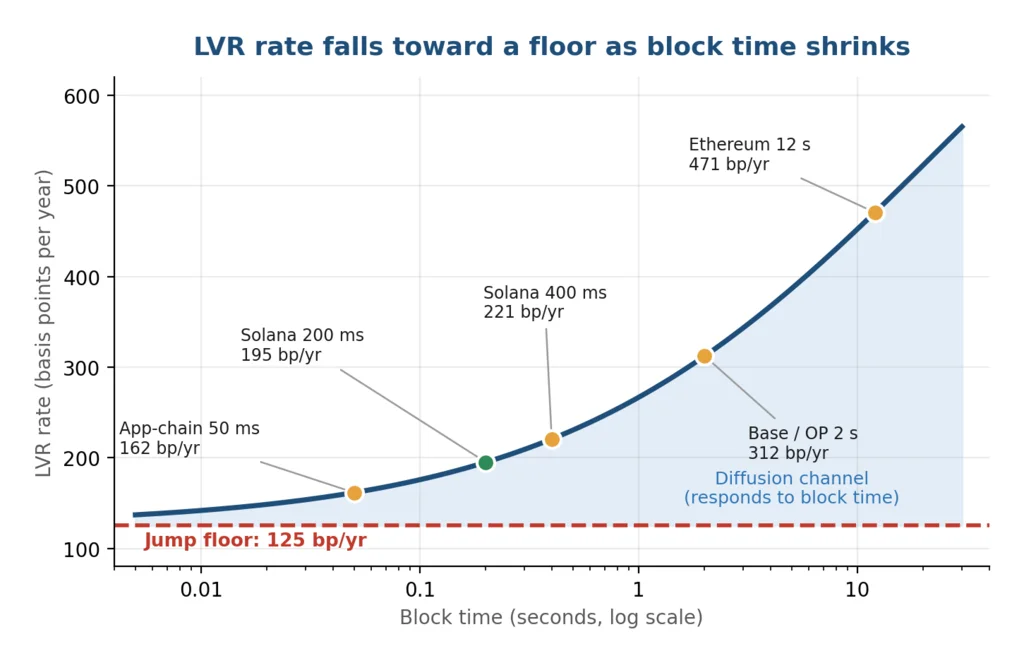
Calibration to Binance ETH/USDT five-minute data from January 2020 to June 2026 yields volatility of 0.8156, 283 jumps per year and a jump standard deviation of 1.92%, applied to a $1 million pool in the 0.05% Uniswap fee tier. The jump floor equals 125 bp/yr and the diffusion ceiling equals 832 bp/yr. Swap fees recover only 4.1% of jump losses, because the 5 bp fee sits far below the 192 bp jump size.
LVR Rates From Ethereum to Solana
At Ethereum’s 12-second slot, the model puts the loss-versus-rebalancing rate at 471 bp/yr, and 73% of it comes from the diffusion channel, which responds to block time. A 2-second slot on Base and OP Mainnet lowers the rate to 312 bp/yr, a 400 ms slot to 221 bp/yr, a 250 ms slot on Arbitrum to 203 bp/yr and a 50 ms slot to 162 bp/yr. Cutting block time 240-fold, from 12 seconds to 50 milliseconds, removes 89% of the diffusion term and leaves the rate 29% above the floor.
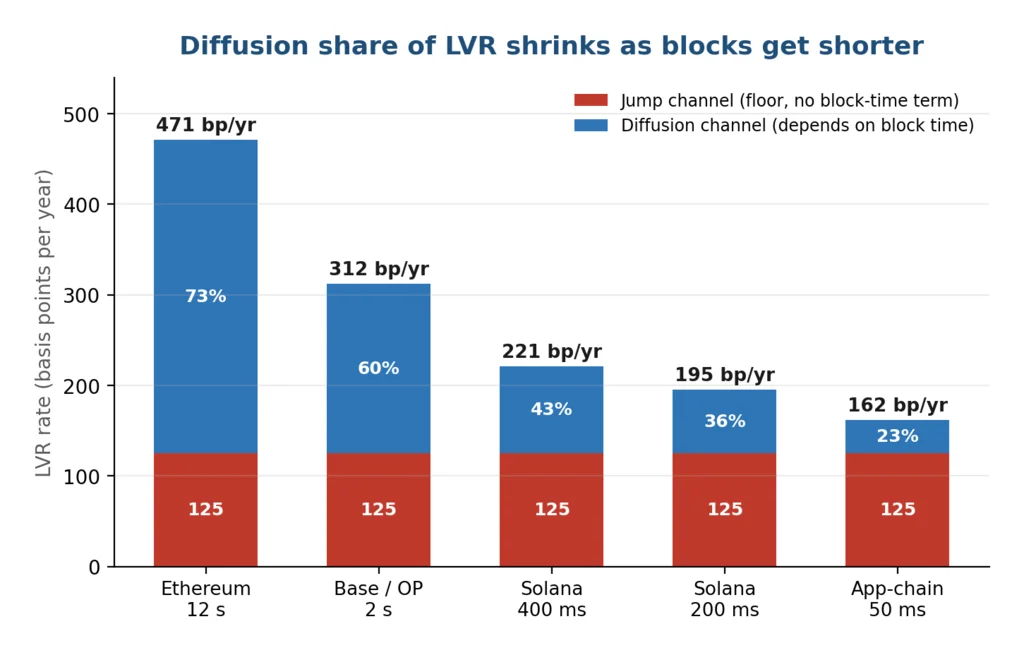
Solana completed a staged cut from 400 ms to 200 ms slots on October 9, 2026 under proposal SIMD-0525, and per-slot compute limits fell in proportion. Applying the model’s formula to the same pool gives about 195 bp/yr at 200 ms, 26 bp below the 400 ms level and 70 bp above the floor. Ethereum developers have discussed a six-second slot through EIP-7782, which would bring the rate to about 404 bp/yr.
Market regime changes the picture: across volatility from 0.30 to 1.50 and jump intensity from 71 to 4,533 per year, the 12-second rate spans 55 to 3,597 bp/yr, and the diffusion share runs from 1% in calm, jump-heavy conditions to 98% in stressed, jump-light conditions. A pool in a calm, jump-heavy regime gains little from shorter blocks.
The 8-Second Optimum and What Sets It
Shorter blocks cost validators bandwidth, signature aggregation and propagation time. The model nets the loss-versus-rebalancing rate against a per-block consensus cost calibrated from Ethereum’s roughly $1.7 billion in annual issuance, and the optimal block time lands near 8.4 seconds. Moving from 12 seconds to the optimum lowers total cost from 539 to 533 bp/yr, a saving under 2%, and total cost stays within 1 bp/yr of its minimum between 7.4 and 9.7 seconds. The model assumes random block arrivals, a conservative choice, since a deterministic proof-of-stake schedule produces lower arbitrage profit.
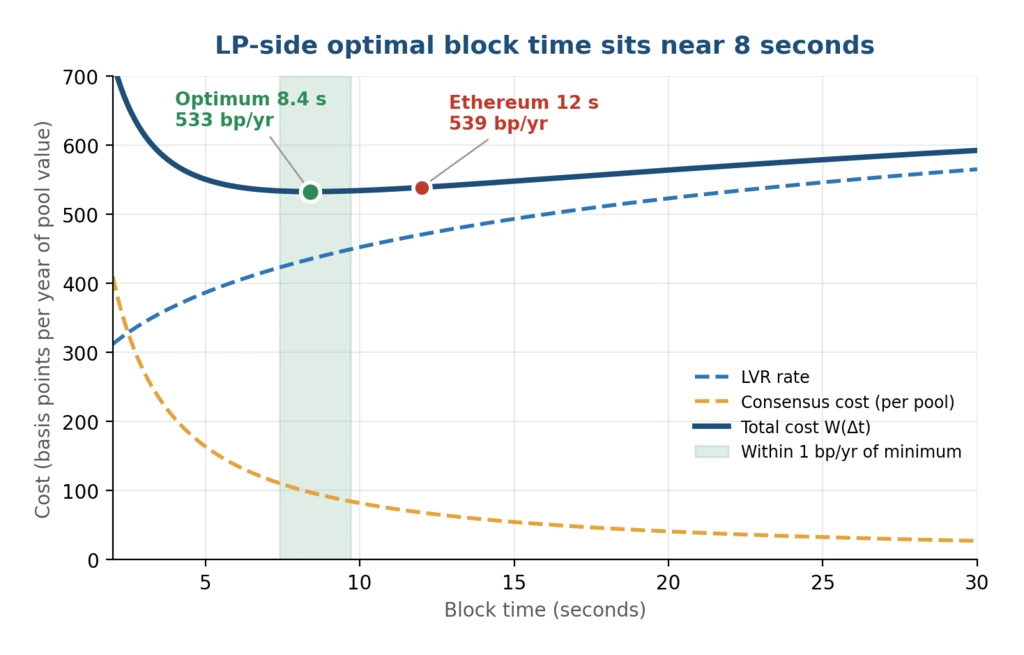
Jump parameters do not move the optimum: intensity, mean and size shift the level of LP loss without changing the marginal trade-off, and pool size cancels from the first-order condition. The remainder in the exact model moves the optimum by about one second at most. Volatility, fee tier and consensus cost set the result. Volatility of 0.30 gives an optimum of 62.3 seconds and volatility of 1.50 gives 2.5 seconds, while consensus cost between 500 and 2 (in units of 10⁻⁵ USD per block) moves the optimum from 15.4 seconds to 0.2 seconds.
Block-time design weighs MEV redistribution, finality, censorship resistance and oracle freshness alongside LP loss, so the 8-second figure bounds one component of the welfare calculation and not the full design choice. Most LVR accrues on concentrated liquidity, where the floor can rise or fall with jump size relative to the position range, so the full-range floor does not bound concentrated positions.
Levers That Work Below the Jump Floor
Block time cannot remove the floor, so the ratio of swap fee to jump size becomes the variable to design. A 5 bp fee against 192 bp jumps recovers 4.1% of jump losses, and fee-tier design therefore moves the floor more than block schedules do. Uniswap v3 offers 0.01%, 0.05%, 0.30% and 1% tiers, and Uniswap v4 allows dynamic fees through hooks, adjustable per swap or on a schedule.
Two mechanisms remove the per-block arbitrage window at its source. Batch auctions, as in CoW Protocol, settle all orders in a batch at uniform clearing prices, which makes transaction order irrelevant and undercuts MEV bots. Auction-managed AMMs auction the right to manage a pool, with the manager’s bid accruing to LPs, and the design targets both LVR reduction and fee optimization.
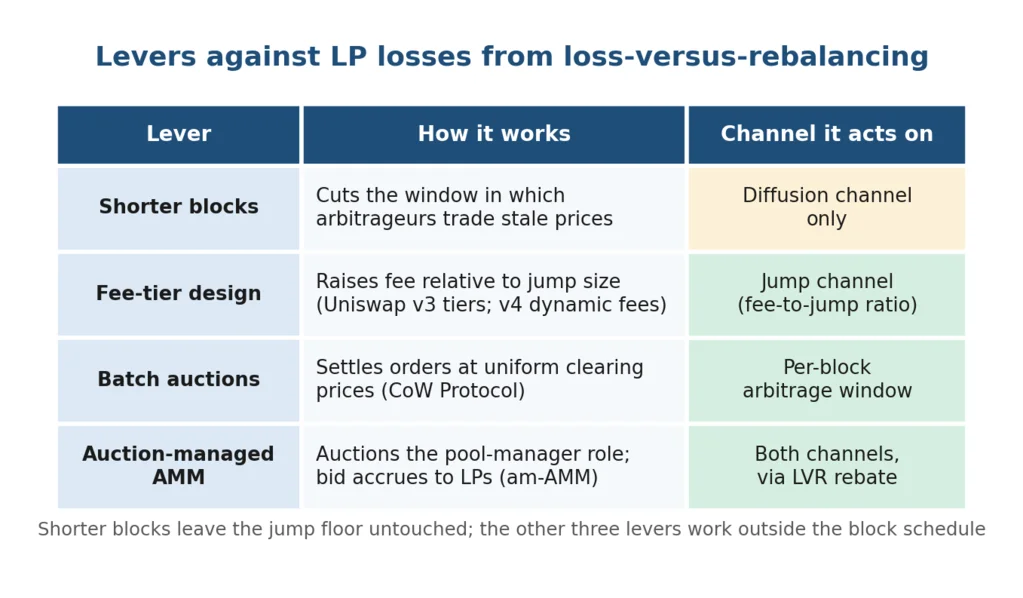
For protocol designers, the numbers separate two questions: block time sets the diffusion share of LVR, while fee tier, batch settlement and manager auctions set the jump share. Chains at 200 ms operate where the diffusion term holds 36% of LP loss, and a further halving to 100 ms lowers the rate by 19 bp/yr.

Isai Alexei is a journalist and financial analyst covering cryptocurrency markets and traditional securities for Blockchaindose. He has spent ten years analyzing digital assets, trading activity, and market structure.