PoliFi tokens, cryptoassets launched by political figures, track presidential approval ratings in a pattern major cryptoassets do not follow, according to a study posted on December 4, 2025 by Ignacy Nieweglowski, Aviv Yaish, Fahad Saleh and Fan Zhang of Staples High School, Yale University, IC3 and the University of Florida. The authors call the pattern the Trump Effect and base it on two Solana memecoins, $TRUMP and $MELANIA, issued under the names of the 47th president of the United States and the first lady.
Hypothesis and Prior Research on Political Memecoins
The authors start from a hypothesis about memecoins, which developers often create with little technical innovation: economic behavior should respond to celebrity endorsements, current events and market sentiment. Political memecoins may respond to approval ratings and to government decisions on other cryptoassets. A confirmed hypothesis would mean political capital shows in the activity and prices of PoliFi tokens and not only in polls.
Four earlier academic studies cover parts of the topic: Li and Yang found spikes in memecoin value followed by crashes in the broader cryptoasset market, White and Wilkoff found celebrity endorsements help token offerings reach higher fundraising goals, Long, Wong and Cai found more stable sentiment in comments on political memecoins. Benton and Philips linked negative posts by Trump during his first administration to higher volatility in the dollar-peso exchange rate.
Data and Methods Behind the Trump Effect
The dataset combines CoinGecko daily prices and market capitalization for $TRUMP, $MELANIA, Bitcoin, Ethereum, Solana, Dogecoin and BNB, DefiLlama series on total value locked, transaction fees and decentralized exchange activity, Gallup approval ratings, posts by Donald and Melania Trump collected with the Truthbrush tool, and an event timeline drawn from eight news outlets. To compare administrations, the researchers kept the first 10 months of data for each presidency and matched every weekly approval reading to the token price on the day of the reading.
The analysis relies on three methods: Spearman rank correlation to measure monotone dependence between approval and the behavior of PoliFi tokens and major assets, the Augmented Dickey-Fuller test, specified with a linear trend and lag selection by the Akaike information criterion, to check stationarity of price and return series, and the PELT change-point algorithm, set with an RBF cost function and a penalty of 50, to find statistical breaks and match them to dated events. A stationary series keeps a constant mean, variance and autocovariance structure over time, and asset prices usually fail the test while returns pass it.
How PoliFi Tokens Correlate With Approval Ratings
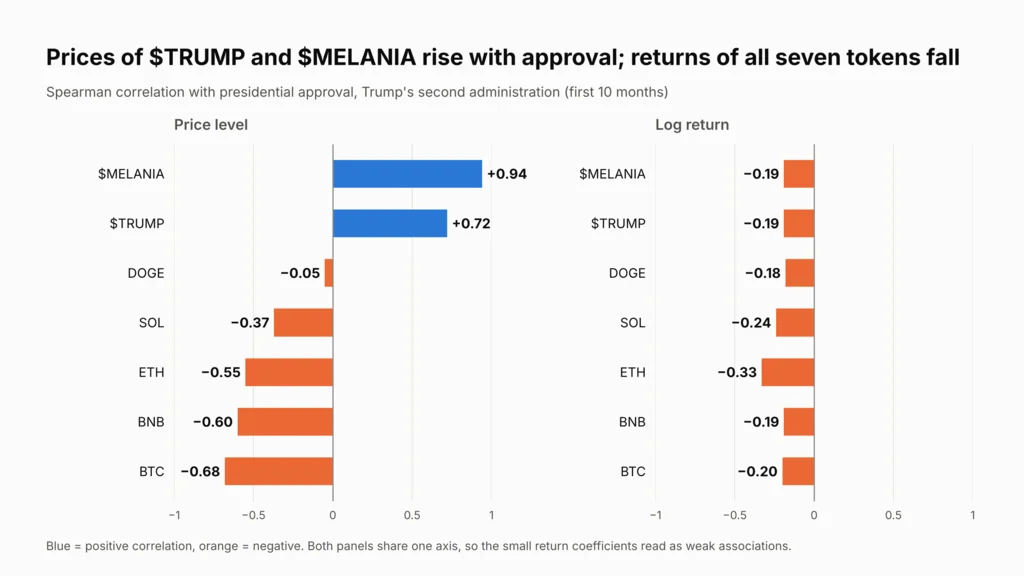
On price levels, $MELANIA shows a Spearman coefficient of 0.94 against approval and $TRUMP shows 0.72, while Bitcoin records −0.68, Ethereum −0.55, BNB −0.6 and Solana −0.37. Dogecoin, the benchmark memecoin, posts −0.05, and its coefficient shifts by administration from weakly positive or negative to moderately negative under Trump’s first term.
Bitcoin correlates negatively with approval under Joe Biden (−0.34), Trump’s first term (−0.73) and Barack Obama’s second term (−0.53), and the authors attribute negative coefficients for major tokens to the decline of approval during a presidency combined with rising asset prices over time.
A scatterplot of log prices against approval shows a break near 46% approval, where the relationship between token prices and polling changes direction for most assets. Approval in the plotted data ranges from about 42% to 52%. Above the threshold, log prices of every tested token rise with approval. Below it, $TRUMP and $MELANIA keep the positive relationship, while Bitcoin, Ethereum, Solana and Dogecoin reverse to a negative one.
Log returns show a second pattern under Trump’s second administration, where approval correlates negatively with returns for all seven tokens, with coefficients of −0.2 for Bitcoin, −0.33 for Ethereum, −0.24 for Solana and −0.19 for both $TRUMP and $MELANIA. The coefficients are small in magnitude, between −0.18 and −0.33, which marks a weak but consistent association. Earlier administrations produced mixed signs, including 0.45 for Dogecoin under Biden, and the authors treat the consistent negative sign as the second component of the Trump Effect.
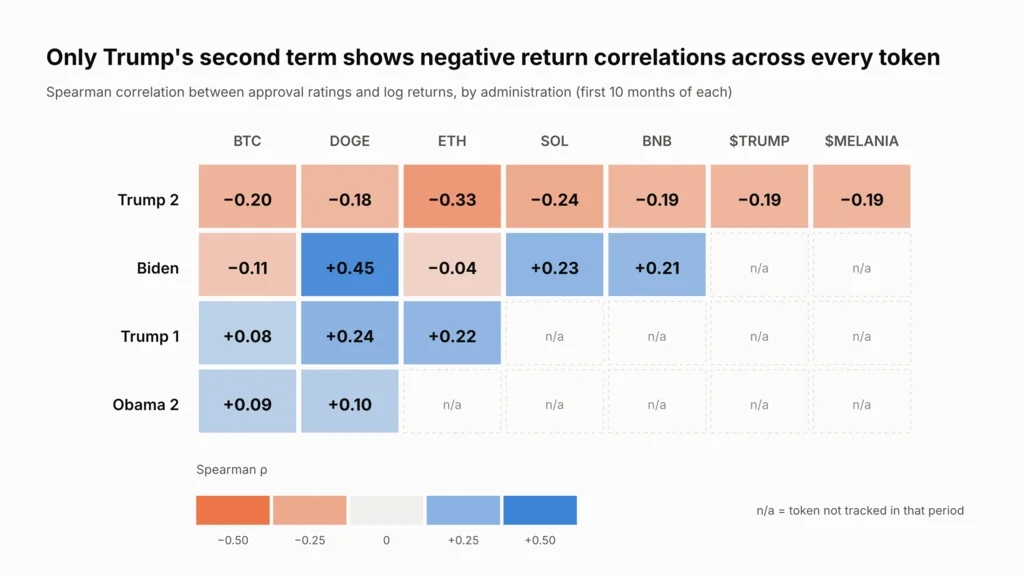
The positive price correlation and the negative return correlation do not conflict, because a positive coefficient on prices measures association with a high price level and not with price gains. $TRUMP and $MELANIA can post negative returns while prices stay elevated. The authors read the combination as mean reversion, in which high price levels correspond to later decreases, a reading consistent with research on the mean reversion of approval ratings. The ADF test classifies $TRUMP prices as non-stationary and returns as stationary.
Event Study: Change Points in 2025
The researchers ran the PELT algorithm first and linked breaks to events afterward, locating structural breaks in the price and return series of PoliFi tokens $TRUMP and $MELANIA on seven dates matching the event timeline: February 1, the announcement of 25% tariffs on Mexico and Canada; April 2, the 10% broad tariffs of “Liberation Day”; April 23, the dinner announcement for top $TRUMP holders; May 30, the farewell ceremony for Elon Musk at the Oval Office; June 17, passage of the GENIUS Act; September 21, Charlie Kirk’s memorial; and October 10, the threat of 130% tariffs on China.
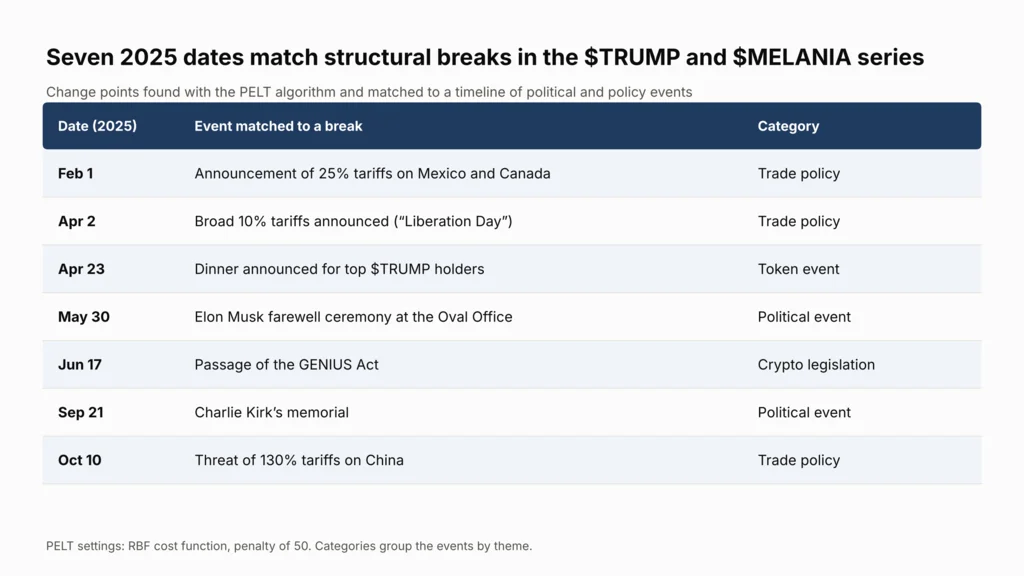
The April 23 break coincides with a notice on the $TRUMP website inviting the top 220 holders to a private dinner on May 22, and Fortune reported a price gain of about 58% to $14.70 on the day of the notice, along with an upcoming release of 40 million additional tokens. On June 17, the U.S. Senate passed the GENIUS Act, the stablecoin legislation Congress later enacted as Public Law 119-27.
Approval and price diverged for three weeks beginning April 2, according to the study’s time-series chart, which shows $TRUMP following approval through the year except in the Liberation Day window. Solana, BNB and Dogecoin do not follow approval in the chart at any point during the 10-month sample, which places the tracking behavior with political memecoins and not with the wider altcoin group.
Solana Metrics After the $TRUMP Launch
The $TRUMP launch on January 17, 2025 moved metrics on Solana, the blockchain hosting both tokens, and Cointelegraph reported a $TRUMP market capitalization near $9 billion within hours. Using DefiLlama series, the study reports decentralized exchange volume on Solana at an all-time high of nearly $50 billion and daily transaction fees peaking at $28 million shortly after the launch.
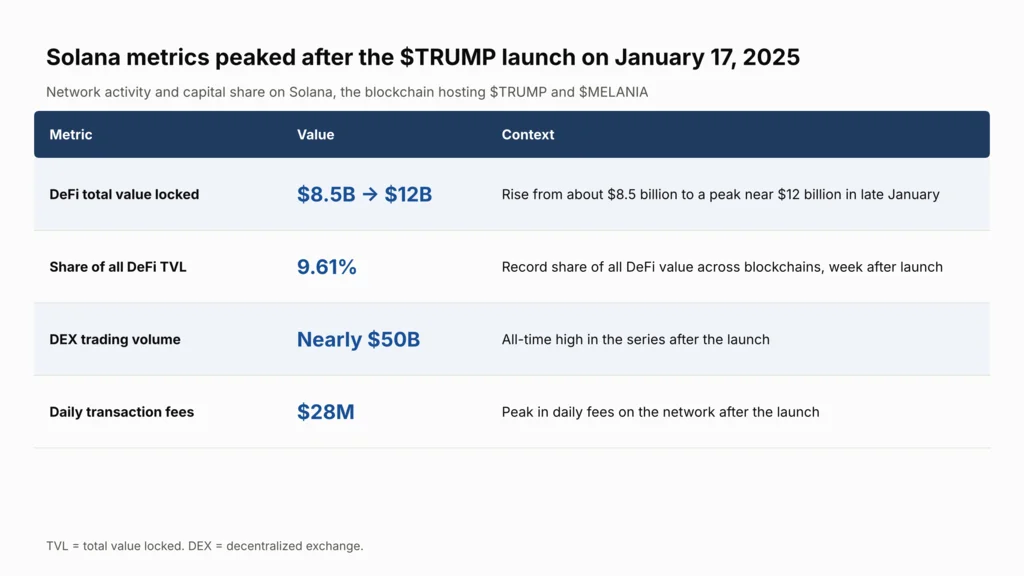
Solana’s DeFi total value locked, which sums deposited assets, rose from about $8.5 billion to a peak near $12 billion in late January, and the chain’s share of total DeFi value across all blockchains reached a record 9.61% in the week after the launch. The authors infer a migration of capital from competing chains, Ethereum among them, toward Solana.

Isai Alexei is a journalist and financial analyst covering cryptocurrency markets and traditional securities for Blockchaindose. He has spent ten years analyzing digital assets, trading activity, and market structure.