EIP-4844 activated in Ethereum’s March 2024 Dencun upgrade, introducing blob transactions as a new data type for Layer 2 rollups. The upgrade created a separate fee market for temporary data blobs, decoupling rollup data availability costs from Ethereum’s execution gas market. Each blob stores approximately 128 KB of data and is pruned after roughly 18 days. The network maintains a target of 3 blobs per ...
zkSync Era implements a custom zero-knowledge virtual machine (zkVM) that diverges from the Ethereum Virtual Machine (EVM) bytecode format. Matter Labs selects this design to reduce proving time and lower per‑transaction cost. The approach replaces direct EVM execution with a compilation pipeline that converts Solidity and Vyper source code into zkEVM bytecode. Developers gain faster block finality but incur ...
The Move programming language, originally developed at Meta for the Diem project, has been widely regarded as a technical advancement over Solidity. Its resource-oriented programming model treats digital assets as first-class resources that cannot be copied or implicitly discarded, eliminating entire classes of vulnerabilities at the language level. Sui’s implementation of Move introduces an object-centric data model that enables ...
Cross-chain Maximal Extractable Value (MEV) has transitioned from a theoretical concern to a systematically quantified economic leakage across blockchain interoperability protocols. Researchers from Flashbots and the Technical University of Munich conducted the first large-scale empirical study of executed cross-chain arbitrage, identifying 242,535 executed cross-chain arbitrages totaling $868.64 million in volume and generating $8.65 million in net profit across nine blockchains over ...
Zero-knowledge proof systems have reached production maturity in 2026, with Groth16, PLONK, and Cairo-based STARKs powering billions in daily transaction volume across Ethereum Layer 2 networks. The selection of a proving system directly determines on-chain gas costs, end-user latency, and security assumptions for any ZK-powered application. This article presents production benchmarks for the three dominant systems as ...
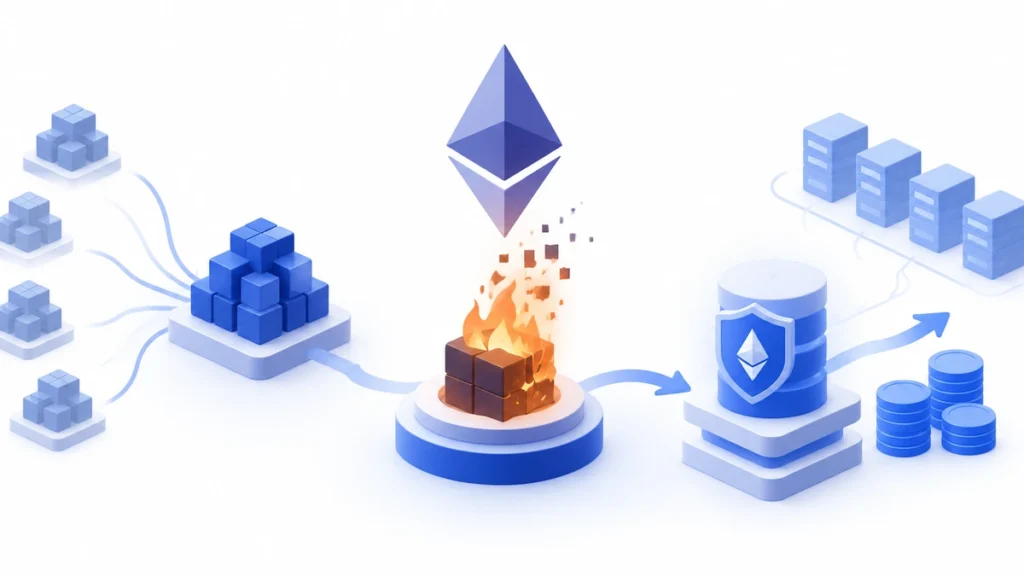
The Ethereum research community has advanced MEV-Burn from a theoretical concept to a protocol-near implementation. Current client software contains the necessary infrastructure to enable MEV-Burn as early as the Glamsterdam upgrade, according to analysis published on Ethereum Research. The mechanism redirects builder auction payments from validators to protocol-level burning, fundamentally altering the economic structure of ...
Dusk Network blockchain is built on the premise that most privacy blockchains misjudge: institutions moving real securities on-chain do not want full anonymity; they want confidentiality that regulators can still access when required. Six years into development, Dusk pairs zero-knowledge cryptography with an EVM-compatible execution layer aimed squarely at tokenized, regulated financial markets. Key Takeaways ...
The emergence of intent-based architectures represents a structural shift in how blockchain transactions are constructed, executed, and monetized. Unlike traditional transaction models where users specify exact execution steps, intent-based systems allow users to declare a desired outcome—a “intent“—while delegating the execution pathway to a competitive class of specialized agents known as solvers. This delegation creates a new economic ...
Data from the 2026 market cycle reveals a structural transformation in decentralized finance liquidity provision. The era of triple-digit annual percentage yields has concluded, replaced by a yield environment where risk-adjusted returns determine protocol viability. This analysis examines the mechanisms driving APY compression, quantifies impermanent loss under varying market conditions, and establishes a framework for ...
Zama is trying to solve blockchain privacy differently than any single chain can: instead of building a new network, it places the core problem behind privacy-focused crypto projects – data confidentiality – into a layer that plugs into chains people already use. Its tool is Fully Homomorphic Encryption (FHE), letting smart contracts compute directly on ...
To enhance your experience, we use cookies. Consent helps us process data like browsing behavior. Denying may affect site features.
Functional
Always active
The technical storage or access is strictly necessary for the legitimate purpose of enabling the use of a specific service explicitly requested by the subscriber or user, or for the sole purpose of carrying out the transmission of a communication over an electronic communications network.
Preferences
The technical storage or access is necessary for the legitimate purpose of storing preferences that are not requested by the subscriber or user.
Statistics
The technical storage or access that is used exclusively for statistical purposes.The technical storage or access that is used exclusively for anonymous statistical purposes. Without a subpoena, voluntary compliance on the part of your Internet Service Provider, or additional records from a third party, information stored or retrieved for this purpose alone cannot usually be used to identify you.
Marketing
The technical storage or access is required to create user profiles to send advertising, or to track the user on a website or across several websites for similar marketing purposes.