In 2021, when the concept of NFT was merely young, the entire building principles around non-fungible tokens revolved around hype. The story is quite different today. Now, more than ever, NVT development involves displaying a keen interest, not just in beautiful arts, but also in tokens that unlock some form of utility, or something tangible. ...
Metaverse development has become a broad category that covers everything from browser-based virtual spaces to large-scale multiplayer environments, immersive training platforms, digital showrooms, social worlds, and blockchain-enabled ecosystems. That breadth creates an obvious problem for companies looking for a development partner: almost every agency that works with 3D technology, virtual reality, blockchain, or interactive applications ...
Remember the 2021 NFT boom? In 2026, the NFT market is just a shadow of what it was in 2021. Yet, many NFT marketplace development services continue to ride on the nostalgia of the NFT boom. Key takeaways: NFT data analytics indicated that the trading volumes plunged to merely 823 million in Q2 2025, a ...
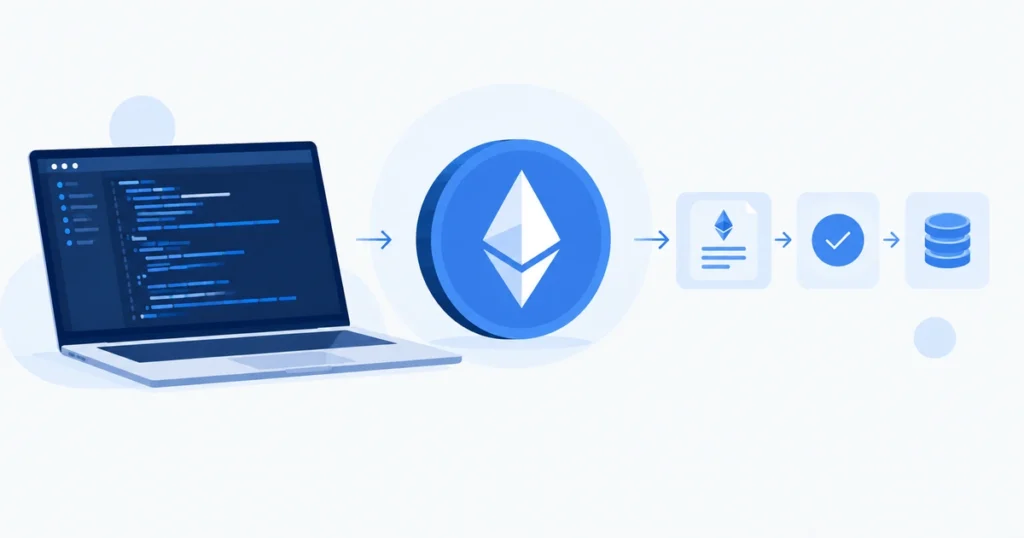
Making a token on an existing blockchain is today something that takes minutes and costs cents. Open-source libraries and already-resolved standards eliminated the technical barrier. The result is a market flooded with new tokens: CoinGecko analyzed 18.67 million tokens launched on Pump.fun and found that 68.67% stopped trading on the same day of their creation. Only 4.55% remained active ...
On Monday, August 31st, Telegram CEO Pavel Durov announced that the social media giant telegram is starting the rollout of its Gram wallet to a select group of users. The CEO announced that the network targets to roll the wallet out gradually in the next few weeks targeting over $1 billion users. In a post ...
Atomic swaps enable trustless peer-to-peer cryptocurrency exchanges across different blockchains. The protocol guarantees a binary outcome: either both parties receive their assets or both receive refunds. Three distinct mechanisms have emerged in this domain: Hash Time-Locked Contracts (HTLCs), Point Time-Locked Contracts (PTLCs), and Taproot-enabled PTLCs. Each represents a successive layer of cryptographic optimization, moving contract logic from on-chain scripts ...
Hedera Hashgraph operates a public distributed ledger that does not rely on a blockchain. The network implements a directed acyclic graph (DAG) data structure combined with the Hashgraph consensus algorithm, a combination that distinguishes it from conventional blockchain architectures. This design delivers ~10,000 transactions per second (TPS) on the mainnet with 3–5 second absolute finality, compared to Ethereum’s ~15–30 TPS and ~13-minute ...
Multiple Layer-1 networks are now building infrastructure designed exclusively for autonomous AI agents, eliminating the human from the transaction loop entirely. Neo co-founder Da Hongfei formalized this direction in March 2026 with a strategy document positioning Neo X as a “Humanless Blockchain“. BNB Chain followed in July 2026 with plans for a dedicated Layer-1 targeting ...
Blockchain-based IoT data trading faces a structural barrier that limits the realization of its projected $1.9 trillion market value. Market illiquidity prevents efficient data exchange between device owners and data consumers. Semi-Fungible Tokens (SFTs), particularly under the ERC-3525 standard, provide a technical mechanism to resolve this friction through granular tokenization and flexible trading operations. The ...
The post-quantum cryptography (PQC) transition has moved from academic discourse to operational planning across global infrastructure. For Bitcoin, the migration presents a distinct set of technical and governance challenges. Unlike centralized systems that can execute coordinated cryptographic upgrades, Bitcoin’s decentralized architecture requires consensus-driven protocol changes. The convergence of reduced quantum resource estimates, regulatory deadlines, and on-chain exposure metrics has ...
To enhance your experience, we use cookies. Consent helps us process data like browsing behavior. Denying may affect site features.
Functional
Always active
The technical storage or access is strictly necessary for the legitimate purpose of enabling the use of a specific service explicitly requested by the subscriber or user, or for the sole purpose of carrying out the transmission of a communication over an electronic communications network.
Preferences
The technical storage or access is necessary for the legitimate purpose of storing preferences that are not requested by the subscriber or user.
Statistics
The technical storage or access that is used exclusively for statistical purposes.The technical storage or access that is used exclusively for anonymous statistical purposes. Without a subpoena, voluntary compliance on the part of your Internet Service Provider, or additional records from a third party, information stored or retrieved for this purpose alone cannot usually be used to identify you.
Marketing
The technical storage or access is required to create user profiles to send advertising, or to track the user on a website or across several websites for similar marketing purposes.