
Most businesses that ask for blockchain need a database. The ones that really need it should keep it simple and solve the legal side first. That’s the thread running through our interview with William Marchand, President of the Montreal software company Webisoft.
Below, William explains how Webisoft adapted after the Terra collapse, when he tells clients they don’t need blockchain at all, what really holds back real-world asset tokenization, the most common smart contract mistake, and the one AI-plus-blockchain use case he finds convincing.
Case study: Webisoft
Webisoft is a Montreal-based software company, in business since 2016, with a second office in Miami. It builds custom software across AI, blockchain and enterprise systems. Its blockchain work covers smart contracts, tokenomics and zero-knowledge proofs. Many clients are traditional businesses, such as a financial company with a private blockchain layer or a demolition company with chain-of-custody records. Webisoft is also building CoinKit, a platform for creating and managing real-world asset tokens.
Webisoft invested heavily in the Terra ecosystem and Rust, then had to adapt when Terra collapsed. Today it tells clients openly when they don’t need blockchain at all. We talked to William Marchand, President and Partner at Webisoft, about what that looks like in practice.
Interview with William Marchand

About William Marchand
William Marchand is the President and Partner at Webisoft, a Montreal-based software development company specializing in AI, blockchain, and custom software solutions. With over a decade of experience in technology and entrepreneurship, he helps businesses turn emerging technologies into practical, real-world solutions.
Webisoft has been around since 2016 and today works across AI, automation and blockchain. How has the blockchain side of your work changed over that time?
When we started working in blockchain, Terra was one of the big ecosystems, and Rust was becoming extremely popular. We invested heavily in that technology, but when Terra collapsed, the market shifted, and we had to adapt.
That’s really been the story of blockchain development over the years. Unlike traditional software, the industry moves incredibly fast. New platforms emerge, others disappear, and what clients need changes constantly. We’ve had to stay flexible, learn new ecosystems, and follow where the technology and market are going.
Today, we’re seeing a major shift toward privacy. It’s no longer just about tokens, NFTs, or DeFi. There’s growing demand for blockchain solutions that protect sensitive information while still benefiting from decentralization and transparency. That’s where we’re focusing a lot of our attention now.
For us, the key has always been to adapt. We don’t want to be tied to one blockchain or technology. We want to build solutions on whichever platforms make the most sense as the industry evolves.
Editor’s note: Terra collapsed in May 2022, after its UST stablecoin lost its dollar peg. The crash erased nearly $45 billion in market capitalization of TerraUSD and LUNA.
A lot of your blockchain work is for traditional businesses, such as a private blockchain layer for a financial company or chain-of-custody records for a demolition company. When does blockchain really make sense for a business, and when do you tell a client they don’t need it?
When we work with traditional businesses, the conversation is very different. It’s much less about buzzwords and more about solving actual business problems.
For example, an immutable ledger can be extremely valuable when a company needs records that can’t be altered, whether that’s for financial transactions, chain of custody, compliance, or auditing.
Blockchain makes sense when multiple parties need to trust the same information without relying entirely on one party to control it. But if a company just needs to store data, manage workflows, or build an internal application, a traditional database is often simpler, faster, and cheaper.
We don’t try to sell blockchain for the sake of blockchain. Most businesses don’t care what technology is running behind the scenes. They care that the solution is reliable, secure, and solves their problem.
With CoinKit, you’re building tools for real-world asset tokens. What’s the biggest obstacle for companies that want to tokenize real-world assets today?
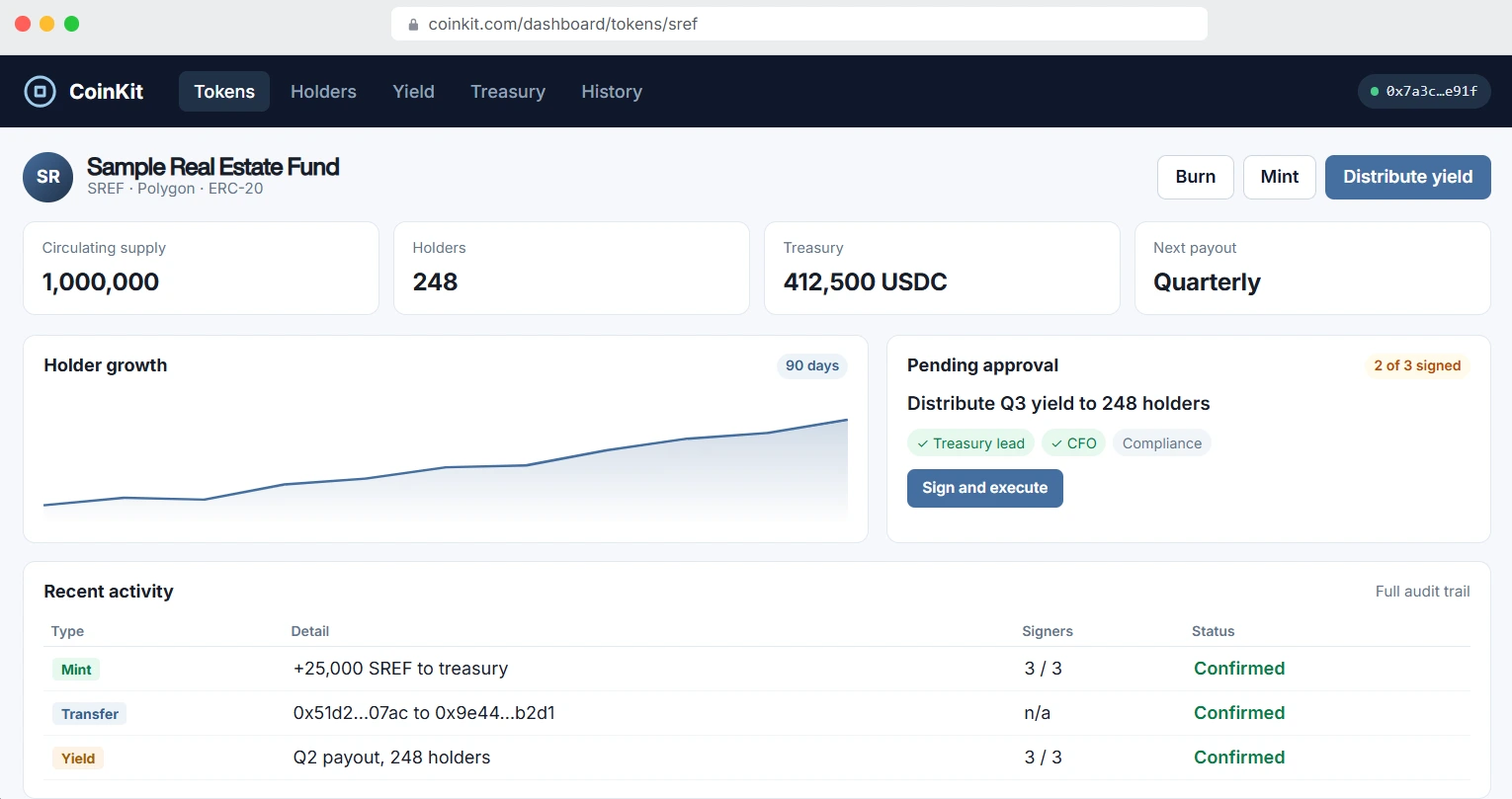
I think the biggest obstacle today isn’t really the technology. Creating a token is relatively straightforward. The complicated part is connecting that token to a real-world asset in a way that is legally enforceable and makes sense for a business.
You have to deal with ownership, regulations, compliance, and what happens when an asset is transferred or sold. Just because you own a token doesn’t automatically mean you legally own the underlying asset.
With CoinKit, we’re trying to simplify the technical side so companies can focus on those bigger challenges. I think tokenization has enormous potential, but for mainstream adoption, it needs to become as straightforward and trustworthy as the financial systems businesses already use.
What’s the most common mistake you see in smart contract projects before they launch?
The most common mistake I see is trying to do too much at once. Teams build overly complicated smart contracts with too many moving parts, dependencies, and interconnected features. The more complex the system becomes, the easier it is to introduce logic flaws that can turn into serious security vulnerabilities.
Unlike traditional software, mistakes in smart contracts can be extremely costly because you’re often dealing directly with assets and transactions that can’t be reversed.
We always encourage clients to keep things as simple as possible, minimize the number of components, and focus on getting the core logic right before adding more features. In blockchain, complexity is often the biggest enemy of security.
Where do AI and blockchain genuinely work well together, beyond the hype?
I think the only genuinely interesting use case for combining AI and blockchain right now is allowing AI agents to own and manage money.
As AI agents become more autonomous, they’ll need ways to make payments, receive funds, and transact with other agents without relying on traditional banking systems. Blockchain can provide that infrastructure.
Beyond that, I haven’t seen many convincing use cases where combining the two technologies actually solves a problem better than using them separately. A lot of it is still driven by hype rather than real business needs.
Our take
We agree with William on the main point: most companies that ask for blockchain don’t need it. If one party controls the data and everyone trusts it, a regular database does the job with far less effort. Blockchain starts to make sense when several parties have to rely on the same records and none of them should hold the keys alone.
Where it does fit, the hard part is rarely the code. A tokenization project stands or falls on the legal link between the token and the asset. With smart contracts, we see complexity as a bigger risk than missing features. A simple, well-tested contract and a clear legal structure are worth more than an ambitious roadmap.
On AI and blockchain, we’re skeptical too. AI agents that hold and move money are a real use case worth watching. Most other pitches that combine the two still look like a solution searching for a problem.
Sources
- Email interview with William Marchand, Webisoft, 18 November 2026
- Webisoft, company website (webisoft.com), accessed 18 November 2026
- The Block, Terra death spiral turns one: Searching for silver linings among the wreckage (May 2023; market capitalization data from CoinGecko)