
Builder-searcher collusion describes coordinated conduct between block builders and MEV searchers which limits competition in the proposer-builder separation (PBS) market of Ethereum. Public data documents exclusive order flow, vertical integration and off-chain settlements between both roles, while proof of an agreement to restrain competition requires evidence which on-chain records cannot supply.
MEV-Boost delivered 90.6% of Ethereum blocks between October 22 and 28, 2026, and Titan and Quasar built 73% of MEV-Boost blocks in October. Microeconomic analysis of the top-of-block auction shows why exclusive pairings between builders and searchers raise builder profit.
Two Nested Auctions Set the Price of a Block
The Searcher Auction Inside the Builder
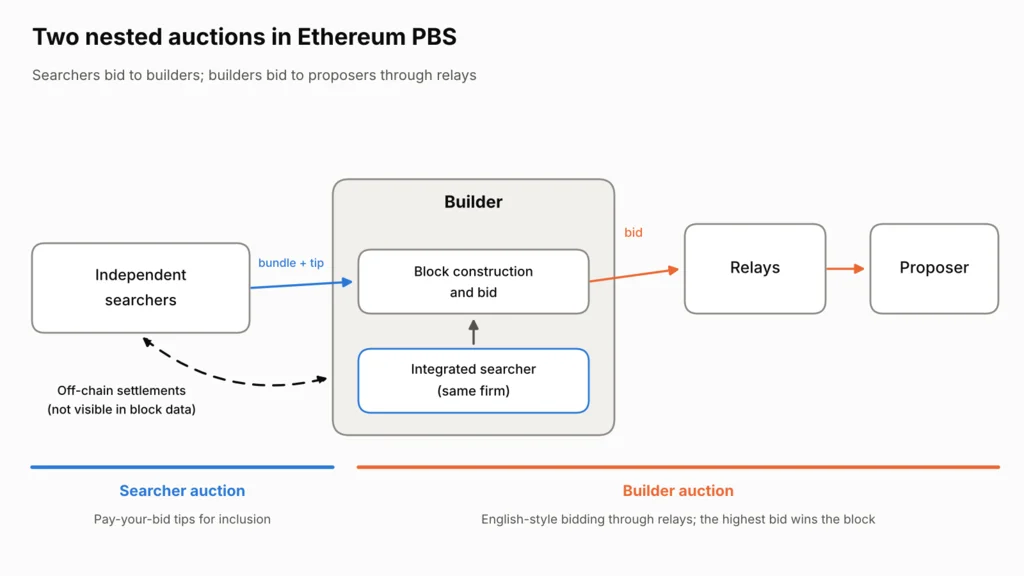
Searchers submit bundles to builders through private APIs, and builders place the most profitable bundles into the block. An independent searcher pays a tip to the builder for inclusion; a higher tip raises the probability of inclusion and lowers the searcher’s net profit. An integrated searcher-builder avoids the tip because profit stays inside one firm.
A 2023 economic model of MEV-Boost shows integrated builders bidding truthfully in their own bundle merge and fixing their margin late in the auction, with more information available. The asymmetry defines the incentive structure behind builder-searcher collusion: integration removes the tip which independent searchers must pay.
The Builder Auction Run Through Relays
Builders send complete blocks and bids to relays, and relays forward the highest bid header to the proposer. The proposer signs the header before the relay reveals the block body, and the winning builder pays its bid to the proposer. Proposers received 638 ETH through MEV-Boost between October 22 and 28, 2026.
The mechanism sells the entire block wholesale: it assigns no separate price to the first ten percent of transactions, the top-of-block segment where arbitrage value concentrates. Measuring builder-searcher collusion across builders requires execution payloads of losing bids, which relays do not publicly disclose.
Why Top-of-Block Position Favors Integrated Builders
Volatility Turns Latency Into Revenue
Top-of-block positions carry CEX-DEX arbitrage, whose value depends on price movement on centralized exchanges. A 2023 study paired PBS auction outcomes with Binance price data and found builder-searchers operated by high-frequency trading firms winning more often under large 12-second price changes.
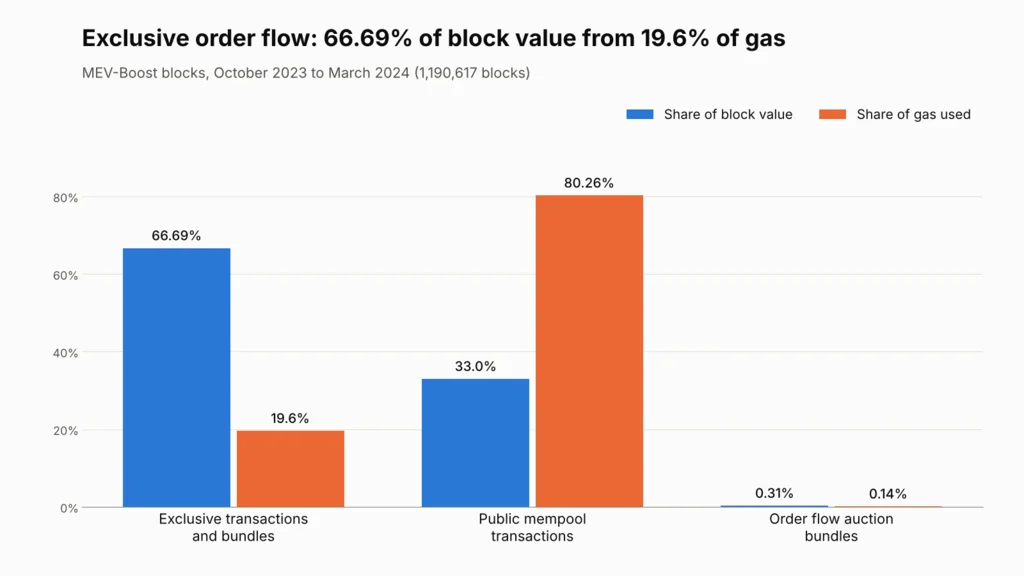
Transactions submitted exclusively to builders produced 66.69% of block value between October 2023 and March 2024 using 19.6% of gas, and beaverbuild, rsync and Titan drew more than 74% of block value from the top-of-block segment.
Late Bids and Cancellations
Flashbots measurements show top builders starting bids later, bidding faster and raising bids in smaller increments. Beaverbuild, rsync and Titan placed more than one cancellation per won block on the Ultra Sound relay between October 2023 and March 2024, and the study ties the practice to integrated builders. An empirical game-theoretic model found that a private order flow advantage shifts bidding incentives sharply, whereas a latency advantage within a threshold does not.
Evidence of Exclusive Searcher-Builder Pairings
Documented Integrations
A study of 1,190,617 MEV-Boost blocks found SCP supplying sizeable order flow only to beaverbuild and Wintermute only to rsync, because each builder operates its own searcher. Titan received sizeable flow from the Banana Gun Telegram bot starting in February 2024, a pattern consistent with an exclusivity deal.
A separate analysis of CEX-DEX arbitrage reports neutral searchers, which distribute flow among several builders, retaining higher profit margins, and exclusive searchers passing most revenue to affiliated builders, sometimes at negative net profit. Research identifies two observable channels of builder-searcher collusion risk: integration and exclusivity deals.
Exclusive Order Flow Revenue
An analysis of 164,249 order flows from September 2023 to August 2025 identified 75 exclusive order flows, which generated 70.53% of trading-related builder revenue. Nine non-atomic flows route exclusively to beaverbuild (five), Titan (two) and rsync (two), and the nine flows account for 70.96% of non-atomic MEV revenue.
Builders with at least one exclusive provider produced profitable blocks at a 46% rate in an earlier six-month dataset, against 20% for builders without one. Measured builder-searcher collusion risk concentrates in few contracts: the top two non-atomic flows capture 56% of non-atomic bribes.
Feedback Between Market Share and Order Flow
Builders need differentiated order flow to profit, yet providers send differentiated flow only to builders with a large market share. The loop raises entry costs: new builders subsidize blocks until they secure flow, and jetbldr, penguin and tbuilder won more than 75% of their blocks by subsidizing. Titan and beaverbuild no longer depended on marginal exclusive flow income to hold share by 2025, because network effects direct searchers toward them. A positive feedback loop sustains the incentive for builder-searcher collusion.
Off-Chain Side Deals and Subsidized Blocks
On-chain records show payments to the proposer and transfers to the builder’s coinbase address, while settlements between searchers and builders occur off-chain. Off-chain settlements place builder-searcher collusion outside on-chain observation. Builder profit estimates overstate profit for builders paying providers for flow and understate profit for integrated builders, whose upstream earnings do not appear in on-chain builder revenue.
Titan and beaverbuild show high exclusive-flow dependence and a sizeable share of negative-profit blocks, consistent with searcher subsidies to hold win rates or off-chain reimbursements. A game-theoretic study of MEV-Boost auctions reports builders holding incentives to collude rather than compete under market conditions favoring decentralization. The result describes incentives in a model and documents no observed agreement. Claims of builder-searcher collusion require evidence of side payments, which public data omit.
Myth vs fact
On-chain data proves that builders and searchers are colluding.
On-chain data shows integration and exclusivity patterns, but it cannot prove an agreement. Settlements between searchers and builders happen off-chain. Even the game-theoretic study that finds incentives to collude describes a model and documents no observed agreement.
Builder Market Concentration in October 2026
Titan built 52.4% of MEV-Boost blocks in October 2026, Quasar 20.6%, BuilderNet 15.0% and Eureka 6.5%. In October 2025, Titan held 50.8%, BuilderNet 29.8% and Quasar 9.6%. The Herfindahl-Hirschman Index computed from the named builders alone exceeds 3,400 in October 2026 and 3,500 in October 2025, and United States merger guidelines classify markets above 1,800 as highly concentrated. Market concentration increases the effect of any builder-searcher collusion.
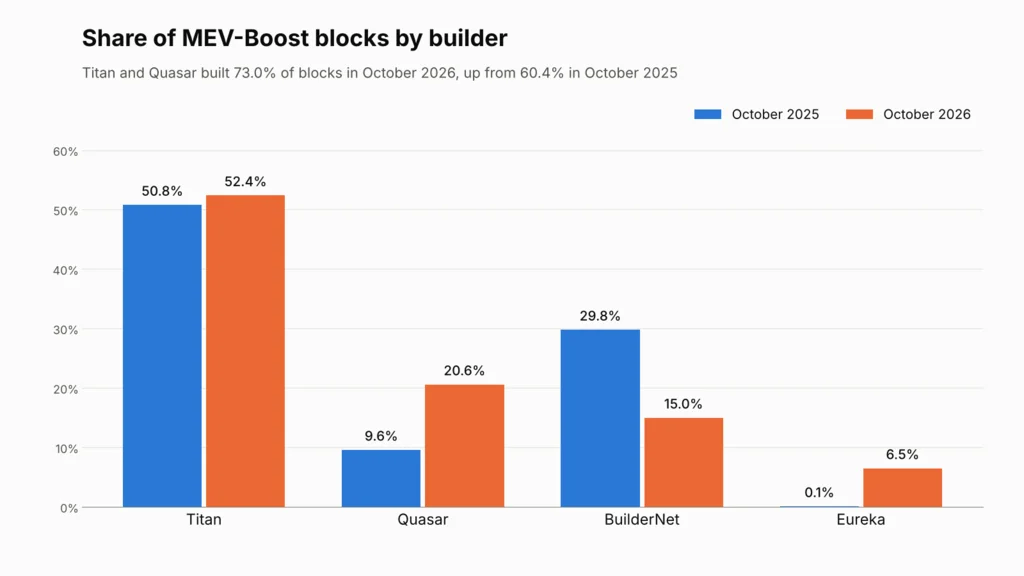
Titan operates a builder and a relay, and its relay delivered 31.9% of MEV-Boost payloads in October 2026 against 15.7% a year earlier.
Countermeasures: BuilderNet and ePBS
BuilderNet’s TEE Model
Flashbots, Beaverbuild and Nethermind launched BuilderNet in November 2024 to neutralize exclusive orderflow deals through builders running inside trusted execution environments. The design targets the exclusive-flow channel of builder-searcher collusion. Flashbots operates BuilderHub, which verifies attestations and authorizes nodes, and the operator set depends on one coordinator.
A 2026 order flow study found BuilderNet’s order flow distribution nearly identical to Beaverbuild’s, which indicates the entrant absorbed an incumbent’s share without restoring competition.
EIP-7732 and the Glamsterdam Schedule
EIP-7732 moves bids, commitments and payments between proposers and builders into the protocol, registers builders as staked entities in the beacon state with a stake as low as 1 ETH, and removes the need for trusted middleware. The proposal still permits trusted payments outside the protocol, and analysts state ePBS neither decentralizes block building by itself nor addresses builder concentration, the market condition behind builder-searcher collusion concerns.
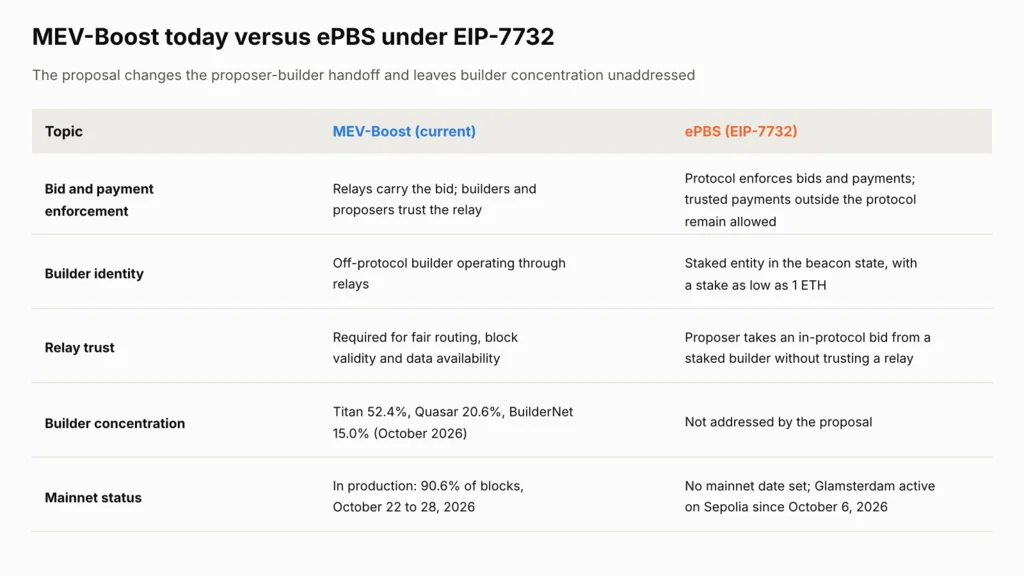
Glamsterdam, the upgrade carrying ePBS, activated on the Sepolia testnet on October 6, 2026. The Ethereum Foundation postponed the Hoodi testnet fork scheduled for October 26 and has set no mainnet date, while EIP-7732 entered Last Call with a deadline of November 1, 2026.
FAQ
What is collusion between builders and searchers in Ethereum PBS?
It is coordinated conduct between block builders and MEV searchers that limits competition in the proposer-builder separation market. Public data show exclusive order flow, vertical integration, and off-chain settlements between both roles.
Why does a searcher-builder integration give an advantage?
An independent searcher pays a tip to the builder to include its bundle. An integrated searcher-builder does not pay it, because the profit stays within the same company.
Can collusion be proven with on-chain data?
No. On-chain records show payments to the proposer and transfers to the builder’s coinbase address, but settlements between searchers and builders occur off-chain. Proving an agreement requires evidence of side payments that public data do not include.
How concentrated is the builder market?
Very. In October 2026, Titan built 52.4% of MEV-Boost blocks and Quasar 20.6%. Among the builders named in the article, the Herfindahl-Hirschman index exceeds 3,400. U.S. merger guidelines consider any market above 1,800 to be highly concentrated.
Do BuilderNet and ePBS solve the problem?
Not entirely. BuilderNet seeks to neutralize exclusive order flow agreements, but its flow distribution is almost identical to Beaverbuild’s. EIP-7732 (ePBS) removes the trust middleware, but on its own it does not decentralize block building or solve builder concentration.

Isai Alexei is a journalist and financial analyst covering cryptocurrency markets and traditional securities for Blockchaindose. He has spent ten years analyzing digital assets, trading activity, and market structure.