


If you only watch prices, you could miss the story. Crypto headlines still orbit around token charts, ETF flows and market mood. But underneath, a quieter shift is underway: businesses are starting to use blockchain-based money for ordinary operations. Corporate adoption, by one of the most credible surveys in the field, has roughly doubled in a year.
Nobody threw a launch party for it. There was no price spike to mark the moment. That is exactly why it is easy to miss.
The number that doubled
The headline figure comes from EY-Parthenon’s 2026 Blockchain Payments Survey. It asked 521 senior decision-makers at corporations and financial institutions how they use stablecoins, the digital tokens pegged to currencies like the US dollar.
The answer: 18% of corporates now use stablecoins in production, meaning real operations rather than pilots or experiments. That is approximately double the 2025 level of about 9%.
The banks and financial firms are moving even faster. 69% of financial institutions already offer, or plan to launch, stablecoin services within two years. A year earlier, that figure was 30%.
EY also found that 15% of corporates use tokenized deposits (bank deposits issued on a blockchain). Counting stablecoins, tokenized deposits or both, 21% of corporates are using at least one.
A fair caution: this is a survey of 521 decision-makers, not a census of every company on earth. But as a direction-of-travel signal, a jump from 30% to 69% among financial institutions is hard to wave away.
| Metric | 2025 | 2026 |
| Corporates using stablecoins in production | ~9% | 18% |
| Financial institutions offering or planning stablecoin services | 30% | 69% |
| Corporates using tokenized deposits | n/a | 15% |
| Corporates using stablecoins, tokenized deposits, or both | n/a | 21% |
Source: EY-Parthenon, 2026 Blockchain Payments Survey.
The on-chain proof: supply stalled, usage didn’t
Surveys tell you what people say. Blockchain data tells you what they do. And here the two line up in an unexpected way.
Allium, an on-chain data platform, tracked stablecoin activity through August 2026. Its findings point in two very different directions:
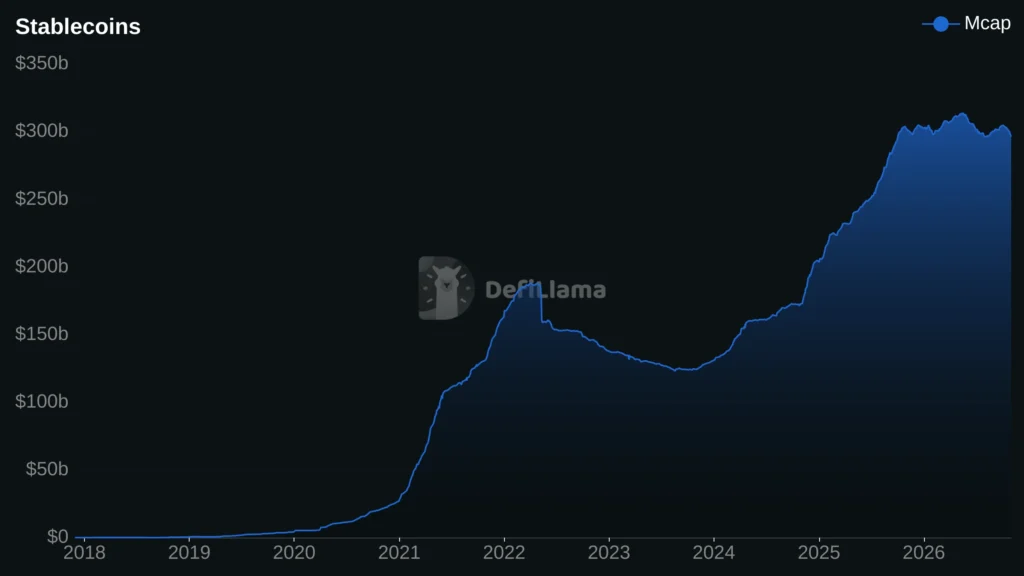
- Stablecoin supply reached $303 billion, up just 6% from a year earlier.
- Stablecoin payment volume reached at least $401 billion from January through August, up 42% or more year over year.
In plain terms: the amount of stablecoins in existence barely grew, but the amount of payment activity running through them jumped dramatically. The same dollars are being used more often, for more things.
That is what a shift from holding to using looks like. Speculators tend to park money. Businesses move it.
CoinDesk Research, using Allium data, found a similar picture through September. Stablecoin market cap rose only 1.0% to $306 billion, while adjusted monthly transfer volume climbed 41.4%. Monthly payment volume rose from $33.2 billion to $54.1 billion. Total transaction volume reached $2.33 trillion, up 48.6% year over year.
| Metric | Figure |
| Stablecoin supply, August 2026 | $303B (+6% YoY) |
| Stablecoin payment volume, Jan–Aug 2026 | At least $401B (+42% or more YoY) |
| Market cap through September | $306B (+1.0%) |
| Adjusted monthly transfer volume through September | +41.4% |
| Monthly payment volume | $33.2B to $54.1B |
| Total transaction volume | $2.33T (+48.6% YoY) |
Sources: Allium, State of Stablecoins and Payments; CoinDesk Research.
Who is actually paying?
The payment data also shows who is on the other end of these transfers, and it is not mostly retail traders.
Allium found that business-to-business settlement is the largest single payment lane, at roughly $137 billion to $153 billion. Businesses also receive the majority of payments, around 58% to 64% of the total.
That fits the EY survey neatly. Companies say they are using stablecoins, and the payment flows show companies on both sides of the transaction. Cross-border settlement and treasury movement, the slow and expensive corners of traditional finance, are exactly where this kind of money is useful.
Addressing the obvious pushback
“Isn’t stablecoin volume mostly bots and traders?” Partly, yes, and Allium is upfront about it. Total stablecoin transfer volume from January to August 2026 was about $85 trillion. But only around $4.0 trillion of that was real economic activity once you strip out exchange-internal moves, DeFi loops and infrastructure transfers.
That is why careful wording matters. The defensible claim is not that $401 billion of all transfers were payments. It is that at least $401 billion was identified stablecoin payment volume, and that figure is growing fast on its own terms.
“Is 18% really that big?” Not as a share of the whole economy. But doubling in a single year, from a small base, is how adoption curves start. The more telling number is the 69% of financial institutions planning to offer these services, because they are the ones who will build the rails for everyone else.
“Is this a prediction?” No. Every figure above is a reported 2026 number from a survey or an on-chain data provider. None of it relies on forecasts.
Why it matters
The loudest metrics in crypto, price and market cap, are the ones that tell you least about whether the technology is being used. The quieter ones, corporate usage, payment volume and who receives the money, tell you much more. Right now they all point the same way: stablecoins are moving from a trading tool toward everyday business plumbing. If you follow only the price chart, you are watching the wrong dial.

Dan is a seasoned crypto writer for Blockchaindose who got his start in the space back in 2019. Over the past four years, he’s built a solid grasp of how the industry moves, focusing heavily on DeFi, NFTs, GameFi, and promising new projects.
Off the clock, you’ll usually find him buried in a good book or kicking back with a movie. His blend of hands-on market experience and straightforward commentary makes him a clear, trusted voice across the platform.