
ePBS changes the block-building auction on Ethereum by letting proposers delay selection of the winning bid and choose which signed bids to disclose, and a game-theoretic model predicts lower proposer revenue and lower allocation efficiency in parts of the parameter space, according to a paper by Jingyu Liu, Bolin Zhang, Lin William Cong, Siguang Li and Xuechao Wang.
Direct Bids Replace Relays
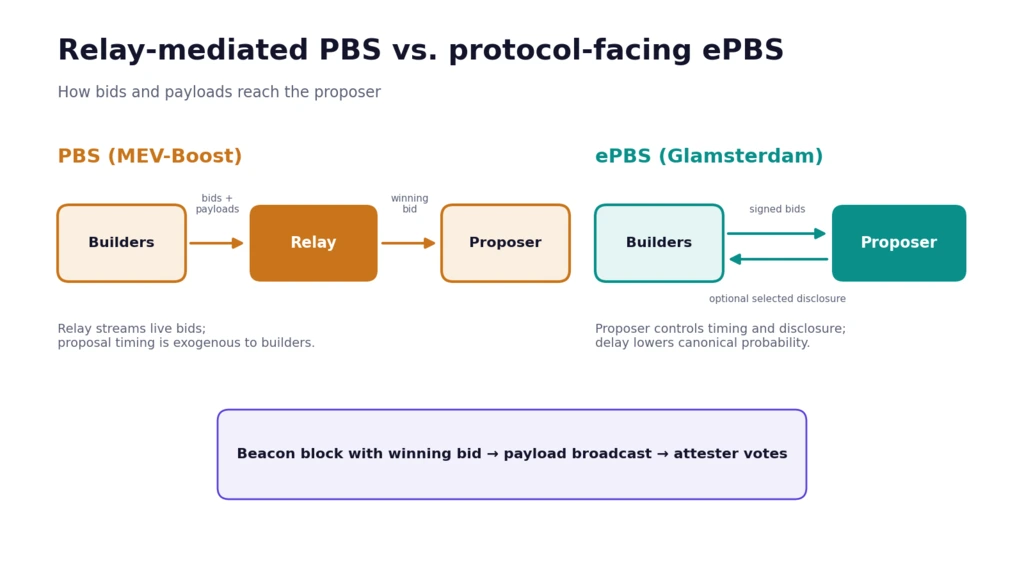
Enshrined proposer-builder separation replaces relay-mediated MEV-Boost with signed bids sent by builders to proposers through direct channels or peer-to-peer gossip. The paper notes the top five relays handled over 90% of block production by July 2026, and ePBS targets relay dependence. Proposers gain control of two margins: the timing of the beacon block and the disclosure of bid history.
Delay carries a cost, because a block proposed later has a lower probability of becoming canonical, which requires attestations from at least two thirds of attesters. Titan, the dominant builder, expects peer-to-peer bids to be used sparingly because they are much slower than direct bids.
Two-Stage Auction Model
The authors model block building as a two-stage auction with imperfect information, where early bids work as both price offers and signals. Builders observe private values and submit stage-one bids, and the proposer either proposes immediately or defers and sends public or private verifiable messages before stage two. Builders are fast or slow: fast builders see disclosed information before rebidding, while slow builders do not.
Each bid carries a signature, which prevents the proposer from fabricating a bid and makes every forwarded record verifiable. The model treats PBS and ePBS as restrictions of one game, where PBS fixes timing and disclosure exogenously and ePBS gives the proposer endogenous control over both.
PBS Preserves First-Price Payoffs
Under PBS, any perfect Bayesian equilibrium with separating stage-one bids gives builders the same interim payoff as a one-shot first-price auction. For independent, regular values and n builders, a symmetric strictly separating equilibrium exists when the probability of stage one settling the auction is at least one half, and none exists below 1/n. With uniform values, the nonexistence region extends to one third.
In production, relays supply a live bid stream and proposer timing stays unknown to builders, which approximates exogenous termination. Some relays, including Ultra Sound, adjust bids to produce payments resembling second-price outcomes.
The Ratchet Effect in ePBS
When delayed proposals are unlikely to become canonical, immediate stopping stays optimal and ePBS can reproduce first-price outcomes. Once continuation becomes attractive, an early bid works as a payment offer and as a signal the proposer can use in stage two. In a tractable two-fast-builder case, the authors construct uni-pooling equilibria: low types pool at zero and high types bid positive amounts. Builders anticipate ex-post extraction, which the paper calls the ratchet effect, and equilibrium revenue and efficiency can fall below the first-price benchmark.
Calibration With Titan and BuilderNet Data
Exact equilibria are intractable in realistic settings, which led the authors to compute no-regret benchmarks with CFR+, a counterfactual regret minimization variant. The calibration uses Titan and BuilderNet, the two largest builders, with relay bid traces and winning-block data from blocks 23,000,151 to 24,698,991, covering July 26, 2025 to March 20, 2026.
A joint log-normal model feeds a game with 16 value levels and 31 bid levels, and the finite ePBS game has over 73 million histories. The normalized error bound stays below 0.3%, and the authors treat the results as robustness evidence, because no-regret dynamics approximate coarse correlated equilibria rather than exact perfect Bayesian equilibria.
Revenue-Efficiency Valley
In the calibrated results, PBS approaches first-price outcomes as stage-one settlement becomes more likely, and ePBS departs from them. ePBS develops a revenue-efficiency valley when the parameter for canonicalization after delay k2 sits between 0.85 and 0.925. At k2 equal to 0.9, proposer revenue falls to 10.39, 10.58 and 10.46 mETH across fast-fast, slow-fast and fast-slow profiles, and efficiency, defined as the winner’s value relative to the highest builder value discounted by canonicalization probability, falls to about 0.902 to 0.915.
The proposer mostly reveals the leader’s signed bid to the trailing builder, and in the fast-fast case stage-one informativeness drops from 0.92 to 0.19 while the bid-to-value ratio falls from 0.78 to 0.59.
Latency Premium Shrinks
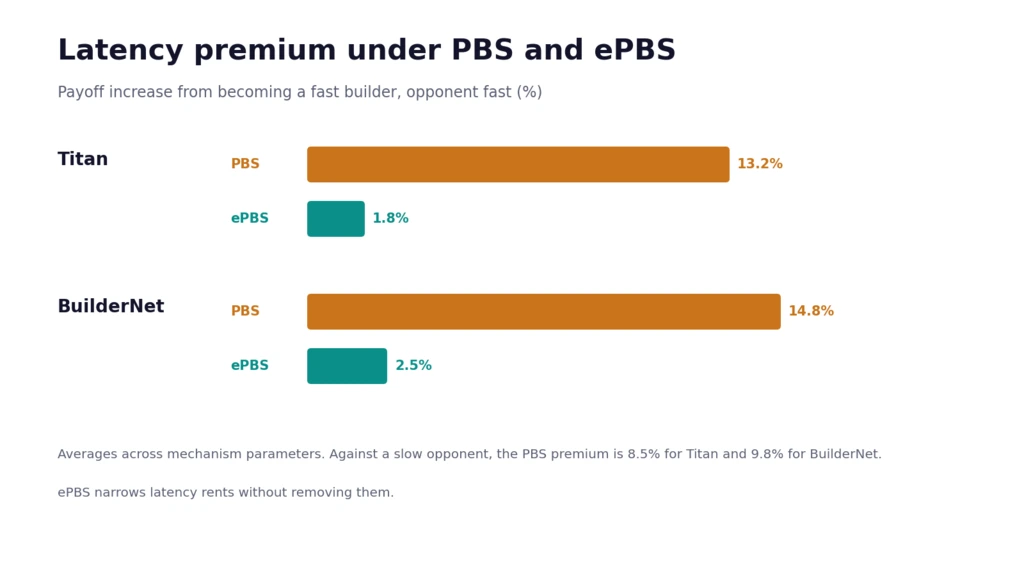
ePBS compresses latency rents without eliminating them, since fast builders keep a smaller payoff advantage over slow builders. Under PBS, becoming fast raises Titan’s payoff by 13.2% against a fast opponent and 8.5% against a slow one, and BuilderNet’s by 14.8% and 9.8%. Under ePBS, the premium against a fast opponent averages 1.8% for Titan and 2.5% for BuilderNet. Proposer regions within range of at least one top builder hold about 94.3% of validator weight and 90.6% of observed node records, so the result applies to most of the network.
TEE Sidecar as Commitment Device
The authors read the ratchet as a commitment failure, because the proposer cannot credibly promise ex ante how it will stop and disclose. A proposer with full ex-ante commitment would implement the Myerson optimal auction, and institutional proposers may commit more credibly than solo validators, which creates centralization pressure.
To give solo proposers a limited version of commitment, the paper proposes a Trusted Execution Environment sidecar fixing stopping and disclosure policies before bids arrive while keeping the highest-bid, pay-as-bid rule at the terminal stage. The design problem reduces to a polynomial-size bilinear program.
TEE Revenue Results
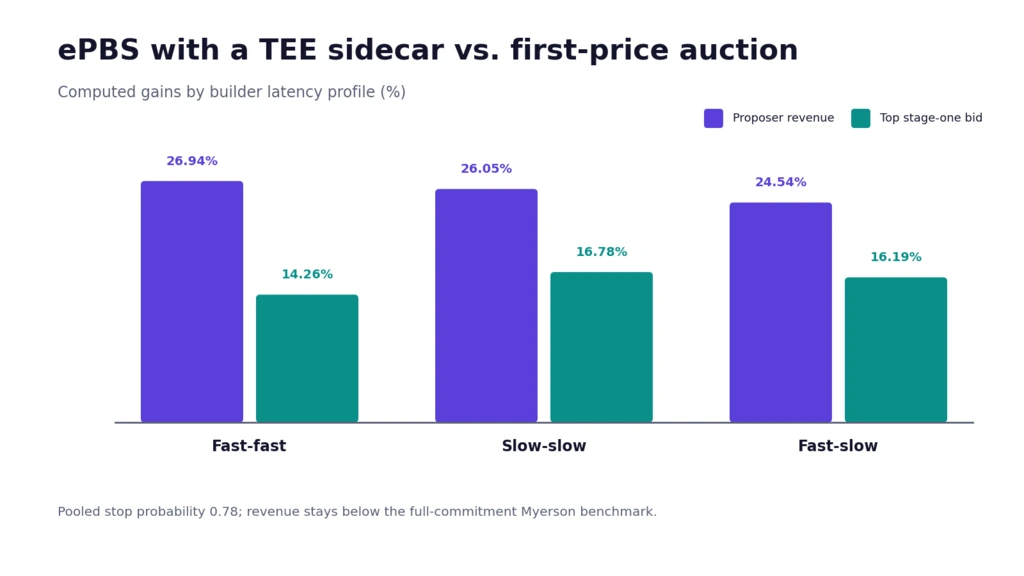
In finite benchmarks on a five-by-five value and bid grid, covering uniform, truncated normal and two beta value distributions and five k2 values from 0.01 to 1.0, the TEE design raises proposer revenue relative to first-price auctions by 26.94% in fast-fast, 26.05% in slow-slow and 24.54% in fast-slow profiles, about 25% overall. Average top stage-one bids exceed first-price levels by 14.26%, 16.78% and 16.19%, and the pooled stop probability is 0.78.
Stopping rises with bid gap and mean bid level, with coefficients of 0.18 and 0.33 in the simplest regression, and revenue stays below the Myerson benchmark, so the design recovers part of the commitment advantage.
Glamsterdam Rollout Schedule
Glamsterdam combines the Amsterdam execution upgrade with the Gloas consensus upgrade and includes EIP-7732, the ePBS specification. The upgrade activated on the Sepolia testnet on October 6, 2026, and the Ethereum Foundation scheduled the Hoodi testnet for October 26, 2026 at 17:42:48 UTC, together with a gas limit increase to 200 million.
Client teams have not set a mainnet date, which leaves the paper’s findings applicable to a design still in testing. Operators using external block-building infrastructure should review its Glamsterdam-specific instructions.

Isai Alexei is a journalist and financial analyst covering cryptocurrency markets and traditional securities for Blockchaindose. He has spent ten years analyzing digital assets, trading activity, and market structure.