

Ask most people how big Bitcoin’s Lightning Network is, and you’ll get a shrug. Ask how big it is right now, and you’ll get a different number depending on whom you ask.
That is the first surprise. The second is that the network has been losing money-in-channels all year, and it is still working.
The headline number is small
Glassnode, which tracks only channels announced to Lightning’s public routing graph, measured public capacity at 3,767 BTC, or about $310 million, at the end of the third quarter of 2026. For context, that is a rounding error next to stablecoins or the daily volume on a major exchange.
Anyone who calls Lightning “tiny” is right.
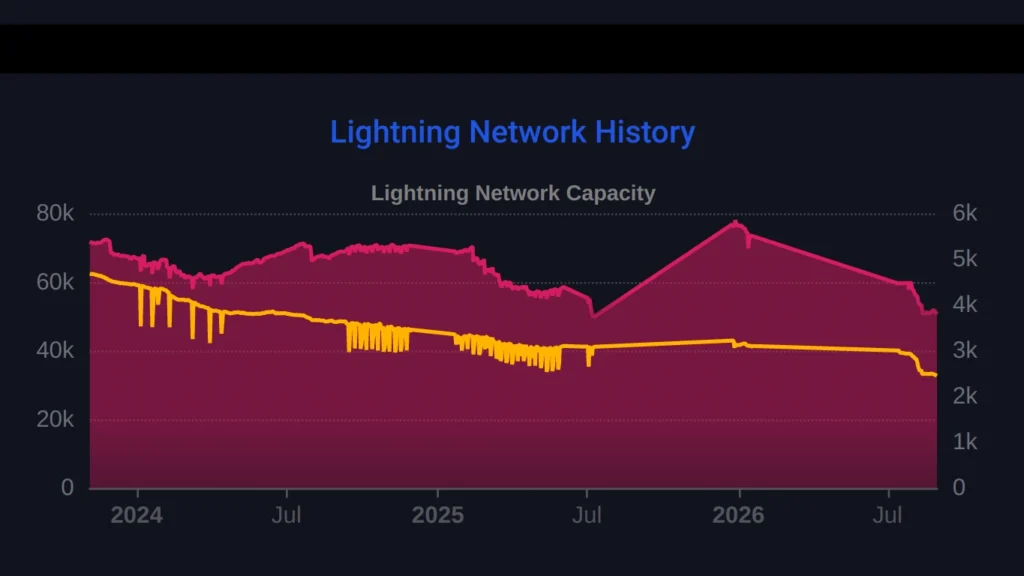
Bitcoin’s lightning network getting smaller
The word “intact” needs an asterisk, because the trend is down:
- Glassnode says public capacity fell 19.3% in Q3 2026.
- A mempool.space-based tracker put capacity at about 4,496 BTC at the end of July and 3,704 BTC at the end of August, a 17.6% drop in a single month.
- Public channels fell from about 43,658 to 36,829 over the same stretch, down roughly 15.6%.
- Public nodes slipped from about 14,869 to 13,803.
- CoinGlass shows 3,255.62 BTC on October 30, and 1ML shows a 15% 30-day decline to 2,270 BTC.
So the claim that Lightning is simply “holding steady” doesn’t survive the data. Capacity has been draining for months.
Why every tracker shows a different number
Here’s the part that confuses people. Look at the latest readings side by side:
| Source | Public capacity | As of |
| Glassnode | 3,767 BTC (~$310M) | Sept. 30, 2026 |
| CoinGlass | 3,255.62 BTC | Oct. 30, 2026 |
| Mempool.space | 2,530.94 BTC | Live |
| 1ML | 2,270.33 BTC | Live |
Part of the gap is timing, since the network is contracting and these readings span different dates. The rest is method. 1ML says its figures are approximations pulled from multiple nodes, and it leaves out nodes that don’t broadcast their state. Glassnode counts only public, gossip-visible channels.
That last point is the hidden catch in every Lightning statistic. Private channels aren’t counted at all. Plenty of wallets and businesses run channels that never appear on the public map. The real network is at least somewhat bigger than any public chart suggests, though nobody can say by how much.
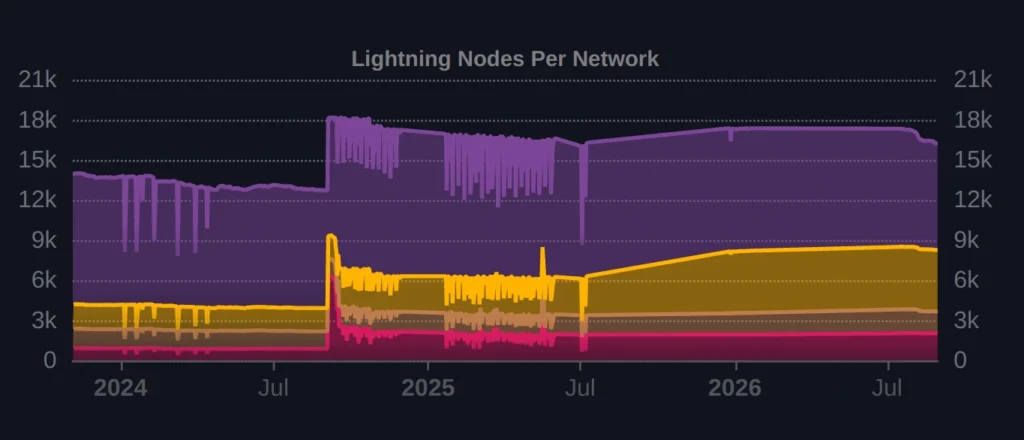
Nodes and channels show the same spread. Mempool.space counts 13,777 nodes and 22,680 channels. 1ML counts 5,903 nodes and 19,102 channels. That is a big difference for the same network on the same day.
So what’s “structurally intact”?
Strip away the shrinkage and look at what’s still standing:
- Thousands of public nodes. Mempool.space shows nearly 14,000 live.
- Tens of thousands of channels. More than 22,000 public channels are live on the same tracker.
- A functioning average channel. The typical public channel holds about 11.16 million sats, roughly 0.11 BTC. That is a retail-sized pipe, not a handful of whale-sized hubs.
A network that lost close to a fifth of its capacity in a quarter and still has this much plumbing hasn’t collapsed. It has thinned out.
The hidden stat: it’s used far more than its size suggests
The most interesting number isn’t capacity at all. It’s activity. Reporting based on Glassnode’s Q3 data cites:
- 62.06 million transactions in the quarter
- A typical payment of about $62
- Roughly 639,000 daily active users
Those figures describe a payments network. People aren’t parking coins on Lightning and walking away. They’re moving them, in small amounts, millions of times.
One caution: these activity figures come from secondary reporting, not directly from a Glassnode chart I could confirm. Verify them against Glassnode’s dashboard before publishing. They fit the thesis, but they should be checked.
What the data does and doesn’t prove
Backs the thesis:
- Public capacity is still in the thousands of BTC.
- Thousands of nodes and tens of thousands of channels are still live.
- Activity appears large relative to the capital locked.
Challenges the thesis:
- Capacity fell about 19% in one quarter.
- Nodes and channels are also declining.
- Trackers disagree widely, so no single number is “the” answer.
The fair summary: Lightning is small, shrinking, and still working.
Why this matters (short version)
Lightning is Bitcoin’s main answer to “how do you pay for coffee with it?” If the layer is shrinking, that tells you something about whether people actually want to use Bitcoin for payments rather than just hold it. If it’s still processing millions of small payments on a thin base, that tells you the idea works even if the money hasn’t followed. Either way, you should know which tracker you’re reading and what it leaves out before quoting a number.

Dan is a seasoned crypto writer for Blockchaindose who got his start in the space back in 2019. Over the past four years, he’s built a solid grasp of how the industry moves, focusing heavily on DeFi, NFTs, GameFi, and promising new projects.
Off the clock, you’ll usually find him buried in a good book or kicking back with a movie. His blend of hands-on market experience and straightforward commentary makes him a clear, trusted voice across the platform.