
Bitcoin has two ways of paying miners. The first is the block subsidy: new coins created with every block, now 3.125 BTC. The second is bitcoin fees, the small payments users attach to their transactions to get them included. For most of Bitcoin’s history, the subsidy did almost all the work and fees were a rounding error.
Then, between early 2023 and the end of 2024, that changed. The change is easy to miss because it rarely made headlines. Prices make the news. The slow rise and fall of a miner’s income mix does not.
The Boom: When Bitcoin Fees Briefly Mattered
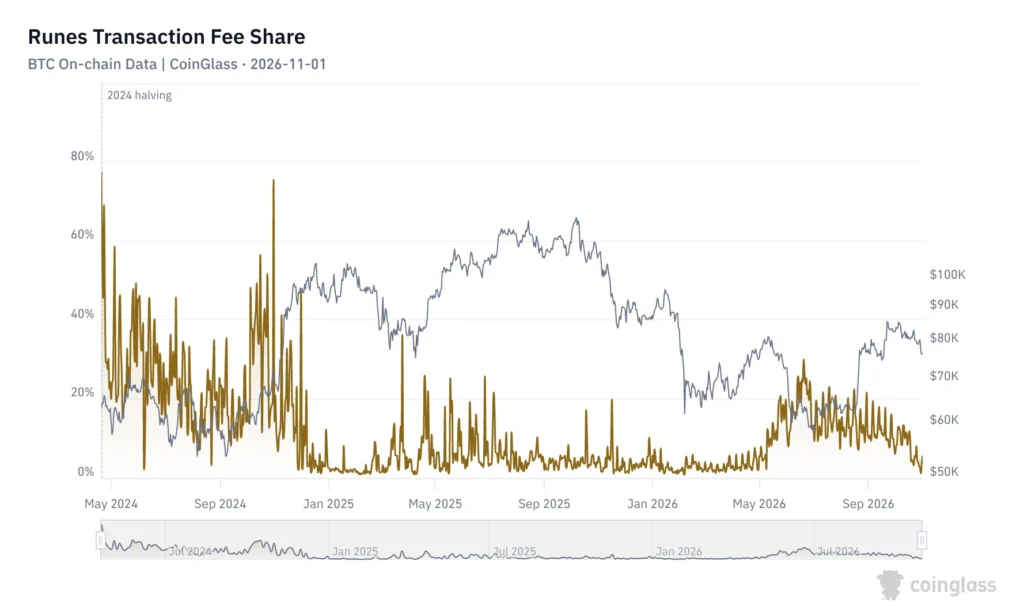
It began with Ordinals inscriptions in early 2023, which turned Bitcoin blocks into a place to store digital collectibles. BRC-20 tokens followed. Then Runes, a token standard, launched on the same day as the April 2024 halving.
According to an InvestAlternative calculation using Coin Metrics data, inscriptions, BRC-20 tokens and Runes paid miners about 38,220 BTC, roughly $1.71 billion, in fees between February 2023 and December 2024. That is an estimate. Separating “inscription fees” from ordinary transfers depends on methodology, so treat it as a ballpark.
The effect on the revenue mix was large. Bitcoin Fees made up just 1.59% of miner revenue in 2022. During the inscription era they averaged 6.78%.
The Peak: One Day in April 2024
The clearest single moment came on April 20, 2024, the halving day. The day before, bitcoin fees were about 11% of miner revenue, according to Glassnode data reported by CryptoSlate. After the halving, they jumped to over 75%.
The numbers that day were extreme:
- Fees reached 1,257.71 BTC, more than 75% of that day’s miner revenue.
- Miners collected more than $81 million in fees, and the average transaction fee hit a record $127.97.
- Glassnode counted $117 million in cumulative Runes fees after the halving, with $62.4 million of that on halving day itself.
- For one day, fees paid miners more than the new coins did.
The Crash: How Fast It Reversed
The spike did not last. Daily bitcoin fees fell from about $80 million on halving day to $3.4 million by April 28. By April 25, Glassnode showed fees back at roughly $6.7 million, matching pre-halving levels.
Kaiko tracked the same slide in average fees. The average fee dropped to between $3 and $5, down from around $45 in January 2024. That is a drop of about 90%.
Glassnode’s fee-share numbers tell the same story over a longer stretch. Fee share fell from 22.3% in January 2024 to 2.3% by September 2024.
The Quiet Years: Fees Below 1%
The Block’s analysis shows the full cycle. Fees were about 7% of miner revenue in 2024, and about 1% in 2025. The Block attributes the fall to the unwinding of the Ordinals, BRC-20 and Runes frenzy.
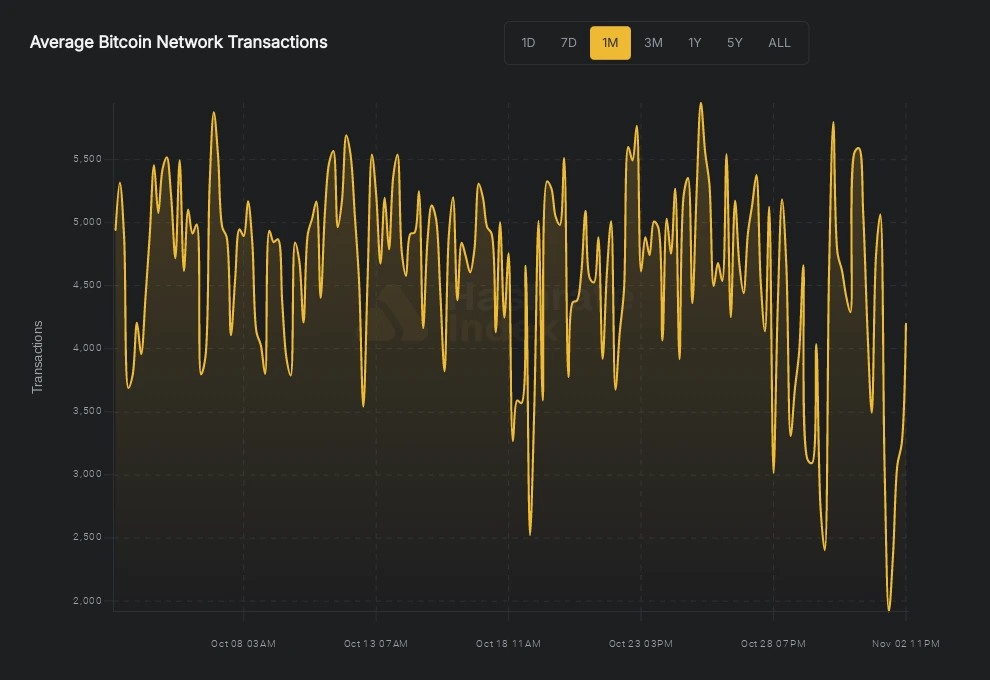
The 2026 readings are lower still:
- Fees were 0.55% of miner revenue between May 14 and May 21, 2026.
- Hashrate Index put June 2026 at roughly 0.76%.
- On August 11, the share was 0.69%, which Glassnode co-founder Rafael Schultze-Kraft flagged as near a 10-year low.
- The latest Coinglass reading, from October 28, 2026, is 0.528%.
For context, Onramp notes that fee share has historically hovered between 2% and 5% in normal market conditions. Today’s level is well below even that.
Debunking the “Fees Are Taking Over” Story
The 2024 spike was sometimes read as proof that fees would soon replace the subsidy. The data does not support that.
- It was a one-off. The April 2024 peak coincided with a halving and a brand-new token launch. Within days, fees were back to normal.
- It was speculation-driven. The Block describes the 2024 fee surge as an on-chain frenzy that later unwound. theblock
- The floor matters more than the peak. The network has shown it can produce $80 million days. It has not shown it can sustain them.
Miners still got by in 2025, but not because of fees. The Block projects miner revenue of $17.2 billion in 2025 against $14.7 billion in 2024, helped by higher bitcoin prices. Price carried them, not fee income.
Why It Matters
Because fees are so small, miners depend almost entirely on the bitcoin price and the shrinking subsidy. Capriole’s Charles Edwards estimated the average cost of mining one coin at $78,254 on August 11, while bitcoin traded near $64,100. He called the situation “the least talked about concerning Bitcoin development in 2026.” He also noted that the decline in hash rate has accelerated since April.
The long-term question is who pays for Bitcoin’s security once the subsidy runs down. Researchers at the Cambridge Centre for Alternative Finance put it this way: an issuance schedule has paid for Bitcoin’s security, and it is running down, but fees have not taken over yet. Knowing the fee-share number is how you can tell whether that handover is happening. Right now, it is not.

Dan is a seasoned crypto writer for Blockchaindose who got his start in the space back in 2019. Over the past four years, he’s built a solid grasp of how the industry moves, focusing heavily on DeFi, NFTs, GameFi, and promising new projects.
Off the clock, you’ll usually find him buried in a good book or kicking back with a movie. His blend of hands-on market experience and straightforward commentary makes him a clear, trusted voice across the platform.