
Stablecoins give people a way to hold and transfer digital money without worrying about the constant price swings of cryptocurrencies like Bitcoin and Ethereum. But while some stablecoins depend on companies to manage them, others use blockchain protocols and smart contracts to operate with less reliance on a central authority.
Key takeaways
- Decentralized stablecoins are designed to maintain a stable value without relying entirely on a central company.
- Many use cryptocurrency as collateral to support their value.
- Smart contracts manage processes such as borrowing, repayment, and liquidation.
- Different stablecoins use different mechanisms, and each comes with its own risks.
- Decentralization does not automatically mean a stablecoin is safe.
Understanding Centralized Stablecoins First
Before understanding decentralized stablecoins, let’s first look at the model most people already know. Centralized stablecoins like USDT and USDC are issued by companies that hold reserves to help keep their value close to $1.
For example, USDC is issued by Circle, which manages the reserves behind it. This means users trust the company to manage those reserves properly and maintain the token’s value. You can learn more about stablecoins and their use in cross-border payments.
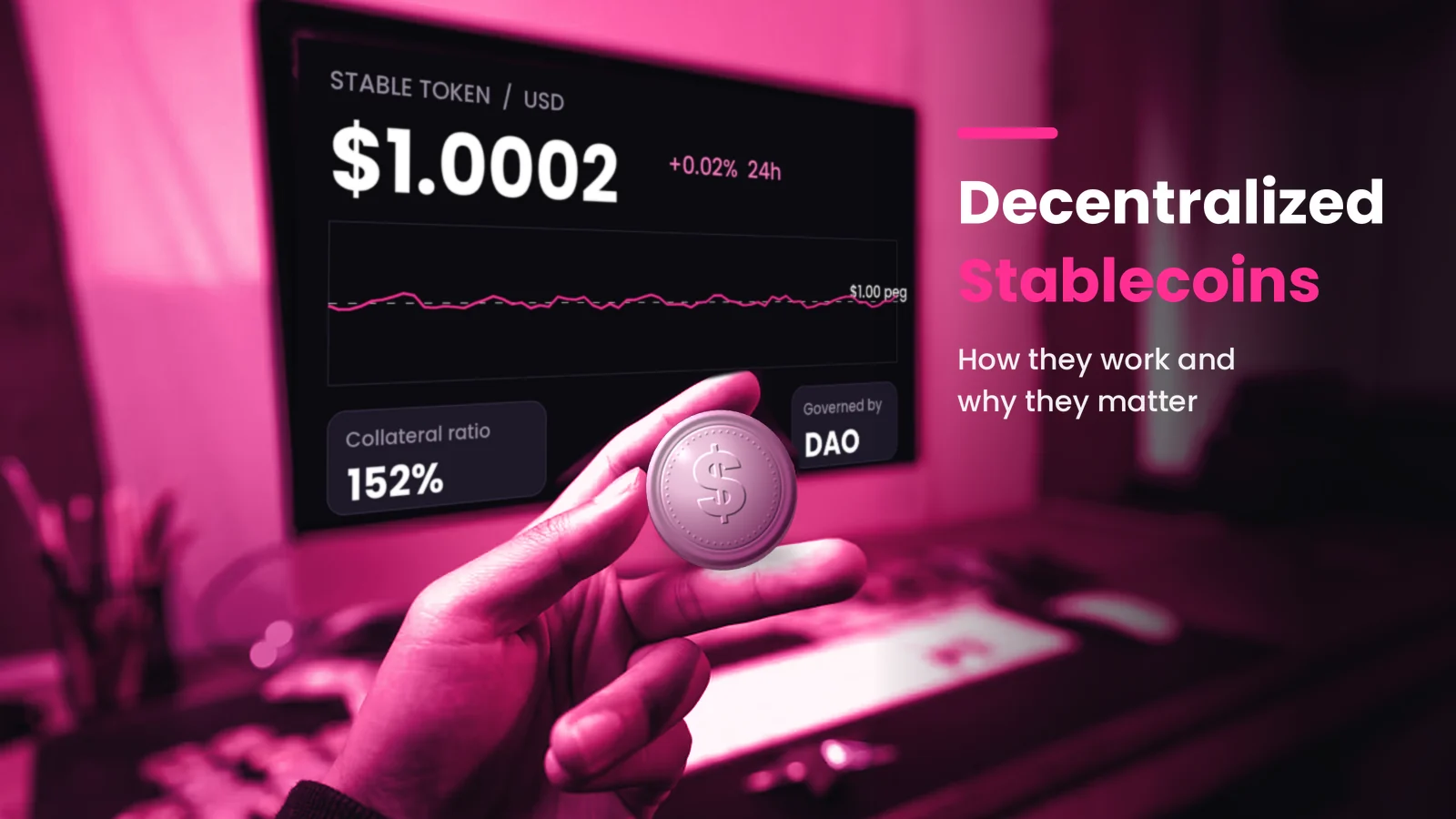
Decentralized stablecoins work differently. Instead of depending entirely on one company, they use blockchain protocols and smart contracts to handle important parts of how they operate.
What Are Decentralized Stablecoins?
Decentralized stablecoins are digital currencies designed to keep their value relatively stable using blockchain technology. Many use cryptocurrency as collateral, while smart contracts help manage how the system works instead of relying entirely on a company to hold reserves in a bank.
DAI is a well-known example. It was originally created through the Maker Protocol, which is now part of the Sky ecosystem. Ethereum co-founder Vitalik Buterin once described decentralized financial applications like DAI as “something really useful and powerful” in an interview with the Harvard International Review.
However, decentralization doesn’t mean nobody is involved in managing the system. Smart contracts handle many operations, while users may also have a say in certain decisions through community governance.
How Do Decentralized Stablecoins Work?
Let’s look at a common model: a crypto-collateralized stablecoin.
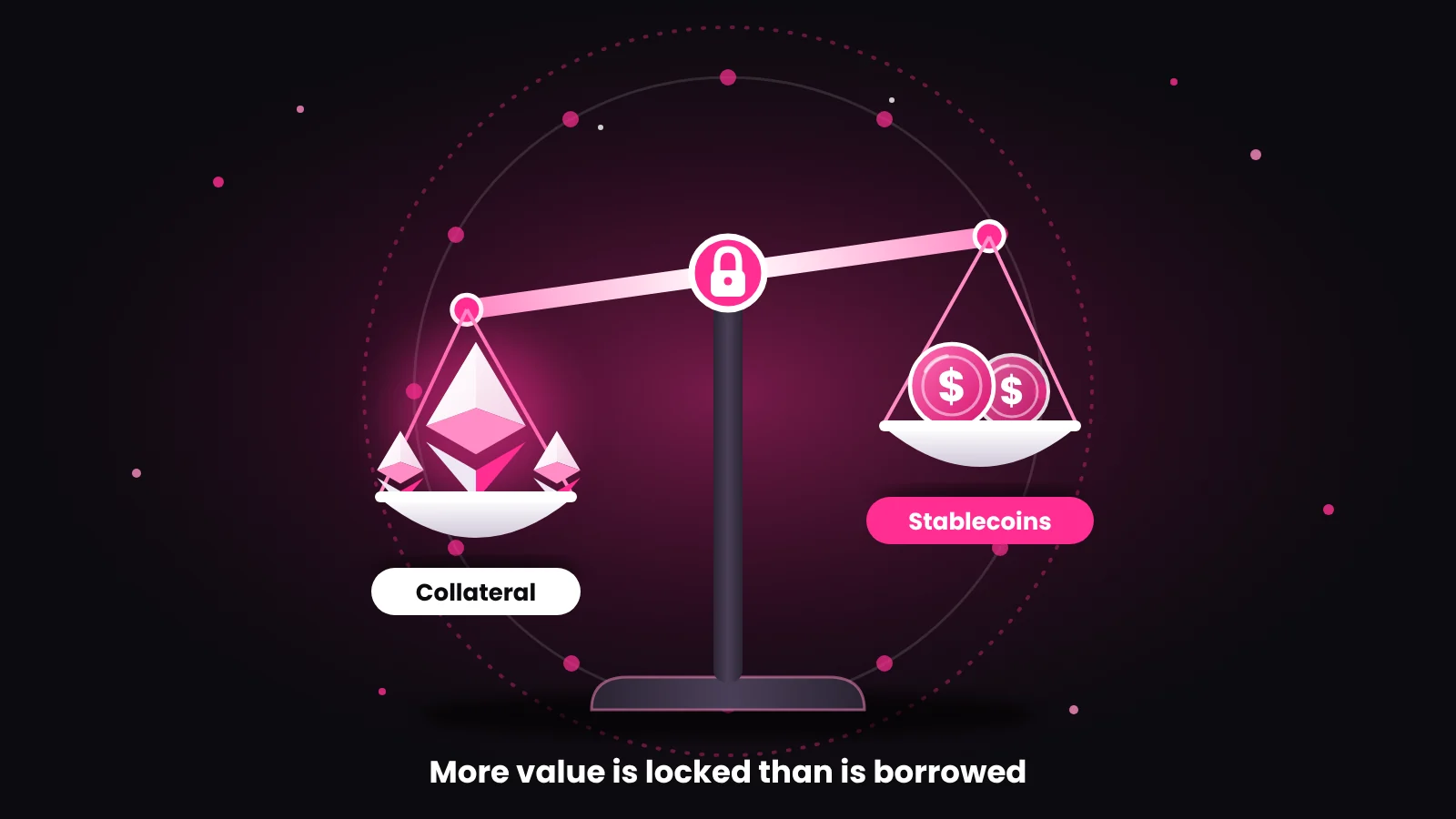
Suppose you own $2,000 worth of Ethereum but don’t want to sell it. You could deposit some of that ETH into a decentralized lending protocol and borrow stablecoins against it.
The ETH you deposit is called collateral. It acts as security for your loan, allowing the protocol to issue stablecoins against the value of your deposited assets.
Smart contracts manage this process automatically. They record your collateral, track your debt, and apply the protocol’s rules when you borrow or repay.
You may be wondering why the protocol requires you to deposit more value than you borrow. This is known as overcollateralization, and it provides a safety buffer because cryptocurrency prices can change quickly.
For example, if your ETH loses significant value, the protocol may liquidate some of your collateral to cover your outstanding debt. This protects the system, but it also means you could lose part of your deposited assets.
Practical tip
Don’t borrow the maximum amount a protocol allows. Leaving room for market fluctuations can help reduce your risk of liquidation.
Different Types of Decentralized Stablecoins
Not every decentralized stablecoin works the same way. Some rely on cryptocurrency collateral, while others use programmed supply mechanisms or combine different approaches.
Crypto-Collateralized Stablecoins
These stablecoins use cryptocurrency as collateral to support their value. Users deposit assets such as ETH into a protocol, which then allows stablecoins to be issued against that collateral.
DAI is a well-known example. Its backing has evolved over time and includes different types of collateral, so users should always check what actually supports a stablecoin rather than assuming every token is backed in the same way.
Algorithmic Stablecoins
Algorithmic stablecoins attempt to maintain their value through programmed rules that adjust token supply or create incentives to influence demand. They may not have enough assets held in reserve to cover every token in circulation.
TerraUSD (UST) is a notable example of this model’s risks. In May 2022, UST lost its dollar peg, triggering a collapse involving its related token, LUNA.
The collapse showed how quickly confidence can disappear when the mechanism supporting a stablecoin stops working.
Hybrid Stablecoins
Hybrid stablecoins combine different approaches to support their value. They may use collateral alongside automated supply mechanisms or other stability measures.
Combining different mechanisms can offer flexibility, but it does not automatically make a stablecoin safer. Its design and the assets supporting it still matter.
Decentralized vs. Centralized Stablecoins
The main difference comes down to how each stablecoin is issued, managed, and supported.
| Centralized stablecoins | Decentralized stablecoins |
|---|---|
| Managed by a company or central issuer | Managed through blockchain protocols and smart contracts |
| Usually backed by issuer-managed reserves, such as cash and government securities | Typically backed by crypto collateral or other onchain assets |
| The issuer controls minting, redemption and reserve management | Protocol rules govern minting, borrowing and redemption |
| Issuers may freeze addresses or restrict transactions | Often offer greater permissionless access, although governance and protocol controls still apply |
| Examples: USDT and USDC | Examples: DAI, LUSD, crvUSD and GHO |
Neither model is automatically perfect. Centralized stablecoins may offer a simpler reserve-based structure, while decentralized models can reduce dependence on a single issuer.
Why Do Decentralized Stablecoins Matter?
Decentralized stablecoins give people another way to hold and use digital dollars without depending entirely on a traditional company. They can be used across decentralized finance (DeFi) applications for lending, borrowing, trading, and payments.
For example, someone can deposit stablecoins into a lending protocol to earn interest, while another user can borrow them by providing cryptocurrency as collateral. Traders can also use them to move between crypto positions without constantly converting their funds back into traditional currency.
This flexibility allows users to move value between compatible blockchain applications and access different financial services while keeping their funds in a digital asset designed to maintain a relatively stable value.
Decentralized Stablecoins and Their Place in the Market
Decentralized stablecoins are gaining attention in the crypto market, but they still have a smaller share compared with centralized options like USDT and USDC. Despite this, their development continues to raise important conversations about the future of digital money.
Ethereum co-founder Vitalik Buterin has also called attention to the need for better decentralized stablecoin designs, highlighting some of the challenges existing systems still face.
We need better decentralized stablecoins.
Vitalik Buterin, Co-founder of Ethereum. Read his comments on the challenges facing decentralized stablecoins.
What Risks Should Users Understand?
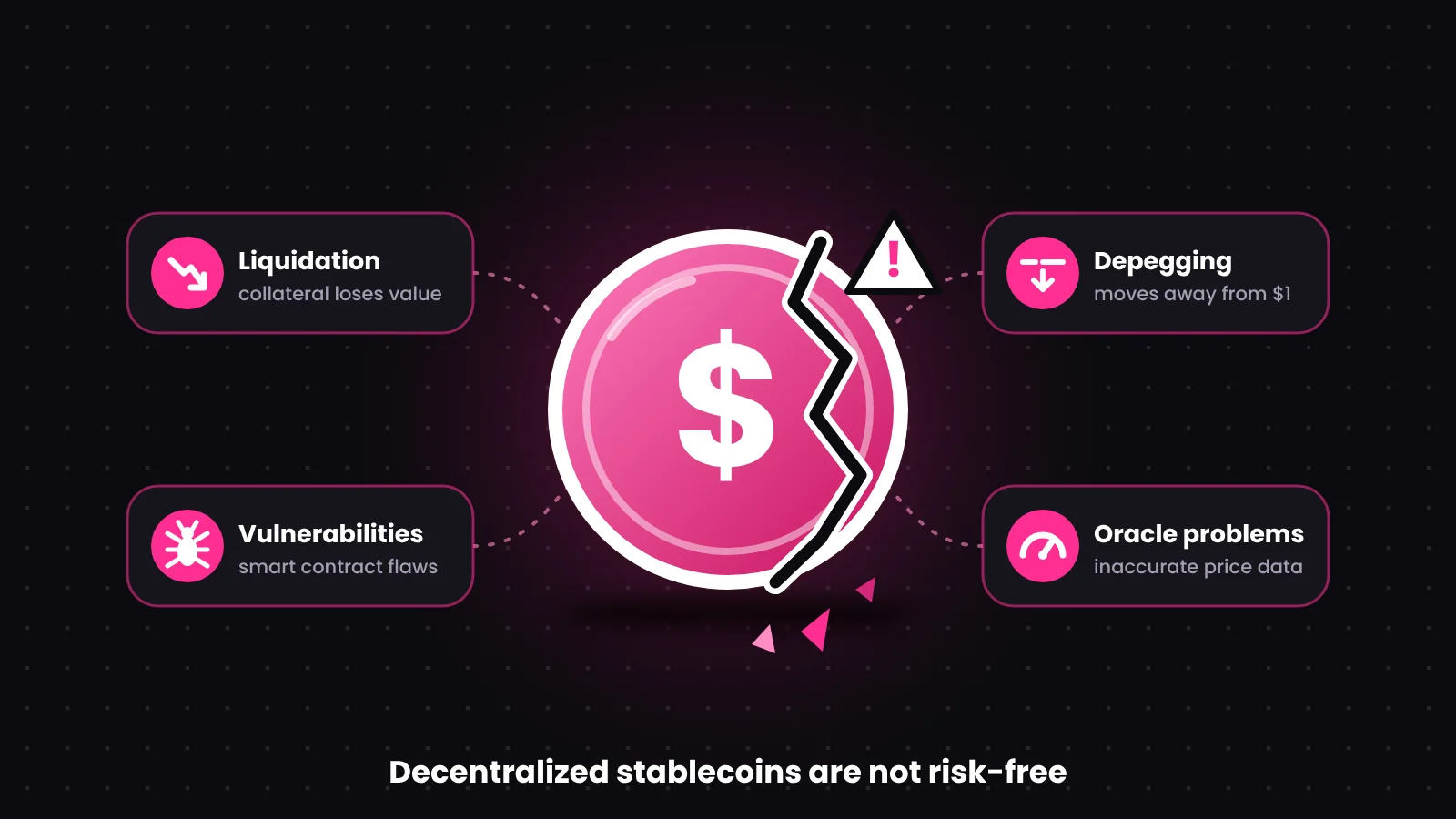
Decentralized stablecoins are not risk-free. Their mechanisms can fail, their collateral can lose value, and the smart contracts controlling them may contain vulnerabilities.
One major risk is depegging. This happens when a stablecoin moves away from its intended value, such as a dollar-pegged token falling to $0.95. You can learn more in our guide to stablecoin depegging.
Other risks include liquidation when collateral loses value and problems with price oracles, which provide external market prices to blockchain protocols. If an oracle supplies inaccurate information, it can affect how a protocol makes important decisions.
Security warning
Before using a decentralized stablecoin, check its collateral, how it maintains its value, whether its smart contracts have been audited, and how it handles sudden market changes. Never assume that the word “decentralized” means your funds are completely safe.
Final Thoughts
What I find interesting about decentralized stablecoins is how they approach something people already understand: keeping money’s value relatively stable. Instead of placing everything in the hands of one issuing company, they explore how blockchain protocols and smart contracts can manage that responsibility, allowing people to interact with digital money through systems that operate on transparent rules.
However, decentralization does not automatically make a stablecoin safe or guarantee that it will always maintain its value. The system still depends on factors such as the assets backing the stablecoin, the reliability of its smart contracts, and how well its mechanism responds when market conditions change. That’s why understanding what supports a stablecoin, how it works, and what could go wrong is just as important as appreciating the freedom decentralization can offer.
For me, that’s the important thing to take away from this topic. Decentralized stablecoins offer an interesting approach to digital money, but knowing how the system works helps you make better decisions about when and how to use them.
Frequently asked questions
What is the main difference between centralized and decentralized stablecoins?
Centralized stablecoins are issued and managed by companies, while decentralized stablecoins use blockchain protocols and smart contracts to manage important functions.
Are decentralized stablecoins always backed by cryptocurrency?
No. Some use crypto assets as collateral, while others rely on algorithmic mechanisms or a combination of different approaches.
How do decentralized stablecoins maintain their value?
They use mechanisms such as collateral, smart contracts, and supply adjustments to keep their market price close to their intended value, often $1.
What happens if the collateral backing a decentralized stablecoin loses value?
The protocol may liquidate some of the collateral to cover outstanding debt. This helps protect the system but can result in losses for borrowers.

I’m a Product Designer, Web3 enthusiast, and technology writer passionate about exploring how emerging technologies are shaping our digital future.
My interests span blockchain technology, cryptocurrency, decentralisation, digital privacy and product innovation. Beyond following developments in the Web3 ecosystem, I enjoy researching complex technical concepts and breaking them down into simple, relatable explanations that anyone can understand, regardless of their technical background.
As a writer, my goal is to educate, share perspectives, simplify ideas and help more people discover the opportunities behind emerging technologies.
I believe technology becomes more powerful when people understand it, and I’m passionate about making that understanding accessible to everyone.