


Try this quick test. Ask a crypto fan who earns the money in “DeFi.” Most will name Uniswap, Aave or Hyperliquid as the source of Defi revenue. The data says Binance, Tether and Coinbase.
The numbers come from 1kx’s Blockchain Revenue Report, published October 29, 2026. The investment firm projects roughly $100 billion in blockchain revenue for 2026, a 28% drop that it blames mainly on falling digital asset prices. That is a big pool of money. The question is who actually collects it.
The label that misleads
1kx’s largest category is “DeFi/Finance.” It is worth an estimated $65 billion, or 66% of all blockchain revenue. Most readers see “DeFi” and assume decentralized protocols earn that money. They don’t.
1kx’s definition is broad. It bundles decentralized apps with centralized exchanges, brokerages, stablecoin issuers, asset managers and prediction markets. Here is what the $65 billion is made of:
| Source | Share | Approx. revenue |
| Centralized exchanges and derivatives venues | 42% | ~$27.3B |
| Stablecoin reserve income and yields | 29% | ~$18.9B |
| On-chain user-paid fees | 13% | $8.6B |
| Asset management, custody, ETF/ETP fees | 7% | ~$4.5B |
| Prediction markets | 6% | ~$4.2B |
Source: 1kx Blockchain Revenue Report 2026.
Only 13% of the “DeFi/Finance” pool, or $8.6 billion, comes from fees paid by users of on-chain protocols like DEXs, lending markets and on-chain perpetuals. Centralized exchanges alone earned roughly three times that.
Stablecoins are quietly a money machine
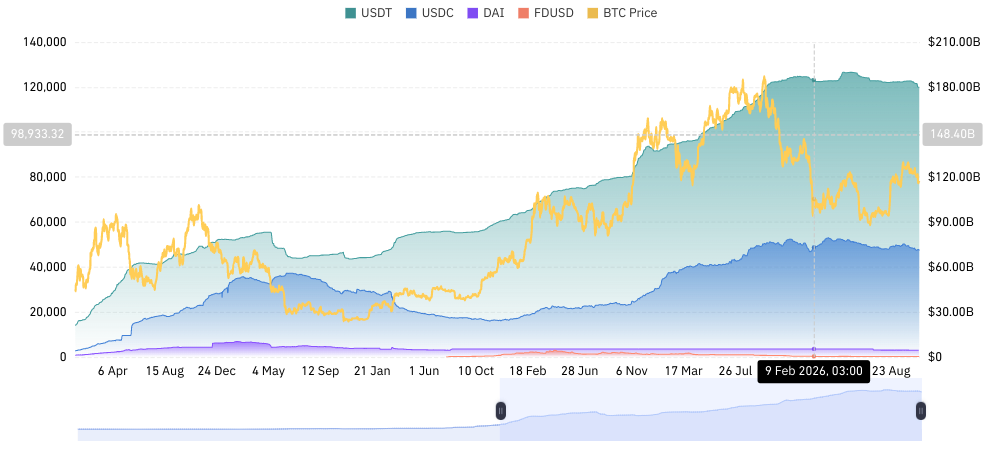
The second-biggest slice is not trading at all. It is interest. Issuers like Tether and Circle hold reserves in assets such as Treasury bills and keep the yield. That income is about $18.9 billion, more than double all on-chain user fees.
Tether alone is estimated at $2.9 billion in the first half of 2026. Circle is in the mix too. Coinbase and Circle together generated about $3.3 billion in blockchain-related revenue in the first half of 2026.
Concentration inside the concentration
The money is not only centralized. It is also concentrated among a handful of names:
- Binance earned an estimated $5.8–7 billion in H1 2026, about half of all CEX revenue.
- Fewer than 10 large CEXs took about 30% of H1 private-sector blockchain revenue.
- The top six public companies (Coinbase, Circle, Robinhood, MARA, Bitdeer, CleanSpark) captured about 60% of public-company revenue. Public companies as a group took 16% of blockchain revenue in 2026. That is more than double their 7% share in 2022.
- The top 20 on-chain protocols earned 60% of on-chain user-paid fees.
- Hyperliquid took 54% of perp and derivatives fees on-chain.
Even the “decentralized” corner is winner-takes-most.
The trend is going the wrong way for decentralization
The “finance” share of blockchain revenue has grown every year since 2022:
| Year | DeFi/Finance share | Infrastructure share |
| 2022 | 52% | 48% |
| 2023 | 55% | 45% |
| 2024 | 61% | 39% |
| 2025 | 64% | 36% |
| 2026 (est.) | 66% | 22% |
But the growth did not come from decentralized protocols. In H1 2026, on-chain user-paid fees fell 31% year over year, CEX revenue fell 25%, and stablecoin reserve income rose 10%. DEX fees dropped 50% in the same period as volumes and prices fell.
The base layer is similar. Mining and staking income was about $20 billion in 2026. Transaction fees and MEV were only $2.3 billion, under 3% of all blockchain revenue.
The counterargument: DEXs are gaining on trading volume
To be fair, DeFi is not standing still. On volume, decentralized exchanges have been taking share:
- The DEX-to-CEX spot ratio closed July 2026 at a record 24%, up from 17% a year earlier.
- The DEX-to-CEX perps ratio rose from 2.1% in January 2023 to 11.7% in November 2025.
- The Block’s chart shows the spot ratio reaching about 25% in September 2026.
So on-chain trading is growing as a share of volume. Revenue is a different story. Volume share is not revenue share, and fees on DEXs are often thin. The 1kx data shows that on-chain activity is real but still earns far less than the centralized businesses it competes with. Even at a 25% spot share, about 75% of spot volume still happens on centralized venues.
One caveat on the broader picture: 1kx also finds that real-world and institutional activity is growing. Revenue from broader economic activity passed blockchain infrastructure revenue for the first time in Q3, at about $5.3 billion versus $5.1 billion. Tokenized assets and prediction markets drive much of that growth, and many of those businesses are not decentralized either.
Why it matters
When someone says “DeFi revenue is booming” or “DeFi is dying,” ask which DeFi they mean. Most of what gets counted is centralized exchanges and stablecoin issuers. If you invest in, build on, or write about on-chain protocols, you need to know that the real, decentralized fee pool is much smaller, more cyclical and more concentrated than the headline suggests.

Dan is a seasoned crypto writer for Blockchaindose who got his start in the space back in 2019. Over the past four years, he’s built a solid grasp of how the industry moves, focusing heavily on DeFi, NFTs, GameFi, and promising new projects.
Off the clock, you’ll usually find him buried in a good book or kicking back with a movie. His blend of hands-on market experience and straightforward commentary makes him a clear, trusted voice across the platform.