18.7 million wallets touched a decentralized application on an average day in Q3 2025, according to DappRadar’s quarterly industry report — gaming led usage at 25%, NFTs followed at 18.5%, DeFi at 17.9%, and DeFi alone held a record $237 billion in total value locked. dApp development is what turns blockchain from an abstract technology into something people actually open and use every day.
Key Takeaways
- dApp development pairs an ordinary web frontend with a backend of smart contracts running on a peer-to-peer network instead of a company server.
- The core departure from Web2: deployed contract code can’t be patched quietly, so testing and audits happen before launch, not after a bug report comes in.
- The 2026 stack has settled into a known shape: Solidity plus Foundry or Hardhat for contracts, viem/ethers.js plus wagmi for frontend connectivity, IPFS for storage, The Graph for indexing.
- Chain choice is a business decision more than a technical one: Ethereum for security and liquidity, Layer 2s and EVM chains for low fees, Solana for raw throughput.
- Utility beats hype in 2026 — account abstraction and gas sponsorship let dApps feel like ordinary apps, which raises the UX bar everyone has to clear.
Building for that audience requires a different mental model than standard web3 development tutorials suggest – because half of your application logic will live on infrastructure you do not control and cannot easily change.
What actually separates a dApp from a normal app, how the architecture works end to end, the tech stack that settled into standard practice by 2026, how to pick a blockchain, the development process step by step, and the security realities that separate production systems from weekend prototypes.
What Is a dApp?
A decentralized application (dApp) is an application whose backend code runs on a peer-to-peer blockchain network rather than on centralized servers, as Ethereum’s developer documentation defines it. The frontend can look and feel exactly like any modern web app – React, Next.js, a mobile app – but instead of calling a private API, it reads from and writes to smart contracts that anyone can inspect on-chain. That single change in blockchain development architecture produces the properties dApps are known for: no single point of control, censorship resistance, transparent logic, and user-owned assets.
It also produces the trade-offs that the same documentation is refreshingly honest about: harder maintenance, performance overhead, and the risk of re-centralizing by quietly moving logic back onto private servers. Good dApp development is largely the craft of managing those trade-offs deliberately.
| Aspect | Traditional app | dApp |
| Backend | Company-owned servers | Smart contracts on a blockchain |
| Data | Private database | Public on-chain state + decentralized storage |
| Login | Email and password | Wallet connection and cryptographic signing |
| Updates | Deploy anytime | Contracts are immutable; upgrades need patterns like proxies |
| Payments | Payment processor | Native tokens, on-chain, no intermediary |
| Downtime | Server outages possible | Runs as long as the network runs |
How dApp Development on Blockchain Actually Works
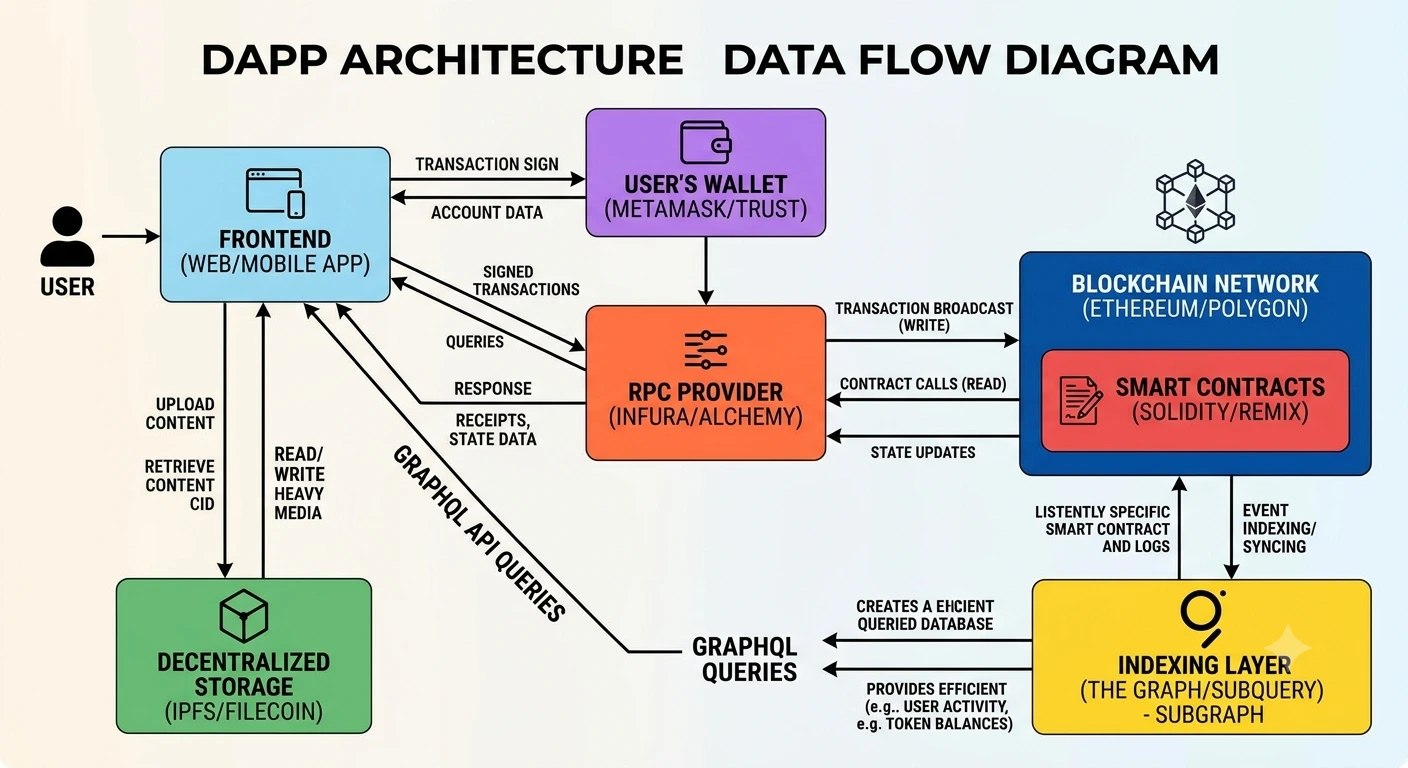
dApp development on blockchain splits the application into layers with very different rules. Understanding who is responsible for each layer – you, the network, or a third-party service – is the foundation of every architectural decision that follows.
The Smart Contract Layer
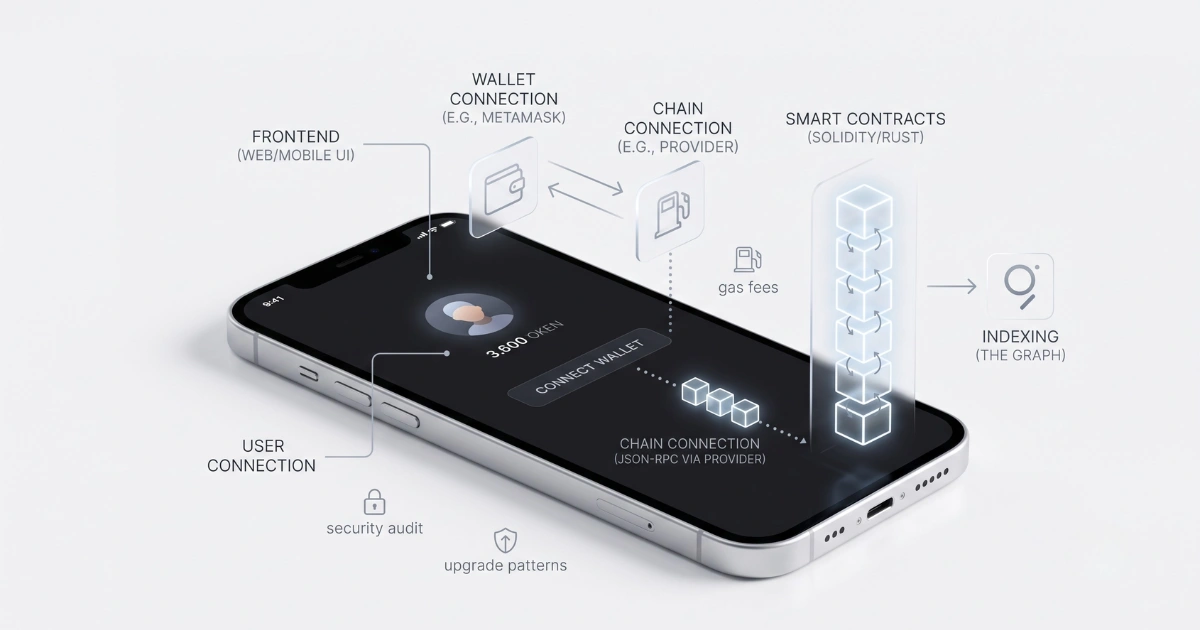
The backend logic lives in smart contracts – programs deployed to the blockchain that execute exactly as written, for anyone, forever. On EVM chains they are written in Solidity (or Vyper), on Solana in Rust. Contracts hold the application state that matters – balances, ownership, game logic, governance rules – and every function call that changes state costs gas paid by the user or sponsored by the app. Because contracts are open like public APIs, dApps routinely compose with contracts other teams wrote: a lending protocol can plug into an existing DEX, a game can use an established NFT standard.
Connecting the Frontend to the Blockchain
The frontend never talks to “the blockchain” directly – it talks to a node via the JSON-RPC API, usually through a provider service (Alchemy, Infura, QuickNode) so you do not have to run infrastructure yourself. In practice, developers use libraries that wrap those RPC calls: as the Consensys developer guide explains, ethers.js and viem handle contract reads and transaction building in JavaScript, while wagmi provides React hooks on top of viem with full type safety. The second half of connectivity is the wallet: “Connect Wallet” authorizes the dApp to read the user’s address and request transaction signatures – the private key never leaves the wallet, which is what replaces passwords as the authentication model.
Storage and Data Indexing
Storing data on-chain is expensive by design, so dApps keep only critical state there. Media, metadata, and frontends themselves go to decentralized storage networks like IPFS or Arweave. Reading blockchain data efficiently is its own problem – querying raw chain history is slow – which is why indexing protocols like The Graph exist: they transform on-chain events into fast, queryable APIs that power dashboards, activity feeds, and search.
The 2026 dApp Tech Stack
A decade of experimentation has consolidated into a fairly standard toolkit. The official list of development frameworks is long, but most production teams in 2026 build from the combinations below.
| Layer | Standard tools | What it does |
| Smart contracts | Solidity, OpenZeppelin libraries | On-chain logic and audited building blocks (tokens, access control) |
| Dev framework | Foundry, Hardhat | Local chain, compiling, testing, fuzzing, deployment scripts |
| Frontend connectivity | viem / ethers.js, wagmi | Typed contract calls, wallet hooks, transaction handling |
| Wallets | MetaMask, WalletConnect, smart accounts (ERC-4337) | Authentication, signing, gas sponsorship and social login UX |
| Node access | Alchemy, Infura, QuickNode, self-hosted node | JSON-RPC access to the network without running infrastructure |
| Storage | IPFS, Arweave | Media, metadata, and frontend hosting off-chain |
| Indexing | The Graph, custom indexers | Fast queries over on-chain events and history |
Choosing a Blockchain for Your dApp
The chain decision shapes costs, audience, and hiring, and it is hard to reverse. The Ethereum network remains the default for anything that needs maximum security, liquidity, and composability with existing protocols – but its base layer processes only a limited number of transactions per second, and mainnet gas costs price out high-frequency use cases. That is what Layer 2 networks like Arbitrum, Optimism, and Base solve: Ethereum security with fees low enough for games and consumer apps.
The wider field of EVM-compatible chains (Polygon, BNB Chain, Avalanche) lets you reuse the entire Solidity toolchain while trading some decentralization for cost, and Solana offers raw throughput with a different language and tooling entirely. Whichever you choose, understand the infrastructure beneath it – the diversity of Ethereum clients, for example, is a real resilience property, not trivia. A practical 2026 pattern: launch on one L2 where your users already are, and treat multi-chain as a scaling milestone rather than a launch requirement.
The dApp Development Process Step by Step
- Define the on-chain / off-chain split. Decide what genuinely needs the blockchain (assets, settlement, governance) and what stays conventional (UI, caching, notifications). Over-decentralizing is as costly as under-decentralizing.
- Design and write the smart contracts. Start from audited OpenZeppelin components, keep contracts minimal, and define upgradeability strategy (immutable vs. proxy pattern) consciously.
- Test aggressively on a local chain. Foundry and Hardhat spin up local networks for unit tests, fork tests against real mainnet state, and fuzzing. This phase should consume more time than writing the contracts did.
- Build the frontend. A standard React/Next.js app with wagmi hooks for wallet connection, contract reads, and transaction flows – including the unhappy paths: rejected signatures, pending states, failed transactions.
- Deploy to a testnet and audit. Run the full product on a public testnet, then put the final contract version through an independent audit before mainnet.
- Deploy to mainnet with monitoring. Verify contract source on the block explorer, set up event monitoring and alerting, and have an incident plan – pausability and admin key policy decided in advance.
- Iterate off-chain, extend on-chain. Frontends ship daily like any web app; contract changes are rare, deliberate events with their own audit cycle.
Generic figures don’t mean much because scope swings wildly from project to project, but published cost estimates for one representative dApp category — marketplaces — run from $20,000–$40,000 for an MVP to $150,000+ for compliance-heavy builds, spanning roughly 2–8 months.
Security: The Part You Cannot Patch Later
The defining constraint of dApp development is that deployed contracts holding user funds cannot be quietly fixed on a Friday night. The same DappRadar report that counts users also counts the cost of getting this wrong: $434 million lost to hacks and exploits in Q3 2025 alone – and that was the year’s calmest quarter. The leading causes are unaudited or under-tested contract logic, compromised admin keys, and vulnerable dependencies.
The professional baseline holds regardless of budget: build on audited libraries, write tests that cover economic attacks and not just function correctness, commission an independent smart contract audit for the exact bytecode headed to mainnet, minimize and timelock admin powers, and monitor contracts after launch. Teams in a hurry skip one of the steps above routinely, and the exploit numbers are the direct, predictable result.
What dApp Users Expect in 2026
Usage is consolidating around utility: gaming holds 25% of activity, DeFi sits at record TVL, and speculative categories like SocialFi shed users through 2025. Analysts describe 2026 as the year dApps must compete on utility rather than hype cycles – which in practice means competing with Web2 apps on user experience.
Account abstraction (ERC-4337) turns wallets into smart accounts with social login and recovery instead of seed phrases; gas sponsorship lets the dApp pay transaction fees so onboarding feels free; sub-second finality on modern chains closes the latency gap. For product categories, the proven templates are worth studying: NFT marketplace development remains the canonical full-stack dApp (contracts, indexing, storage, and payments in one product), while NFT game development shows how on-chain assets integrate with conventional real-time gameplay servers.
dApp development in 2026 is no longer experimental – the stack is standard, the UX gap is closing, and the market punishes products that offer decentralization as their only feature. Learn the architecture, respect the immutability constraint, budget for the audit, and build something people would use even if they did not know a blockchain was underneath.
FAQ
What is the difference between a dApp and a regular app?
A regular app runs its backend on servers owned by one company; a dApp runs its backend logic as smart contracts on a decentralized network. Users authenticate with a wallet instead of a password, own their assets directly, and can verify the application logic on-chain.
What programming languages are used for dApp development?
On Ethereum and EVM-compatible chains, Solidity dominates smart contract development (with Vyper as an alternative); Solana uses Rust. Frontends use the normal web stack – JavaScript/TypeScript with React or Next.js – plus Web3 libraries like viem, ethers.js, and wagmi.
How much does dApp development cost?
Scope drives everything, but industry estimates for representative products run roughly $20,000-$40,000 for an MVP and $80,000-$150,000+ for complex, compliance-heavy platforms, plus $5,000-$20,000 for an independent audit. A simple contract with a thin frontend can cost far less; a novel DeFi protocol far more.
Can a dApp be updated after deployment?
The frontend – yes, freely, like any web app. Smart contracts are immutable by default: changes require either deploying new contracts and migrating, or building in upgradeability upfront via proxy patterns. Upgradeable contracts are more flexible but concentrate power in whoever holds the upgrade keys – a trust trade-off users increasingly scrutinize.
Do dApps need a traditional backend server?
Usually yes, for the parts that do not belong on-chain: caching, notifications, search, analytics. The design rule is that the server should be a convenience layer, not a trust layer – anything involving ownership, balances, or core logic stays in the contracts, otherwise the dApp is decentralized in name only.
Are dApps really decentralized?
It is a spectrum, not a binary. Many dApps rely on centralized RPC providers, hosted frontends, and admin keys – each a re-centralization point. Honest dApp development means knowing exactly where those points are, minimizing them where it matters, and being transparent with users about the ones that remain.