NFT smart contracts are the technical foundation behind every digital collectible, on-chain artwork, and tokenized asset you see traded today. Without them, there is no verifiable ownership, no automated royalty, and no way to prove authenticity at the blockchain level. As the global NFT market was valued at approximately $43 billion in 2025 according to Precedence Research, understanding how these contracts actually work has moved from a developer concern to a genuine literacy issue for anyone participating in the space.
Key Takeaways
- NFT smart contracts are self-executing blockchain programs that handle minting, ownership, transfer, and royalty rules for every NFT.
- The two dominant Ethereum standards are ERC-721 (unique tokens, one per contract) and ERC-1155 (multiple token types in one contract, lower gas costs).
- ERC-2981 is the royalty standard used across most NFT marketplaces – but it only signals royalty intent, it does not force payment.
- On-chain royalty enforcement is genuinely difficult: wrapped NFTs, private wallet transfers, and uncooperative marketplaces can all bypass royalty logic.
- Newer solutions like ERC-721C and Metaplex Core on Solana offer stronger royalty enforcement, but come with their own trade-offs.
This article breaks down what nft smart contracts do, which token standards they use, how royalty enforcement works in practice (and why it often does not), and what tools are available for creators who want to build or deploy contracts without writing Solidity from scratch. The Reddit community discussions woven throughout this piece reflect questions that come up constantly – most of them pointing to the same frustrating gap between how royalties are supposed to work and how they actually do.
What NFT Smart Contracts Actually Do
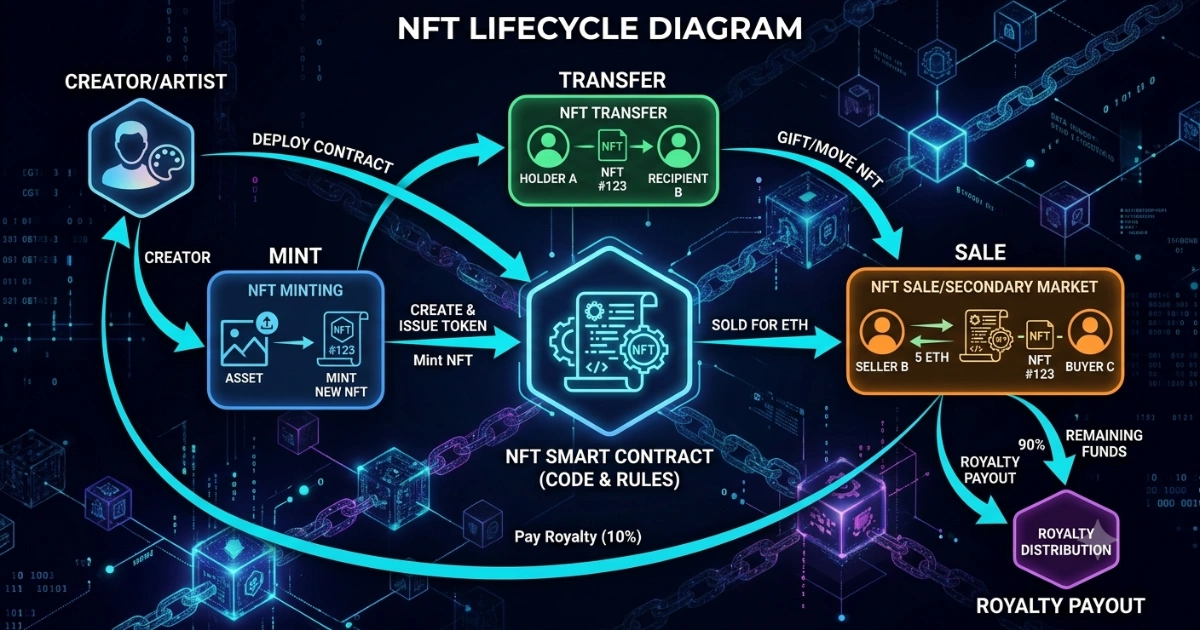
A smart contract is a program stored directly on a blockchain that runs automatically when predefined conditions are met. In the context of NFTs, the smart contract defines every rule governing a token from the moment it is minted to every transfer that follows. There is no company, platform, or person needed to verify or approve these actions. The code does it.
When you mint an NFT, the smart contract creates a unique token ID, assigns it to your wallet address, stores or references the metadata (image, description, attributes), and records the transaction permanently on-chain. When you sell that NFT, the contract verifies the transaction, transfers ownership to the buyer’s wallet, and – if properly configured – sends royalty payments to the original creator. All of this happens automatically.
Four core functions define what an NFT smart contract controls:
- Minting: Creating new tokens and assigning them unique IDs tied to metadata stored on IPFS or a similar decentralized system.
- Ownership verification: Maintaining an immutable record of who holds each token at any point in time.
- Transfer rules: Defining whether a token can be freely transferred, sold only through specific platforms, or moved only when certain payment conditions are met.
- Royalty logic: Specifying what percentage of each future sale should be sent back to the creator – and whether that payment can be skipped.
The Token Standards Behind NFT Smart Contracts
Not all NFT smart contracts are the same. On Ethereum, the rules a contract follows are defined by a token standard – a set of technical specifications developers agree to implement so that NFTs work consistently across wallets, NFT marketplaces, and applications. The two most widely used are ERC-721 and ERC-1155.
ERC-721: The Original NFT Standard
ERC-721 was introduced in 2018 and established the foundation for non-fungible tokens on Ethereum. Each token minted under this standard is completely unique with its own token ID and metadata. No two ERC-721 tokens are interchangeable, which is what makes them suitable for one-of-a-kind digital art, certificates, or collectibles.
The drawback is efficiency. Under ERC-721, every single transfer requires its own transaction, meaning sending ten NFTs at once costs ten separate gas fees. For large collections or gaming applications managing thousands of assets, this becomes expensive quickly. CryptoKitties – built on an early version of ERC-721 – became so popular in December 2017 that it congested the entire Ethereum network, demonstrating both the standard’s reach and its scaling limits.
Check out also: Top 25 NFT Marketplace Development Companies
ERC-1155: Multi-Token Flexibility
ERC-1155 was developed by Enjin to solve ERC-721’s efficiency problem. A single ERC-1155 contract can manage multiple token types simultaneously – fungible tokens, non-fungible tokens, and semi-fungible tokens all within the same deployment. This makes it significantly more cost-effective for gaming projects, editions, and any project managing a large variety of asset types.
The batch transfer capability is the most practical difference: instead of ten separate transactions, you can transfer ten different NFTs in a single call. ERC-1155 tokens are also considered somewhat more secure because all assets sit within a single contract rather than being spread across individual ones. A flaw in one ERC-721 contract puts only that collection at risk. A flaw in an ERC-1155 contract could affect every token type stored there – the flip side of centralized management.
How the Two Standards Compare
| Feature | ERC-721 | ERC-1155 |
| Token type | Non-fungible only | Fungible, non-fungible, semi-fungible |
| Tokens per contract | One collection per contract | Multiple types in one contract |
| Gas efficiency | Lower (one tx per transfer) | Higher (batch transfers supported) |
| Best use case | 1-of-1 art, rare collectibles | Gaming items, editions, mixed assets |
| Security profile | Isolated per contract | Centralized, simpler to audit |
Solana: A Different Architecture
Solana NFTs operate on a separate technical framework. The dominant standard has historically been Metaplex Token Metadata, but in 2025 the ecosystem has largely shifted toward Metaplex Core for new projects. Core uses a single-account design that reduces minting costs by over 80% compared to the previous standard – approximately 0.0029 SOL per mint versus 0.022 SOL. It also includes enforced royalties by default through an allowlist and denylist system, something Ethereum-based standards have struggled to achieve consistently.
NFT Royalties: The Promise vs. the Reality of Smart Contract Enforcement
Royalties are one of the most-discussed features of NFT smart contracts – and one of the most misunderstood. The basic idea is straightforward: every time an NFT is resold, the original creator receives a percentage of the sale price automatically. In practice, whether this actually happens depends heavily on where the sale takes place and which standard the contract uses.
How ERC-2981 Works and Why It Is Not Enough
ERC-2981 is the Ethereum royalty standard adopted across most major NFT marketplaces. It works by embedding a function called royaltyInfo(tokenId, salePrice) into the smart contract. When a marketplace processes a sale, it can query this function to determine who should receive royalties and how much. The standard integrates with ERC-165, which lets marketplaces detect whether a contract supports royalty information at all.
The critical limitation: ERC-2981 signals royalty intent but does not enforce payment. Marketplaces can query the function and simply choose not to honor it. As of 2024-2025, adoption of ERC-2981 is widespread, but enforcement remains fragmented. Some platforms honor the full royalty, some cap or reduce it, and some ignore it entirely. OpenSea’s 2023 decision to end its Operator Filter – which had previously restricted trading to royalty-enforcing platforms – accelerated this fragmentation.
A developer in a Reddit thread on ethdev put it plainly: royalties at the smart contract level cannot reliably distinguish between a genuine sale and a wallet-to-wallet transfer. If someone transfers an NFT to their own secondary wallet, should they pay a royalty? If the answer is no, then anyone can call any sale a transfer and route around the royalty. If the answer is yes, users get charged for moving their own assets. There is no clean technical solution to this dilemma under ERC-2981.
The Wrapping Problem
One of the more technically sophisticated workarounds discussed in the developer community is NFT wrapping. A buyer purchases an NFT normally, then deposits it into a separate smart contract – a wrapper – and trades ownership of that wrapper contract instead of the NFT itself. The underlying NFT never formally changes hands on the original contract, so no royalty is triggered.
Preventing this at the contract level is possible in theory – for example, by blocking transfers to addresses that have associated code or have never sent a transaction. But as one developer noted in the Reddit thread: you can pre-calculate what address a contract will deploy to before actually deploying it, transfer the NFT to that address, and then deploy the contract afterward. This means even address-based checks have gaps.
Blockchain-Level vs. Marketplace-Level Enforcement
The important distinction, and one that created genuine confusion in the Reddit discussions, is between royalties enforced at the marketplace level and royalties enforced at the blockchain level.
Most NFTs in existence use marketplace-level royalties. The NFT contract itself contains no royalty logic – instead, the marketplace smart contract handles payments when a sale goes through its interface. If the NFT is transferred outside that marketplace, or on a platform that does not honor the royalty data, no royalty is paid. This is how the majority of NFTs on OpenSea and similar platforms work.
Blockchain-level enforcement means the royalty logic lives in the NFT contract itself. A transfer cannot be completed without the royalty being paid – the transaction will revert if the required amount is not included. This approach solves the enforcement problem but creates a new one: every transfer, including moving an NFT to your own second wallet, triggers the royalty payment. One Reddit commenter responded to this point simply: that is not cool.
ERC-721C: The Newer Enforcement Standard
ERC-721C (Creator Token Standards) was developed by Limit Break as an attempt to solve the royalty enforcement problem more definitively. It works by restricting which platforms and contracts are allowed to transfer the NFT – only operators on an allowlist can move it. This effectively blocks sales on marketplaces that do not honor royalties.
The trade-off is real: ERC-721C introduces centralized control over who can interact with the token. Not all marketplaces support it. Creators using it must actively manage which platforms are allowed, and users may find their NFTs incompatible with platforms they want to use. The standard is most practical for gaming projects and collectible creators who control the ecosystem around their tokens.
Read also: Blockchain Development: The Complete Guide
Minting NFTs from a Smart Contract: Key Decisions for Creators
Should You Pre-Mint or Let Buyers Mint?
One of the most common questions from new NFT developers is whether to mint the entire collection before listing or let buyers mint tokens themselves. The community consensus is clear: lazy minting or buyer-side minting is almost always preferable because it shifts gas costs to the buyer at the time of purchase rather than requiring the creator to pay upfront for every token.
The exception is specific use cases where all tokens need to exist on-chain before trading begins, such as certain game asset systems. In those cases, batch minting functions can reduce gas costs compared to minting one at a time, but the creator still bears the cost of the entire collection at launch.
Metadata and the Delay Reveal Mechanic
Using sequential numbers as token IDs is standard practice and is visible on-chain – which means anyone can technically discover all tokens before a mint is complete. For projects with random trait assignment (common in PFP collections), this creates a problem: buyers could game the system by viewing the metadata for unclaimed IDs and selectively minting the rarest ones.
The solution is the delay reveal mechanic. Metadata is initially hidden – replaced by a placeholder URI – and only revealed after the mint is complete. The token URI for all metadata is updated in a single transaction post-mint, making it impossible to preview traits before they are locked in. Once the URI is set and the contract is locked, it cannot be modified.
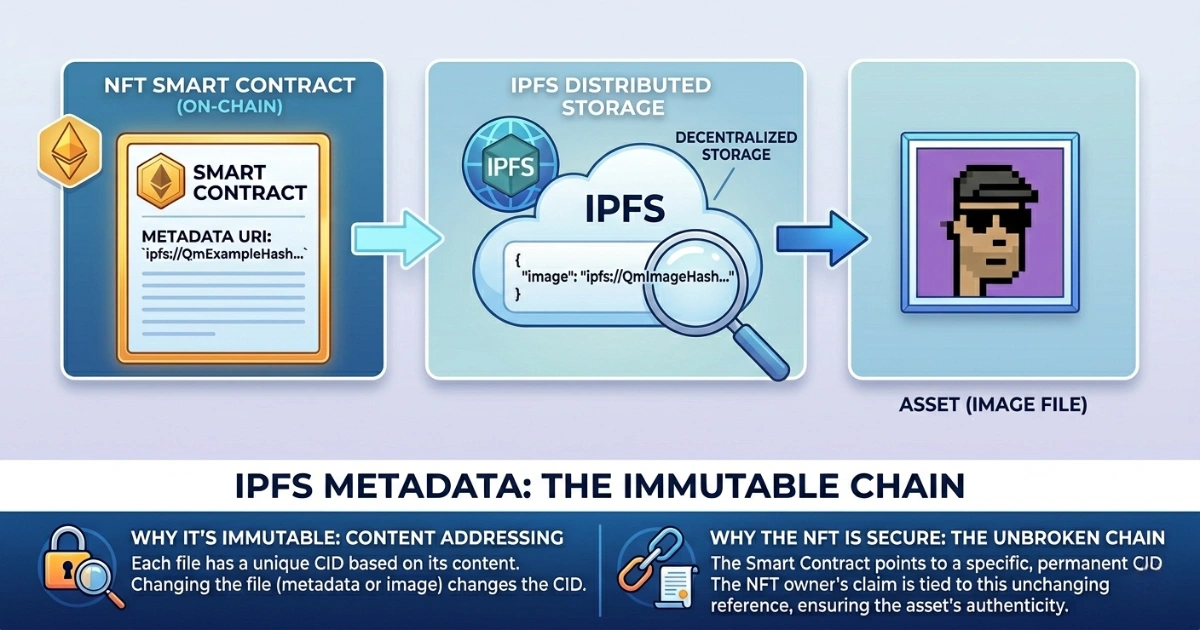
Metadata itself is typically stored on IPFS, which generates a content-based hash for each file. Once this hash is embedded in the contract, the metadata is effectively immutable – changing the file would change the hash, and the contract would no longer point to it.
Stablecoins and Royalty Currencies
A question that surfaces occasionally from artists is whether royalties can be paid in stablecoins instead of ETH. The technical answer is yes – a smart contract can be written to accept and distribute royalties in any ERC-20 token. In practice, most NFT contracts and marketplaces default to the native chain currency (ETH on Ethereum, SOL on Solana) because it is the simplest implementation and avoids requiring an additional token approval step from buyers.
Custom royalty currencies are possible but require custom contract development and marketplace support. Off-the-shelf standards like ERC-2981 do not natively specify a currency – the royalty amount is returned as a value in the same currency as the sale price.
No-Code and Low-Code Options for NFT Smart Contract Deployment
Not every creator needs to write Solidity or Rust. A growing range of platforms offer prebuilt, audited smart contracts that can be deployed with minimal or no coding.
On Ethereum and EVM Chains
OpenZeppelin Contracts provides the most widely used open-source library for ERC-721 and ERC-1155 smart contracts. Developers can inherit from OpenZeppelin’s audited base contracts and add their own logic. It is not no-code, but it significantly reduces the amount of Solidity that needs to be written from scratch.
iMintify is a no-code platform that offers one-click deployment of audited ERC-721 and ERC-1155 contracts across Ethereum and other EVM-compatible chains. All contracts on the platform have been audited by 0xMacro, which provides a baseline security guarantee.
For developers with some coding experience, the pattern recommended in the Reddit discussions is deploying contracts via frameworks like Hardhat or Truffle with OpenZeppelin as a dependency. Deploying and verifying a basic ERC-721 contract can be done in under an hour with these tools, even by developers who are new to Solidity.
On Solana
Metaplex is the primary framework for Solana NFT development and offers tools ranging from developer SDKs to higher-level abstractions. The Candy Machine program handles NFT collection launches including minting queues, whitelist functionality, and reveal mechanics. Metaplex Core, the newer standard, has audited smart contracts deployed on Solana mainnet and can be accessed via the Metaplex JavaScript SDK without writing on-chain Rust code.
The Candy Machine’s Solana smart contracts have been audited by Sec3, and Core contracts are production-ready. For creators who want a Solana NFT collection without touching Rust, Metaplex’s tooling is currently the closest to a no-code solution the ecosystem offers.
Mint Commission vs. Royalty: Understanding the Difference
A source of confusion in the Reddit discussions was conflating two different revenue mechanisms: mint commissions and secondary sale royalties.
A mint commission is a one-time fee charged to users who want to mint NFTs using a deployed smart contract. The contract owner sets this fee at deployment. If the commission is set to 1 MATIC, any user who wants to mint on that contract pays 1 MATIC to the contract owner. The owner can mint for free. This is a deployment-time revenue mechanism.
A royalty is a percentage of every subsequent resale that goes back to the original creator. These are two separate systems and are tracked separately. A contract can have both, either, or neither.
Security Considerations for NFT Smart Contracts
Security is non-trivial for NFT contracts that will hold or transfer real value. According to research published by MoldStud in June 2025, approximately 70% of vulnerabilities in blockchain applications stem from insufficient code review during development. Projects audited by professional auditors experience roughly a 50% reduction in security incidents post-launch compared to unaudited projects.
The most common vulnerability classes in NFT contracts include:
- Reentrancy attacks: Where an external contract calls back into the original contract before the first execution completes, potentially draining funds or minting unauthorized tokens.
- Access control flaws: Missing or improperly configured ownership modifiers that allow unauthorized addresses to mint, burn, or transfer tokens.
- Unlimited minting vulnerabilities: Logic errors that allow users to mint more tokens than the collection permits.
- Front-running: Exploiting the public mempool to predict and intercept transactions before they confirm.
Automated tools like Slither and MythX can detect roughly 92% of known vulnerability classes in test environments, according to coinlaw.io’s 2025 security audit statistics. But they miss edge-case logic issues, which is why manual review by experienced auditors remains necessary for any contract handling significant value.
For smaller projects or creators using prebuilt contracts, the most practical security step is to use contracts that have already been independently audited – OpenZeppelin, Metaplex Core, and iMintify’s templates all fall into this category.
Frequently Asked Questions
An NFT smart contract is a program stored on a blockchain that defines the rules for a specific NFT collection. It controls who can mint tokens, who owns which token, how transfers work, and whether royalties are paid on resales. Once deployed, it runs automatically without needing a company or intermediary to manage it.
True on-chain enforcement is technically possible but comes with trade-offs. ERC-2981, the most widely used royalty standard, signals creator intent but does not force payment – marketplaces can ignore it. Newer approaches like ERC-721C (Creator Token Standards) and Metaplex Core on Solana offer stronger enforcement by restricting which platforms can process transfers, but this limits where the NFT can be traded and introduces centralized allowlist management.
ERC-721 creates one unique token per ID – ideal for 1-of-1 art and rare collectibles. ERC-1155 lets a single contract manage multiple token types at once, including both fungible and non-fungible tokens, and supports batch transfers that reduce gas costs significantly. ERC-1155 is generally better for gaming and large collections; ERC-721 is the standard choice for unique digital art.
Under most existing contracts using ERC-2981, no – royalties are only triggered when a sale goes through a marketplace that honors them. Under contracts with forced on-chain royalties (such as certain custom implementations or ERC-721C), yes – any transfer including to your own wallet can trigger the royalty requirement. This is a genuine limitation: there is no reliable technical way to distinguish a sale from a personal transfer on-chain.
Layer 2 networks like Polygon, Arbitrum, and Base offer significantly lower deployment and minting costs compared to Ethereum mainnet. On Solana, Metaplex Core reduces minting costs to approximately 0.0029 SOL per token. For Ethereum-compatible chains, using prebuilt OpenZeppelin contracts with a tool like Hardhat minimizes the gas spent on contract logic.
For any contract handling real monetary value, yes. Unaudited contracts carry significantly higher risk of exploit. If using a prebuilt contract from OpenZeppelin, iMintify, or Metaplex, the core code has already been audited – though any customization you add introduces new risk. Projects building custom royalty logic, complex minting mechanics, or staking systems should commission an independent audit before mainnet deployment.
It depends on how the contract is written. Contracts that store metadata on IPFS using a content-based hash effectively make metadata immutable – changing the file changes the hash, breaking the link. Some contracts allow the metadata URI to be updated by the contract owner, which makes tokens semi-mutable. Fully immutable contracts lock the URI permanently at mint time or after a reveal, and cannot be altered even by the creator.

Stefan is the founder of Blockchaindose and a long-time tech enthusiast who first dove into crypto back in 2012, starting out by mining his first coins on graphics cards. Over the years, he shifted gears into active trading and investing. Today, his main focus is driving the platform forward and showing people how crypto can actually be used in the real world—beyond just the speculation.
That blend of early-adopter roots, hands-on market experience, and a practical vision makes his perspective a solid anchor for the team.