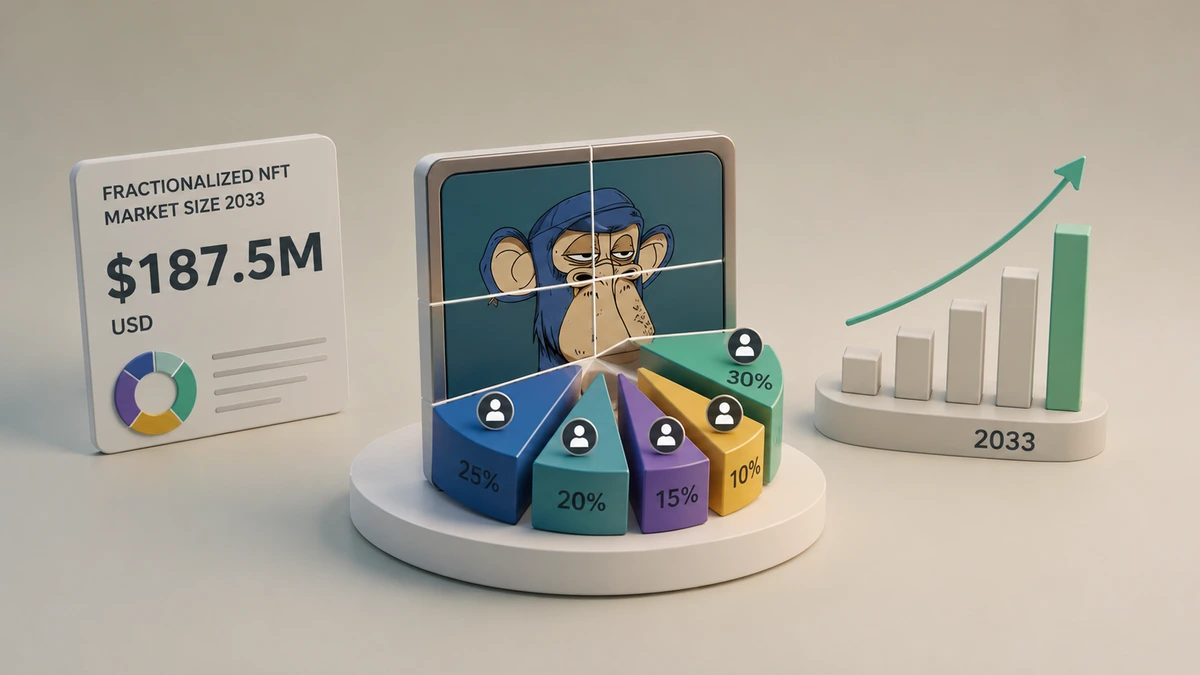
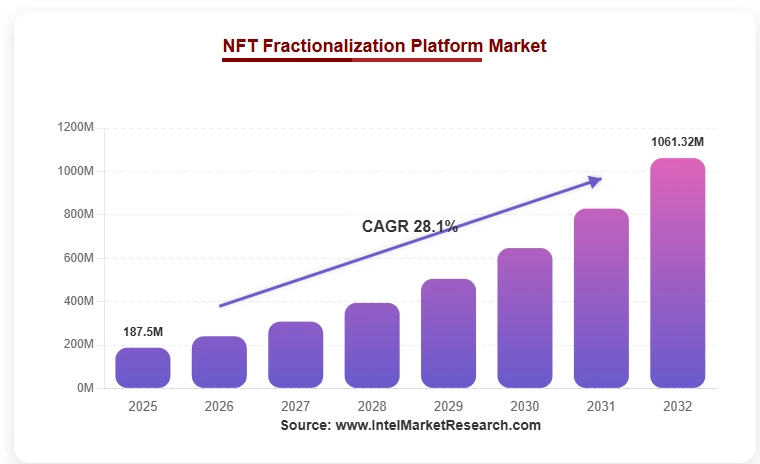
Breaking high-value NFTs into ERC-20 tokens created a new market segment. In 2025, it reached $187.5 million USD. Projections suggest $1.67 billion USD by 2034, with 28.1% annual growth. Compared to Bitcoin ($1.3 trillion) or global bond markets ($130 trillion), fractionalized NFTs remain a small asset class, exhibiting 62-78% annual volatility and behavior correlated with overall risk cycles.
An NFT valued at 100 ETH faces a practical barrier: only wealthy investors can purchase it outright. Once split into 10,000 tokens of 0.01 ETH each, the pool of potential buyers expands significantly.
Platforms like Raydium (Solana) operate smart contract vaults. Original NFTs sit in the vault. Fractional tokens distribute as ERC-20 claims. An Automated Market Maker (AMM) enables continuous trading of fragments without requiring bilateral buyer-seller matching.
Cost structure is straightforward: annual custody (0.5-2%), DEX trading fees (0.25-1%), redemption fees (1-3%). Vault operators earn 180-320 basis points annually—comparable to traditional alternative asset funds.
Head-to-Head Comparison: Is NFT Fragmentation a Store of Value?
Different assets carry the label “store of value.” Reality: they function very differently.
| Criterion | Bitcoin | Physical Gold | Fractionalized NFTs |
|---|---|---|---|
| Scarcity | 21M maximum (hard-coded) | Finite supply | Dependent on underlying NFT |
| 30-day Volatility | 35-42% annually | 8-12% annually | 62-78% annually |
| Liquidity (bid-ask) | <0.02% | 0.5-1.5% | 2-6% |
| Total Market Cap | $1.3 trillion | $700 billion | $3.8 billion |
| Correlation with Market Downturns | -0.18 (rises when markets fall) | -0.12 (rises when markets fall) | +0.62 (falls with markets) |
| Historical Track Record | 17 years | Millennia | <4 years |
Bitcoin and gold move opposite to equity crashes—defensive assets. Fractionalized NFTs move with equity crashes, like speculative stocks. NFT volatility exceeds gold by 7 times. A difference that magnitude defines functioning under stress.
Current NFT Fragmentation Market Data
Daily aggregate volume in fractionalized NFT trading ranges between $68 and $124 million USD. Raydium (Solana) processes $48-78 million, and secondary platforms generate $8-15 million. For perspective: Bitcoin moves $28-32 billion daily. Fractionalized NFTs represent 0.22-0.44% of that volume.
Participant composition reveals who actually buys. Retail speculative traders control 62-68% of activity, small hedge funds are 18-24%, large institutions represent barely 2-4%, and professional market makers close with 8-12%. Institutions—pension funds, wealth managers, investment banks—are almost entirely absent. BlackRock and Vanguard have zero positions.
Real Use Cases: Beyond Collectibles
In May 2025, Dubai Land Department launched PRYPCO Mint. A single commercial property became fractional tokens. Results were immediate: 224 investors from 40+ countries purchased within less than 24 hours, with average investment of $2,900 USD and minimum of $540 USD. A second property sold in less than 2 minutes.
Operational frictions emerged. DEX spreads reached 8-15%, higher than traditional real estate markets. Speed improved significantly—conventional closings take 60-120 days. Dubai projects its real estate tokenization market will reach $15 billion USD by 2030.
Music Streaming Rights Tokenization
Electronic music producer fractionalized future royalty claims. He projected $180,000 USD annual royalties, issued 18,000 tokens at $10 per token, and retained artistic control completely. Expected investor return: 7-9% annually. No bank involvement. Trade-off: low secondary market liquidity and absence of institutional support.
Institutional Treasury Tokens
Ondo Finance tokenized U.S. Treasury bonds. By April 2026, managed $3.015 billion USD in total value locked. Main product (OUSG) reached $692 million with 3.49% APY. Institutional clients include Goldman Sachs, BlackRock, Fidelity, and Franklin Templeton.
In January 2026, Ondo launched 200+ U.S. stocks tokenized. Access for international investors previously blocked from direct U.S. equity purchase. SEC approved in 2025 for broker-dealers to use blockchain for securities settlement—first federal regulatory authorization.
Why Fractionalized NFTs Aren’t Stores of Value
A Bored Ape purchased in November 2021 at 120 ETH sold in 2026 at 7.65 ETH. Loss: 93.6%. Fragments inherit underlying asset volatility. Additionally, attempting to sell $500,000 USD in fragments causes 15-25% slippage due to constrained order book depth. Correlation with risk appetite is strong: when investors flee speculative assets, fractionalized NFTs drop first.
Bitcoin dropped 80% in 2022, recovered completely by 2024. Fractionalized NFTs remain depressed with no visible recovery trajectory. Contrast defines real functioning under market stress.
Three Unresolved Problems
A single smart contract holds original NFTs. A hack vaporizes fragment value. Parity MultiSig lost $30 million in 2017, dYdX lost $100 million in 2022, and Raydium suffered a $4.4 million exploit in June 2026. Audits reduce risk but cannot eliminate it.
Unlike Bitcoin (millions of equivalent units), fractionalized NFT markets divide into thousands of tiny markets. Average order book depth: <$100,000 USD. Typical spreads: 2-6%. Attempting to exit $1 million USD position results in 20%+ loss. Liquidity fragmentation is structural with no solution in sight.
Financial regulators (SEC in U.S., FCA in U.K., BaFin in Germany) have not defined legal status of fractionalized tokens as securities. Raydium and similar platforms operate in a gray zone. Future clarity could mandate removal of unauthorized tokens from unregulated venues.
NFT Market Projections: Reality Without Oversimplification
Single projections of “$9.2 billion by 2033” oversimplify and obscure variability. Realistic scenarios require breakdown.
A base case with 60% probability envisions annual growth of 15-18%, reaching $8.2-9.8 billion by 2033. That assumes continued retail adoption and ongoing collection fragmentation, but volatility persists, institutions avoid the sector, and regulators remain cautious. Limitations are structural, not transitory. A bull case with 25% probability visualizes annual growth of 28-35%, resulting in $27-38 billion.
That requires massive real-world asset integration, sudden institutional adoption, and regulatory clarity—multiple conditions must converge simultaneously, reducing probability. A bear case with 15% probability projects annual change of -8% to +3%—contraction or stagnation.
Market size in 2033 would be $2.1-4.0 billion. Catalysts include regulatory prohibition or custody fraud collapse. Precedent: general NFT markets fell 95% from 2021-2022 peaks.
Realistic range spans $2.1 billion to $38 billion under different regulatory regimes. Reduction to single figures is academically dishonest.
Bitcoin Isn’t Being “Superseded”
Bitcoin and fractionalized NFTs solve different problems. Bitcoin: deflationary store of value. Hard cap of 21 million, cannot be printed, globally recognized, network of 40 million+ active addresses, predictable cycles without permanent collapse.
Accurate classification places fractionalized NFTs as alternative investment vehicles (similar to contemporary art, fine wines, rare collectibles), not Bitcoin or bond replacements. Appropriate portfolio allocation: 2-5% maximum for sophisticated investors.

Isai Alexei is a journalist and financial analyst covering cryptocurrency markets and traditional securities for Blockchaindose. He has spent ten years analyzing digital assets, trading activity, and market structure.