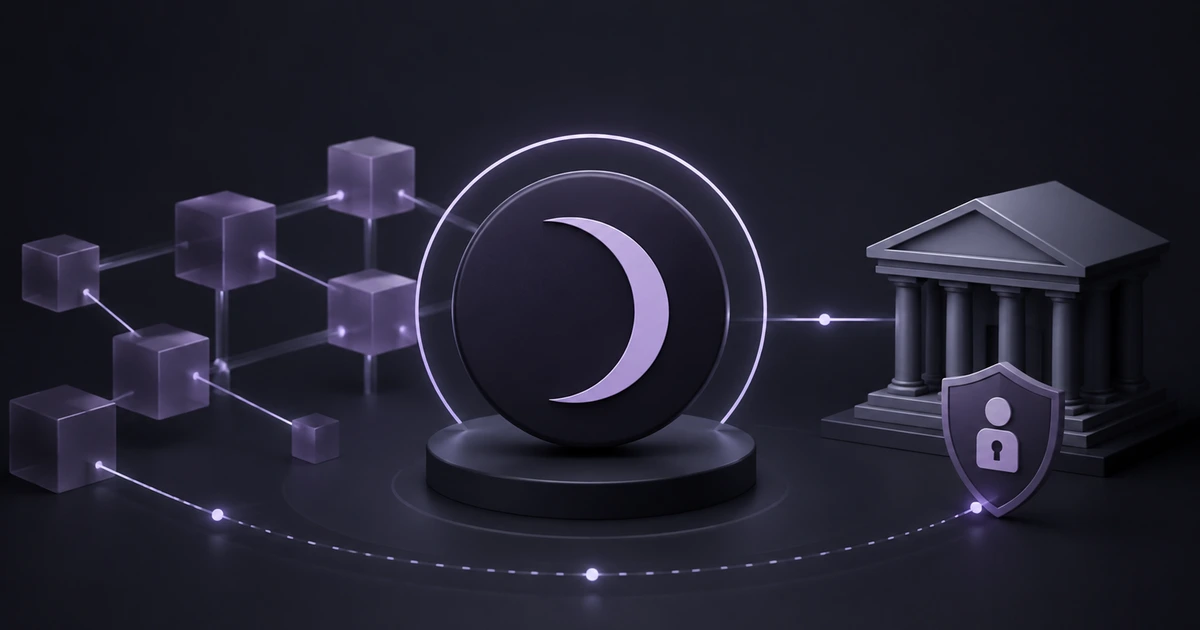
Dusk Network blockchain is built on the premise that most privacy blockchains misjudge: institutions moving real securities on-chain do not want full anonymity; they want confidentiality that regulators can still access when required. Six years into development, Dusk pairs zero-knowledge cryptography with an EVM-compatible execution layer aimed squarely at tokenized, regulated financial markets.
Key Takeaways
- Dusk’s base Layer-1 (DuskDS) mainnet launched January 7, 2025, after six years of development, followed by its DuskEVM execution layer going live in the second week of January 2026.
- Dusk’s core partnership is with NPEX, a licensed Dutch trading venue, which has tokenized roughly €300 million in traditional securities onto the blockchain through the DuskTrade platform.
- Despite these institutional partnerships, Dusk’s on-chain total value locked sat below $1 million as of April 2026 – a real gap between announced partnerships and measurable on-chain activity.
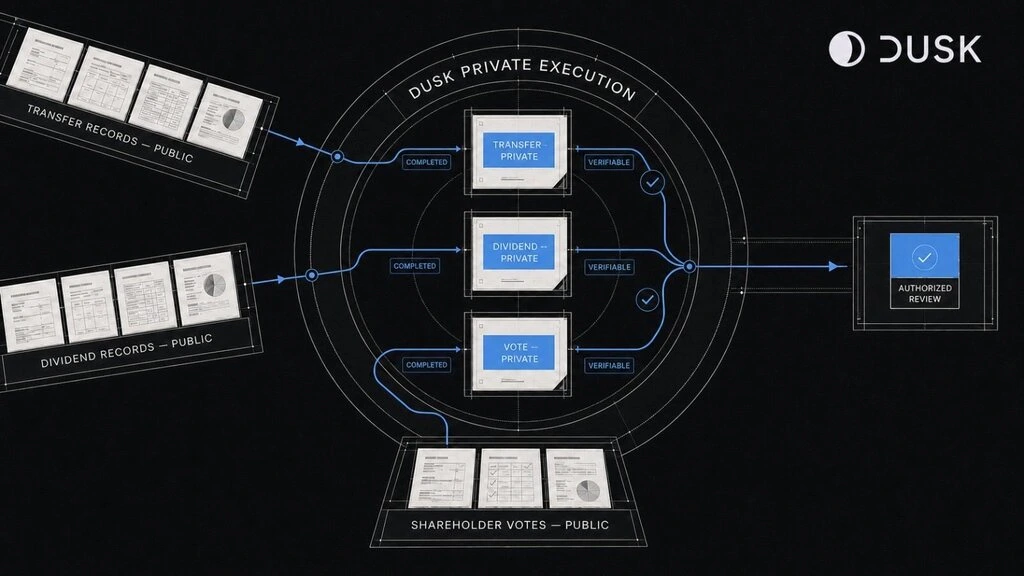
- Dusk uses “auditable privacy” rather than full anonymity: transactions are private by default, but authorized regulators can be granted access through selective disclosure.
- A January 2026 Chainlink CCIP integration and a March 2026 network upgrade (Boreas / Rusk v1.7.0) were both aimed at improving cross-chain settlement and readiness for DuskEVM.
The guide explains how Dusk’s privacy-and-compliance architecture works, compares its approach to Secret Network, Midnight, and other privacy chains using community debate, examines the gap between institutional partnerships and on-chain usage, and closes with the project’s status in 2026.
What Is Dusk Network Blockchain?
Dusk Network blockchain is a Layer-1 built specifically for regulated finance: tokenized securities, compliant DeFi, and real-world asset settlement, rather than general-purpose smart contracts or anonymous payments. Its base consensus and data-availability layer, DuskDS, launched mainnet on January 7, 2025, the culmination of six years of development. A second, EVM-compatible execution layer called DuskEVM followed roughly a year later, going live in the second week of January 2026 and letting developers deploy ordinary Solidity contracts while still settling to DuskDS underneath.
Dusk’s flagship real-world use case runs through NPEX, a licensed Dutch trading venue holding Multilateral Trading Facility, broker, and clearing-related licenses. Through the DuskTrade platform, NPEX has tokenized roughly €300 million worth of traditional securities onto Dusk, giving the project one of the more concrete institutional deployments among privacy-focused chains.
The full breakdown of how Dusk actually combines privacy with regulatory access – its layered architecture and the Hedger component – follows in the next section.
How Dusk’s Privacy and Compliance Architecture Works
Dusk runs a three-layer modular stack. DuskDS handles consensus, data availability, and final settlement. DuskEVM is the execution layer where developers write and deploy smart contracts using standard Solidity tooling such as Hardhat and Foundry. A planned third layer, DuskVM, is reserved for heavier, privacy-specific applications that need more than what the EVM layer can offer.
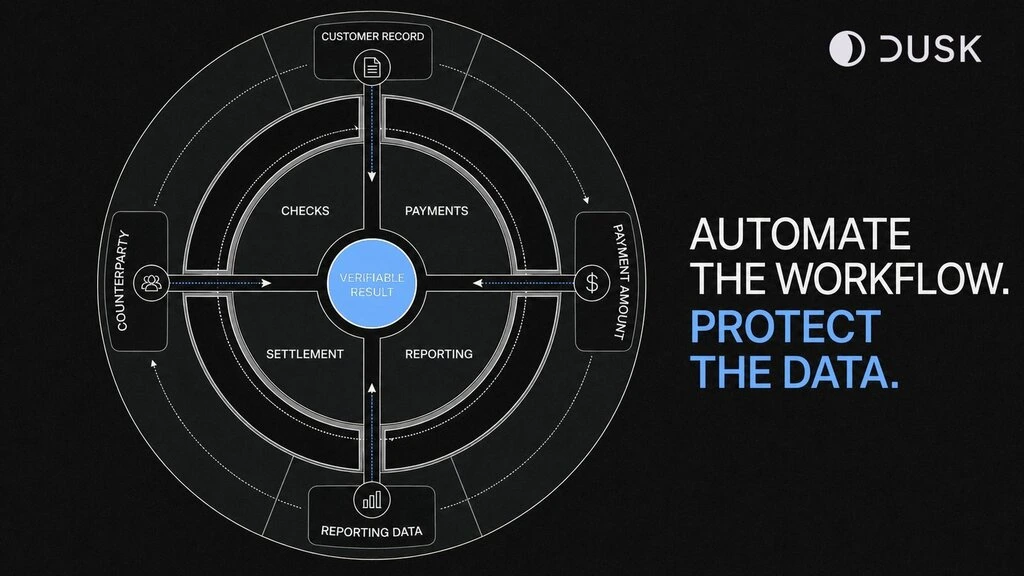
Privacy on Dusk comes from a component the team calls Hedger, which combines zero-knowledge proofs with homomorphic encryption to keep transaction data opaque to outside observers while still allowing authorized regulators to access it for auditing. Security tokens issued through the system follow a compliance-focused token specification (the project calls it Zedger) designed to encode securities-law rights and duties, such as read-only regulator access or the ability to reject a transaction before it settles, into the token standard itself rather than adding compliance as a secondary addition.
Dusk vs Other Privacy Blockchains
Community debate over Dusk’s technical approach versus other privacy chains goes back years and remains useful context. In discussions comparing Dusk to Secret Network, the core disagreement centers on trusted hardware versus standalone cryptography: Secret Network’s TEE-based design was defended as fast and capable of general-purpose computation today, while Dusk’s zero-knowledge approach was argued to avoid the vendor lock-in, undocumented APIs, and hardware-vulnerability risks that come with trusting a chipmaker’s secure enclave.
Dusk’s own team has publicly argued that TEE technology was designed for simpler use cases like DRM and contactless payments, not for securing hundreds of millions of dollars of decentralized, general-purpose computation.
Midnight Network, built by the engineering team behind Cardano, has emerged as another zero-knowledge competitor in the same regulated-privacy niche, using recursive zk-SNARKs and viewing keys that let regulators or counterparties selectively see transaction details while the rest of the network sees nothing. Oasis Network, which uses secure enclaves similarly to Secret Network, has also been raised by community members as a comparison point for confidential DeFi specifically.
None of this makes one architecture strictly better across the board – it mostly comes down to whether a project values proven, hardware-backed speed today or a slower-maturing, hardware-free cryptographic approach for the long run.
|
Project |
Privacy Method |
Regulator Access |
Base Chain |
|
Dusk Network |
ZK proofs + homomorphic encryption (Hedger) |
Yes – selective disclosure |
Standalone L1 (EVM-compatible) |
|
Secret Network |
Intel SGX (TEE) |
Via viewing keys |
Cosmos SDK |
|
Midnight Network |
Recursive zk-SNARKs |
Yes – viewing keys |
Standalone L1 |
|
Oasis Network |
Secure enclaves (TEE) |
Limited |
Standalone L1 |
Among privacy-focused crypto projects, Dusk’s differentiator isn’t the cryptography alone but the years spent building compliance into the token layer for MiFID II and, more recently, MiCA-aligned securities markets — a narrower but more institution-ready focus than payment-privacy chains like Monero or Zcash.
Known Challenges: The Adoption Gap
Dusk’s biggest honest weakness right now isn’t technical – it’s the visible gap between its institutional story and measurable on-chain activity. Total value locked on Dusk sat below $1 million as of April 2026, despite a licensed exchange partnership tokenizing hundreds of millions of euros in securities. That mismatch suggests NPEX’s tokenized volume isn’t yet reflected in general DeFi-style usage of the chain, or that most institutional activity is happening in ways that don’t show up in typical TVL trackers.
Community perception reflects the disconnect. Long-time holders have openly asked why there’s so little public discussion of the project despite years of active development, with some framing the small community as a hidden opportunity and others treating it as a genuine warning sign.
It’s also worth noting that some of the most enthusiastic community predictions from Dusk’s early years, including claims it could reach a top-5 market capitalization once securities tokenization took off, look, with hindsight, like standard early-hype-cycle overreach rather than realistic targets – Dusk’s market cap in 2026 sits in the tens of millions of dollars, not the tens of billions that would be required for that kind of ranking.
Dusk’s Institutional and Regulatory Angle
Dusk has pursued a crypto regulations-first strategy aimed at Europe’s MiCA framework, positioning itself as a compliant infrastructure layer rather than a privacy-at-all-costs alternative. A Chainlink CCIP integration announced around the turn of 2026 is meant to let tokenized securities on Dusk settle across other EVM chains, and reporting has also linked Dusk to 21X, a separate DLT Pilot Regime trading venue in the EU, as an early trade participant.
This regulatory-first focus places Dusk squarely in the Real-World Asset (RWA) category of crypto projects, alongside a general network upgrade cadence, including the Boreas Protocol Upgrade (Rusk v1.7.0) activated on testnet in March 2026, aimed at improving resource accounting and client compatibility ahead of greater DuskEVM adoption. Holders can also delegate DUSK through Hyperstaking, a programmable staking system advertised at around 12% APY, though, as with any staking yield, that rate is subject to change as network participation grows.
Is Dusk Network Worth Watching in 2026?
Dusk Network’s pitch is one of the more institution-specific stories in privacy crypto: a licensed European exchange partner, a compliance-first token standard built for securities law, and a genuine multi-year head start on regulatory relationships that newer competitors like Midnight are still building. DuskEVM’s arrival lowers the barrier for existing Ethereum developers to build on the infrastructure, which the project needed after years of niche, hard-to-adopt tooling.
Whether that translates into real on-chain usage remains an open question. Sub-$1 million TVL alongside hundreds of millions in tokenized securities is either a sign that institutional volume lives off-chain or a warning that the announced partnerships haven’t yet turned into active usage of the Dusk Network blockchain itself. Investors and developers evaluating Dusk in 2026 should consider its real regulatory head start against the unproven adoption curve.
FAQ
Is Dusk Network the same as Secret Network?
No. Both aim to support private smart contracts, but Secret Network uses Intel SGX trusted hardware enclaves, while Dusk uses zero-knowledge proofs combined with homomorphic encryption and doesn’t depend on specialized hardware. Dusk is also built specifically around regulated securities use cases rather than general-purpose private computation.
What is DuskEVM?
DuskEVM is Dusk Network’s Ethereum Virtual Machine-compatible execution layer, letting developers deploy standard Solidity smart contracts using familiar tools like Hardhat and Foundry while still settling to Dusk’s underlying DuskDS consensus layer. It launched in the second week of January 2026.
Does Dusk Network have meaningful on-chain activity?
As of April 2026, Dusk’s tracked total value locked was below $1 million, despite a partnership with the licensed Dutch exchange NPEX tokenizing roughly €300 million in securities. This gap between institutional partnerships and general on-chain usage is a genuine open question for the project.
What is NPEX and why does it matter for Dusk?
NPEX is a licensed Dutch trading venue holding Multilateral Trading Facility and broker licenses. Its DuskTrade partnership with Dusk Network has tokenized roughly €300 million worth of traditional securities, giving Dusk one of the more concrete real-world institutional deployments among privacy-focused blockchains.
Is Dusk Network fully anonymous like Monero?
No. Dusk uses what it calls auditable privacy: transactions are private by default, but the underlying token standard can grant authorized regulators read-only access, which is a deliberate design choice aimed at institutions rather than at maximum anonymity.
What is Hyperstaking?
Hyperstaking is Dusk’s programmable staking system, allowing customized staking logic for delegators and validators, advertised at around 12% APY as of early 2026, though actual rates can change as network participation and emission schedules evolve.

Isai Alexei is a journalist and financial analyst covering cryptocurrency markets and traditional securities for Blockchaindose. He has spent ten years analyzing digital assets, trading activity, and market structure.