The NFT metaverse was pitched as the next version of the internet, and the gap between that pitch and what exists today is the most useful thing a newcomer can understand about it. The idea underneath it – blockchain-based digital ownership – does work as described. Whether virtual worlds ever needed it is a separate question, and a fairer one.
Key Takeaways
- Meta’s Reality Labs has lost $73 billion since 2021, and the company came within a day of switching Horizon Worlds off in VR before reversing the decision in March 2026.
- A Sandbox estate bought for about $450,000 in December 2021 now prices at roughly $1,025 on a floor-equivalent basis, a drawdown of about 99.8%.
- Across the first three quarters of 2025, NFT sales counts rose 158% while the number of trading wallets grew only 28.6% – existing holders trading more, not new buyers arriving.
- Virtual land scarcity is a policy choice, not a physical constraint, which is the structural flaw most retail buyers were never shown.
- The strongest surviving use case is tokenized real-world collectibles, not virtual real estate.
This guide explains how the core technology works, what happened to virtual land valuations, where blockchain ownership still earns its place, and how to judge a project before committing money to it.
What the NFT Metaverse Was Supposed to Solve
The premise was simple. In a conventional online world, your items live in a company’s database. If the company shuts the servers down, your inventory goes with them. Recording ownership on a public blockchain was meant to fix that: the asset outlives the platform, and, in principle, could be transferred from one environment to another.
The most expensive test of the broader idea did not involve NFTs at all. Facebook renamed itself Meta in 2021, and its Reality Labs division has lost $73 billion since. In March 2026 the company said Horizon Worlds would drop VR support entirely, then reversed that decision within a day when CTO Andrew Bosworth confirmed the app would keep working in VR. The mobile version has passed 45 million downloads, yet total consumer spending inside it sits near $1.1 million – a rounding error against what the division has burned.
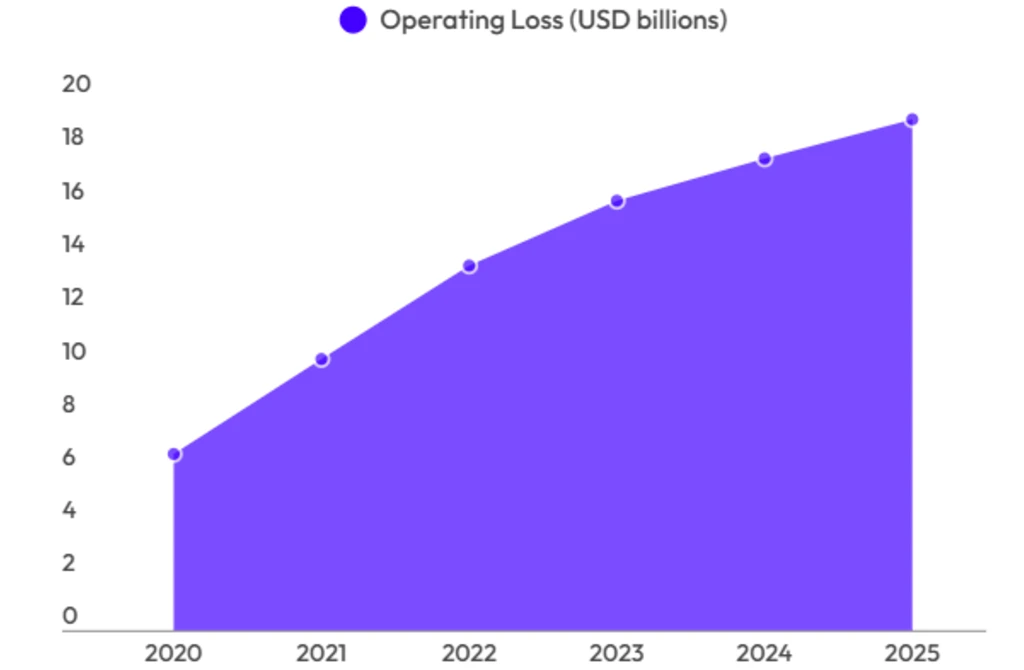
That shift is worth noting, because it contradicts the simplest version of both stories. The product wasn’t shut down. What came to an end was the corporate conviction behind it. The headlines announcing the end of the metaverse referred to a shift in strategy toward AI, not to a server being taken offline.
Blockchain-native worlds ran the same experiment with less capital and reached a similar place, which is where the numbers get specific.
How the Technology Actually Works
Almost every NFT you will encounter follows ERC-721, formalised as EIP-721 in January 2018. It is a deliberately small specification: a contract tracks which address owns which token ID, and exposes a standard interface so any wallet, marketplace or auction app can handle any compliant token without custom integration work. The mechanics of how NFT smart contracts enforce that ownership are the same whether the token represents art, a game item or a parcel of land.
The detail beginners consistently miss is what the token contains. In most collections the blockchain stores an owner address, a token ID, and a pointer to metadata held somewhere else – a JSON file with the image or 3D model behind it. The token is a receipt. The object it refers to usually lives on ordinary web infrastructure, and if that infrastructure goes away, the receipt survives while the thing it points at does not.
Why interoperability never arrived
The promise that an item bought in one world would appear in another was the most-repeated claim of the 2021 cycle, and it rested on a category error. A shared token standard means every marketplace can read your asset. It says nothing about any game agreeing to render it. Anyone who has looked at what building an NFT game actually involves knows the work required: the second world’s team has to build the model, rig it, balance it against their own economy, and moderate it. No studio had a commercial reason to do that for a competitor’s asset, and none did at scale.
What Happened to Virtual Land Prices
The trophy deals of the boom are the cleanest record of what followed, because each one has a public purchase price and a current floor. Figures below are floor-equivalent valuations from March 2026, meaning what the same parcels would fetch at prevailing collection floors rather than what any buyer has recently paid.
| Deal | Purchased | Price paid | Floor-equivalent, Mar 2026 | Change |
|---|---|---|---|---|
| Snoopverse 3×3 estate, The Sandbox | Dec 2021 | ~$450,000 | ~$1,025 | -99.8% |
| Fashion District, 116 parcels, Decentraland | Nov 2021 | ~$2.4m | ~$8,929 | -99.6% |
| Republic Realm 24×24 estate, The Sandbox | Late 2021 | $4.3m | ~$65,583 | -98.5% |
| Republic Realm, 259 parcels | Jun 2021 | ~$913,228 | ~$19,935 | -97.8% |
| Otherdeed #24, Otherside | May 2022 | ~$1m (333 ETH) | ~$167 floor | near-total |
The collapse was already well advanced before these marks. A CoinGecko research study found that as of June 2024, average metaverse land prices had fallen 72% from their highs, with The Sandbox down 95%, Decentraland down 89% and Otherdeed for Otherside down 85% against peak-cycle average floors. That measurement is now two years old and is quoted here as a historical marker rather than a current reading; the 2026 case-by-case figures reflect the current state. For anyone still evaluating an entry, the broader metaverse category is worth understanding before the asset class is.
The scarcity problem nobody solved
One objection surfaces again and again in public discussion of the crash, and it is the one the sales material never addressed: virtual land is not scarce in any physical sense. A blockchain can enforce a fixed parcel count inside a single platform. Nothing stops that platform, or a competitor, from launching a second map tomorrow. Physical land is scarce because the planet is finite. Virtual land is scarce because a company picked a number and wrote it into a contract. Those are different kinds of promises, and only one of them remains valid when the company loses interest.
The companion criticism, equally common, is that these platforms shipped the monetization layer years ahead of anything worth monetizing. Land markets, governance tokens and marketplaces were live long before there was an experience people wanted to spend their evenings inside. Buyers were asked to price scarcity in a world that had not yet demonstrated demand.
Where Blockchain Ownership Still Earns Its Place
Writing the whole category off would be the mirror image of the 2021 overclaim. NFT trading did not stop; it changed shape. In Q3 2025, DappRadar recorded 18.1 million NFTs sold for $1.58 billion, the highest sales count since 2022.
The composition of that activity matters more than the headline. Sales rose 158% between the first and third quarters of 2025, but the number of wallets trading grew only 28.6%, from 1.66 million to 2.14 million. Average holdings traded per wallet went from 4.2 to 8.4. That is a market getting deeper among people already in it, not one reaching new users, and it is the same pattern visible in more recent NFT market data.
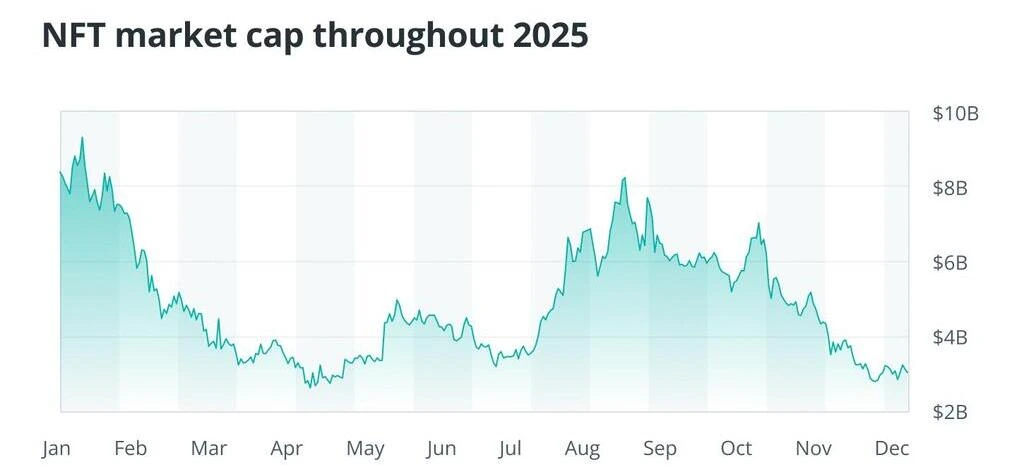
The leading collection by volume in that quarter was not art. It was Courtyard, which tokenizes physical trading cards held in a vault and lets holders redeem the actual card, turning over $145 million across 1.55 million items. That places it closer to real-world asset tokenization than to the JPEG market it is usually filed under. Sports collectibles grew trading volume 337% to $71.1 million. The only NFT category that declined was gaming, down 17% in volume and 32% in items sold.
A pattern falls out of that. Tokens perform best when they point at something that already had value and an established market, and worst when the token was itself the entire product.
What the free platforms suggest
A recurring counterpoint in community discussion deserves a hearing: Second Life ran a functioning virtual economy with real currency conversion for roughly two decades without a blockchain, and outlasted several well-funded blockchain worlds. VRChat sustains far larger concurrent populations than most token-based platforms on a fraction of the budget, with users producing nearly all the content themselves. The argument being made is that what virtual worlds lacked was never an ownership ledger; it was a reason to show up.
It is a fair challenge, though not a complete one. Those platforms genuinely do keep your items inside their walls, on their terms, for as long as they choose to operate. That is the problem tokenized ownership was invented to address. The immediate conclusion is that the problem was real and the market for solving it was much smaller than anyone had projected.
How Regulators Treat Metaverse NFTs
In the EU, the Markets in Crypto-Assets regulation excludes crypto-assets that are genuinely unique and not fungible with others, which is why NFTs were widely assumed to sit outside it. ESMA guidance narrows that assumption considerably: national authorities are directed to apply a substance-over-form test, and attaching a unique identifier to an asset is explicitly not sufficient on its own to qualify it as non-fungible. This sits inside a wider shift in crypto regulation away from labels and toward economic function.
The practical consequence for anyone buying into a virtual world economy is that fractionalised NFTs – tokens split into interchangeable pieces, or ones that grant equivalent financial rights – can fall inside the regulation’s scope regardless of how they are labelled. A large identical collection sold primarily as an investment is not automatically outside the rules simply because each token carries a different number. “It is an NFT” is not a regulatory category.
How to Judge an NFT Metaverse Project Today
Most of the losses above were foreseeable from questions that were available to ask at the time. These five separate a project with a mechanism from one with a narrative.
| Question | Weak answer | Stronger answer |
|---|---|---|
| What does the token point at? | The token is the asset | A redeemable claim on something with an existing market |
| Who renders it? | “Interoperable” with no named integration | At least one world that already displays it well |
| Where does the metadata live? | A URL the issuer controls | On-chain, or on IPFS or Arweave |
| Who is actually trading? | Volume rising, distinct wallets flat | Buyer count growing alongside volume |
| What if the company stops? | Nothing functions | Assets and metadata stay accessible |
The metadata question is the one often dismissed, and it is worth verifying rather than taking on trust. A token whose artwork sits behind a single company-controlled URL is one hosting decision away from pointing at nothing, which is why decentralized storage is the difference between a durable claim and a fragile one.
The last question is the one that would have saved the most money. A parcel of virtual land whose value depends entirely on one company continuing to operate a map is not an owned asset in the sense the marketing implied. It is a subscription with a very poor cancellation policy.
The nft metaverse is smaller and less exciting than its 2021 description, but it is not empty. The technology does one narrow thing well: it proves who holds a claim, without asking anyone to trust the platform. Judge any project by whether that specific property is doing real work, and most of the confusion clears up.
Frequently Asked Questions
Is the metaverse dead in 2026?
No, but it is much smaller than projected and the corporate enthusiasm has moved to AI. Platforms are still running and NFT sales counts actually rose through 2025. What collapsed was the valuation of virtual property and the belief that mainstream users would relocate their social lives into 3D worlds.
Did Meta shut down its metaverse?
It announced in March 2026 that Horizon Worlds would drop VR support, then reversed that within a day and kept VR access running. The strategic priority has shifted to the mobile version, and the Reality Labs division has taken heavy layoffs, but the platform was not shut down.
Can you still make money on virtual land?
The historical record is discouraging: the flagship purchases of the boom are down between 97% and 99.8% against current floors. Anyone considering it should treat it as an illiquid bet on a single company continuing to operate, not as property. This is general information, not investment advice.
What is the difference between an NFT and the thing it represents?
The NFT is an on-chain record of who owns a token ID. The image, 3D model or metadata is usually stored off-chain and referenced by a link. Ownership of the token does not automatically mean the underlying file is permanently preserved, nor does it usually transfer copyright.
Do virtual worlds actually need NFTs?
Not to function. Second Life and VRChat run large virtual economies and social spaces without them. NFTs add one specific property: ownership that does not depend on the operator’s goodwill. Whether that property is worth its costs depends entirely on the use case.
Are metaverse NFTs regulated in the EU?
Sometimes. MiCA excludes genuinely unique, non-fungible assets, but ESMA instructs regulators to look at economic function rather than labels. Large identical collections and fractionalised NFTs can fall within scope.

Isai Alexei is a journalist and financial analyst covering cryptocurrency markets and traditional securities for Blockchaindose. He has spent ten years analyzing digital assets, trading activity, and market structure.