

World ID proof of personhood answers one question at internet scale: is the account behind a request a real, unique human, or a bot? The Sam Altman-backed project scans a user’s iris with a device called the Worldcoin Orb to issue the proof. In doing so it became the most recognizable product in decentralized digital identity, and the most contested.
Key Takeaways
- World ID uses an iris-scanning hardware device (the Orb) to generate a cryptographic proof that a given account belongs to a unique, real human – without (the company claims) storing raw biometric images.
- It genuinely solves a hard problem: Sybil attacks and bot farms are increasingly effective against text-based CAPTCHAs, and a growing set of platforms – including Tinder, Zoom, and Docusign – have partnered with World in 2026 to use it for exactly this.
- It is also banned or under active investigation in at least six countries – Brazil, Hong Kong, the Philippines, Thailand, and others – over consent, minors, and data-collection concerns.
- The centralized collection point is the actual controversy: the Orb is a company-owned device, and regulators have focused specifically on how biometric data is captured, not on the decentralized proof that results.
- World has responded with real technical concessions – open-sourcing the Orb software, adding a self-custody “Personal Custody” feature, and passing a third-party security audit – though experts remain split on whether this resolves the core objection.
How World ID Proof of Personhood Actually Works
Most explanations get the proof of personhood architecture wrong, so the sequence matters. Your World ID is a random number generated locally on your phone, before any humanness check runs. The Orb never issues the credential; it only verifies one.
At the Orb, the device captures iris images and converts the iris into a unique code. The code is then split into randomized multi-party compute (MPC) fragments. The Orb sends the images and fragments to your device as a Personal Custody package, then permanently deletes its copies. Your phone forwards the fragments to the AMPC service, which confirms you have never verified before. Only the uniqueness check crosses the network.
Presentation of the credential works differently again. World ID uses zero-knowledge proofs built on the open-source Semaphore protocol. A verifying app learns one fact: the holder has a valid World ID. It cannot read your public key, and it cannot track you across applications. Some apps add a Face Auth step, which runs locally on the phone. One Orb visit covers enrollment permanently.
The distinction carries weight for anyone evaluating the claims. Both Tools for Humanity and the World Foundation state they deleted their database of iris codes entirely. Uniqueness is checked against distributed fragments, not against a company-held biometric archive.
The Problem It Genuinely Solves
Sybil resistance and bot detection are real problems, and worsening ones. AI defeats text CAPTCHAs trivially. Fake-account farms distort metrics and drain reward pools. The volume of machine-generated content makes “prove you are human” a legitimate infrastructure need, not a solution hunting for a use case.
Adoption suggests the pitch lands beyond crypto-native audiences. In April 2026 World announced partnerships with Tinder, Zoom, and Docusign, targeting the mass-market role its founders originally described. A dating profile, a call participant, or a document signer gets checked as a real, unique person.
Sybil Resistance vs. Privacy: Weighing the Trade-off Objectively
The controversy is not really about whether proof-of-personhood is useful – it is about the collection method. World ID has been banned or halted in at least six countries – including Brazil, Hong Kong, the Philippines, and Thailand – with the complaints strikingly consistent across jurisdictions: insufficient consent disclosure, data collected from minors, and biometric deletion claims that cannot be independently verified.
Spain’s data protection authority specifically found that Orb operators provided insufficient information and failed to allow consent withdrawal; the Philippines’ privacy commission cited similar consent and vulnerability concerns when it ordered an immediate halt to data collection in October 2025.
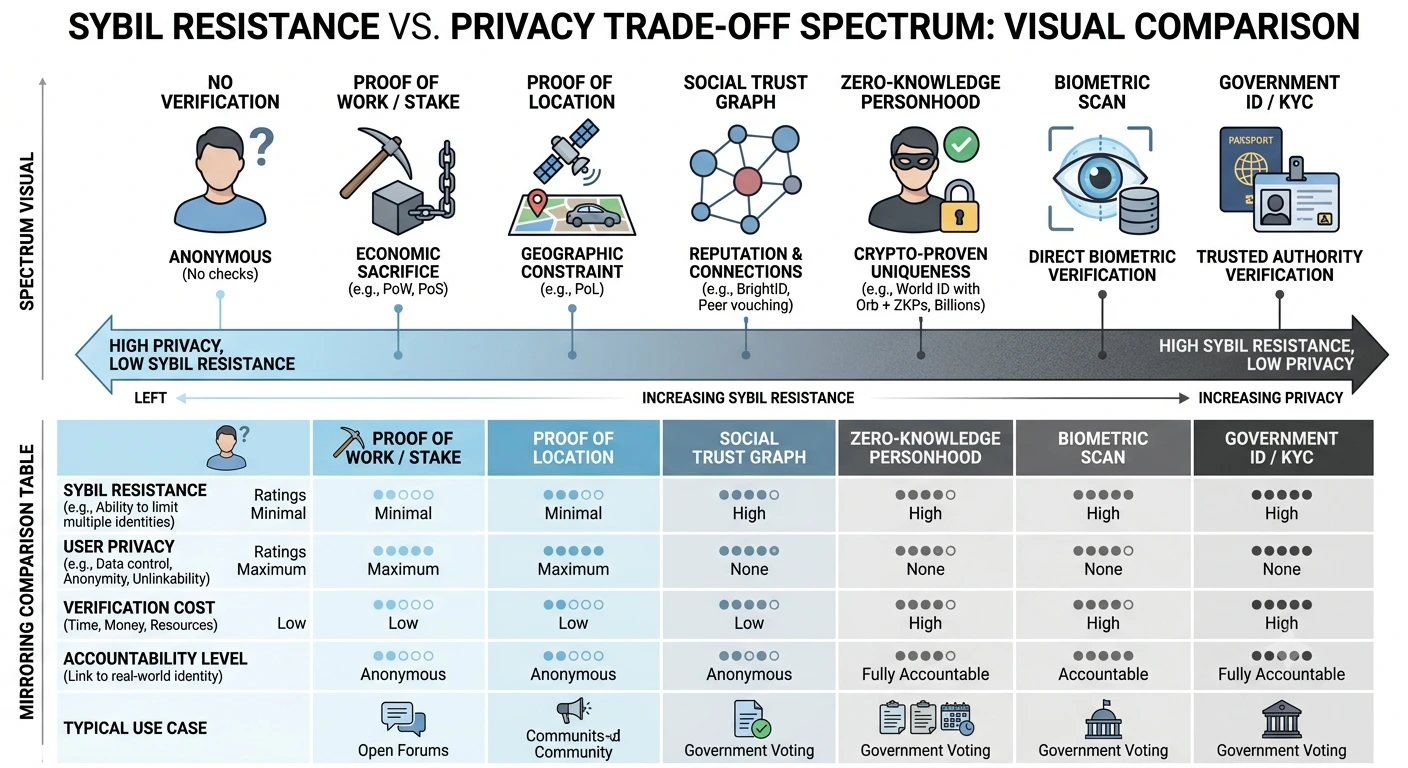
World’s response has included real technical steps: the company open-sourced the Orb’s software, introduced a self-custody feature called “Personal Custody” that lets users hold their own encrypted data, and passed a third-party audit of its end-to-end encrypted messaging with no vulnerability found.
These are not nothing – but legal and privacy experts remain genuinely split, with some treating the concessions as a meaningful first step and others arguing the core problem is the centralized collection event itself, which no amount of downstream encryption fully resolves. That is the honest framing worth carrying into any evaluation of World ID: the “decentralized” credential that results is real, but the biometric was captured by a company-owned device before it ever became decentralized.
For context, this trade-off is not unique to biometrics generally – the wider field of decentralized identity solutions includes non-biometric approaches to similar problems, such as Privado ID’s zero-knowledge credentials, which prove claims without any biometric collection step at all.
Where World ID trades a one-time biometric capture for very strong Sybil resistance, zero-knowledge credential systems trade weaker Sybil resistance (a credential can, in principle, be shared) for no biometric collection whatsoever – a genuinely different point on the privacy/security curve, not a strictly better or worse one.
|
Dimension |
World ID (biometric) |
Zero-knowledge credentials |
|
Sybil resistance |
Very strong – unique iris per person |
Weaker – credential could be shared |
|
Data collected |
Iris scan, at a centralized Orb device |
None – proof only, no biometric |
|
Regulatory exposure |
High – banned in multiple countries |
Lower – no biometric collection event |
|
Best fit |
Mass platforms needing hard bot resistance |
Compliance/KYC use cases needing privacy |
What the Compensation and Deletion Process Actually Look Like
Thailand’s order is the most detailed. The PDPC found inadequate transparency, invalid consent for sensitive biometric processing, and non-compliance with rules on cross-border transfers and long-term storage. Regulators also raided a Worldcoin exchange in Thailand in October 2025, with an arrest reported.
Brazil’s reasoning deserves particular attention, because it inverts a detail usually filed under marketing. World paid citizens for the iris scan. Under Brazilian data law, consent for biometric collection must be free, informed, and unequivocal, and ANPD held that payment vitiates the “free” requirement. So the compensation is not a footnote about whether users got a fair price. Compensation is the legal basis of the ban..
A Complication for the Alternatives Too: Passport-Based Systems Aren’t Automatically Better
It would be convenient if the answer were simply “prove a government passport with zero-knowledge instead.” Several projects take the approach, proving age or citizenship from e-passport data without exposing the document. The move swaps one centralization point for another, though. A passport is not decentralized merely because many governments issue them. You cannot self-issue citizenship, and no cryptography restores standing a government revokes.
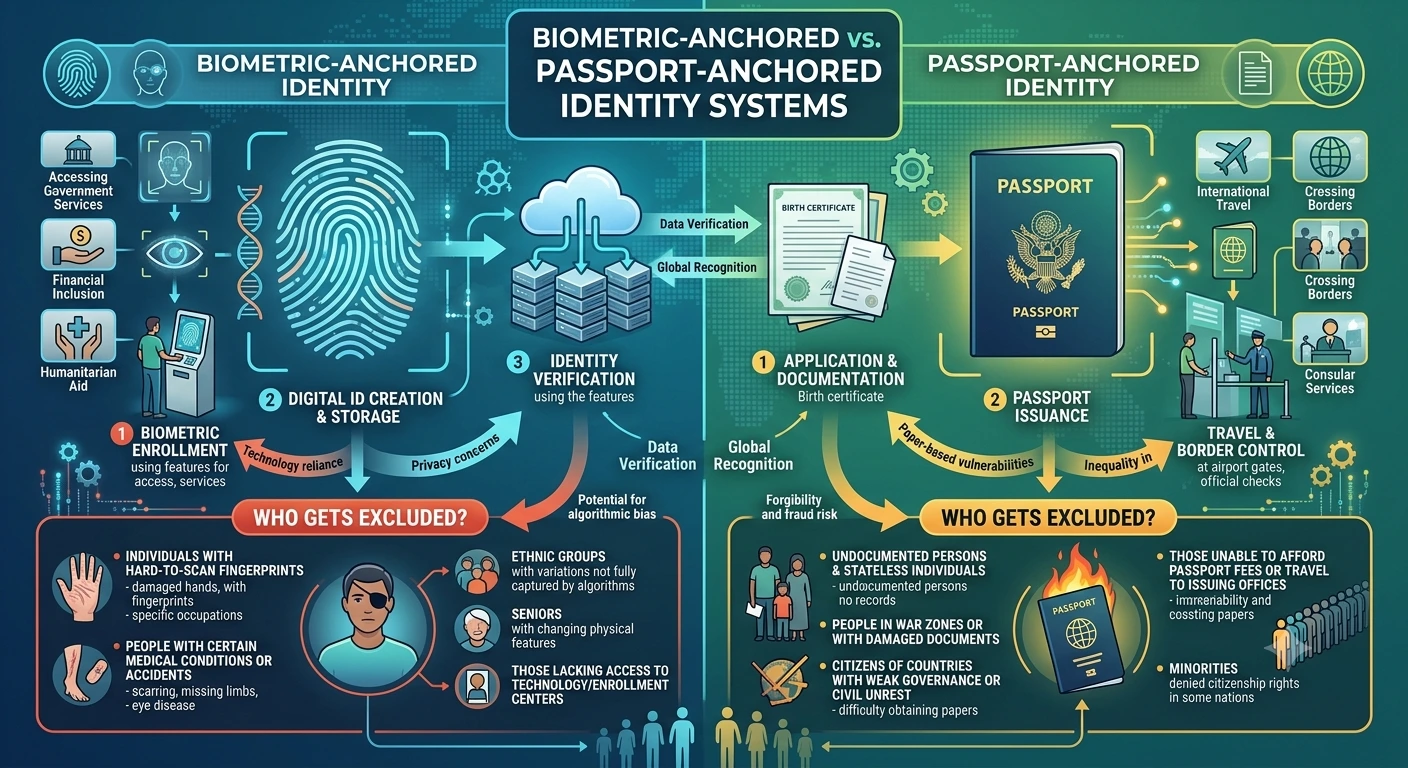
The exclusion is measurable, and the original framing understates it. UNHCR counted 4.5 million stateless people at the end of 2025 across 100 reporting countries. The agency notes the true figure runs significantly higher, since under half of all countries report at all. The broader number matters more here. World Bank ID4D estimates that more than 800 million people lack official proof of identity, or roughly one in ten. The count fell from 850 million in 2021 and just over a billion in 2017. Over half are children whose births were never registered.
The population above is precisely who any proof-of-personhood system most needs to reach. It is also precisely who every passport-anchored design excludes by construction. So the question worth asking of any such product, World ID included, is not just whether it is decentralized, but decentralized relative to what, and who gets left out.
Does World ID store my actual iris image?
The company states it stores an encrypted iris code (a mathematical hash), not a raw image, and that this data is deletable by the user. These claims are not independently verifiable by outside parties, which is precisely the concern several regulators have cited.
Why is World ID banned in some countries?
Regulators in Brazil, Hong Kong, the Philippines, Thailand, and others cited insufficient consent disclosure, data collected from minors, and unverifiable deletion claims tied to the Orb’s biometric collection process – not the resulting credential itself.
Can I use World ID without visiting an Orb in person?
No – the core proof-of-personhood mechanism requires an in-person iris scan at a physical Orb device. This is a deliberate design choice: remote-only verification would be far easier to spoof or automate at scale.
Is World ID the same as Worldcoin?
World ID is the identity/proof-of-personhood credential; Worldcoin (WLD) is the associated cryptocurrency token. The project rebranded from “Worldcoin” to “World” in 2024, though both the identity and token components remain part of the same ecosystem, built by Tools for Humanity.
What are the alternatives to World ID for proof-of-personhood?
Zero-knowledge credential systems like Privado ID solve adjacent compliance problems without biometric collection, though they offer weaker guarantees against a determined Sybil attacker sharing credentials. There is currently no biometric-free system that matches World ID’s specific claim of cryptographically proven, non-duplicable uniqueness.
Why are mainstream apps like Tinder and Zoom adopting World ID despite the bans?
These partnerships target a narrower use case – confirming a user is a real, unique person for dating safety or meeting authenticity – in markets where World ID currently operates legally. The bans are jurisdiction-specific, so expansion into permitted markets and regulatory rejection in others are both happening simultaneously.
Are passport-based zero-knowledge identity systems more decentralized than World ID?
Not automatically. Passport-anchored systems avoid biometric hardware collection, which is a real advantage, but they still depend entirely on a government choosing to recognize you – you cannot self-issue citizenship, and people without state-issued documents are excluded from both approaches. Neither model is decentralized in the fullest sense; they trade different centralization points.

Isai Alexei is a journalist and financial analyst covering cryptocurrency markets and traditional securities for Blockchaindose. He has spent ten years analyzing digital assets, trading activity, and market structure.