Remember the 2021 NFT boom? In 2026, the NFT market is just a shadow of what it was in 2021. Yet, many NFT marketplace development services continue to ride on the nostalgia of the NFT boom.
Key takeaways:
- NFT marketplace development services cover not only code, but also general smart contracts, security audits, wallet integrations, and post-launch support decide whether a build survives.
- Realistic 2026 budgets range from roughly $10,000–$30,000 for a white-label NFT marketplace to $150,000+ for custom enterprise builds.
- The custom vs. white-label decision is the single biggest trade-off between cost, speed, and long-term flexibility.
- The NFT market contracted sharply from 2021, so vet a vendor’s market assumptions as carefully as the code.
- It is vital to note red flags like guaranteed profits, no audit history, or anonymous teams before deciding to work with a vendor.
NFT data analytics indicated that the trading volumes plunged to merely 823 million in Q2 2025, a 45 percent quarterly Drop. This came even as individual sales rose by about 78% based on DappRadar data. But, you will find NFT marketplace development agencies promise to help you launch an OpenSea Killer in weeks.
Anyone commissioning a marketplace now needs a partner who understands the current numbers, not one still quoting bull-market projections. A solid grounding in how NFT marketplace development works end to end is the best defense against overpaying for the wrong build.
The guide below breaks down what NFT marketplace development services actually include, what custom, white-label, and clone-script approaches cost in 2026, how to evaluate a development team, and which warning signs should end a conversation immediately.
What NFT Marketplace Development Services Actually Include
A production-grade NFT marketplace is far more than just a single application. Different vendors tend to have different models of packaging their offerings. However, a complete solution for production grade NFT marketplace comes with the following three layers:
- The storefront itself
- The on-chain logic
- Everything that happens after launch
Only after understanding the three layers can we compare quotes that otherwise look wildly inconsistent. Well, let’s break everything down.
Core Marketplace Development
The main part always seen by users is the trading interface. This includes listing pages, search and discovery, collection pages, user profiles, bidding and fixed-price flows, and an admin panel for fees and moderation.
However, deep in the background, the marketplace demands wallet integrations like Metamask and WalletConnect. Moreover, an NFT marketplace also needs blockchain indexers to keep the marketplace updated with on-chain activity, and storage systems like IPFS or Arweave to store NFT images and other files. The frontend and backend together make up standard NFT software development work, and it is where the majority of billable hours go.
Smart Contract Development and Auditing
Smart contracts handle important NFT actions such as buying, selling, minting, and paying royalties. In most cases, NFT marketplaces use ERC-721 for unique assets, and ERC-1155 for editions and gaming items.
After the deployment of a smart contract, it is next to impossible to change or fix it. Hence, the contract should be audited before being deployed on the blockchain. Such audits will help spot any security vulnerabilities that could put users and their funds at risk. A vendor that treats a security audit as an optional extra may not be giving security the attention it deserves.
Post-Launch Services
Of course, after building the expensive infrastructure, maintenance, updates and post launch support are a must. As you plan your budgets, include costs for hosting, maintenance, and even general promotion from day one. You should also have a separate plan for attracting users, either through an NFT marketing agency or your own team.
A common mistake is spending the entire budget on development and having little or no money left for marketing and building a community. Without users and active buyers and sellers, even a well-built marketplace may struggle to generate trading activity.
Custom Build vs. White-Label vs. Clone Script
The first decision that shapes every facet of NFT marketplace development from budget, timeline, and ownership is the development approach. Today, there are three models that dominate the market, and vendors usually specialize in one.
The first model is custom build. It is a from-scratch Web3 development project with bespoke smart contracts, custom trading logic, and full intellectual property ownership. A very good choice when a business model needs non-standard mechanics like fractional ownership, real-world asset tokenization, or compliance-heavy onboarding. The biggest con associated with custom builds is their expensive nature, and slow developments.
Second is the White-label model. This is an NFT marketplace pre-built solution re-skinned with your branding and configured for your asset type. When compared to the custom builds, the white label model is faster and cheaper. However, vendors can rarely customize fee structures, contract logic, or compliance flows in depth. It works well for market validation and niche verticals where the template fits.
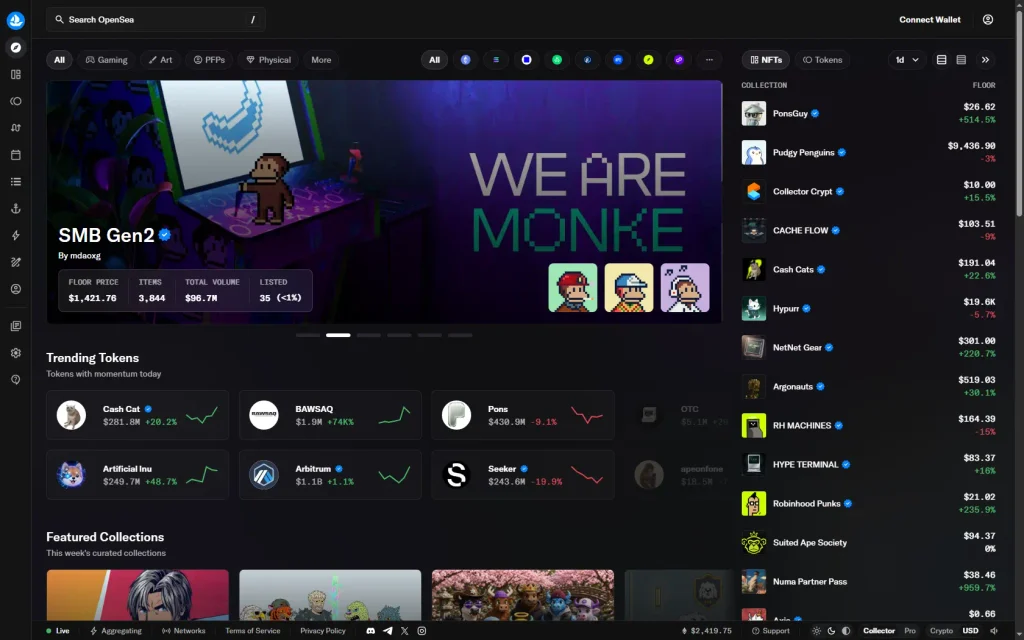
Finally, the clone scripts. While dealing with offshore vendors, you will likely get cheap offers for OpenSea Clones, or Rarible Clones. It is important to approach these clone scripts with caution. In most cases, the code provenance is unclear, vendors resell the same codebase to many buyers, and “audit-ready” in marketing copy is not the same as audited. Choosing a clone script still requires an independent security review of the delivered code.
| Criteria | Custom build | White-label | Clone script |
| Typical cost | $80,000-$150,000+ | $10,000-$30,000 | $7,000-$20,000 |
| Timeline | 4-8+ months | 2-6 weeks | 2-8 weeks |
| Customization | Unlimited | Limited to template | Superficial (branding) |
| IP ownership | Full, if contracted | Usually licensed | Often shared codebase |
| Main risk | Budget and scope overruns | Hitting template limits | Unverified code quality |
| Best for | Unique business models, RWA, compliance | Fast validation, niche verticals | Minimal-budget experiments |
Figures are indicative industry ranges for 2026; see the cost section below for sourcing and caveats.
NFT Marketplace Development Costs in 2026
There are no fixed prices associated with developing NFT marketplaces. Every agency comes with its own quotation for the services rendered. Here below are ranges of self reported costs which stay mostly within the industry cost guides.
| Tier | Scope | Cost range | Timeline |
| Basic MVP | Wallet connect, minting, fixed-price sales | $20,000-$40,000 | 2-3 months |
| Mid-tier marketplace | Auctions, royalties, multi-wallet, advanced search | $40,000-$80,000 | 3-5 months |
| Enterprise platform | Multi-chain, secondary trading, compliance, audit | $80,000-$150,000+ | 5-8 months |
Yet, the quotes do not include other mandatory items that must be carried out during the development phase. For instance, there are smart contract audits ($5,000–$20,000), KYC/AML integration ($5,000–$15,000 plus per-verification API fees) for regulated markets, and ongoing hosting and maintenance of roughly $1,000–$3,000 per month. To remain on the right side, you should always ask whether a quote covers the extras above or bills them as change orders.
These development costs can be heightened by the following key facets:
- The team – For instance, using freelance Solidity developers attracts less rates ranging between $81–$100 per hour. This looks cheaper than an agency until project management, QA, and the risk of a single point of failure get priced in.
- The chain – Projects developed on Ethereum will often attract higher deployment costs than other low fee networks. For instance, a Polygon NFT marketplace deployment comes with reduced development friction and the transaction costs. Launching NFT marketplaces with the multi-chain support feature increases the costs and time associated with engineering. Unless it is core to your business, treat it as a phase-two feature unless it is core to the business case.
How to Choose the Right Development Team
Research and evaluation are very critical especially when dealing with NFT development agencies. It is very easy for teams to inflate their portfolios. In our research, we reviewed the top NFT marketplace development companies.
Evaluation Criteria That Actually Matter
- Live marketplaces in production. To get live verifications, ask the vendor to provide the actual URLs of builds the team shipped that are operating today. Do not work with merely screenshots and demo videos.
- Request audit reports for past projects from recognized firms. Do not fall for the popular marketing phrase “Audit-ready code.” Get your real confirmation.
- Different agencies have different experiences with different blockchains. If a team is strong on Solana, it will not be autonomously strong on Ethereum. Notice that the coding language, tooling, and auditor pool differ substantially between different blockchains.
- Write down a contract on the actual ownership of the IP, delivered code and smart contracts. This is especially crucial when dealing with clone scripts. Full ownership is never really automatic.
- Before signing any contracts, it’s vital to discuss the down response times, maintenance scope, and pricing for future changes.
- Anti-fraud and moderation tooling. Ask your vendor how their creation will deal with counterfeits, copy mints and spoofed NFT collections.
Red Flags That Should End the Conversation
- If an agency guarantees you profits, user numbers, or high trading volumes, watch out.
- If the team is anonymous or unverifiable, it may be best to avoid the agency at all costs.
- If the agency employs pressure pricing techniques, that is not a mark of quality. Ever seen promos like “Sign this week for 40% off”? Well, that should be a red flag in most cases.
- If the quotations are far below the market target of $5,000 for a “full custom marketplace,” then you are either dealing with a resold template or a project that will die in change orders.
- If the vendor never asks about your niche, audience, or realistic volumes, then you are merely buying a code, not a good product.
What the NFT Market in 2026 Means for Your Project
Most vendor websites skip the topic below, yet it should shape the entire brief. The NFT market recorded a fifth consecutive quarterly decline in trading volume by mid-2025. According to data by CryptoSlam, as compiled by Cointelegraph, in the first half of 2025, NFT sales totalled $2.82 billion. The average sale value for NFTs ranged between $80 and $100. With the average fee on trades standing at 2%, and the sales value very low, it will be very hard to break even. Do your math before starting the project.
Consolidation shows at the marketplace level too. In 2026, Foundation shut down permanently. This project followed others like MakersPlace, KnownOrigin, Nifty Gateway, and X2Y2. All the above mentioned were already established marketplaces with existing audiences but still could not sustain operations. The wave of NFT marketplace closures has continued into 2026, and the latest NFT market data undercuts the recovery narrative that many sales teams still pitch.
When the market contracts, its not just new marketplaces that suffer, but the ones running on general idea that volumes are everything. Even with the sharp market downturns, there are severla segments that grew vastly including sports collectibles, real-world asset tokenization, and low-price high-frequency trading. Sales counts actully rose sharply even as dollar volume fell.
Most of the best NFT marketplaces today survived because they own a niche instead of trying to serve everyone. Use these ideas to challenge the vendors and note their reactions. A good development partner will engage with the idea, while a bad one will reduce the conversation to features.
The Development Process Step by Step
Regardless of vendor, a professionally run project follows a predictable sequence. Use it to sanity-check any proposed timeline.
- Discovery and scoping. Define and price the niche, audience, revenue model, feature list, and compliance requirements.
- Architecture and chain selection. Select the blockchain, token standards, storage, and third-party integrations.
- Smart contract development. Begin the writing of the minting, trading, royalty, and fee logic, then cover it with automated tests.
- Frontend and backend build. Bring the storefront, wallet flows, indexers, and admin panel together into a working build on a testnet.
- Independent audit and QA. A third-party firm audits the contracts, then the team fixes and re-verifies every finding before anything touches mainnet.
- Deployment and launch. Deploy the contracts live on chain and set up monitoring.
- Post-launch operations. Begin maintenance, feature iterations, and growth work, the phase that determines whether the investment pays off.
Professional NFT marketplace development services are worth paying for, but only when matched to a realistic business case. Define your niche first, choose the build model that fits your budget and validation stage, demand audits and IP ownership in writing, and walk away from anyone selling 2021 numbers in a 2026 market.
FAQ
How much does it cost to build an NFT marketplace in 2026?
Industry estimates put a basic MVP at $20,000–$40,000, a mid-tier build at $40,000–$80,000, and enterprise builds at $80,000–$150,000+, with white-label options starting around $10,000. Add a security audit, KYC integration where required, and monthly maintenance on top of any headline quote.
How long does NFT marketplace development take?
White-label deployments launch in 2–6 weeks. Custom builds run 2–3 months for an MVP and 5–8 months or more for enterprise builds with compliance and multi-chain requirements. Audits can extend timelines when they uncover issues that require redesign.
Should I choose a white-label solution or a custom build?
Use white-label to validate a niche cheaply and quickly; move to custom development once real transaction data proves demand or when your model needs non-standard mechanics like fractional ownership or regulated onboarding. Starting custom without validation is the most common way to burn a six-figure budget.
Is launching an NFT marketplace still worth it in 2026?
For generalist marketplaces competing with OpenSea and Magic Eden on volume, the data says no: established marketplaces have been shutting down, not multiplying. For focused niches like sports collectibles, real-world assets, gaming communities, and regional markets, there are still many opportunies because sales activity has stayed resilient even as prices fell.
Do I really need a smart contract audit?
Yes. Deployed contracts cannot be patched like normal software, and contract vulnerabilities are the leading cause of marketplace exploits. Budget $5,000–$20,000 for an independent smart contract audit and treat any vendor who calls it optional as a red flag.
Can I hire freelancers instead of a development company?
You can, and at $81–$100 per hour for freelance Solidity developers it looks cheaper than an agency retainer. In practice, project management, QA, and continuity risk fall on you, and a marketplace needs frontend, backend, contract, and security skills that rarely live in one person. Freelancers work best when a team wants to hire NFT developers to extend an existing build, not to build one from zero.

Dan is a seasoned crypto writer for Blockchaindose who got his start in the space back in 2019. Over the past four years, he’s built a solid grasp of how the industry moves, focusing heavily on DeFi, NFTs, GameFi, and promising new projects.
Off the clock, you’ll usually find him buried in a good book or kicking back with a movie. His blend of hands-on market experience and straightforward commentary makes him a clear, trusted voice across the platform.