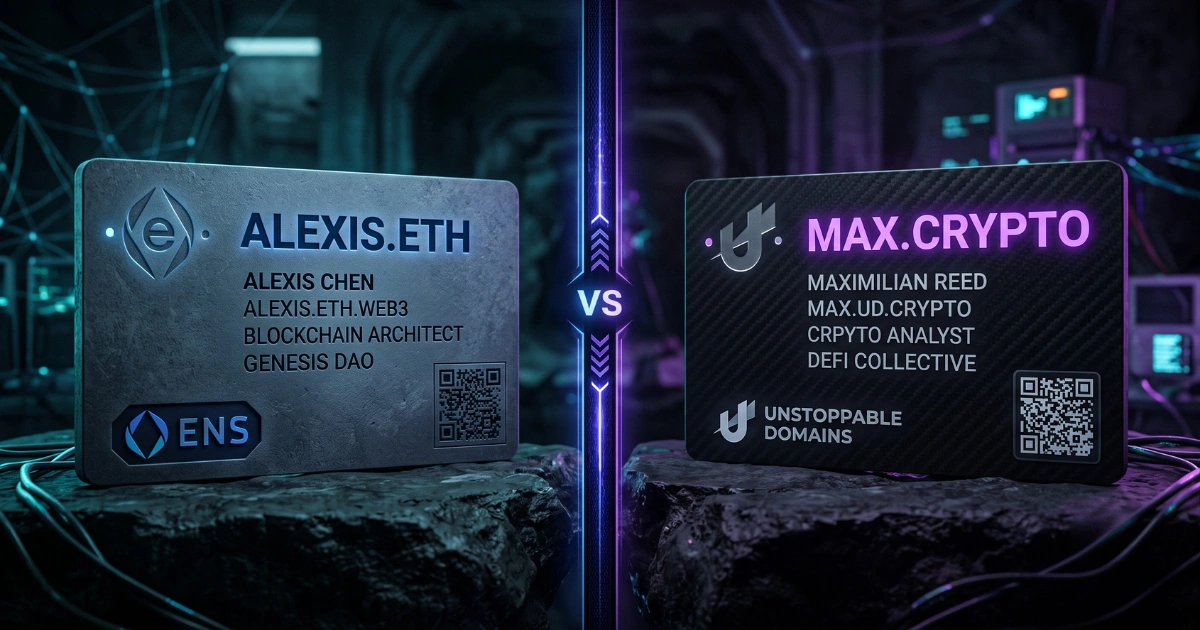
The ENS vs Unstoppable Domains debate has been running in crypto communities for years, and in 2026 it finally has real stakes. ENS has passed 2.8 million registered .eth names as of early 2026, while Unstoppable Domains reports over 4.2 million registered domains (a self-reported figure from the company itself). Both projects solve the same surface-level problem: replacing a 42-character wallet address with a name a human can read.
Key Takeaways
- ENS rents you a name with yearly renewals, while Unstoppable Domains sells names once with no renewal fees, and both models carry real trade-offs.
- ENS is governed by a DAO and open smart contracts; Unstoppable Domains is a venture-backed company that controls its own registry contracts.
- ENS registration gas costs dropped roughly 99% after Ethereum’s 2025 scaling upgrades, removing its biggest historical cost disadvantage.
- The ICANN 2026 gTLD round (applications open 30 April to 12 August 2026) could finally make some Web3 extensions work in normal browsers, or kill the ones that lose.
- Neither system resolves natively in mainstream browsers today, so treat every Web3 domain as a crypto identity tool first, not a website address.
Under the surface, they are built on opposite philosophies. One is a rental-based public protocol governed by a DAO. The other is a private company selling permanent NFT domains. And in 2026, ICANN’s first new gTLD application round since 2012 is forcing both models to answer a question they have dodged for years: will any of these names ever work on the normal internet?
This article compares ownership, pricing, decentralization, adoption, and the ICANN question, using verified 2025 and 2026 data plus the unfiltered experiences of people who actually own these domains. It is written for buyers, not for either project’s marketing team.
What Are ENS and Unstoppable Domains?
ENS: A Public Protocol Governed by a DAO
The Ethereum Name Service (ENS) launched in 2017 as an open protocol on Ethereum. It maps human-readable .eth names to wallet addresses, content hashes, and profile records. Every .eth name is an ERC-721 NFT, and registration fees flow into a treasury controlled by the ENS DAO, not a private company. Long-time community members describe this as the project’s core advantage: ENS positioned itself as a public good and spent years building integrations before monetization, which is why one widely upvoted Reddit comment summarized the rivalry as ENS having built a community while its competitor tried to outspend it with venture capital.
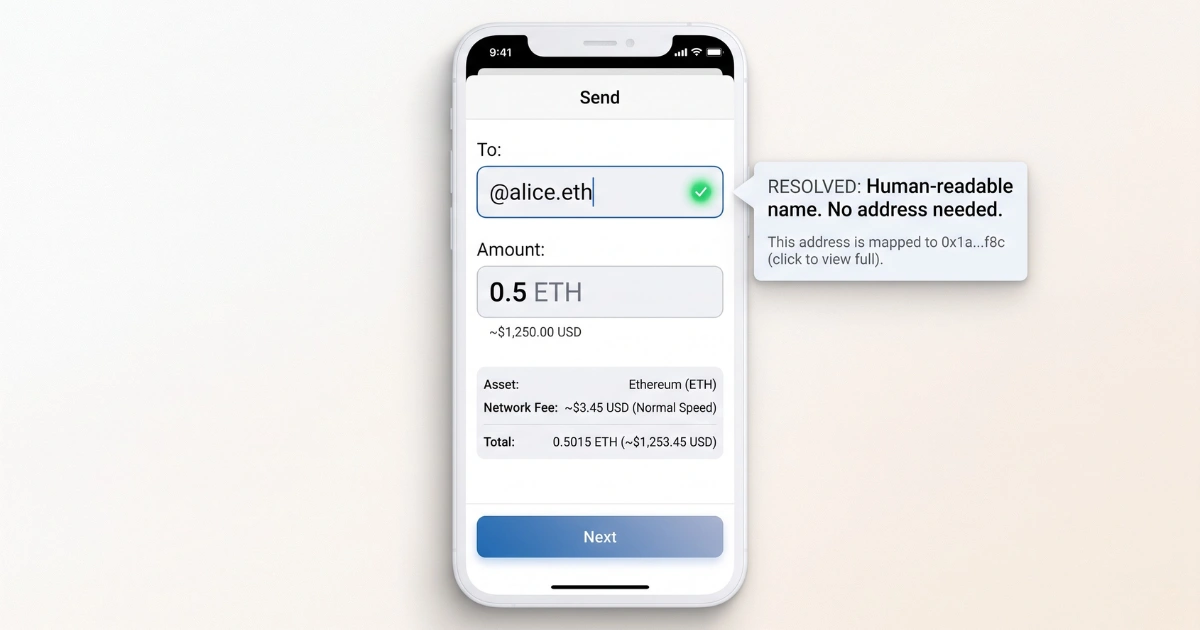
In February 2026, ENS Labs made a major architectural decision: it cancelled its planned Namechain Layer 2 and committed to deploying the ENSv2 upgrade exclusively on Ethereum mainnet. The reason was simple economics. Ethereum’s gas limit increases in 2025 cut average ENS registration gas costs by roughly 99%, from around 5 dollars to a few cents, which removed the original justification for a dedicated rollup.
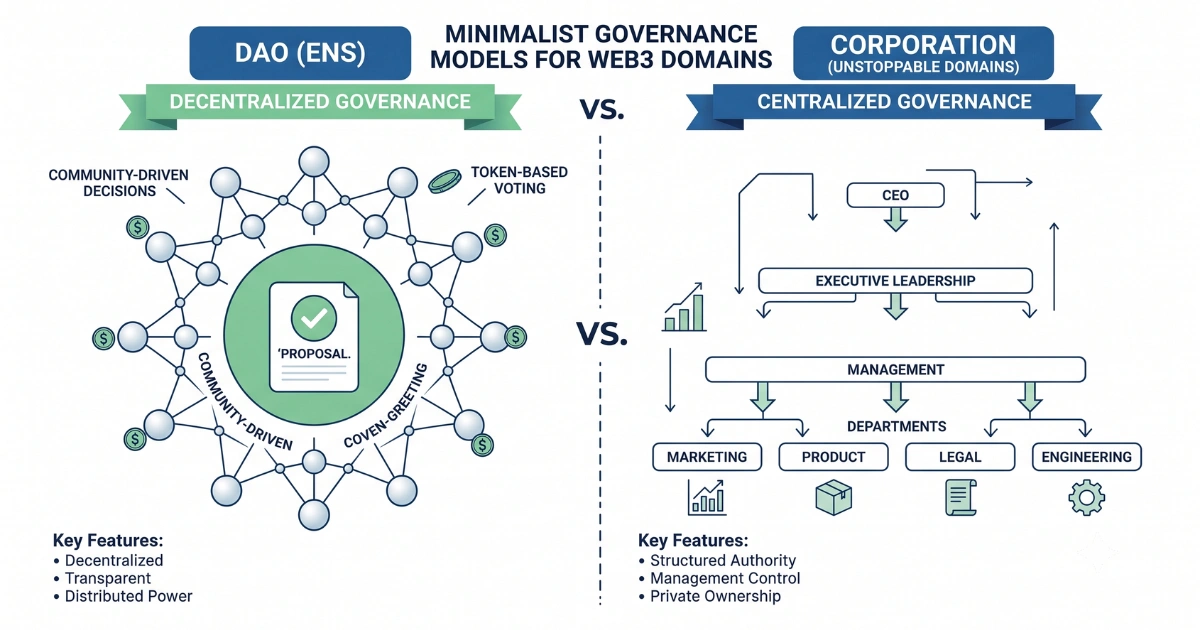
Unstoppable Domains: A Company Selling Domains as NFTs
Unstoppable Domains (UD) launched in 2018 as a for-profit, venture-backed company. It mints domain NFTs (originally on Ethereum, now mostly on Polygon) under extensions it created itself: .crypto, .nft, .wallet, .x, .dao and dozens more. Its headline pitch is one payment, no renewal fees, ownership forever. Since August 2024, UD has also been an ICANN-accredited registrar, selling traditional .com-style domains alongside its Web3 catalog and tokenizing DNS domains onto the blockchain.
That corporate structure is exactly what its critics attack. The company sets prices, reserves brand-protected names, decides which extensions live or die, and controls the registry smart contracts. Community members have reported finding their own personal names locked behind UD’s brand protection system with no way to verify which entity the name was protected for, and being told by support that the company’s goal was adoption, not permissionless registration.
Read also our article about: Tokenization of Real Estate
ENS vs Unstoppable Domains: Key Differences at a Glance
The table below condenses the structural differences that actually matter to a buyer in 2026.
| Factor | ENS | Unstoppable Domains |
| Governance | ENS DAO, open-source protocol | Private VC-backed company |
| Payment model | Yearly renewal (prepay multiple years possible) | One-time purchase, no renewals |
| Main chain | Ethereum mainnet (ENSv2 stays on L1) | Polygon, plus other chains for partner TLDs |
| Extensions | .eth, plus imported DNS names | Dozens of self-created TLDs (.crypto, .x, .wallet, .nft…) |
| Revenue goes to | DAO treasury | The company |
| Brand-name policy | Permissionless, squatting possible | Company reserves protected names |
| TLD removal precedent | None | .coin dropped in 2022; more TLDs refunded in 2025-2026 |
| ICANN status | No gTLD application; .eth is an ISO country code string (Ethiopia) | ICANN-accredited registrar; multiple gTLD applications planned for 2026 |
Ownership Model: Yearly Renewals vs One-Time Purchase
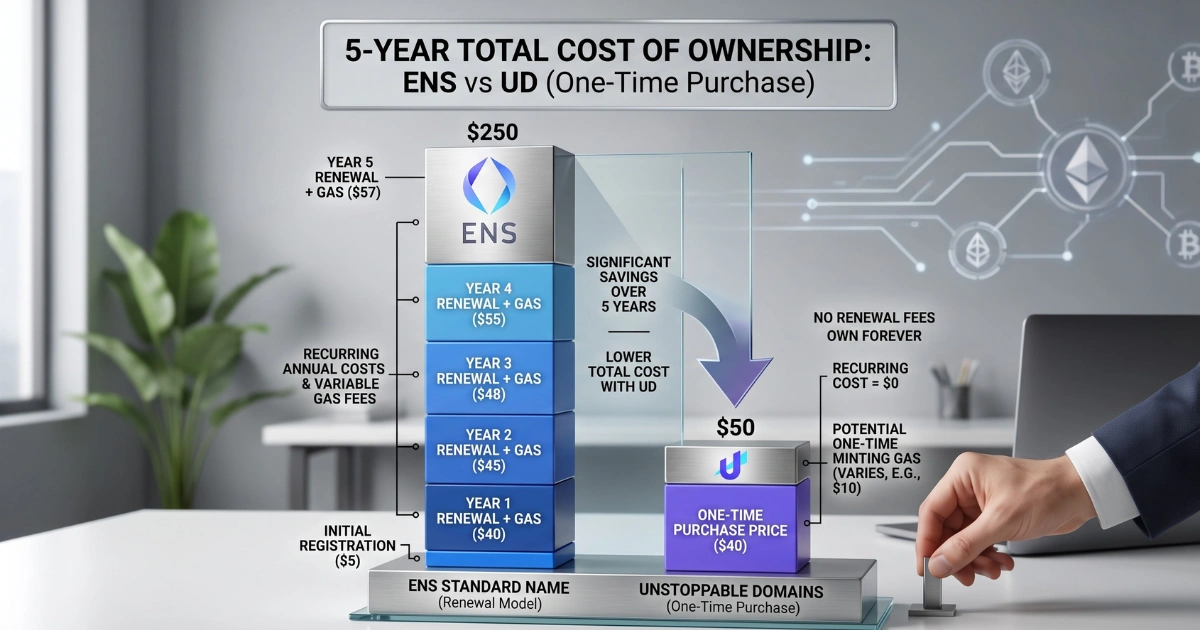
This is the single most argued point in every ENS vs UD thread, and both sides usually argue it badly. ENS charges 5 dollars per year for names of five characters or more, 160 dollars per year for four-character names, and 640 dollars per year for three-character names. UD charges once, from a few dollars for long names up to six-figure sums for premium ones, and never again.
Why Renewals Are Not Automatically a Downside
The renewal fee is a feature as much as a cost. It acts as a squatting tax: names held purely for speculation bleed money every year, and abandoned names return to the market. One Reddit user described reclaiming a name relevant to his project after the previous holder, who had apparently lost the keys, simply failed to renew. Under a buy-once-forever model, that name would have been dead namespace permanently. Lost private keys plus no expiry means the name is gone for everyone, forever, which is a genuine long-term scaling problem for UD’s namespace.
Renewals also carry real risk, and ENS holders admit it openly. Expired names enter a grace period and then a decaying premium auction, and inattentive owners lose them. One user in an ENS thread reported losing seven domains to his own negligence. If you register with ENS, treat renewal dates like tax deadlines: prepay several years for names you care about and set calendar reminders.
The Hidden Risk of Forever Domains
UD’s one-time payment is genuinely attractive for small buyers, and users priced out of Ethereum gas historically praised Polygon minting for saving them significant fees. But the model has a structural weakness that its own community discovered the hard way: a forever domain is only forever if the extension itself survives. The company has no recurring revenue from an already-sold domain, so, as one skeptical Reddit commenter put it, the seller has no skin in the game after the sale. The one-time price roughly equals a few years of conventional renting, and everything after that depends on the company’s continued goodwill and solvency.
Decentralization: Who Actually Controls Your Domain?
Both projects market decentralization. Neither delivers it completely, but the gap between them is real. ENS contracts are open source, the protocol is specified through public EIPs, and pricing changes go through DAO governance. UD’s registry contracts are controlled by the company, which can add new TLDs, freeze protected names, and change policy without any community vote. Community critics have called it a centralized GoDaddy on the blockchain, and even technically minded defenders concede that UD retains control of the smart contracts that manage the NFTs.
The .coin Removal: A Warning Buyers Should Not Forget
In 2022, Unstoppable Domains discovered its .coin extension collided with an existing blockchain naming project (Emercoin) and dropped support for roughly 100,000 sold .coin domains. Resolution in UD’s own libraries and services was disabled with no phase-out period. Holders were compensated, initially in store credits worth three times the purchase price rather than cash, though cash refunds were later made available on request. Technically savvy owners could still use their .coin NFTs by interacting with Polygon contracts directly, but every wallet and app integration that relied on UD’s libraries stopped resolving the names.
The episode matters because it was not a one-off. In late 2025 and early 2026, UD began offering refunds for entire partner TLDs whose operators decided not to pursue ICANN applications. The pattern is consistent: the NFT on the blockchain is genuinely yours, but the usefulness of that NFT depends on a company-maintained resolution layer that can be switched off. As one Reddit user joked after the .coin decision, the elevator pitch writes itself: we sell unstoppable domains, and yes, we can stop them.
ENS Is Not Perfectly Decentralized Either
Fairness requires the counterpoint. ENS migrated from its v1 auction system to the current model in 2019 largely by having the core team and wallet developers agree on it, with no community vote at the time. The ENS token airdrop enriched early holders and insiders in ways some users consider indistinguishable from any other token launch. And the ecosystem depends on gateways and infrastructure that can be attacked: in April 2026, the popular eth.limo gateway was briefly hijacked through a social engineering attack on its DNS registrar. Squatting is also rampant on ENS precisely because registration is permissionless; famous brand names sit in speculator wallets waiting for a payday.
Read also our article about: Equity Tokenization
What ENS and Unstoppable Domains Cost in 2026
Prices below reflect standard, non-premium names. Premium and short names on both platforms are priced individually and can run into thousands of dollars.
| Cost item | ENS | Unstoppable Domains |
| Standard name | $5/year (5+ characters) | Typically $5-$40 one-time |
| 4-character name | $160/year | Individually priced |
| 3-character name | $640/year | Rarely available; premium priced |
| Gas at registration | Under $0.05 on average after 2025 Ethereum upgrades | Free minting on Polygon |
| Renewal | Yearly, prepayable for multiple years | None |
The pricing story changed materially in 2025. For years, UD’s strongest practical argument was gas: registering a cheap .eth name could cost 50 to 250 dollars in Ethereum fees, which made a 5 dollar domain absurd. That argument is now largely dead. With ENS registration gas at a few cents, the real cost comparison is 5 dollars per year against a one-time payment, and for a five-year horizon the totals are close enough that pricing should no longer decide the choice.
The ICANN Factor: Why 2026 Changes the Whole Debate
The oldest criticism of Unstoppable Domains, repeated in nearly every Reddit thread since 2021, is that the company created top-level domains out of thin air with no ICANN registration, guaranteeing eventual collisions with the real DNS. In 2026 that criticism meets its test. ICANN’s new gTLD application round, the first since 2012, opened for applications on 30 April 2026 and closes on 12 August 2026, with an evaluation fee of 227,000 US dollars per application.
Unstoppable Domains’ DNS Gamble
UD is going all in. The company and its partners have publicly signaled intent to apply for multiple strings in the 2026 round, with trademark analysts listing candidates including .x, .wallet, .crypto, .nft, .dao, .agent, .robot and .polygon. A successful application would make those extensions resolve natively in Chrome and Firefox while keeping their on-chain function, which would be a genuine breakthrough for the buy-once model. But the flip side is already visible: several partner TLDs confirmed they will not pursue ICANN, and UD is offering refunds on those domains. Buyers are effectively holding lottery tickets on which extensions make it through a 227,000 dollar, multi-stage evaluation with contention auctions.
There is also a collision scenario the community flagged years ago: if a different applicant wins a string like .wallet in the ICANN round, holders of UD’s blockchain .wallet names end up with domains that clash with an official DNS extension owned by someone else. ICANN’s trademark protection mechanisms do not apply to blockchain registrations, which is why intellectual property firms are warning brand owners about the entire cryptoTLD category.
Where ENS Stands: Deliberate Coexistence
ENS took the opposite approach. It never invented new TLD strings; .eth is the ISO 3166 country code string reserved for Ethiopia, which ICANN has historically not delegated, and ENS also supports importing existing DNS names (yourname.com can work as an ENS name via DNSSEC). This makes ENS future-compatible with the global namespace rather than in competition with it, though it also means .eth’s browser-level future depends on ICANN policy toward country code strings remaining unchanged. Neither project can promise you a name that just works in a standard browser today, and any purchase should assume that stays true.
Adoption and Integrations: The Network Effect Question
When a Reddit user asked years ago why .eth names were everywhere while UD names were not, the top answers were blunt: network effect, first-mover advantage, and software integrations. That verdict has aged well. ENS is the default identity layer across Ethereum wallets, dApps, and marketplaces, and even users who own domains from both providers report that only their ENS name works everywhere. The new ERC-8004 standard for AI agent identity, launched on Ethereum mainnet in January 2026 with contributors from MetaMask, the Ethereum Foundation, Google, and Coinbase, treats ENS names as first-class identifiers, extending the moat into the agent economy.
UD counters with breadth rather than depth: more than 4.2 million domains sold (self-reported), integrations across numerous wallets, free minting for newcomers, and the unique two-way bridge of tokenized DNS domains plus its ICANN registrar status. For users on a budget who mainly want a payment alias and a profile, UD’s offer is functional. For anyone who wants a name that other applications reliably recognize, the integration gap still favors ENS in 2026.
Which One Should You Choose?
There is no universal winner, and the maximalism on both sides of this debate is mostly bag-holding. The honest answer depends on what you are buying the name for.
- Choose ENS if you want maximum compatibility across wallets and dApps, care about decentralized governance, or are building a long-term Web3 identity or brand. Budget for renewals and set reminders.
- Choose Unstoppable Domains if you want a cheap one-time payment alias, are experimenting with multiple names, or specifically want to bet on a TLD that wins ICANN approval in the 2026 round.
- Choose both if the cost is trivial for you; plenty of users hold .eth for daily use and UD names as speculative or backup identities.
- Choose neither if you expect a working website address in a normal browser. Neither system delivers that today.
Whatever you pick, the comparison between ENS and Unstoppable Domains in 2026 comes down to a philosophical trade: ENS asks you to keep paying a small rent for a name inside the most widely integrated, community-governed system in Web3, while Unstoppable Domains asks you to pay once and trust a private company’s roadmap, resolution infrastructure, and ICANN ambitions. Know which trade you are making before you check out.
FAQ
Do ENS or Unstoppable Domains work in normal browsers like Chrome?
Not natively. Both require browser extensions, special browsers like Brave or Opera, or gateway services. UD’s ICANN applications in the 2026 round could change this for winning TLDs, but approval is not guaranteed and would take 18 to 24 months after submission at best.
Do Unstoppable Domains really never expire?
The NFT never expires and cannot be taken from your wallet. However, the .coin case showed that the company can stop resolving an entire extension in its libraries, which removes most practical utility even though the token remains yours.
Can I lose my ENS name?
Yes, if you fail to renew. After expiry there is a grace period, then the name enters a public decaying-price auction. You can prepay many years in advance to reduce this risk.
Which is more decentralized, ENS or Unstoppable Domains?
ENS, by a clear margin: open contracts, DAO governance, and DAO-held revenue. UD offers self-custody of the domain NFT, but the company controls the registry contracts, pricing, brand reservations, and which TLDs remain supported.
What happens if ICANN gives a UD extension like .wallet to another company?
Blockchain domains have no standing in the ICANN process. If a different applicant wins the string, the official DNS version would belong to them, and blockchain names under the same string would collide with the mainstream internet rather than join it.
Is a Web3 domain a good investment in 2026?
Treat it as utility, not investment. Resale markets exist, especially for short .eth names, but liquidity is thin, and speculation-driven registrations churn heavily. Buy a name you will actually use.

Stefan is the founder of Blockchaindose and a long-time tech enthusiast who first dove into crypto back in 2012, starting out by mining his first coins on graphics cards. Over the years, he shifted gears into active trading and investing. Today, his main focus is driving the platform forward and showing people how crypto can actually be used in the real world—beyond just the speculation.
That blend of early-adopter roots, hands-on market experience, and a practical vision makes his perspective a solid anchor for the team.