
EIP-4844 activated in Ethereum’s March 2024 Dencun upgrade, introducing blob transactions as a new data type for Layer 2 rollups. The upgrade created a separate fee market for temporary data blobs, decoupling rollup data availability costs from Ethereum’s execution gas market.
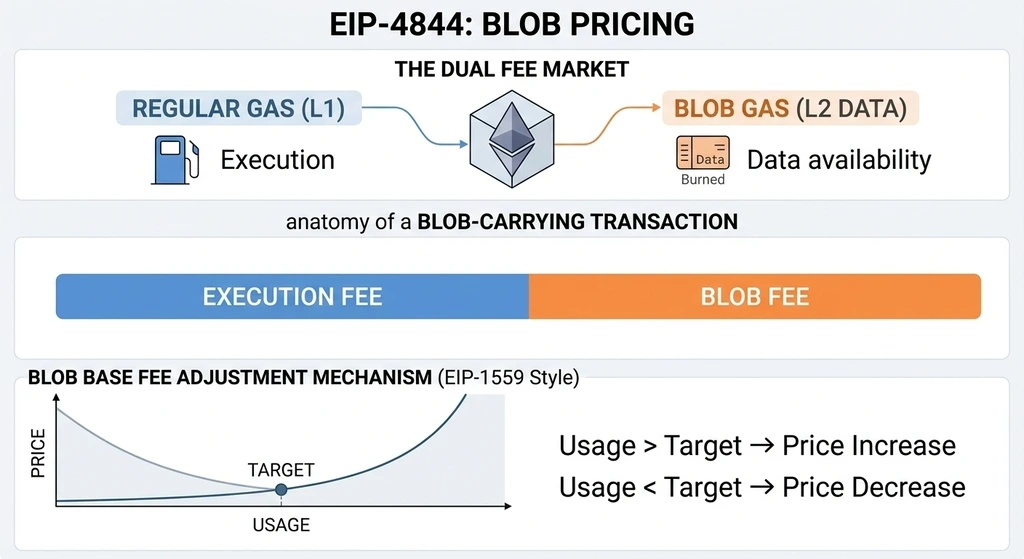
Each blob stores approximately 128 KB of data and is pruned after roughly 18 days. The network maintains a target of 3 blobs per block with a maximum of 6.
Blob Pricing Mechanism and Volatility
The blob base fee starts at 1 Wei and adjusts using an EIP-1559-style mechanism. When blob demand exceeds the target of 3 per block, the base fee increases by 12.5% per block. This design creates a structural supply constraint: blob space is fixed at 6 blobs per block (approximately 0.75 MB), and validators cannot expand capacity.
Demand concentration exacerbates volatility. A small number of large rollups—Arbitrum, Optimism, and Base—dominate blob space consumption. When these entities simultaneously compete for blob space, prices spike disproportionately.
BlobScriptions demonstrated this vulnerability. In March 2025, the protocol allowing users to inscribe data directly onto blobs drove blob fees up by over 10,000%, reaching nearly $300 per blob. Pending blobs per block soared by over 3,700%, with blob space utilization reaching 100%. Average fees later subsided to approximately $6.57 (13.97 gwei). This event exposed the fragility of blob pricing under non-rollup demand.
The Pectra upgrade (May 2025) increased the target to 6 blobs per block and the maximum to 9, raising daily blob data capacity to approximately 8.15 GB. The base fee adjustment fraction was reduced, with full blocks now raising the base fee by approximately 8.2% per block. Despite this capacity expansion, blob utilization has remained below the new target, keeping fees near zero.
Fee Compression: Actual Numbers
The transition from calldata to blobs produced quantifiable cost reductions:
| Metric | Before EIP-4844 | After EIP-4844 |
|---|---|---|
| L2 data posting method | Calldata (permanent) | Blobs (temporary, ~18 days) |
| Typical L2 swap fee | $0.50 to $2.00 | $0.01 to $0.10 |
| Data cost per byte | 16 gas | 1 gas |
Data cost per byte dropped from 16 gas to 1 gas—a reduction of up to 94%.
Specific rollup fee reductions:
Arbitrum: Gas fees fell from $0.37 to $0.012 post-Dencun
Optimism: Dropped from $0.32 to $0.009
Base: Transactions frequently process for under $0.01
Median blob fees have reached as low as $0.0000000005. Some blob transactions settle at fractions of a penny—less than one-thousandth of a cent has been paid by rollups daily in certain periods.
Layer 2 fees fell roughly 90 to 95 percent overall following Dencun. The Dencun upgrade reduced median L2 fees by up to 99% by expanding blob capacity for rollup data availability. Major rollups reported over 90% reductions in data posting fees.
ZK rollups saw data costs drop from 75% of total costs to just 15%. Optimistic rollups experienced even more pronounced savings, with Optimism and Base fees dropping to near-negligible levels.
Total rollup expenditure on blobs has been approximately $3.55 million, with a per-GB cost of $16,473.
Impact on L2 Economics
Revenue Model Disruption
Before Dencun, L2 gas consumption accounted for up to 15.5% of Ethereum mainnet gas. Post-Dencun, this figure has remained around 1%. This compression has fundamentally altered L2 business models.
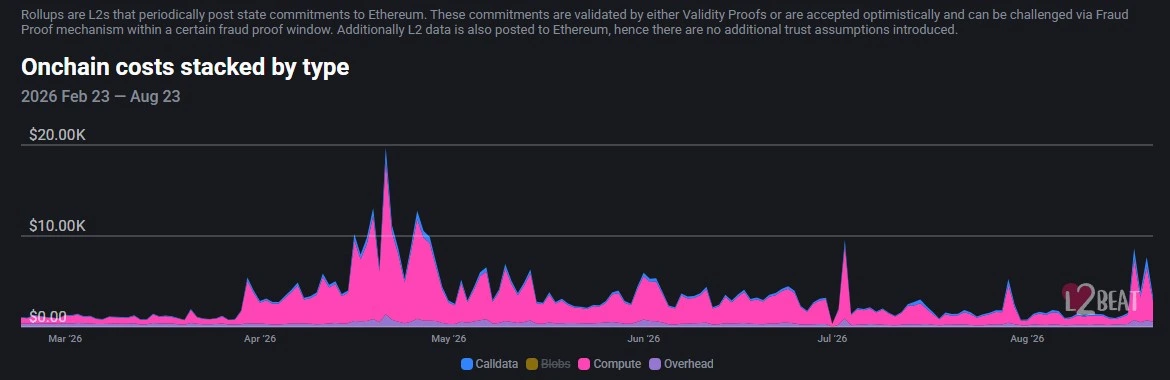
Sequencer revenue—historically the cornerstone of L2 economics—is evaporating. When transaction fees approach zero, the gas fee extraction model breaks. A rollup processing 10 million transactions per month at $0.001 per transaction generates just $10,000 in gross revenue—insufficient to cover infrastructure costs.
Divergent Outcomes
Rollups with established ecosystems have weathered the transition more effectively:
Base generated approximately $75.4 million in sequencer revenue in 2025, posting a 98.3% profit margin in May 2025 on $5.8 million in revenue. Base’s SocialFi and Meme sectors drove sustained activity.
Base and Arbitrum together command over 75% of Layer 2 DeFi total value locked (TVL).
Rollups dependent on gas—such as ZkSync—faced existential pressure. The geometric reduction in gas fees did not produce the anticipated user growth, forcing ZkSync to conduct its token airdrop to achieve partial exit.
Strategic Inefficiencies
Empirical analysis of the post-EIP-4844 market has identified widespread economic inefficiencies:
2.5× of blocks containing blobs are constructed sub-optimally, earning less revenue than achievable
Flawed submission strategies have led to 29.48% ETH in direct losses for rollups
Average inclusion delays exceed 186.92 seconds
Fee Market Function Failure
As L2 fees approach zero, the three functions of gas fees—throughput allocation, spam prevention, and revenue generation—break down:
Throughput allocation: Willingness to pay no longer distinguishes legitimate users from speculative actors
Spam prevention: At near-zero fees, spam becomes economically rational. On Base, a single arbitrage yielding $0.12 profit was preceded by approximately 350 failed probing transactions
Revenue generation: Any L2 business model predicated on gas fee extraction faces structural compression
MEV search bots on leading OP-Stack rollups now consume over 50% of all gas while paying under 10% of fees—meaning legitimate users and L2 operators are subsidizing bot activity at near-zero fee levels.
The Dencun upgrade achieved its primary objective: drastic L2 fee reduction. However, the blob pricing mechanism introduces structural volatility that complicates long-term planning for rollup operators. The supply constraint—6 blobs per block—combined with concentrated demand creates a market prone to extreme price spikes during congestion events.
The Pectra upgrade’s capacity expansion temporarily alleviated pressure, but utilization is expected to increase toward the new target. The underlying scarcity mechanism remains intact.
For L2 operators, the economic model has shifted from stable gas to uncertain, volatility-exposed costs. Rollups must now develop sophisticated fee abstraction layers and consider alternative revenue streams—including MEV capture, sequencer auctions, and ecosystem value extraction—to maintain sustainable operations.
The fee compression is structurally irreversible: every scaling improvement accelerates the convergence of L2 fees toward zero. The long-term viability of the rollup-centric roadmap depends on L2s’ ability to diversify revenue beyond transaction fees.
FAQ
What is a blob and how does it differ from calldata?
A blob is a temporary data structure introduced by EIP-4844 that stores approximately 128 KB of data for rollup transactions. Unlike calldata, which is stored permanently on Ethereum and competes with execution gas, blobs are pruned after roughly 18 days and operate in a separate fee market. This separation allows rollups to post data at a fraction of previous costs—data costs dropped from 16 gas per byte to 1 gas per byte.
Why are blob fees so volatile?
Blob fees exhibit extreme volatility due to a fixed supply constraint—a maximum of 6 blobs per block—and concentrated demand from a small number of large rollups. The EIP-1559-style pricing adjusts the base fee by 12.5% per block when demand exceeds the target of 3 blobs. Events like BlobScriptions have driven fees up by over 10,000% within hours. The 1 Wei minimum base fee means prices can spike from near-zero to hundreds of dollars during congestion.
How much did L2 transaction fees actually decrease after Dencun?
L2 fees fell roughly 90 to 95 percent overall following the Dencun upgrade. Specific reductions include: Arbitrum from $0.37 to $0.012, Optimism from $0.32 to $0.009, and Base consistently under $0.01. Some blob transactions have settled for as low as $0.0000000005. The Dencun upgrade reduced median L2 fees by up to 99%.
How has the fee compression affected L2 business models?
The fee compression has disrupted the traditional L2 revenue model based on gas extraction. Sequencer revenue has plummeted as transaction fees approach zero. Rollups with established ecosystems—such as Base, which generated $75.4 million in sequencer revenue in 2025—have adapted by leveraging MEV capture, sequencer auctions, and ecosystem value extraction. Rollups dependent on fee revenue, like ZkSync, have faced existential pressure. The long-term viability of L2s now depends on diversifying revenue streams beyond transaction fees.
What role did BlobScriptions play in blob market disruption?
BlobScriptions—a protocol allowing users to inscribe NFT-like assets onto Ethereum’s blobs—caused significant congestion in March 2025. The event drove blob fees up by over 10,000%, reaching nearly $300 per blob. Pending blobs per block soared by over 3,700%, with blob space utilization reaching 100%. This demonstrated that non-rollup demand can crowd out legitimate L2 data availability activity, creating unexpected cost spikes for rollup operators.

Isai Alexei is a journalist and financial analyst covering cryptocurrency markets and traditional securities for Blockchaindose. He has spent ten years analyzing digital assets, trading activity, and market structure.