
Canton Network blockchain confirms that Wall Street’s biggest names are taking Real-World Asset (RWA) tokenization seriously: DTCC, Goldman Sachs, HSBC, and Visa are all active participants, not just curious observers. Built by Digital Asset, a company that has spent over a decade on institutional distributed ledger technology, Canton bets that banks will only bring real securities on-chain if the network keeps their data private by default.
Key Takeaways
- Canton Network was publicly launched in May 2023 with backing from over 30 financial institutions, including Goldman Sachs, Deutsche Börse, and BNP Paribas.
- Digital Asset, the company behind Canton, raised $135 million in June 2025 from backers including the DTCC, Goldman Sachs, BNP Paribas, and Citadel Securities.
- DTCC and Digital Asset are targeting a gated MVP to tokenize a subset of U.S. Treasury securities in the first half of 2026, with broader rollout planned for the second half of the year.
- Canton has processed or issued over $6 trillion in tokenized assets to date, and its native token, Canton Coin, traded at a roughly $5.5 billion market capitalization as of July 2026.
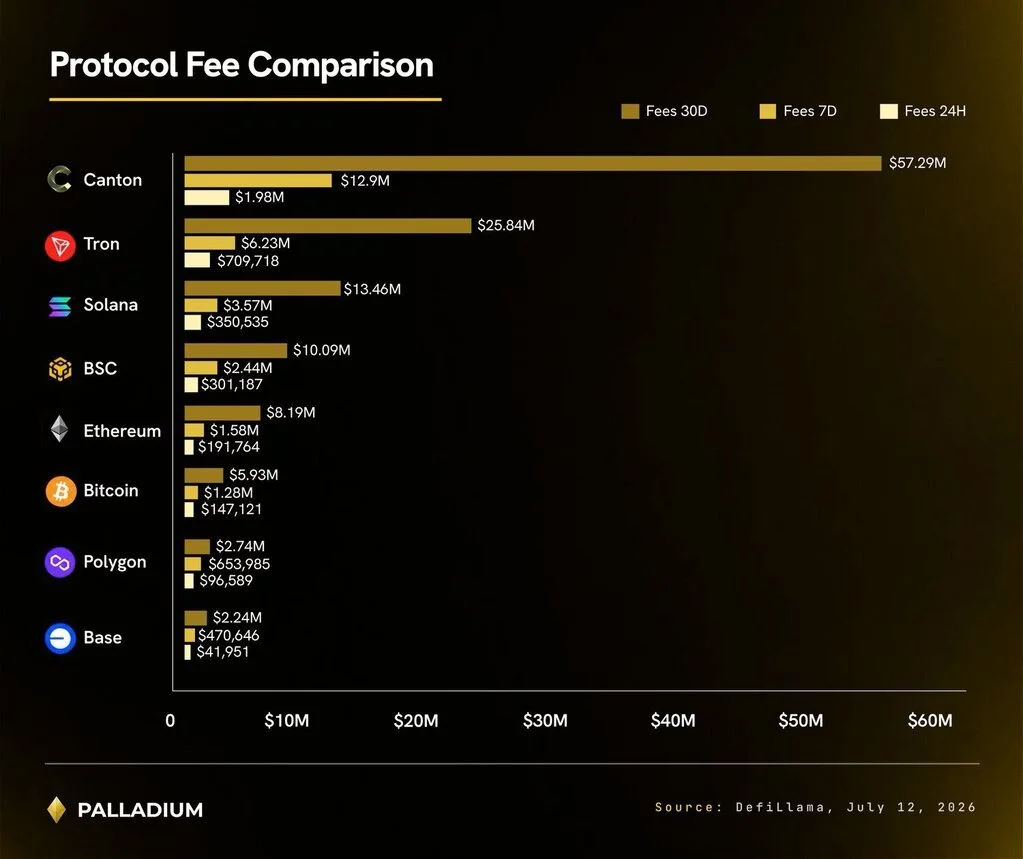
- Canton generates around $1.67 million in daily network fees, among the highest of any blockchain, though whether that usage translates into Canton Coin demand remains genuinely unproven.
This guide explains how Canton’s privacy-preserving architecture actually works, walks through the real, ongoing community debate over Canton versus Hedera for institutional adoption, examines how well claims that Wall Street is moving to Canton hold up, and closes with where Canton network stands in 2026.
What Is Canton Network Blockchain?
Canton Network blockchain is a public, permissioned Layer-1 built specifically for regulated financial markets: tokenized securities, digital bonds, repo trading, and collateral management, rather than general-purpose or retail crypto applications. It was developed by Digital Asset, a company founded in October 2014 that spent nearly a decade building Daml, an institutional smart-contract language, before publicly launching the Canton Network in May 2023 with backing from more than 30 financial institutions, including Goldman Sachs, Deutsche Börse, and BNP Paribas.
Digital Asset has continued raising institutional capital since launch, including a $135 million round in June 2025 backed by the DTCC, Goldman Sachs, BNP Paribas, and Citadel Securities. Cumulatively, the network has now processed or issued more than $6 trillion in tokenized assets, largely through applications like Broadridge’s distributed ledger repo platform.
The full breakdown of how Canton actually keeps transaction data private while still settling atomically across institutions follows in the next section.
How Canton’s Privacy and Consensus Architecture Works
Canton implements the ledger model of Daml, Digital Asset’s open-source smart contracts language, in which no single party ever sees the entire global ledger. Instead, each participant sees only the sub-transactions relevant to them, a design the whitepaper calls sub-transaction privacy. A clearinghouse can validate that a trade is legitimate without seeing its price; a regulator can audit a specific transaction without exposing an institution’s full portfolio.
Consensus itself runs on what Digital Asset calls Proof-of-Stakeholder, a two-layer design: a two-phase commit protocol that replicates each contract only to its actual stakeholders, plus a separate sequencing layer, run per “sync domain,” that uses a Byzantine Fault Tolerance algorithm to order transactions. Because different sync domains can process transactions in parallel, Canton is designed for horizontal scalability – institutions can run their own sync domains for jurisdictional or operational reasons while still atomically settling transactions with counterparties on other sync domains.
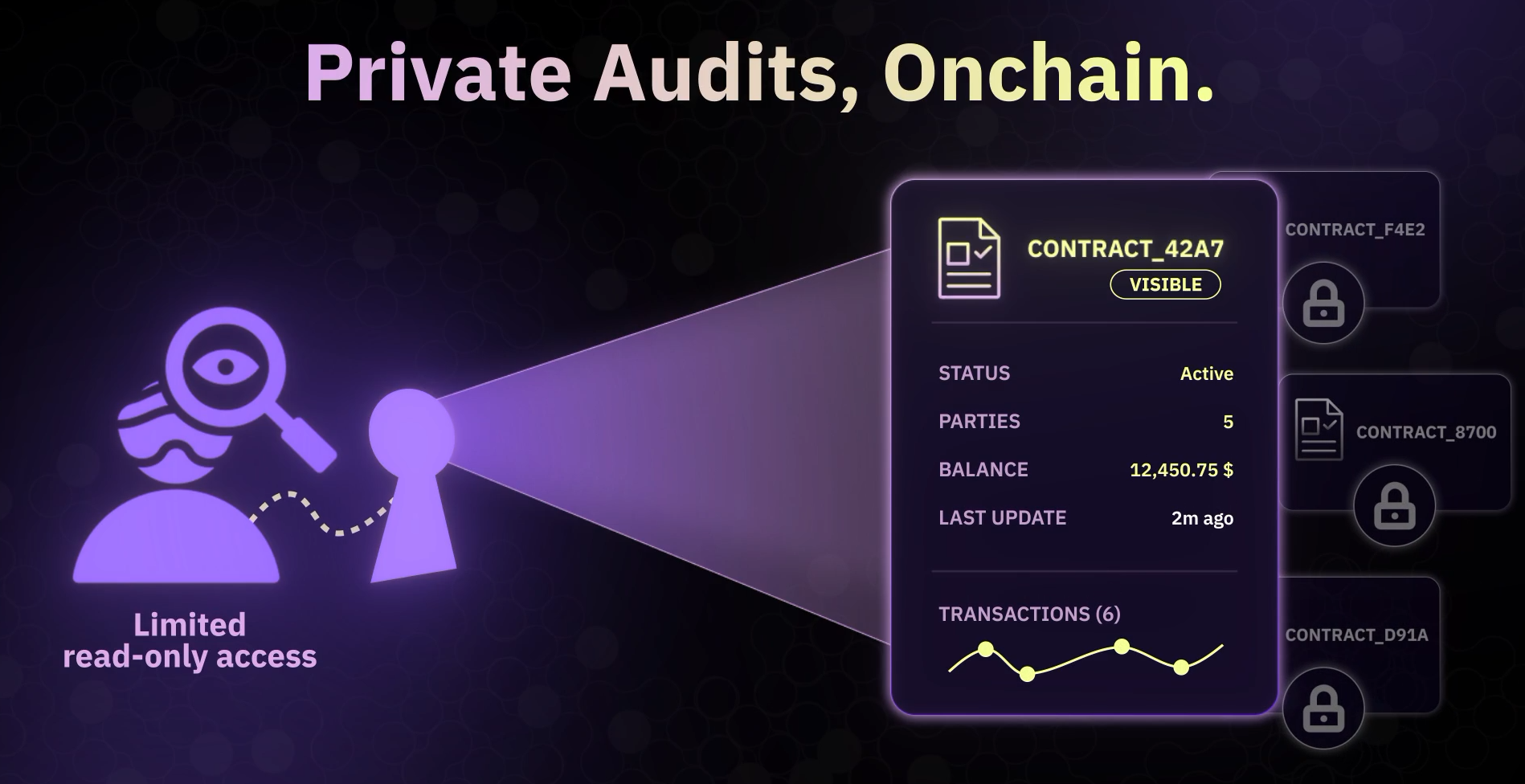
Canton describes itself as “public permissioned” rather than fully permissionless: anyone can request to run a validator node, though sponsorship is currently required, and individual applications built on Canton can set their own access rules ranging from fully open to entirely private. This flexibility is central to its pitch – institutions get a shared, publicly verifiable network without being forced into Ethereum-style full transparency.
Canton vs Hedera: The Institutional Blockchain Rivalry
No comparison generates more real, detailed community debate than Canton versus Hedera, another enterprise-oriented network competing for the same institutional business. Worth noting upfront: much of this debate plays out in Hedera’s own community, so the framing often favors Hedera – but the underlying technical distinctions are real and worth understanding on their own terms.
Vault vs Rail: Two Different Institutional Bets
A recurring analogy from community discussion frames Canton as a “vault” and Hedera as a “rail.” Canton is optimized for low-volume, high-value transactions, like a single multi-billion-dollar Treasury transfer, where privacy and institutional control matter more than raw throughput. Hedera, with its fixed, minimal fees, is pitched as better suited to high-volume, low-value transactions, such as millions of micropayments or fractionalized retail trades.
Under this framing, DTCC’s Canton partnership covers a specific, high-value slice of its business (a subset of Treasury custody) rather than the roughly 200 million daily transactions DTCC processes across equities and bonds overall.
BFT vs aBFT: A Genuine (and Contested) Technical Debate
Canton’s own technical documentation confirms its sequencing layer runs a standard Byzantine Fault Tolerant consensus algorithm per sync domain, which typically assumes partial synchrony (the network becomes reliably fast after some unknown but finite delay). Hedera instead uses a leaderless, asynchronous BFT (aBFT) hashgraph algorithm that makes no such timing assumptions.
Hedera’s community argues this makes aBFT more resilient under adversarial network conditions; Canton has not positioned itself as competing on this specific property, since its architecture prioritizes privacy and institutional control within permissioned sync domains over maximum theoretical fault tolerance in a fully adversarial, permissionless setting. Reasonable technologists disagree about how much this distinction matters in a network of vetted, sponsored validators rather than a fully open, adversarial one.
Fee Models: High-Value vs High-Volume
Community analysis of Canton’s published fee structure describes bandwidth-based synchronizer fees priced in USD, alongside percentage-based transfer fees that are proportionally higher for small transfers and show a steep decline for large ones. That structure fits institutions moving large, infrequent transactions but would be comparatively expensive for high-frequency, small-value activity, which is precisely the gap Hedera’s fixed, sub-cent fees are designed to fill.
Whether that fee-model difference determines which network wins specific institutional use cases, or simply reflects two different niches within the same overall tokenization market, is still an open and actively debated question.
Is Canton Really Winning Institutional Adoption?
Some favorable coverage of Canton implies a number of major financial institutions concentrating on the network. A detailed review complicates the picture. When one widely discussed analysis listed DTCC, HSBC, JPMorgan, Goldman Sachs, BNY Mellon, Nasdaq, BlackRock, and Fidelity as evidence of institutional tokenization momentum around Canton, community fact-checking pointed out that several of those same institutions’ most recent tokenization products, including JPMorgan’s JLTXX money market fund and BlackRock’s BSTBL and BRSRV funds, were actually built on Ethereum, not Canton.
The more accurate interpretation is that the institutions are experimenting across multiple chains at the same time instead of consolidating on one. DTCC itself has repeatedly described its ComposerX tokenization platform as “chain-agnostic,” meaning its Canton partnership for Treasury tokenization is one deployment among what will likely be several, not an exclusive commitment. The distinction matters for anyone evaluating Canton’s actual competitive position instead of its headline partnership announcements.
Canton Coin (CC) Tokenomics
Canton Coin’s distribution model is unusual for a project with this much institutional backing: there was no pre-mine, no ICO, and no direct VC token allocation. Institutional investors who backed Digital Asset bought equity in the company, not CC tokens directly, which is itself a point of community debate – some see it as a sign the token’s value capture is secondary to the company’s, since node operators and application providers earn CC through network participation rather than by buying into an allocation.
CC uses a burn-and-mint model: network fees are paid by burning CC at its current market rate, while new CC is minted roughly every 10 minutes as rewards for validators, synchronizers, and application providers. As of July 2026, CC traded around $0.14 with a market capitalization of roughly $5.49 billion, with the network generating approximately $1.67 million in daily fees – reportedly among the highest of any blockchain by that measure.
Whether the arrangement translates into durable token demand remains unresolved: token liquidity relative to market cap has been described as weak, and institutional usage could keep growing on private sync domains without producing a large increase in visible demand for the public CC token.
Is Canton Network Worth To Keep an Eye on in 2026?
Canton Network’s institutional credibility is genuinely hard to dismiss: a DTCC partnership actually targeting production use in 2026, over $6 trillion in cumulative tokenized asset activity, and a growing list of banks and market infrastructure providers building on top of it. Its privacy-by-default, sub-transaction-visibility model addresses a real, specific objection institutions have long raised about fully transparent public blockchains.
The gap between Canton‑the‑network and CC‑the‑token requires attention, as most of the largest names associated with Canton are building on competing chains like Ethereum, and Hedera’s community presents a concrete technical case for a different set of trade‑offs. Canton’s position in 2026 looks less like a settled winner in institutional crypto regulations-first finance and more like one serious, well-funded contender in a market that traditional finance is still actively testing across several networks at once.
FAQ
Is Canton Network the same as Hedera?
No. Both target institutional and enterprise use cases, but they use different consensus designs (Canton’s per-sync-domain BFT versus Hedera’s leaderless aBFT hashgraph), different fee models (Canton’s bandwidth and percentage-based fees versus Hedera’s fixed low fees), and different positioning – Canton for large, private, high-value settlement, Hedera for high-volume, low-value throughput.
Is Canton Network fully public and permissionless?
Canton describes itself as “public permissioned.” Anyone can request to run a validator node, though sponsorship is currently required, and individual applications built on the network can set their own permission rules, ranging from fully open to fully private, rather than the network itself dictating a single access policy.
What is Canton Coin (CC) used for?
CC pays fees on Canton’s Global Synchronizer and rewards validators, synchronizers, and application providers. It follows a burn-and-mint model with no pre-mine, ICO, or direct VC allocation – institutional investors in Digital Asset hold company equity rather than CC tokens.
Has Canton actually replaced Ethereum for institutional tokenization?
No. Major institutions associated with Canton, including JPMorgan and BlackRock, have also launched recent tokenized fund products on Ethereum. DTCC has described its own tokenization platform as chain-agnostic, meaning institutions are testing multiple networks rather than consolidating on Canton alone.
What is Daml?
Daml is Digital Asset’s open-source smart-contract language, designed specifically for multi-party financial applications. It builds privacy and authorization directly into the language itself, so contracts define exactly who can see and act on each piece of data.
Does Canton use the same consensus as Hedera?
No. Canton uses a two-layer “Proof-of-Stakeholder” design with Byzantine Fault Tolerant sequencing per sync domain. Hedera uses a leaderless, asynchronous BFT (aBFT) hashgraph algorithm. Which approach is “better” is a genuinely contested technical debate rather than a settled question.

Isai Alexei is a journalist and financial analyst covering cryptocurrency markets and traditional securities for Blockchaindose. He has spent ten years analyzing digital assets, trading activity, and market structure.