Introduction and Market Context
Interoperability remains one of the unresolved problems in Web3. Ethereum, Cosmos, BNB Chain, Solana and hundreds of other networks operate independently, each with its own consensus rules, signature formats and execution models. Blockchain bridges provide the infrastructure that connects them: they allow a chain C2 to verify that an event occurred on a chain C1, and vice versa. The event may involve an asset transfer, a message passed between contracts or a state update.
The main problem with bridges is security. In 2022, the Ronin case, involving roughly $600 million after 5 of its 9 validator keys were compromised; Wormhole, involving roughly $320 million through a signature-verification flaw; and Nomad, involving roughly $190 million through an initialization bug, demonstrated the risks of concentrating liquidity in contracts protected by small committees or in code without formal proofs. Industry estimates attribute the largest share of funds stolen from the crypto sector that year to attacks on bridges.
Bridge designs have historically combined native verification using block headers and Merkle proofs, a model that does not depend on trusted third parties but requires storing and verifying C1 block headers inside C2, creating high computational and storage overhead.
External validator committees represent the other approach, offering lower costs and higher speed, although their security depends on a majority of nodes acting honestly; if the committee is compromised, the bridge is also compromised.
Zero-knowledge proofs introduce a third alternative: the zero-knowledge bridge (zkBridge). The model seeks to resolve the tension between efficiency and trustlessness because it inherits the security of the underlying blockchain without requiring the destination chain to repeat the entire verification process itself.
Core Concepts and Technical Architecture
What a zk-SNARK is and why it matters for bridges
A zk-SNARK (Zero-Knowledge Succinct Non-interactive ARgument of Knowledge) is a cryptographic protocol whose properties relevant to a bridge include its non-interactive nature (NIZK), which allows the prover to generate the proof without exchanging messages with the verifier, so the proof can be published within a transaction.
The proof is also succinct, meaning it is small and its verification time grows sub-linearly with the size of the computation it attests to. As an argument of knowledge, the proof convinces the verifier that the prover knows a valid witness without revealing it.
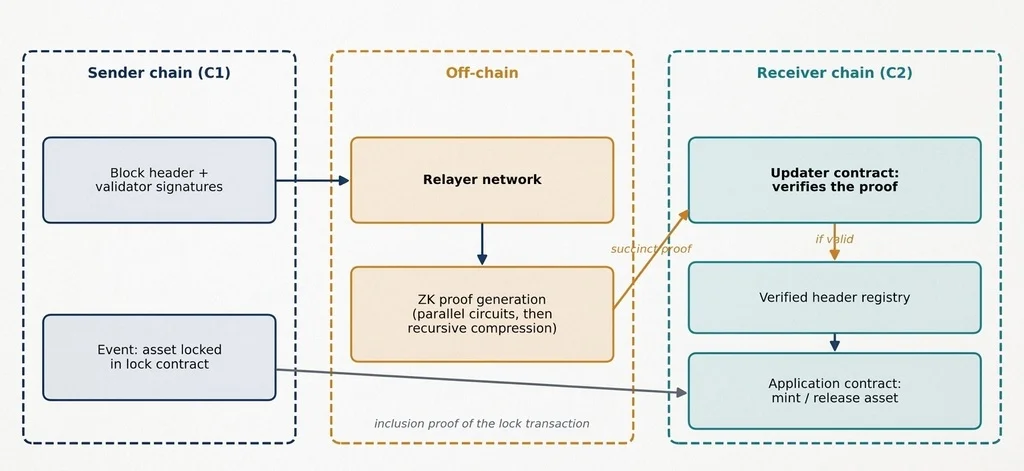
In a bridge, the witness consists of the set of signatures and headers showing that a C1 block has been finalized. The destination chain does not repeat that verification, a process that would cost millions of units of gas. Instead, it verifies a small proof showing that the verification was performed correctly.
The relayers and the two on-chain roles
The relayer network is responsible for fetching the block header from the sender chain and generating the ZK proof of its validity off-chain, and it is not a trusted entity: if it provides false information, the proof fails verification.
The updater contract runs on the receiving chain, verifies the proof on-chain, and records the new block header only when the proof is valid. Applications built on top of the bridge, which include token transfers, NFTs, or messaging, use the verified headers without reimplementing the verification logic.
Two ideas that make it practical
Proof generation is the part of the system that demands the most computational capacity, and the zkBridge design proposes two optimizations to address it.
One of them is parallelism through data-parallel arithmetic circuits: since bridge circuits contain many identical copies of a small sub-circuit, for example the verification of a validator signature, the system distributes N copies across N machines instead of processing them sequentially. This approach is called deVirgo, a distributed version of the Virgo proof system, and its authors report that proof generation time decreases by a factor of M when the work is distributed across M machines.
The other optimization is compression through recursion. A deVirgo proof can be generated quickly, but it occupies significant space, so the design addresses this problem by recursively proving the correctness of the previous proof using Groth16, a classic zk-SNARK. The final proof has constant size and can be verified at low cost inside a smart contract.
A clarification on EdDSA
Some introductions describe EdDSA as “the signature scheme used by zk-SNARKs.” The description is imprecise. EdDSA (Edwards-curve Digital Signature Algorithm), typically Ed25519 over a twisted Edwards curve, is the scheme used by validators on Tendermint/Cosmos-based chains. The ZK circuit proves that those signatures were verified correctly. The element with constant size and fast on-chain verification is the Groth16 proof, not the signature.
How It Works in Detail: Use Cases and Comparison
Token transfer flow
In a cross-chain token transfer, the user locks an amount of token A on the sender chain and receives the same value in token B, a “wrapped” asset, on the receiver chain. The process is sometimes described as staking, but the mechanism consists of a contract-held lock with no associated yield. The bridge verifies that the lock occurred and, only after that verification, mints the equivalent amount of the token on the receiver chain.
Use case: NFT transfers
Because NFTs require uniqueness—the same asset cannot exist on two chains at the same time—they illustrate the bridging process, which begins when the user deploys or uses a lock contract on C1 and a mint contract on C2. The lock contract then holds the NFT on the sender chain.
Next, zkBridge generates a proof that the lock transaction is included in a block that has already been verified. The mint contract then verifies the proof against the registered header and mints the NFT on C2.
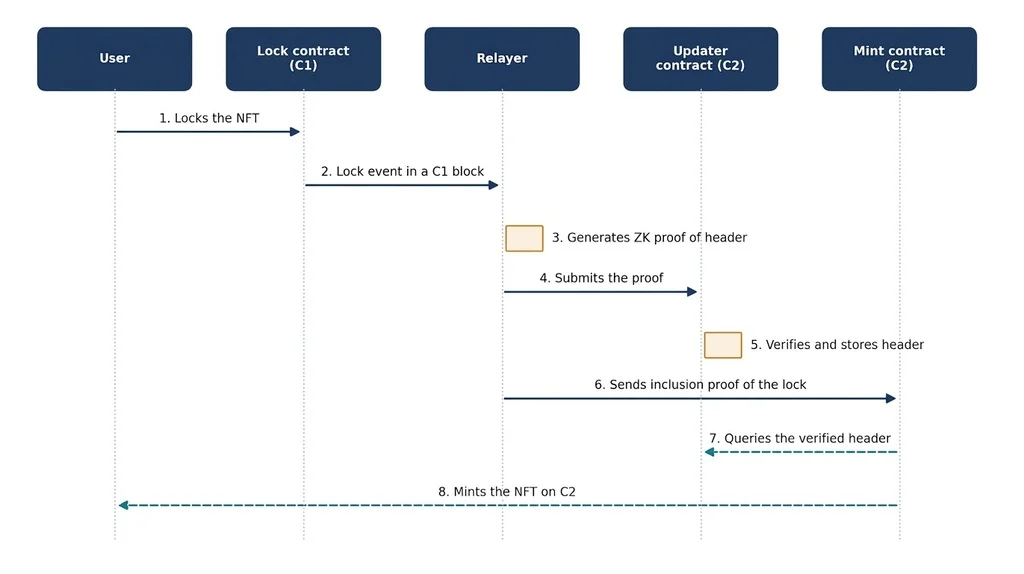
Application logic — lock, mint and burn — remains separate from verification logic. The same bridge can support NFTs, fungible tokens, cross-chain governance or messaging without repeating the cryptographic component.
Supported routes
The reference implementation supports a Cosmos → Ethereum bridge, a direction that requires large circuits. The authors also implemented and evaluated the direction from Ethereum to other EVM-compatible chains, such as BSC, which requires smaller circuits and produces much less overhead. Companies such as Polyhedra Network later developed solutions based on this line of research.
Comparison of bridge design approaches
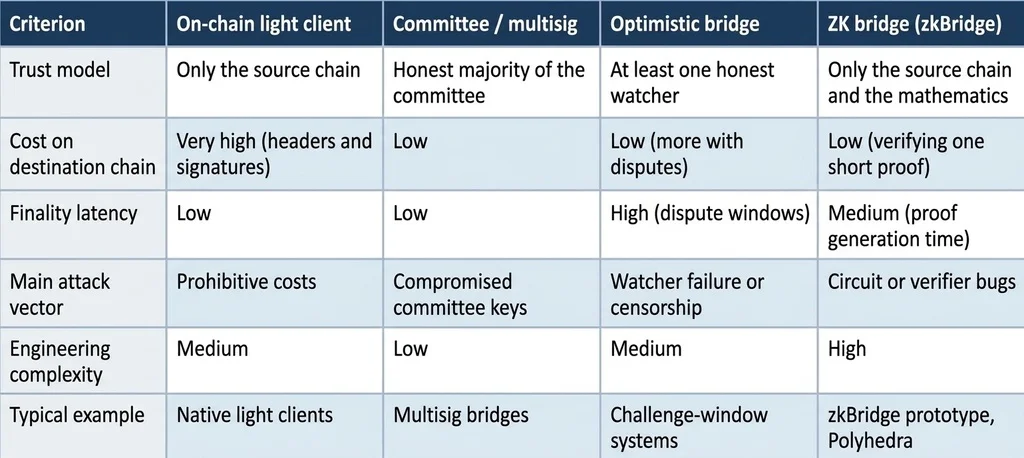
Challenge-based systems require waiting hours or days to allow disputes to be submitted. With zkBridge and batching, confirmation latency remains below approximately two minutes because validity is demonstrated through cryptographic proofs rather than depending on someone raising an objection.
Economic Impact, Tokenomics and Financial Implications
The cost that matters: gas
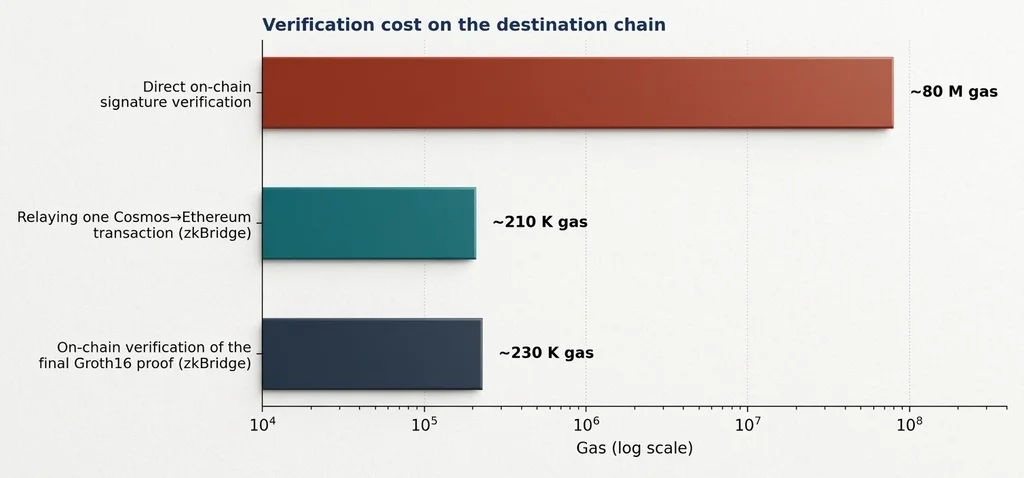
The main economic advantage comes from reducing verification costs. Verifying the signatures of an external chain directly on Ethereum can cost tens of millions of gas. According to the paper’s evaluation, zkBridge reduces verification from roughly 80 million gas to under 230,000. The authors also report that relaying a transaction from Cosmos to Ethereum costs around 210,000 gas.
With a gas price of 20 gwei and ETH at $1,600, an illustrative example puts direct verification at 80 million gas, equivalent to about $2,560. Proof-based verification, in turn, consumes 230 thousand gas, around $7.
Costs can be amortized further because a single header proof can serve many transactions included in the same block.
Key performance metrics
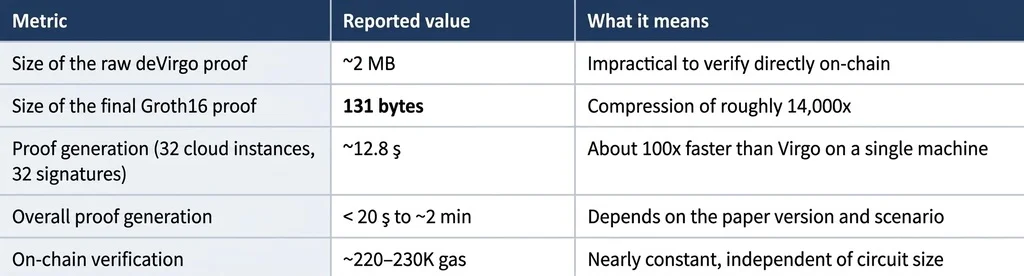
For example, with 32 cloud instances, the system generated a proof for 32 signatures in 12.8 seconds and reduced its size from 1.9 MB to 131 bytes. Timings vary across different versions of the paper: some report around 20 seconds, while others reach two minutes per header. The figures are therefore best interpreted as orders of magnitude.
Incentives and economic model
The design raises tokenomics questions that the research does not resolve, beginning with the need for relayer incentives, since generating proofs requires hardware, including GPUs and clusters, and commercial projects typically fund this work through per-message fees or token emissions.
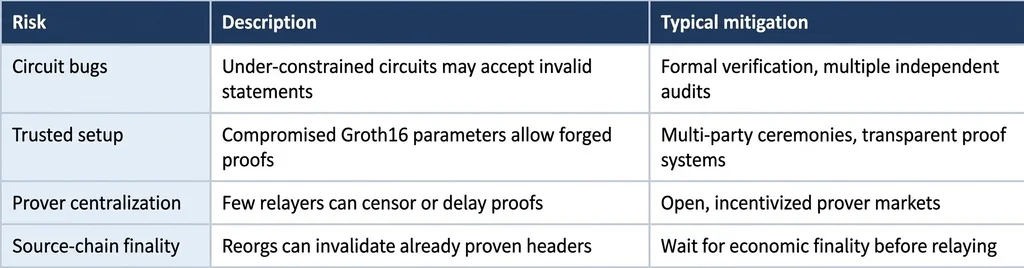
Although a malicious relayer cannot forge a proof, it can censor or delay operations, and a competitive market of provers reduces that risk. Wrapped assets create separate pools, and while a safer bridge reduces the risk premium, it does not eliminate the fragmentation problem.
Challenges, Risks and Outlook
Complexity is the first risk, since a ZK bridge moves the attack surface from the committee to the circuits and the on-chain verifier. A constraint error, such as an under-constrained circuit, can allow forged proofs. Auditing ZK circuits remains a young discipline with few specialists.
Groth16 requires a trusted setup for each circuit. If the initial parameters are compromised, forged proofs can be generated. Multi-party ceremonies reduce this risk, but the setup still depends on an assumption that must be disclosed.
Trustless verification does not eliminate dependence on RPC providers, proof-generation hardware, or relayer availability. If the source chain experiences a deep reorganization, the finality of its headers depends on the source chain’s own consensus.
The trend points toward improved proof systems, including STARKs, more efficient recursion, specialized hardware acceleration, and broader adoption of ZK light clients to verify Ethereum’s consensus. If proof-generation costs continue to decline, ZK bridges could become a standard for moving value between high-value chains.

Isai Alexei is a journalist and financial analyst covering cryptocurrency markets and traditional securities for Blockchaindose. He has spent ten years analyzing digital assets, trading activity, and market structure.