
A popular headline rang in crypto corridors this August, 45 Bitcoin metrics were in “capitulation.” According to analysts, this was the longest such stretch since the FTX collapse. It sounded like 45 separate alarms going off at once.
That isn’t what the data said. And what happened next says more about the claim than the headline did.
What the “45” actually is
Glassnode’s Bitcoin Cycle Position Heatmap combines data from 45 indicators into one picture, and a mostly blue board means the market is in a capitulation phase. It is a dashboard, and “capitulation” is its color, not a vote.
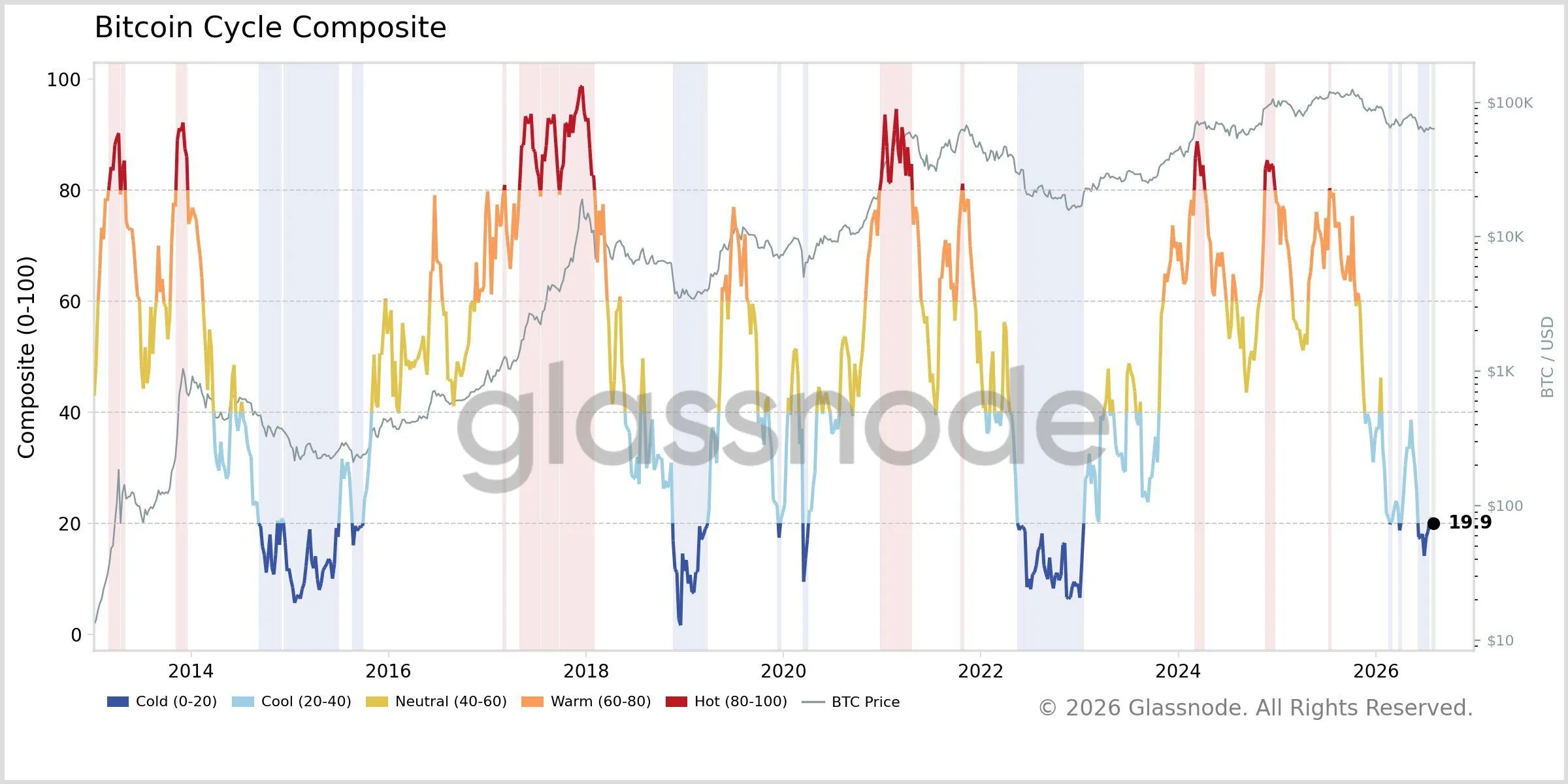
The number that matters is buried further down. Glassnode data showed 41 of the 45 indicators sitting in the bottom two quintiles of their historical ranges, and the Cycle Composite, which squeezes all 45 into a 0-100 score, read 19.9. That was the coldest reading since the FTX collapse.
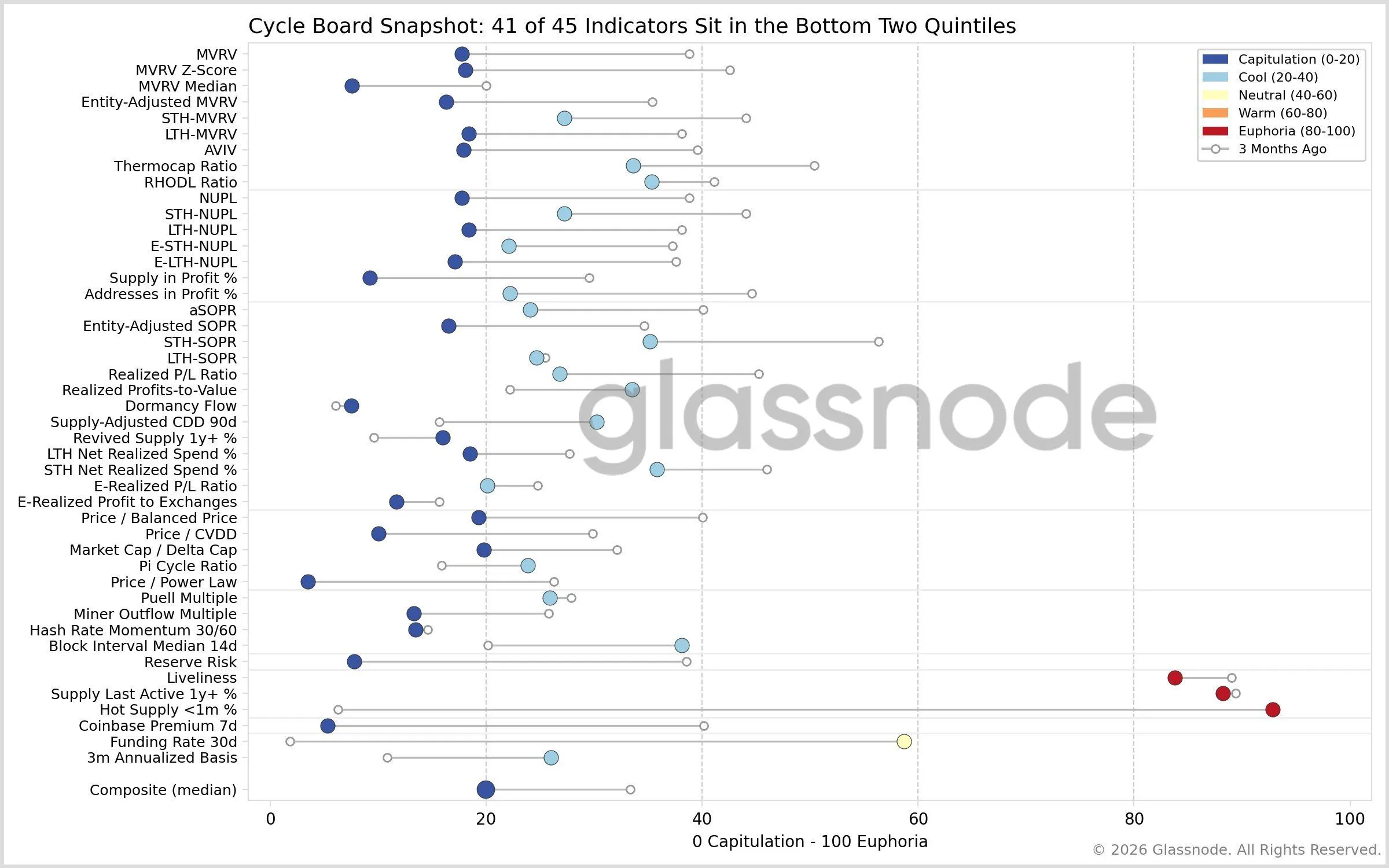
So the honest version is “41 of 45 indicators were in the cold zone.” Four were not. A few gauges even flashed red, including Liveliness and the share of supply last active over a year ago, though the analyst argued that coins moving between custodians inflates those coin-age readings.
The composite is also simpler than it sounds. It is the median of the 45 cycle indicators. Nothing is weighted by predictive power, so no single metric gets extra say.
The deepest readings
Some of the 45 were far colder than the median. Approximate percentile ranks put Price/Power Law at the 4th percentile and the 7-day Coinbase Premium at the 6th. Dormancy Flow, Reserve Risk and MVRV Median each sat near the 8th. A 4th percentile means price was lower against its trend model than on roughly 96% of past readings.
Put simply, Bitcoin was cheap against its own history on almost every measure. The median of 19.9 shows the whole basket leaning that way, not a few extreme outliers dragging it down.
“Longest” measures time, not depth
The phrase “longest since FTX” is easy to misread. It describes how long the board stayed blue, not how blue it got.
The 2022 comparison shows the difference. After a euphoric peak in late 2021, the heatmap turned blue through much of 2022, and Bitcoin bottomed near $15,600.
Glassnode co-founder Rafael Schultze-Kraft was careful about this. He said the board was late in the bear market but still not the unanimous deep blue that marked earlier bottoms.
The duration was real. Glassnode later said the composite had spent seven months in the cool band before returning to the neutral 40 level. The slide into the cold zone was also fast. Three months before the 19.9 reading, the composite median was near 33.
Did anyone else see the same thing?
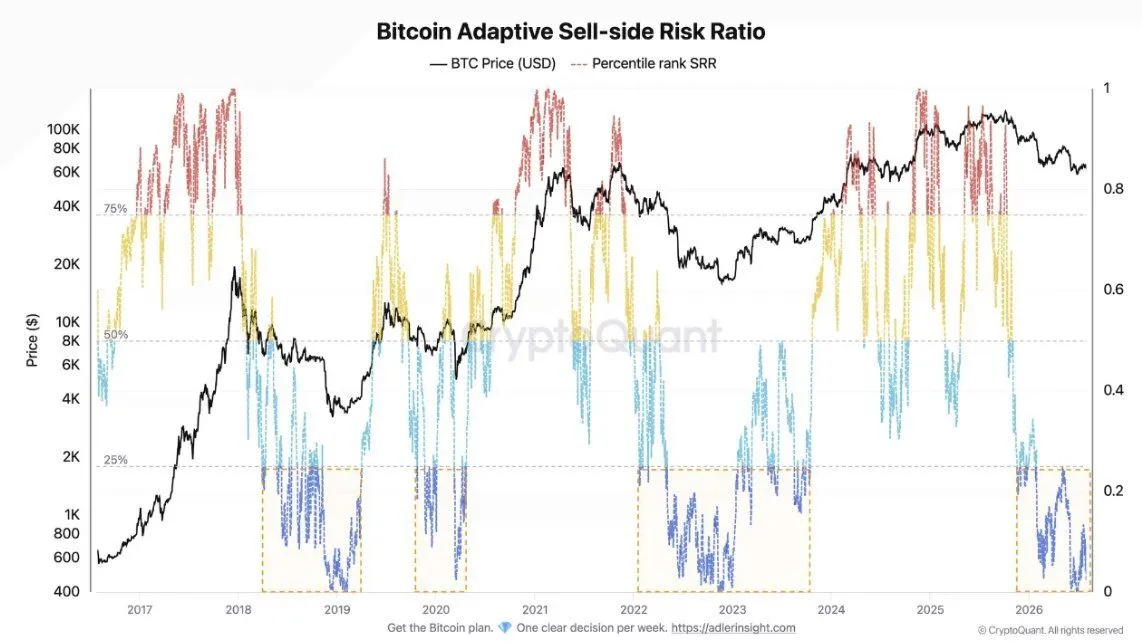
An independent dataset pointed the same way. CryptoQuant’s Adaptive Sell-side Risk Ratio fell to 0.031, the 3rd percentile of the current halving cycle. That is lower than on 97% of days since April 2024, and it had stayed below the 25th percentile since late January.
The profit picture agreed too. CryptoQuant data showed only 52% of Bitcoin supply in profit, and the share briefly fell below 50% in June and July. Almost half of all coins were underwater.
Price told the same story. Bitcoin traded near $64,587 after a low near $62,000, almost 50% below its October 2025 peak. One report puts the June low lower, at roughly $58,000, the lowest in 21 months. Sources differ on the exact low, but not on the direction.
What happened next
The “still not the bottom” caveat looks fair in hindsight. The low arrived first, and the recovery followed.
Price first went sideways. Glassnode saw signs of seller exhaustion, with Bitcoin stuck between $63,500 and $65,000 in early August. Then came a sharp break.
August 19 was the largest single-day short liquidation event in Glassnode’s data since 2019, with about 85% of liquidated positions on the short side. Real money followed the squeeze. US spot ETFs took in $2.23 billion across the window without a single outflow day, the strongest seven-day intake of 2026. Glassnode also noted that Bitcoin ran 26% off its mid-August low.
By September the move had widened. US spot Bitcoin ETFs took in $2.39 billion in the week to September 25, the strongest week of 2026. That helped push year-to-date flows out of a $5.8 billion deficit. Bitcoin touched highs near $87,000 around September 21 and was trading below $82,800 on September 28.
By my arithmetic, that is about 28% above the roughly $64,600 price when the capitulation headline ran, and about 43% above the $58,000 low. It is still around a third below the $126,200 record set in October 2025.
Where the claim holds up, and where it doesn’t
It holds up on the cold reading. The 19.9 composite, the 41-of-45 count and the percentile ranks are all documented. An outside dataset, CryptoQuant’s, agreed with them.
It holds up on duration. The board did stay cold for most of the year.
It falls short as a bottom call. By early August, price was already about 11% above the $58,000 low. The board was still cold while the recovery had quietly begun. It describes the state of the market, not the exact day to buy.
It falls short as a “buy everything” signal. The recovery now faces a wall of supply. Glassnode flagged a band of overhead supply between $81K and $86K. There is also a quieter friction. When Bitcoin returned to $78K in late August, 68% of supply was in profit, up from 65% at the same price in May, which means more coins are ready to sell into strength.
The composite has also moved on. By late August it had climbed back to 40, and Glassnode said the cycle board “still reads early.” The dramatic 45-metric reading now describes August, not today.
Most readers only ever see the shorthand, “45 bitcoin metrics in capitulation.” The useful information is 41 of 45, a median of 19.9, a duration record, and no unanimous deep blue. Those details separate “the market is stretched and cheap” from “the market has bottomed.” Knowing the difference keeps you from reading a heatmap’s color as a prediction.

Dan is a seasoned crypto writer for Blockchaindose who got his start in the space back in 2019. Over the past four years, he’s built a solid grasp of how the industry moves, focusing heavily on DeFi, NFTs, GameFi, and promising new projects.
Off the clock, you’ll usually find him buried in a good book or kicking back with a movie. His blend of hands-on market experience and straightforward commentary makes him a clear, trusted voice across the platform.