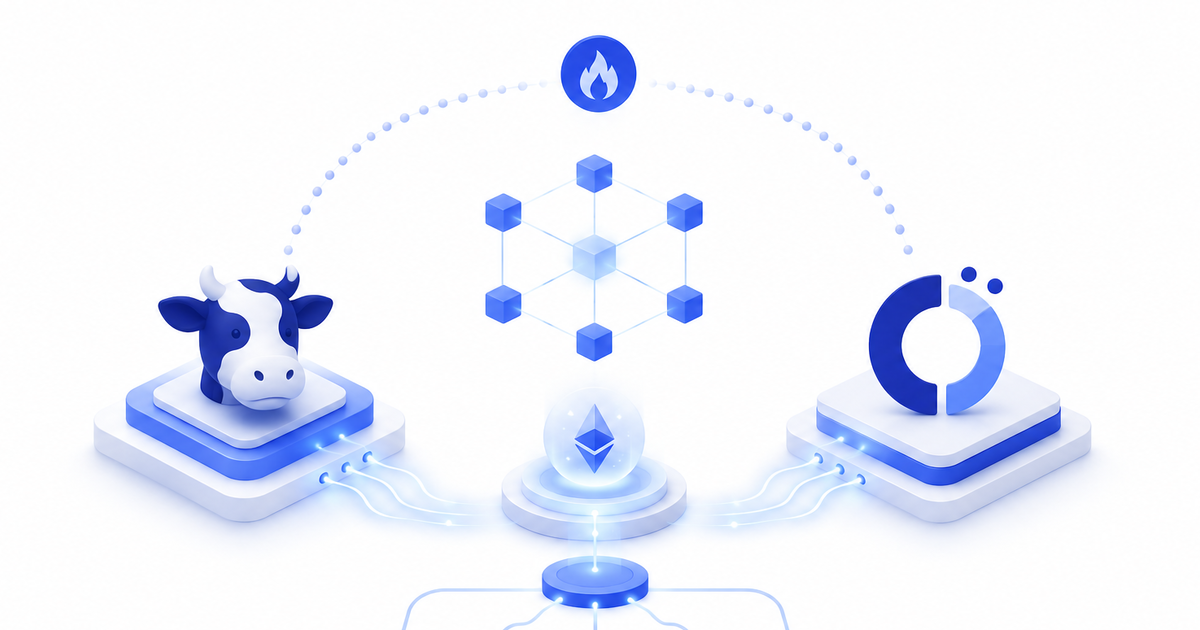
The emergence of intent-based architectures represents a structural shift in how blockchain transactions are constructed, executed, and monetized. Unlike traditional transaction models where users specify exact execution steps, intent-based systems allow users to declare a desired outcome—a “intent“—while delegating the execution pathway to a competitive class of specialized agents known as solvers. This delegation creates a new economic layer where solvers compete to capture execution surplus, and protocols design incentive mechanisms to align solver behavior with user welfare and protocol sustainability.
Two implementations—CoW Protocol and Anoma—exemplify distinct approaches to solver-driven execution. Both introduce novel solver economics that reallocate value from traditional execution intermediaries (validators, MEV extractors) to optimization-focused agents. However, their architectures, scope, and monetization strategies diverge significantly.
CoW Protocol: Batch Auctions and Competitive Solver Markets
CoW Protocol operates as an intent-based trading layer where users sign off-chain orders specifying desired trade parameters. These intents are submitted to a private order book rather than the public mempool, preventing front-running and MEV extraction. The protocol aggregates orders over approximately 30-second intervals and clears them through a batch auction mechanism.
Solvers—independent, bonded participants—compete to construct valid settlement solutions for each batch. A solver’s solution may include Coincidence of Wants (CoW) matching (peer-to-peer order matching within the batch), on-chain AMM routing, or off-chain liquidity sourcing. The protocol selects the solution that generates the maximum total surplus for the batch, and the winning solver receives compensation in COW tokens.
The economic model follows a clear value flow: users pay fees collected on trade surplus and volume, through integration partners and as network fees covering gas. CoW DAO retains a portion of these fees as protocol revenue; what remains after solver incentives constitutes gross profit. In Q1 2026, CoW Protocol reported $9.6 million in fees (-10.2% QoQ, +54.1% YoY) and $6.8 million in revenue (-36.6% QoQ, +23.1% YoY), with monthly active users reaching 64,500 (+5.9% QoQ, +71.1% YoY). Q2 2026 saw fees of $5.8 million (-40.3% QoQ, +42.6% YoY) and revenue of $3.9 million (-42.2% QoQ, +15.7% YoY), with 56,100 monthly active users.
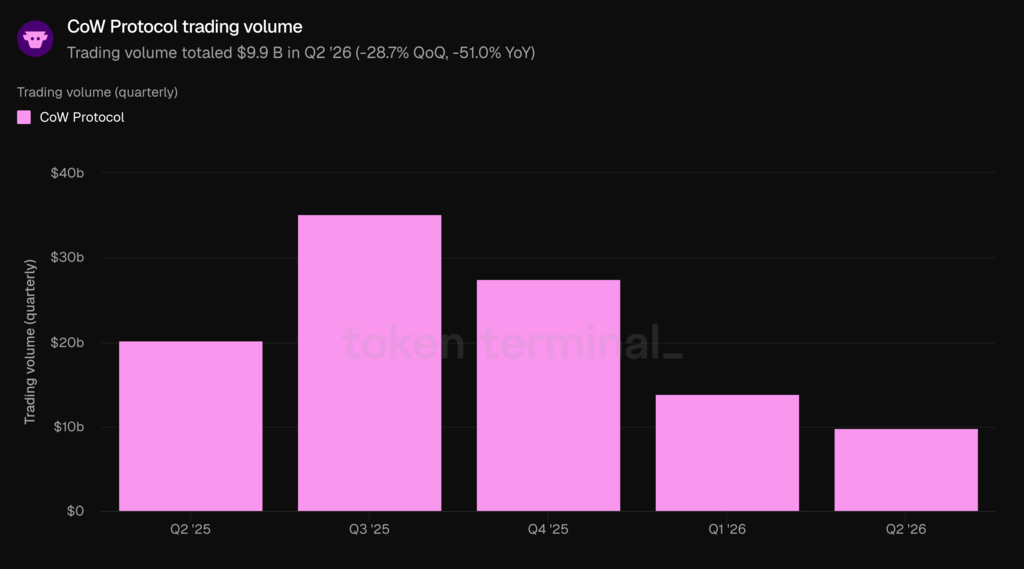
The team explicitly prioritized profitability over raw volume through the implementation of modest volume fees, a trade-off described as “healthy” given continued price improvement.
CIP-74: Aligning Solver Rewards with Protocol Revenue
A critical evolution in CoW Protocol’s solver economics is CIP-74, effective December 8, 2025. Prior to CIP-74, the protocol used a fixed reward cap in a second-price auction mechanism, which suppressed solver rewards on high-value batches while allowing rewards to exceed protocol fees on low-fee batches, particularly on Layer 2s.
CIP-74 replaced the fixed cap with a cap tied to protocol fees generated by the winning solution and introduced an unconditional volume fee of 2 basis points (0.02%). This reform reallocated trading value by order size and increased volume-weighted solver concentration—the Herfindahl-Hirschman Index (HHI) rose from 0.176 to 0.241. A July 2026 preprint analyzing the reform found that the ad-valorem fee is competitively neutral, while the dynamic reward cap restructures incentives across order sizes.
Some solvers noted that rewards on small trades sometimes fall below operational overhead. Despite these tensions, overall revenue remained stable, with the protocol earning more from a broader range of trade sizes.
Anoma: Generalized Intent Infrastructure and Cross-Chain Coordination
Anoma takes a broader approach, positioning itself as a generalized intent-centric Layer 1 blockchain—a “decentralized operating system” rather than a single application. The architecture comprises three layers: an intent pool collecting user intents, a Solver Network matching intents and generating transaction proposals, and a settlement layer executing final state transitions.
Users submit intents to a gossip network of Intent Gossip nodes and solvers. Solvers are permissionless market participants who may specialize in specific intent types (e.g., stablecoin routing, NFT matching) or operate as general solvers. Solvers listen for intents, match complementary intents, and compose them into complete, executable transactions with zero net value change. The solver determines what to match, when to match, what to charge for partial solving, and how to handle surplus.
XAN Token and Economic Coordination
Anoma’s native token, XAN, has a fixed total supply of 10 billion tokens. Unlike the traditional “one chain, one native asset” model, XAN’s value derives from cross-chain economic flows coordinated by Anoma. Users attach execution fees to their intents; solvers earn fees for matching, proving, and routing; the consensus layer charges for ordering and confirmation. These value streams can theoretically distribute across Ethereum, L2s, BNB Chain, and Anoma’s native Fractal Instances, positioning XAN as an “operating-system-level settlement and coordination currency”.
The token serves four core functions: (1) global economic coordination among users, solvers, consensus providers, and deployers; (2) fees and payments for network activity; (3) governance through locked token voting; and (4) future expansion including solver staking and slashing mechanisms. The 2.5 billion XAN Intents Initiates grant pool plus multi-season airdrops (approximately 10% of supply) directly drive developer and user growth. As of 2026, the Anoma DOS has expanded to multiple EVM ecosystems, with applications like AnomaPay entering public testing.
Solver Network and Decentralized Counterparty Discovery
The Solver Network enables decentralized counterparty discovery by collecting and matching multiple intents to find trading pairs that satisfy all participants. Solvers are assumed to have the computational power to see intents, match them, and output transactions. Users provide solvers with the data required to create future transactions, including resource objects, nullifier keys, and signed messages. Once a solver forms a fully balanced transaction, the transaction function is sent for ordering and final execution.
Anoma’s design emphasizes generalized intents—users can declare desired state changes across multiple domains, not just token swaps. This generality positions Anoma as infrastructure for a broader range of applications, from payments to complex DeFi workflows, all coordinated through the solver network.
Two Models of Solver Economics
CoW Protocol and Anoma represent two distinct implementations of solver-driven execution:
| Feature | CoW Protocol | Anoma |
|---|---|---|
| Scope | DEX aggregator with batch auctions | Generalized intent layer / OS |
| Intent Type | Token swaps | Generalized state transitions |
| Selection Mechanism | Batch auction, max surplus | Permissionless matching |
| Solver Compensation | COW tokens + fee share | XAN fees for matching/proving/routing |
| Token Function | Governance, bonding, rewards | Coordination, fees, governance, staking |
| Value Capture | Protocol fees, revenue share | Cross-chain economic flows |
Both models share a core logic: open market competition among solvers drives execution quality and price improvement. However, the value accrual mechanisms differ. CoW Protocol captures value through protocol fees on trade surplus and volume, distributing a portion to solvers as incentives. Anoma captures value through XAN’s role as a coordination medium across chains and applications, with solvers earning fees directly from users.
CoW Protocol’s CIP-74 provides empirical evidence on how solver reward structures affect market concentration. The reform increased volume-weighted solver concentration (HHI from 0.176 to 0.241), suggesting that reward design directly shapes market structure. The finding that ad-valorem fees are competitively neutral while dynamic reward caps restructure incentives by order size has implications for protocol design beyond CoW Protocol.
FAQ
What is an intent-based architecture in blockchain?
An intent-based architecture allows users to declare a desired outcome (an “intent”) rather than specifying the exact execution steps. The network delegates execution to specialized agents called solvers, who compete to find the optimal pathway to fulfill the user’s intent.
How do solvers earn revenue in CoW Protocol?
Solvers earn COW token rewards for winning batch auctions. Additional revenue comes from user fees collected on trade surplus and volume, with CoW DAO retaining a portion and distributing the remainder as solver incentives. The reward structure is governed by a series of CIPs (CoW Improvement Proposals), with CIP-74 introducing a dynamic reward cap tied to protocol fees.
What is the role of the XAN token in Anoma’s solver economy?
What are the main risks associated with solver-based execution?
Key risks include solver centralization, where a small number of dominant solvers reduce competitive pressure and potentially degrade execution quality. Bonding requirements create barriers to entry that may limit solver diversity. Additionally, governance capture could weaken accountability mechanisms if solver-aligned interests gain control over slashing parameters.
How does CIP-74 change solver incentives in CoW Protocol?
CIP-74 replaced the fixed solver reward cap with a dynamic cap tied to protocol fees generated by the winning solution and introduced a 2-basis-point volume fee. This reform reallocated trading value by order size and increased solver concentration, as measured by the HHI rising from 0.176 to 0.241. The change aims to align solver incentives with protocol revenue but has also made small orders economically unattractive for some solvers.

Isai Alexei is a journalist and financial analyst covering cryptocurrency markets and traditional securities for Blockchaindose. He has spent ten years analyzing digital assets, trading activity, and market structure.