
Aztec Network Ethereum is the project trying to prove that a public blockchain doesn’t have to choose between privacy and programmability, building what it calls a private world computer as one of the more ambitious zero-knowledge rollups built on Ethereum. Rather than shielding just payments, Aztec lets developers write smart contracts where some data stays private, some stays public, and the split is up to them.
Key Takeaways
- Aztec Network’s “Ignition Chain” mainnet went live November 19, 2025, becoming one of the few Layer-2 networks Vitalik Buterin has recognized as reaching “Stage 2” decentralization.
- Aztec Network is not the same project as the older Aztec Connect, which was sunset in 2023 amid centralization issues and Tornado Cash sanctions fallout – lessons from that shutdown shaped Aztec’s permissionless sequencer design from day one.
- The AZTEC token sale drew over 16,700 participants and raised roughly 19,476 ETH, following $119 million in earlier funding from Paradigm and a16z.
- A critical vulnerability discovered March 17, 2026 delayed a planned fix into the “v5” release, which finally shipped in alpha on July 21, 2026.
- v5 introduced client-side proving, generating zero-knowledge proofs directly on a user’s own device and cutting typical private transaction fees to under $0.05.
This guide explains how Aztec’s hybrid public/private execution model actually works, looks at what went wrong with its predecessor Aztec Connect, unpacks real community debate over its token sale and KYC approach, and closes with where the project stands after its latest v5 upgrade.
What Is Aztec Network Ethereum?
Aztec Network Ethereum is a Layer-2 zkRollup – it doesn’t run its own independent consensus outside of Ethereum’s security, but bundles transactions and zero-knowledge proofs that ultimately settle back to Ethereum mainnet. Its mainnet consensus layer, called Ignition Chain, went live on November 19, 2025, triggered automatically once its validator queue reached 500 participants and began producing blocks. At launch, Ignition was a functioning, block-producing chain without its full smart-contract execution layer turned on yet – a deliberate staged rollout rather than a single big-bang launch.
The project is backed by more than $119 million in funding from investors including Paradigm and a16z, and its AZTEC token sale – an on-chain auction rather than a typical presale – drew over 16,700 participants who committed roughly 19,476 ETH.
The full breakdown of how Aztec’s private and public execution actually work together, using the Noir programming language, is covered in the next section.
How Aztec’s Hybrid Public/Private Execution Works
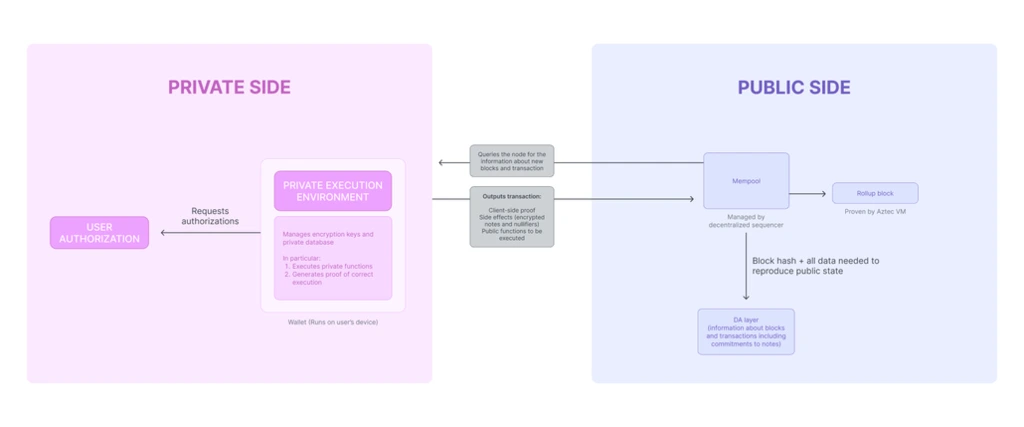
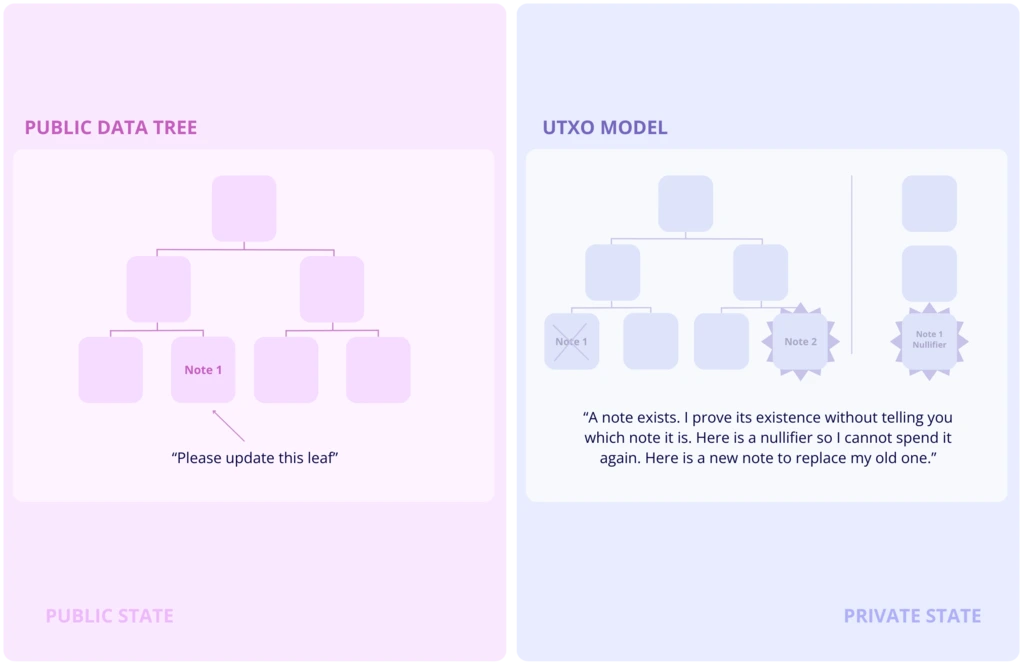
Aztec’s core technical bet is what it calls hybrid execution: a single smart contract can have both private functions, which run locally on a user’s own device and only publish a zero-knowledge proof of correctness, and public functions, which execute transparently like a normal Ethereum smart contract. Developers write this logic in Noir, an open-source, Rust-like programming language purpose-built for zero-knowledge circuits, rather than Solidity.
Network operation splits across three roles: sequencers collect transactions and build blocks, provers turn those blocks into validity proofs that get verified on Ethereum, and nodes sync and serve chain data. The v5 upgrade, shipped in alpha on July 21, 2026, pushed proof generation itself onto users’ own phones and laptops instead of centralized proving infrastructure – a change the team says more than doubled proof speed, cut the average cost of a private transaction by about half, and brought typical private transfer fees under $0.05.
From Aztec Connect to Aztec Network: What Changed
Aztec Network isn’t the company’s first attempt at bringing privacy to Ethereum. An earlier product, Aztec Connect, let users deposit ETH and other assets into a shielded pool and use that shielded balance directly with DeFi protocols like Aave or Lido, without withdrawing first – functionally similar to Tornado Cash but composable with DeFi. It was sunset in 2023.
Community critiques of Aztec Connect at the time were fairly specific and, with hindsight, informative: its anonymity set was tiny compared to a payment-only privacy coin, with only a few million dollars in value moving through the bridge at any given time. Transaction processing ran through a single centralized relayer, and after Tornado Cash was sanctioned by the US Treasury, that relayer stopped accepting transactions from independent, decentralized nodes altogether rather than staying permissionless. Deposit caps limited individual transactions well below what a serious DeFi user might want to move privately.
Aztec Network’s current design responds to prior events.Sequencers and provers are permissionless from launch rather than centralized-then-decentralized-later, addressing the core complaint that Aztec Connect’s privacy depended on trusting one operator not to censor or surveil transactions.
The Token Sale, KYC, and Community Reaction
Aztec’s approach to its own token sale generated a genuinely interesting debate in staking communities. Eligibility leaned heavily on existing, verifiable participation – solo staker lists, Rocket Pool node operators, EthStaker community contributors, and similar groups – rather than a blanket public airdrop. Participants did have to complete a know-your-customer style check to confirm they weren’t in a small number of restricted jurisdictions, which some users initially found ironic for a project built entirely around privacy.
In practice, the verification used zero-knowledge identity tools that check a government ID locally on the user’s own device and only share a yes-or-no answer about age and jurisdiction, rather than uploading a passport scan to a company database. Reaction split along predictable lines: some users still objected to any KYC step on principle, while others argued that proving compliance without handing over the underlying personal data is close to the best version of that trade-off achievable today.
Aztec vs Other Privacy Blockchains
Aztec occupies a distinct niche among privacy-focused crypto projects: it’s one of the only major projects treating privacy as a general-purpose smart-contract feature built directly into an Ethereum Layer-2, rather than as a standalone Layer-1 or a payments-only shield. Zcash and Monero shield transfers of their own native asset but offer no programmable contracts. Iron Fish takes a similar zk-SNARK route but, like Zcash, focuses on shielding its own native asset rather than general computation. Aztec’s bet is that developers and liquidity already live on Ethereum, so privacy should be added there rather than asking users to bridge assets to an entirely separate chain first.
|
Project |
Privacy Method |
Programmable Privacy |
Base Chain |
|
Aztec Network |
zk-SNARKs (Noir circuits) |
Yes – full private smart contracts |
Ethereum L2 |
|
Zcash |
zk-SNARKs (Sapling) |
No |
Standalone L1 |
|
Monero |
Ring signatures, RingCT |
No |
Standalone L1 (PoW) |
|
Iron Fish |
zk-SNARKs |
No |
Standalone L1 |
Known Challenges and Open Questions
The March 2026 Critical Vulnerability
In March 2026, Aztec’s team discovered and disclosed a critical vulnerability in the network’s proving system, serious enough that, per its own severity matrix, exploitation could have led to theft of user funds and severe protocol disruption. Rather than patch it immediately, the team folded the fix into its next major release, v5, which slipped from its original schedule and didn’t ship until July 2026.
Publicly disclosing a critical bug before a fix is fully live is an unusually transparent move by crypto standards, but it also meant the network operated for months with a known, unpatched, funds-at-risk issue in its core cryptography. It is worth noting this was a disclosed vulnerability, not a confirmed exploit – no funds are reported to have been stolen as a result.
Partial Decentralization at Launch
Aztec’s November 2025 mainnet launch was explicitly described by outside reporting as decentralized “almost” – Ignition Chain produced blocks and reached consensus, but launched without its smart-contract execution layer active, meaning the network’s most privacy-relevant feature wasn’t actually usable by ordinary users on day one. Full transaction and smart-contract functionality only began rolling out in stages afterward, with block times only expected to reach a competitive 3-4 seconds by the end of 2026.
Aztec’s Place in the Ethereum and Rollup Ecosystem
Aztec’s zkRollup design is fundamentally a blockchain scalability technique as much as a privacy one: bundling many transactions into a single proof reduces the data Ethereum has to store and verify, lowering fees for everyone using the rollup. Unlike most rollups built for cost savings alone, Aztec uses a custom, privacy-preserving virtual machine rather than the standard EVM, which places it among non-EVM blockchain environments even though it settles to Ethereum – developers can’t simply redeploy existing Solidity contracts unmodified and expect private execution to work.
Is Aztec Network Worth Watching in 2026?
Aztec Network Ethereum is one of the more complex technical attempts to deliver real, programmable privacy to a major smart-contract ecosystem rather than to a standalone chain. Its hybrid public/private model, permissionless sequencer set from day one, and now client-side proving in v5 directly address the specific failures that sank its own predecessor, Aztec Connect. Vitalik Buterin’s public backing and recognition of its decentralization progress add real credibility that few competing privacy projects can claim.
At the same time, a critical vulnerability that remained unpatched for four months, a mainnet launch that deployed without its core feature enabled, and a still-evolving KYC-and-token-sale process are issues common in projects at an early stage. Whether Aztec becomes the default way developers add privacy to Ethereum, or one of several competing approaches, will likely depend on how quickly v5’s real-world usage grows now that private transactions are actually live.
FAQ
Is Aztec Network the same as Aztec Connect?
No. Aztec Connect was an earlier, separate product from the same team that let users shield ETH and use it directly in DeFi; it was sunset in 2023. Aztec Network is a newly built zkRollup with permissionless sequencers and provers from launch, designed partly in response to Aztec Connect’s centralization problems.
Is Aztec Network live yet?
Partially. Its Ignition Chain mainnet consensus layer launched in November 2025, and full private transactions and smart contracts have been rolling out in stages since, with the v5 upgrade in July 2026 enabling client-side proving and real application usage.
What is Noir?
Noir is Aztec’s open-source, Rust-like programming language built specifically for writing zero-knowledge circuits, used instead of Solidity to define Aztec’s private and public smart-contract logic.
Did Aztec’s token sale require KYC?
Yes. Participants had to pass a zero-knowledge identity check confirming their age and that they weren’t located in a small number of restricted jurisdictions, using tools that verify this locally on the user’s device rather than uploading identity documents to a central database.
How is Aztec different from Zcash and Monero?
Zcash and Monero shield payments involving their own native asset but have no general smart-contract capability. Aztec is built to support full private and public smart contracts on top of Ethereum, letting developers choose what stays confidential on a per-application basis.
Was Aztec Network hacked?
No confirmed exploit or fund loss has been reported. The team did disclose a critical vulnerability in its proving system in March 2026, which it says was fixed as part of the v5 release in July 2026, but this was a proactively disclosed weakness rather than an executed attack.

Isai Alexei is a journalist and financial analyst covering cryptocurrency markets and traditional securities for Blockchaindose. He has spent ten years analyzing digital assets, trading activity, and market structure.