
Blockchain development is no longer a niche pursuit for cryptography enthusiasts. It has grown into a broad software engineering discipline, covering everything from smart contract programming and decentralized application (dApp) architecture to Layer 1 protocol engineering and enterprise-grade distributed ledger systems. Whether you are a founder evaluating which chain to build on, a developer considering a career switch, or a business exploring blockchain for operational efficiency, understanding what blockchain development actually involves is the first step.
Key Takeaways
- Blockchain development is the process of building software on distributed ledger infrastructure, covering smart contracts, dApps, protocols, and tooling.
- The global blockchain technology market is projected to grow from USD 24.46 billion in 2025 to USD 299.54 billion by 2030, according to Mordor Intelligence.
- Blockchain developers are among the highest-paid tech professionals, with average salaries ranging from $120,000 to $190,000 annually in the US.
- The field spans multiple tracks: smart contract development, protocol engineering, dApp development, and blockchain infrastructure – each requiring different skills and languages.
- Despite hype cycles and debate, real adoption is accelerating in DeFi, tokenization of real-world assets, identity verification, and enterprise finance.
The market reflects this growth. According to Mordor Intelligence, the blockchain technology market is expected to reach USD 24.46 billion in 2025 and expand to USD 299.54 billion by 2030 at a compound annual growth rate of 65%. Much of that growth is driven not by cryptocurrency speculation but by enterprise adoption in financial services, supply chain, healthcare, and identity management.
This guide covers what blockchain development is, how it works, the main types and languages involved, what the development process looks like in practice, and how the field is evolving in 2026. It is written for non-technical readers who need to understand the landscape – not for those looking for a coding tutorial.
What Is Blockchain Development?
Blockchain development refers to the process of creating applications, protocols, and tools that operate on or interact with a blockchain network. A blockchain is a distributed ledger – a database that is replicated across many computers (nodes) simultaneously, where records are grouped into blocks, cryptographically linked in sequence, and made virtually tamper-proof once confirmed.
What makes blockchain development different from conventional software development is the environment it targets. When code is deployed to a blockchain – most commonly as a smart contract – it becomes immutable. There is no central server to patch, no admin panel to adjust settings. This creates both significant advantages (transparency, trustlessness, censorship resistance) and serious constraints (bugs cannot be fixed after deployment, every computation costs money in the form of transaction fees).
One observation that comes up repeatedly in developer communities is that blockchain development blends technical and social challenges in unusual ways. As one developer noted: “The tech is the easy part – the human layer is where things get complicated.” Governance, community coordination, and trust design are not afterthoughts in blockchain projects; they are core architectural decisions.
Blockchain Development vs Traditional Software Development
Several differences define blockchain development relative to standard software engineering:
- Immutability: deployed code cannot be changed, making pre-deployment testing and auditing critical
- Execution costs: every operation on a public blockchain consumes gas (transaction fees), which forces developers to optimize code efficiency in ways that traditional systems do not require
- Trustless logic: code must be self-executing and not depend on external authority – if a condition is met, the contract executes, regardless of what any party wants
- Public transparency: most blockchain code and transaction data are publicly visible, which changes how developers think about privacy and data architecture
- Off-chain complexity: real applications require significant off-chain infrastructure – databases, APIs, frontends, oracles – that must coordinate with on-chain logic
Types of Blockchain Development
Blockchain development is not a single discipline. Depending on what you are building, you will encounter different technical requirements, languages, and toolchains. The main categories are:
Smart Contract Development
Smart contracts are self-executing programs stored on a blockchain that automatically carry out predefined actions when specific conditions are met. Smart contract development is the most common entry point into blockchain programming and underpins DeFi protocols, NFT marketplaces, tokenization projects, and governance systems.
The dominant language for smart contracts on Ethereum and EVM-compatible chains (Polygon, Arbitrum, Base, Optimism, Avalanche) is Solidity. For Solana and other high-performance chains, Rust is the standard. Newer chains like Sui and Aptos use Move, a language designed specifically for asset-oriented programming with stronger safety guarantees.
A key challenge for smart contract developers is security. Because deployed contracts are immutable and often control significant financial value, vulnerabilities can be catastrophic and irreversible. Common issues include reentrancy attacks, integer overflows, and access control failures – which is why smart contract auditing has emerged as its own specialized field.
Decentralized Application (dApp) Development
A dApp (decentralized application) combines a blockchain backend with a traditional web frontend. The on-chain component handles logic that must be trustless – token transfers, voting, lending – while the off-chain component handles user interface, data indexing, and API access.
dApp development requires familiarity with blockchain-specific libraries such as ethers.js or web3.js for Ethereum interaction, alongside standard frontend skills in React or Vue. Developers also need to understand wallet integration (MetaMask, WalletConnect), transaction signing, and how to read and write blockchain state efficiently.
Protocol and Layer 1/Layer 2 Development
Building a blockchain itself – the base layer network, consensus mechanism, and validator infrastructure – is protocol development. This is significantly more complex than smart contract work and typically requires systems programming expertise in languages like Rust, Go, or C++.
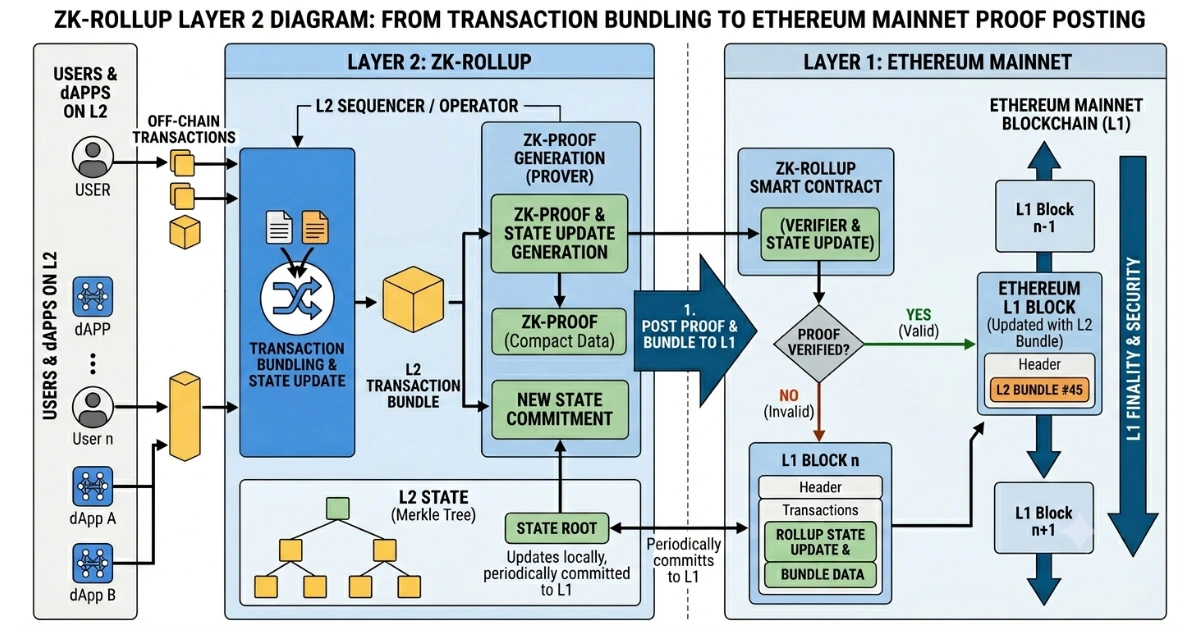
Layer 2 development involves building scaling solutions on top of existing blockchains. Technologies such as Optimistic rollups and ZK-rollups (used by Arbitrum, Optimism, and zkSync respectively) process transactions off-chain and post compressed proofs to Ethereum, dramatically reducing costs and increasing throughput.
Blockchain Infrastructure Development
Infrastructure development covers the tooling and services that applications need to function: RPC node providers, indexing solutions, oracle networks, and cross-chain bridges. Companies like Alchemy, QuickNode, and Infura provide managed node infrastructure that allows dApp developers to interact with blockchains without running their own nodes. The Graph protocol provides decentralized indexing so applications can query blockchain data efficiently.
Enterprise Blockchain Development
Enterprise blockchain development focuses on permissioned networks – blockchains where access is restricted to known participants. Frameworks such as Hyperledger Fabric (used by IBM and major financial institutions) allow organizations to get the benefits of distributed ledger technology – auditability, shared state, tamper resistance – without the openness of public networks. Development here typically uses Go or Java.
Blockchain Game Development and the Metaverse
Blockchain game development applies decentralized infrastructure to gaming, enabling true ownership of in-game assets through NFTs, player-driven economies with tradeable tokens, and game logic that runs transparently on-chain.
The primary languages and platforms used in blockchain game development mirror those of the broader smart contract ecosystem – Solidity for EVM-compatible games and Rust for Solana-based titles – with additional tooling for asset standards such as ERC-721 and ERC-1155 for NFT items and ERC-20 for in-game currencies.
The metaverse angle extends this further. Metaverse projects use blockchain as the ownership and economic layer for virtual worlds – recording land ownership, avatar assets, and in-game commerce on-chain so that value can persist and transfer across platforms. Projects like Decentraland and The Sandbox pioneered this model, though the broader vision of a fully interoperable metaverse remains a work in progress in 2026.
For developers, blockchain game development sits at the intersection of smart contract programming, game engine work (typically Unity or Unreal), and frontend web3 integration. It is one of the more technically demanding combinations in the field, but it also represents one of the clearest consumer-facing use cases for blockchain technology outside of finance.
Blockchain Development Types at a Glance
| Type | Primary Languages | Key Platforms | Common Use Cases |
|---|---|---|---|
| Smart Contract Dev | Solidity, Rust, Move | Ethereum, Solana, Sui, Aptos | DeFi, NFTs, DAOs, tokenization |
| dApp Development | Solidity + JavaScript | Ethereum, EVM chains | Web3 apps, marketplaces, gaming |
| Protocol / L1 Dev | Rust, Go, C++ | Custom L1s, Cosmos SDK | New blockchains, consensus design |
| Layer 2 Development | Solidity, Rust | Arbitrum, Optimism, zkSync | Scaling, low-cost transactions |
| Infrastructure Dev | Go, TypeScript | Alchemy, The Graph, Chainlink | Nodes, indexing, oracles |
| Enterprise Blockchain | Go, Java | Hyperledger, R3 Corda | Supply chain, trade finance, identity |
Blockchain Programming Languages
Choosing the right language in blockchain development depends entirely on which chain and what type of application you are targeting. Unlike traditional software development where JavaScript or Python are broadly applicable, blockchain development is more fragmented by ecosystem.
Solidity
Solidity is the dominant language for Ethereum and all EVM-compatible blockchains. It is statically typed, purpose-built for smart contracts, and compiles to EVM bytecode. Most DeFi protocols, NFT contracts, and DAO governance systems are written in Solidity. The learning curve is moderate for developers with JavaScript or Python experience, but writing secure Solidity requires deep understanding of the EVM execution model.
Rust
Rust has become the language of choice for high-performance blockchain development. Solana’s smart contracts (called programs) are written in Rust, as are significant portions of the Substrate framework (used to build Polkadot parachains), NEAR Protocol, and several Layer 2 implementations. Rust’s memory safety guarantees and performance characteristics make it well-suited for systems where correctness and speed are critical. The learning curve is steep compared to Solidity.
Move
Move was originally developed for Meta’s Diem project and is now used by Sui and Aptos. It treats digital assets as first-class objects with explicit ownership and access control, making certain categories of bugs (like double-spending) harder to introduce by design. Move is gaining traction among projects that want stronger safety guarantees than Solidity provides.
Go and TypeScript
Go is widely used in blockchain infrastructure and node client development – the Ethereum execution client Geth is written in Go, as is much of the Cosmos SDK and Hyperledger Fabric. TypeScript is increasingly common for dApp frontends, indexers, and developer tooling, especially when using frameworks like Hardhat or interacting with blockchain APIs.
The Blockchain Development Process
Building a blockchain application follows a structured process that differs in important ways from conventional software delivery – primarily because the cost of post-deployment errors is so high.
1. Define Use Case and Chain Selection
The first question in any blockchain project is whether blockchain is actually the right tool. Blockchain adds value when decentralization, transparency, or censorship resistance matter. If the requirement is simply a shared database between known parties, a conventional database is almost always faster, cheaper, and easier to maintain.
If blockchain is appropriate, the next decision is which network to build on. Key factors include transaction costs, ecosystem size, programming language support, and regulatory considerations. Ethereum remains the default for high-value applications requiring maximum security and ecosystem depth. Solana suits applications needing high throughput and low fees. Layer 2 networks like Base, Arbitrum, or Optimism offer Ethereum-compatible environments at lower cost.
2. Architecture and Tokenomics Design
Before writing a line of code, teams design the on-chain and off-chain architecture of the application. This includes defining what logic lives on-chain (and therefore cannot be changed after deployment) versus what lives off-chain (and can be updated conventionally). If the application involves a native token, tokenomics design – supply mechanics, distribution, incentive structures – is a critical early-stage decision.
3. Smart Contract Development
Development typically starts on a local development environment using frameworks like Hardhat or Foundry for Ethereum, or Anchor for Solana. These tools allow developers to write contracts, run automated tests, simulate transactions, and debug without spending real money. A meaningful portion of blockchain development time is spent writing tests – because unlike traditional software, bugs cannot be patched after deployment.
4. Security Audit
Before mainnet deployment, any serious project undergoes a security audit – an independent review of the smart contract code by specialized security firms. Major audit firms include Trail of Bits, Certik, Hacken, and OpenZeppelin. Audit costs range widely, but for production-grade DeFi contracts handling significant value, a thorough audit is non-negotiable. Many high-profile exploits in the blockchain space have occurred on contracts that were either not audited or where audit findings were not addressed.
5. Testnet Deployment
Before going live, applications are deployed to a testnet – a blockchain that mirrors the mainnet environment but uses tokens with no real value. This allows teams to test real user interactions, integration with wallets and frontends, and edge cases that unit tests may not catch.
6. Mainnet Deployment and Monitoring
Mainnet deployment makes the contract live and immutable. Post-deployment, teams monitor on-chain activity through block explorers and analytics tools, maintain off-chain infrastructure, and in some cases implement upgradeable proxy patterns that allow limited contract modifications through governance mechanisms.
Key Blockchain Development Tools in 2026
The developer tooling ecosystem has matured significantly. The following are the core tools used across most Ethereum-compatible development projects:
| Tool | Category | Use |
|---|---|---|
| Hardhat | Development framework | Contract compilation, testing, local node, Solidity debugging |
| Foundry | Development framework | Fast Solidity testing in Solidity (not JavaScript), gas reporting |
| Remix IDE | Browser IDE | Beginner-friendly contract writing and deployment |
| Alchemy / QuickNode | Node infrastructure | Managed RPC access to Ethereum, Solana, Polygon, and others |
| Ethers.js / Web3.js | JavaScript library | Frontend interaction with smart contracts and wallet signing |
| The Graph | Indexing | Querying blockchain data via GraphQL APIs |
| Chainlink | Oracle network | Bringing real-world data (prices, randomness) on-chain |
| OpenZeppelin | Smart contract library | Audited, reusable contract templates for tokens, access control |
| Tenderly | Monitoring / debugging | Transaction simulation, alerting, and error tracing |
Blockchain Development as a Career in 2026
The career outlook for blockchain developers is genuinely complex. On one hand, the hype cycle of 2021-2022 has clearly passed, and AI has absorbed much of the tech industry’s speculative attention. On the other hand, real adoption continues to grow in areas that generate legitimate demand for developers.
In terms of compensation, blockchain developers remain among the highest-paid technology professionals. According to ZipRecruiter, the average annual pay for a blockchain developer in the United States is $111,845 as of early 2026, with experienced professionals earning between $130,000 and $187,000. Web3-native companies frequently offer additional compensation in the form of token allocations, staking rewards, or protocol revenue shares.
The practical advice from experienced developers in the community is consistent: build real things. Contributing to open-source projects, deploying contracts on testnets, and maintaining a visible GitHub portfolio matters more than certifications. As one developer put it: “Use AI models not to generate code for you, but to generate problems for you to solve.” That approach – using tools to increase learning surface rather than to skip learning – is increasingly how skilled developers are entering the space.
The realistic assessment is that the job market is more selective than it was in 2021-2022. Developers who specialized primarily in NFT minting contracts or token launches have found demand reduced. Those with skills in smart contract security, ZK-proof systems, Layer 2 development, and cross-chain interoperability are seeing sustained and growing demand.
Blockchain Development Trends in 2026
Several technical directions are defining where blockchain development is heading:
ZK Technology Going Mainstream
Zero-knowledge proofs (ZKPs) have moved from theoretical research to practical production systems. ZK-rollups like zkSync, Starknet, and Polygon zkEVM use ZK proofs to validate transaction batches, dramatically reducing costs while inheriting Ethereum’s security. ZK technology is also being applied to privacy-preserving identity verification and confidential smart contract execution.
Real-World Asset Tokenization
The tokenization of real-world assets (RWA) – including bonds, real estate, private credit, and commodities – has become one of the most actively funded areas in blockchain development. Major financial institutions including BlackRock, Franklin Templeton, and JPMorgan have deployed tokenized products on public blockchains, signaling a shift from experimentation to production.
Account Abstraction
Account abstraction (AA), standardized in Ethereum through ERC-4337, enables smart contract wallets to replace traditional externally owned accounts. This allows for features like sponsored transactions, social recovery, multi-signature control, and automated recurring payments without requiring changes to the base protocol. It is widely seen as a prerequisite for mainstream user onboarding.
Cross-Chain Interoperability
As multiple Layer 1 and Layer 2 networks have matured, the ability to move assets and data between them has become critical infrastructure. Chainlink CCIP, LayerZero, and Wormhole are competing standards for cross-chain messaging. The development complexity of multi-chain applications is higher than single-chain work, but the user demand for chain-agnostic experiences is growing.
AI and Blockchain Convergence
The intersection of AI and blockchain is early but active. Use cases under development include AI-verifiable computation on-chain, decentralized model training incentive systems, and blockchain-based provenance tracking for AI-generated content. Whether this convergence produces durable applications or remains speculative will become clearer over the next 2-3 years.
A blockchain developer writes, tests, deploys, and maintains code that runs on blockchain networks. This can mean writing smart contracts in Solidity or Rust, building the frontend and APIs of decentralized applications, developing protocol-level software, or building infrastructure like node clients and indexing services.
Yes. Prior programming experience significantly reduces the learning curve. Most experienced developers recommend starting with Python or JavaScript, understanding how web applications work, and then transitioning to blockchain-specific languages like Solidity. Starting directly with Solidity without any programming background is possible but substantially harder.
For most new projects, Ethereum or an Ethereum Layer 2 (Base, Arbitrum, Optimism) is the default choice due to ecosystem depth, developer tooling maturity, and liquidity. Solana is preferred for applications requiring high throughput and low latency. The choice depends on your specific use case, target user base, and cost requirements.
For a developer with existing programming skills, reaching a level of proficiency sufficient for entry-level work typically takes 6-12 months of focused learning and project work. Mastering smart contract security, which is a prerequisite for working on production systems handling real value, takes considerably longer.
The honest answer is: it depends on your goals. The hype-driven boom of 2021-2022 is over, and the job market is more competitive than it was then. However, real enterprise adoption in tokenization, DeFi, and identity is continuing to grow. Developers with skills in smart contract security, ZK systems, and Layer 2 infrastructure are seeing sustained demand and above-average compensation.
A smart contract developer specializes in writing and auditing the contracts that run on blockchain networks. A blockchain developer is a broader term that can include protocol engineers, dApp developers, infrastructure specialists, and smart contract developers. The distinction matters in job listings – a “smart contract developer” role will focus on Solidity or Rust security, while a “blockchain developer” role might encompass full-stack dApp work.
A smart contract audit is an independent code review conducted by specialized security researchers who look for vulnerabilities, logic errors, and deviations from best practices. Audits are essential before deploying any contract that handles real value – many significant blockchain exploits (representing hundreds of millions of dollars in losses) have occurred in contracts that were either unaudited or where known vulnerabilities were not addressed.