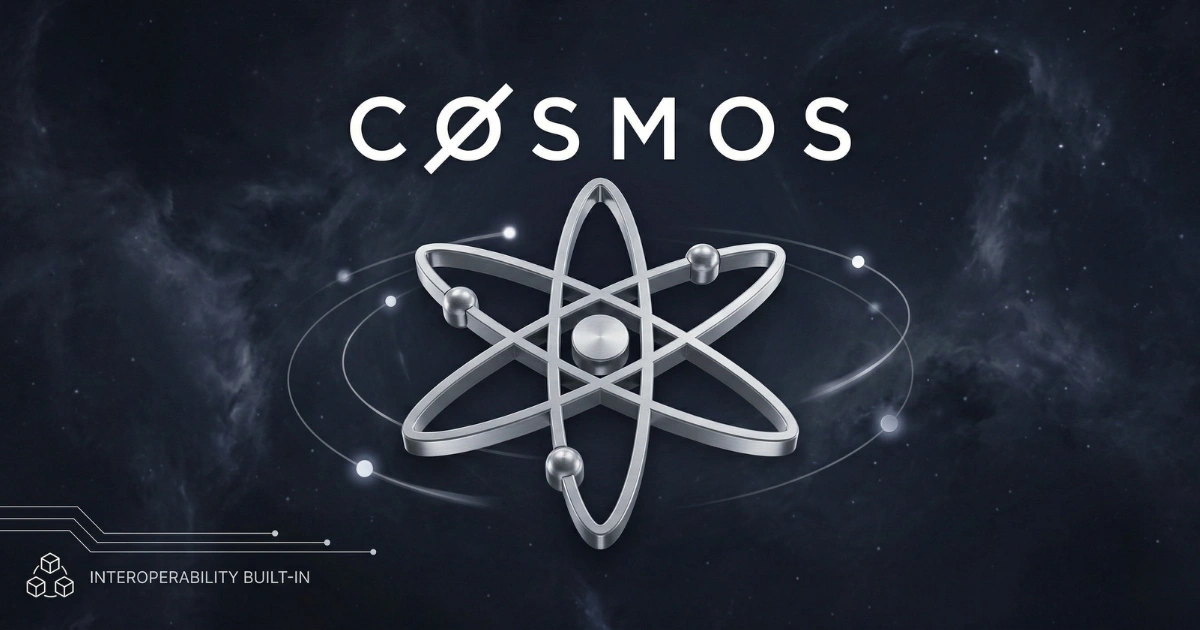
Cosmos crypto is one of the most technically sophisticated blockchain ecosystems ever built – but there is a wide and important gap between the quality of the technology and the performance of the ATOM token
Key Takeaways:
- Cosmos is the ‘Internet of Blockchains’: a framework allowing independent blockchains to communicate via the IBC protocol.
- IBC moves up to $3 billion per month across chains, with 35M+ annual cross-chain transactions and 2M monthly active users
- ATOM is down approximately 95% from its 2021 all-time high of $44.70, trading around $1.74-$2.08 in early 2026
- The core problem: chains built on Cosmos SDK (BNB, Injective, SEI, dYdX) do not accrue value to ATOM
- IBC Eureka launched April 2025, connecting Cosmos to Ethereum and Bitcoin ecosystems for the first time
- Staking yields 10-15% APR, but this comes from inflation (7-20% annually), not from protocol revenue
- The honest assessment: Cosmos tech is excellent and still highly relevan
Cosmos is one of the most important and most misunderstood projects in crypto. Founded in 2014, built through a 2017 ICO, and launched on mainnet in 2019, it pioneered the concept of sovereign, application-specific blockchains connected through a shared interoperability protocol. The vision was a decentralized ‘Internet of Blockchains‘ – an ecosystem where hundreds of independent chains could communicate, exchange assets, and share security without sacrificing autonomy.
That vision has largely been realized on the technology side. Chains like Binance Smart Chain, Injective, SEI, Celestia, dYdX, and dozens of others were built using the Cosmos SDK. The IBC protocol moves billions of dollars monthly. But despite this technological success, ATOM – the native token of the Cosmos Hub – has been one of the worst-performing major assets of the past two years, down roughly 95% from its 2021 peak. Understanding why requires separating the ecosystem from the token.
What Is Cosmos Crypto?
Cosmos is not a single blockchain. It is a framework – a set of open-source tools that allow developers to build their own sovereign, application-specific blockchains, then connect those blockchains together through a shared communication protocol.
The three core components of Cosmos are: the Cosmos SDK (a modular framework for building blockchains), CometBFT (formerly Tendermint Core) (the consensus and networking engine), and IBC (Inter-Blockchain Communication) (the protocol that allows chains to transfer tokens and data between each other). Together, these tools form what Cosmos calls the Interchain Stack.
The Cosmos Hub is the flagship blockchain at the center of this ecosystem – the first chain built with the Cosmos SDK and the primary routing layer for IBC traffic. ATOM is the native token of the Cosmos Hub, used for staking, governance, and network security. This distinction matters: Cosmos is the ecosystem; the Hub is one chain within it; and ATOM is the token of that chain.
Key Metrics at a Glance
| Metric | Current (2026) | Context |
| ATOM Price | ~$1.74-$2.08 (Apr 2026) | ~95% below 2021 ATH of $44.70 |
| Market Cap | ~$884M – $1.01B | Ranked ~#58 in crypto |
| Circulating Supply | ~497-499M ATOM | No maximum supply cap; inflationary |
| Staking APR | 10-15% annually | Inflation-backed; ~61% of supply staked |
| IBC Volume | Up to $3B/month | Over 115+ connected chains |
| IBC Transactions | 35M+ annually | 2M monthly active users |
| IBC Ecosystem Market Cap | $58B+ | All IBC-enabled chains combined |
| GitHub Commits | 950+ in multiple 2025 periods | Among top blockchain projects |
| Cosmos Ecosystem Apps | 250+ apps and services | Per Interchain Labs April 2025 |
What are The Core Tools of the Cosmos?
The Cosmos network achieves its role as the Internet of Blockchains through three core tools that work together. Each one handles a distinct layer of the ecosystem. So, what are those tools?
CometBTF (formerly Tendermint Core)
The foundation of the Cosmos stack is CometBFT, the consensus and networking engine. Originally known as Tendermint Core, it was rebranded to CometBFT in 2023 to reflect its evolution beyond the original Tendermint codebase.
CometBFT uses a Byzantine Fault Tolerant (BFT) Proof-of-Stake consensus mechanism, which offers several advantages over older systems like Proof of Work:
- Transactions reach finality in under 1 second, compared to minutes or hours on PoW chains
- The network can handle 10,000+ transactions per second under optimized conditions
- BFT consensus requires a two-thirds supermajority to confirm blocks, making attacks significantly harder
- Both public and permissioned private blockchains can be built on top of it
- Validators are accountable – malicious behavior results in slashing of staked tokens
Cosmos SDK

The Cosmos SDK is a modular, open-source framework for building application-specific blockchains. Rather than deploying a smart contract on an existing chain, developers using the Cosmos SDK build their own sovereign blockchain tailored to their use case.
The SDK provides pre-built modules covering governance, staking, token transfers, and more – meaning developers do not need to code these from scratch. It supports any ledger architecture including public, private, permissioned, and consortium chains.
A key addition is Cosmos EVM, a plug-and-play Ethereum Virtual Machine compatibility layer built into the SDK. It provides full Solidity smart contract support, Ethereum JSON-RPC compatibility, and access to the entire Ethereum developer toolset – making it straightforward for Ethereum developers to build on Cosmos without learning new languages.
The Cosmos SDK currently powers 200+ blockchains in production, including chains used by Injective, dYdX, Celestia, and institutional deployments by Mitsubishi UFJ (Progmat) and others.
IBC – Inter-Blockchain Communication Protocol
IBC is the communication protocol that connects all Cosmos-based chains to each other – and increasingly to blockchains outside the Cosmos ecosystem. It enables trustless, permissionless transfer of tokens and data between independent blockchains without requiring a centralized bridge or trusted intermediary.
IBC launched in March 2021 and has never been exploited since. It currently connects 115+ chains.
How IBC v2 works (launched March-April 2025) breaks down into three components:
- Clients – each chain runs a light client of its counterpart chain, allowing it to verify transactions cryptographically without trusting a third party
- Router – handles packet routing between chains, replacing the complex 10-step handshake of IBC v1 with a simplified 3-step process
- Applications – handle the actual logic of what happens when a packet arrives, such as crediting tokens or executing a cross-chain contract call
The biggest upgrade is IBC Eureka (IBC v2), launched in April 2025, which extended IBC beyond Cosmos for the first time. Using zero-knowledge proof verification, it now connects Cosmos chains directly to Ethereum, with Solana, Base, and Arbitrum integrations in development. Transfer costs from Ethereum to Cosmos run under $1 at normal gas prices.
Together, CometBFT, the Cosmos SDK, and IBC form the Interchain Stack – the complete toolkit for building sovereign, interconnected blockchains that retain full autonomy while communicating freely with the broader multi-chain ecosystem.
How the IBC Protocol Works
IBC is the technical foundation that makes Cosmos meaningful. Launched in March 2021, it enables trustless, permissionless communication between independent blockchains – without requiring bridges, wrapped assets, or trusted third parties. It has never been exploited since launch.
When you send tokens via IBC, an off-chain relayer watches for a committed transaction on the source chain, then submits a cryptographic proof to the destination chain’s light client. The destination chain verifies the proof against the source chain’s consensus state. Upon successful verification, it executes the packet – crediting tokens to your address – and issues an acknowledgment back to the source. No central intermediary is required at any step.
IBC v2 (IBC Eureka) launched in March 2025 with major improvements: a streamlined design that removes the 4-step channel handshake, ZK-enabled verification that reduces costs for Ethereum connections (approximately $0.97 per transfer at 2.5 gwei gas), and support for non-Cosmos blockchains including EVM chains, Solana, and Bitcoin. IBC Eureka launched commercially in April 2025, connecting Ethereum and Bitcoin ecosystems to Cosmos chains through the Hub as a routing layer.
The current scale of IBC is significant and measurable: up to $3 billion transferred monthly, 35 million+ annual cross-chain transactions, 115+ connected chains, and 2 million monthly active users. These are not theoretical numbers – they represent real economic activity flowing through the protocol every day.
The Cosmos Ecosystem: What Has Been Built
The Cosmos SDK has become one of the most widely adopted blockchain development frameworks in the industry. Understanding the full scope of what has been built – and what has failed – gives a realistic picture of the ecosystem.
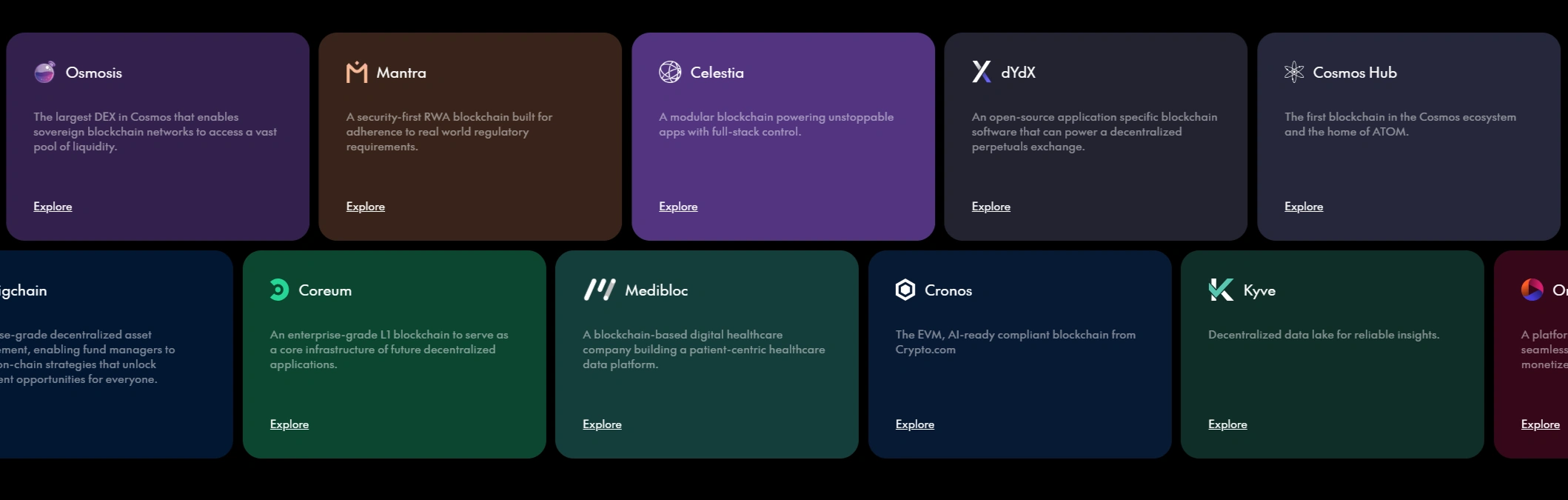
| Chain/Protocol | Type | Built With | Status 2025-2026 |
| Osmosis | DEX / DeFi hub | Cosmos SDK + IBC | Integrating with Hub; token burn mechanism active |
| Injective | DeFi L1 | Cosmos SDK | Active; strong DeFi volume |
| dYdX | Perps DEX | Cosmos SDK (own chain) | Added IBC Eureka; major trading volume |
| Celestia (TIA) | Modular DA layer | Cosmos SDK + IBC | High-value airdrop to ATOM/OSMO stakers in 2023 |
| Stargaze | NFT marketplace | Cosmos SDK + IBC | Integrating with Hub |
| Babylon | Bitcoin staking | Cosmos SDK + IBC | Bitcoin LSTs bridged via IBC Eureka April 2025 |
| Nolus | DeFi lending | Cosmos SDK | Buyback ~3% of supply; user protection mechanisms |
| Noble | Stablecoin issuance | Cosmos SDK | Moving toward EVM; retaining IBC compatibility |
| Binance Chain (BNB) | CEX chain | Cosmos SDK-based | Built on Cosmos SDK – does not accrue to ATOM |
| Ondo Finance | RWA tokenization | Cosmos integration planned | Institutional RWA project joining ecosystem |
The critical distinction: building on Cosmos SDK does not make a chain part of the Cosmos Hub or benefit ATOM holders. Binance Smart Chain – one of the most used blockchains in crypto – was built on a fork of the Cosmos SDK, yet its activity has never accrued value to ATOM. This is simultaneously a sign of how good the technology is and one of the central structural problems with ATOM as an investment
What Has Failed
The community is right to acknowledge the failures directly. Between 2022 and 2025, Juno, Evmos, Sifchain, Stride, dVPN, Passage, Celestial, Kryxivia, and multiple other projects shut down or became effectively inactive. Some lost user funds through bad debt in lending protocols. Others saw their bridge contracts trap liquidity as the ecosystem lost volume. The airdrop culture of the 2021-2022 period created a dynamic where new projects launched primarily to attract farming capital, then failed when growth stalled.
One long-term community member summarized it accurately: ‘After 4 years in Cosmos I’ve bled a tremendous amount of money. After ending -88% I moved everything to BTC/ETH. Too many broken promises, disappointing launches, and no utility for ATOM.’ This experience is common and should be taken seriously by anyone considering investing.
The ATOM Token: The Central Problem
Cosmos technology is strong. ATOM’s performance is not. Understanding why requires looking at four structural problems with the token
1. No Hard Supply Cap and Persistent Inflation
ATOM has no maximum supply. The initial supply was 236 million; circulating supply has grown to approximately 497-499 million ATOM through ongoing block emissions. Inflation dynamically adjusts between 7% and 20% annually, targeting a 67% staking ratio. If less than 67% is staked, inflation rises to incentivize more staking. If more is staked, inflation falls.
The staking APR of 10-15% sounds attractive until you account for the fact that it comes entirely from inflation – new ATOM being minted and distributed to stakers. This is not protocol revenue. It is a transfer from non-stakers to stakers. If you stake, you maintain your percentage of total supply. If you do not stake, you are diluted. And since ATOM’s price has declined despite high staking rates, even stakers have seen their purchasing power erode significantly.
2. Technology Adoption Does Not Accrue to ATOM
This is the core issue that even enthusiastic community members acknowledge. When Binance built BNB Chain on Cosmos SDK, none of that activity benefited ATOM. When Injective, SEI, or dYdX built on Cosmos SDK, they created their own tokens and their own economic systems. A project can use every component of the Interchain Stack – SDK, CometBFT, IBC – and never hold, use, or benefit ATOM.
As one community member noted: ‘Most blockchains use the cosmos ecosystem but they haven’t linked it to the price of ATOM. It’s weird tokenomics – even years ago most Layer 1s and Layer 2s use its ecosystem.’ This is an accurate observation. The Cosmos Hub needs to position itself as a service layer that chains actively pay to use – not just an optional connection point.
3. Proposition 848 and the Staking Reward Cut
In 2023, the community passed Proposition 848, which reduced ATOM staking rewards significantly. The intent was to reduce inflation and make ATOM less inflationary. The effect was to remove one of the main reasons retail investors held ATOM – the high APR – without replacing it with another compelling reason to buy. Community reaction was strongly negative, with many long-term holders selling after the cut passed.
‘Some people thought it was a good idea to make a proposal to cut staking rewards. So one of the few incentives to hold ATOM got severely limited. All it did was make people run away, because the high APR is the only real useful utility ATOM had for most people.’ This is a fair and widely-shared assessment.
4. The Fragmentation Problem
Cosmos’s philosophy of sovereign chains is also its greatest weakness from an investment perspective. Ecosystem fragmentation means liquidity is scattered across dozens of chains, each with its own token, community, and economic system. Unlike Ethereum or Solana where activity flows into ETH or SOL, activity in the Cosmos ecosystem flows into OSMO, INJ, ATOM, TIA, SEI, and dozens of other tokens independently.
When dYdX chose Cosmos SDK for its own chain, it created dYdX tokens – not ATOM demand. When Celestia launched, it created TIA – and airdropped to ATOM/OSMO stakers, which was positive, but Celestia is not part of the Hub’s economy. The sovereign chain model maximizes each project’s independence at the cost of the Hub’s centrality.
What Is Actually Happening in 2025-2026: The Bull Case
Despite the legitimate criticisms above, there are genuine developments that warrant attention. The bear case for ATOM is well-known and mostly priced in at current levels. The question is whether the bull case has substance.
IBC Eureka: The Most Important Development
IBC Eureka launched in April 2025 and represents the most significant technical milestone for Cosmos since IBC itself launched in 2021. For the first time, Cosmos chains can connect trustlessly to Ethereum, Bitcoin, Solana, and major L2s without centralized bridges.
At launch, IBC Eureka connected Babylon (Bitcoin staking), Lombard, PumpBTC, dYdX, Injective, and MANTRA to the Ethereum and Bitcoin ecosystems. The Cosmos Hub serves as the routing layer for all Eureka connections – meaning every IBC Eureka transfer passes through the Hub and generates activity on the Hub. If IBC Eureka achieves meaningful adoption, the Hub becomes genuinely central to cross-chain finance in a way it has not been before.
The key question is whether Eureka’s routing-through-the-Hub model translates to ATOM demand. Unlike IBC classic, where chains could connect peer-to-peer without touching the Hub, Eureka’s routing design creates a direct dependency on the Hub. This is the most plausible path to ATOM accruing real value from ecosystem growth.
Institutional Adoption of the Cosmos SDK
Sovereign Day 2025 showcased banks, governments, and enterprises building sovereign Layer 1 blockchains on the Cosmos stack for stablecoins, CBDCs, and cross-border payments at institutional scale. Japan’s largest banks are using Progmat Coin on IBC. Mastercard and Wells Fargo have been connected to Cosmos SDK deployments.
Cosmos Labs (formerly Interchain Labs, rebranded Q3 2025) is explicitly positioning the Cosmos stack as enterprise blockchain infrastructure – competing with Hyperledger Fabric and private chain solutions. This is a legitimate market: enterprises need interoperable, sovereign chains, and the Cosmos SDK is the most mature technology for building them. The question is whether this institutional activity will drive ATOM demand or simply use the SDK as a free tool without engaging the Hub.
Osmosis and Stargaze Integrating Into the Hub
Two of the most active remaining Cosmos protocols – Osmosis (the largest DEX) and Stargaze (the NFT marketplace) – are integrating with the Hub. Osmosis has changed its tokenomics to convert revenue into OSMO burns, making it deflationary. A proposal exists to convert OSMO to ATOM as a neutral settlement layer for cross-chain swaps, which would directly drive ATOM usage.
If Osmosis and Stargaze integrate successfully, the Hub would gain a DEX, an NFT marketplace, and increased liquidity – making it comparable to a general-purpose L1 rather than just a routing hub. Whether this consolidation can reverse the ecosystem’s fragmentation decline is the central unknown of the current phase.
GitHub Activity and Development Momentum
Cosmos has maintained consistently elite developer activity throughout 2025, with 950+ commits in multiple reported periods and ranking among the top blockchain projects by GitHub activity. The team has released Cosmos SDK v0.53 (a developer-friendly upgrade), Gaia v27.0 for the Hub, and active security audits with doubled bug bounty rewards.
This is not a dead project. The builders are building. The gap is between development activity and market narrative – the ecosystem has excellent engineers working on meaningful problems, but has largely lost the public attention it needs to attract new capital.
The Rational Investor’s View: What the Community Gets Right and Wrong
Spending time in the Cosmos community reveals a split between two perspectives that are both partially correct but often talk past each other. Here is a rational synthesis.
What the Bears Get Right
The bears are correct that ATOM’s underperformance relative to Bitcoin during the 2024-2025 bull market is damning. When BTC reached new all-time highs and Solana pumped 10x, ATOM declined from $6.53 at the start of 2025 to approximately $2.20 by December 2025. This is not a temporary setback – it reflects fundamental questions about ATOM’s value capture that have never been resolved.
They are also correct that staking yield from inflation is not real income. If you earn 12% APR in ATOM but ATOM’s price declines 50%, you have lost significantly in purchasing power terms. The ‘buy low and stake’ strategy only works if the token eventually appreciates – which requires resolving the value capture problem first.
And they are correct that many altcoins with comparable or lesser technology have performed better simply because they have stronger communities and narratives. In crypto, price action is driven by narrative and community energy as much as by technology. Cosmos has lost much of both.
What the Bulls Get Right
The bulls are correct that IBC is genuinely valuable infrastructure that continues to grow in adoption. The $3B monthly volume is real. The 115+ connected chains are real. The institutional interest in the Cosmos SDK is real. These are not made-up metrics.
They are also correct that current prices may be pricing in excessive pessimism. ATOM at ~$2 with a $1B market cap, while powering infrastructure used to move $3B/month, does suggest the market has overcorrected. But market inefficiency requires a catalyst to correct – it does not correct simply because the fundamentals deserve better.
The most defensible bull case: IBC Eureka creates a new reason for chains to route through the Hub, which creates real ATOM usage. If this routing model works and institutional deployments on Cosmos SDK begin paying Hub fees, the value capture problem could be partially resolved. This is speculative but not irrational.
What Both Sides Often Miss
The technology vs. token distinction is the most important concept that community discussions consistently blur. You can believe Cosmos tech is excellent while being bearish on ATOM. These are not contradictory positions. Many great technologies have produced poor investment outcomes.
A rational framing: ATOM is a bet on whether the Cosmos Hub can position itself as a necessary service layer that chains actually pay to use, rather than an optional connection point that chains can ignore. IBC Eureka’s routing-through-the-Hub model is the first real mechanism for this. Whether it succeeds is genuinely uncertain – the project is at a critical juncture where the next 12-18 months will either validate or invalidate the bull case.
Frequently Asked Questions
Cosmos is a blockchain ecosystem that enables independent blockchains to communicate through the IBC (Inter-Blockchain Communication) protocol. ATOM is the native token of the Cosmos Hub – the flagship blockchain at the center of the ecosystem. ATOM is used for staking, governance, and network security. The broader Cosmos ecosystem includes 250+ apps across 115+ chains, but ATOM’s utility is specific to the Hub itself.
Several structural reasons: First, chains built on Cosmos SDK create their own tokens, so technology adoption does not translate to ATOM demand. Second, ATOM has no supply cap and inflates at 7-20% annually, permanently diluting holders. Third, Proposition 848 (2023) cut staking rewards – the main reason most retail investors held ATOM – without adding new utility. Fourth, the sovereign chain model fragments liquidity across dozens of independent tokens rather than concentrating value in ATOM. Strong technology is necessary but not sufficient for token appreciation.
IBC (Inter-Blockchain Communication) is a protocol that allows independent blockchains to transfer tokens and data between each other without trusted intermediaries. It has never been exploited since launching in March 2021. IBC moves up to $3 billion per month across 115+ chains. IBC v2 (Eureka) launched in April 2025, connecting Cosmos to Ethereum and Bitcoin ecosystems for the first time using ZK-proof verification.
This depends entirely on your risk tolerance and investment thesis. The bear case is strong: ATOM down 95% from ATH, persistent inflation, no hard supply cap, unclear value capture from ecosystem growth, and community exodus. The bull case is speculative but not irrational: IBC Eureka routes through the Hub creating real demand, institutional Cosmos SDK adoption is growing, and current prices may be pricing in excessive pessimism. This is not financial advice – ATOM is a high-risk asset. Anyone considering it should understand the value capture problem and have a specific thesis for why IBC Eureka changes the equation.
IBC Eureka is the commercial launch of IBC v2, released in April 2025. It connects Cosmos chains to Ethereum and Bitcoin ecosystems using zero-knowledge proof verification, making cross-chain transfers fast (under $1 from Ethereum at normal gas prices) and removing the need for the complex 4-step channel handshake of IBC v1. Critically, Eureka uses the Cosmos Hub as a routing layer, meaning all Eureka transfers pass through the Hub – creating a direct dependency that could drive ATOM demand as adoption grows.
Staking ATOM means delegating your tokens to a validator node that helps secure the Cosmos Hub. In exchange, you earn approximately 10-15% APR in newly minted ATOM. This yield comes from inflation, not protocol revenue. Approximately 61% of circulating ATOM supply is currently staked. The main reason to stake is to avoid being diluted by inflation – if you hold unstaked ATOM, your percentage of total supply decreases over time. Stakers maintain their proportion. Use Keplr wallet for desktop staking and Cosmostation for mobile.
Between 2022 and 2025, many major Cosmos projects failed or shut down: Juno lost relevance, Evmos shut down, Sifchain closed, Stride struggled, dVPN became inactive, Passage and Celestial shut down. The 2021-2022 airdrop culture attracted capital hunting rather than genuine builders, and when new player inflows dried up, the token economics collapsed. Surviving projects include Osmosis, Injective, Stargaze, Noble, Nolus, and newer entrants like Babylon and Ondo. The ecosystem has contracted significantly from its peak but retains real utility in its surviving protocols.

Dan is a seasoned crypto writer for Blockchaindose who got his start in the space back in 2019. Over the past four years, he’s built a solid grasp of how the industry moves, focusing heavily on DeFi, NFTs, GameFi, and promising new projects.
Off the clock, you’ll usually find him buried in a good book or kicking back with a movie. His blend of hands-on market experience and straightforward commentary makes him a clear, trusted voice across the platform.