

Machine learning crypto trading models ranked cryptocurrency price extrema accurately, yet lost money as Binance Spot trading policies. Researcher Ayoub Jadouli of Abdelmalek Essaâdi University audited candle-based timing models and recorded negative net results after assumed transaction costs in every executable test. All evaluated policies remain NO_TRADE.
Ranking power and policy returns diverge
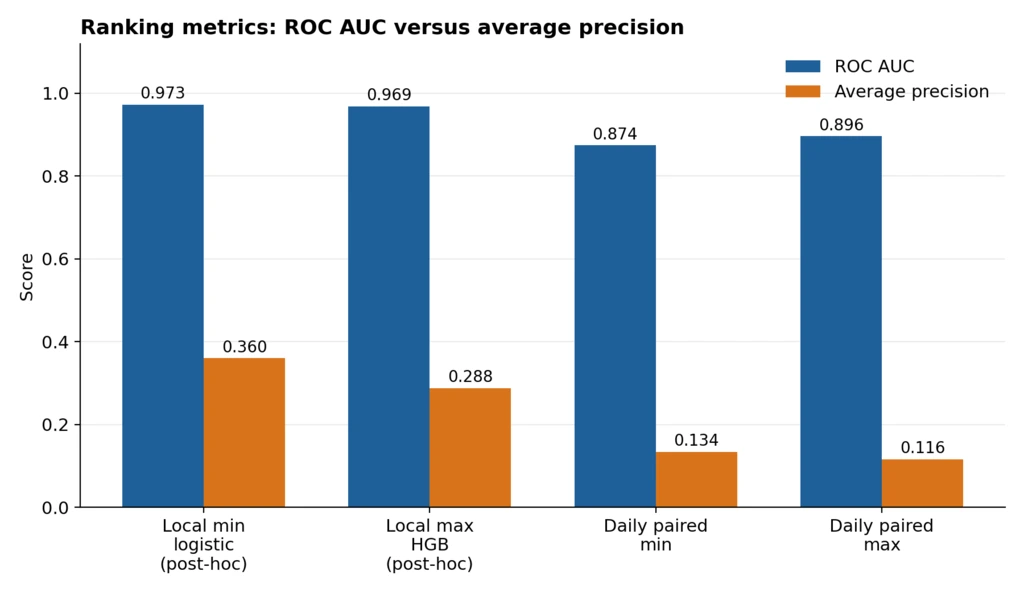
Jadouli trained 14 architectures per direction, from logistic regression to attention CNN–LSTM networks, on BTC, ETH and SOL five-minute candles. Post-hoc detectors reached ROC AUC near 0.97, while average precision stayed between 0.29 and 0.36 against event prevalence near 1.5%. Their paper policies returned −4.02% and −16.50% at 31 basis points per completed cycle.
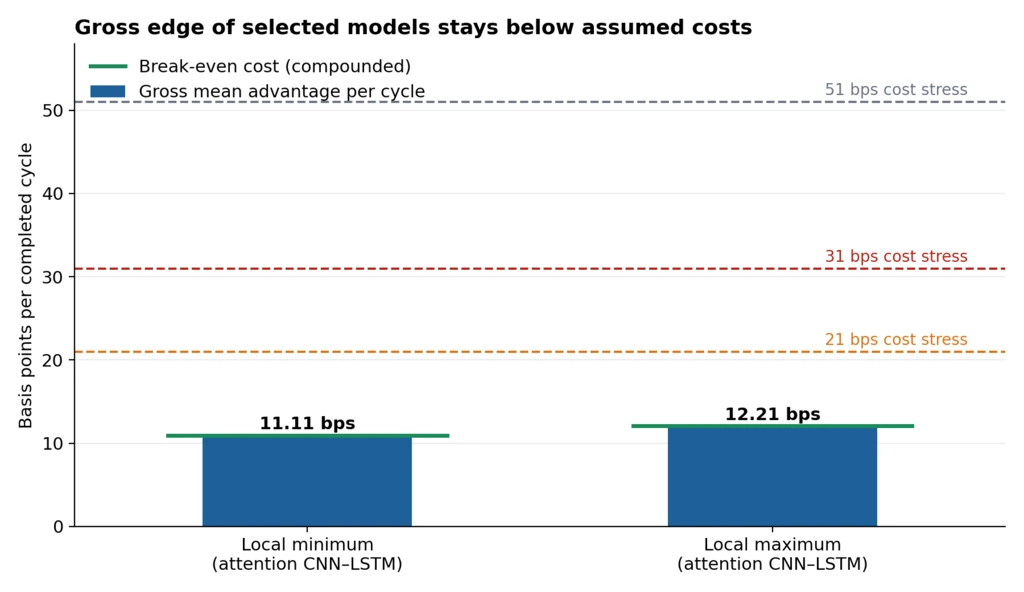
Validation-selected models ranked events worse but lost less. The attention CNN–LSTM returned −1.79% on minima and −2.80% on maxima, where the policy sold held Spot positions to cash and repurchased later. Gross mean gains of 11.11 and 12.21 basis points per cycle fell below the lowest cost stress of 21 basis points. Break-even costs measured 10.96 and 12.07 basis points.
Mandatory daily selection loses in 16 of 19 cycles
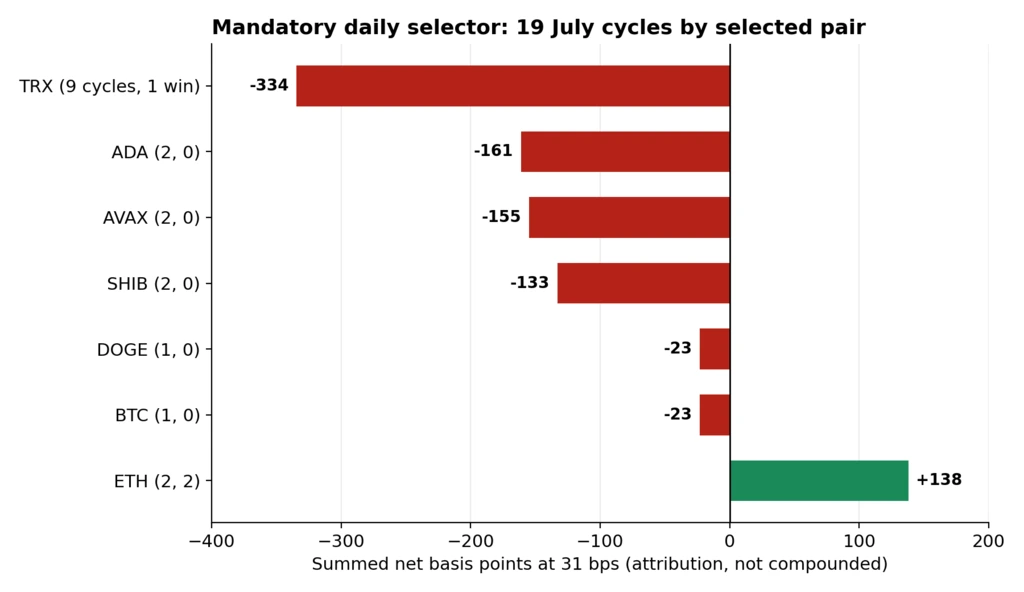
A ten-pair selector built on an ExtraTrees regressor picked one USDT pair daily, entered at the next one-minute open, and held up to four hours with a +100/−150 basis-point target and stop. Across 19 July cycles it lost 6.72% at 31 basis points, winning 3 daily cycles for a mean net result of −36.40 basis points. Costs of 20 and 51 basis points left equity at 95.26 and 89.79 USDT from 100 USDT.
TRX won one of nine selections and contributed −334 basis points of summed net result, the largest drag among seven symbols. ETH alone produced a positive sum, +138 basis points. The stored model was reloaded without retuning for July 8–19 and lost 354.28 basis points. Selection followed comparison of at least 946 candidates on April–June data, so the test is prospective only conditionally.
Daily models and slow rotation
An OHLCV-only adaptation of the Gurgul, Lessmann and Härdle paired-extrema design reached AUC of 0.874 for minima and 0.896 for maxima on daily BTC and ETH data, with average precision of 0.134 and 0.116. Six of seven completed cycles lost money. The strategy returned −44.30% against −41.20% for cost-matched buy-and-hold. A 21-basis-point cost moved the result only to −44.10%, so fees do not explain the shortfall.
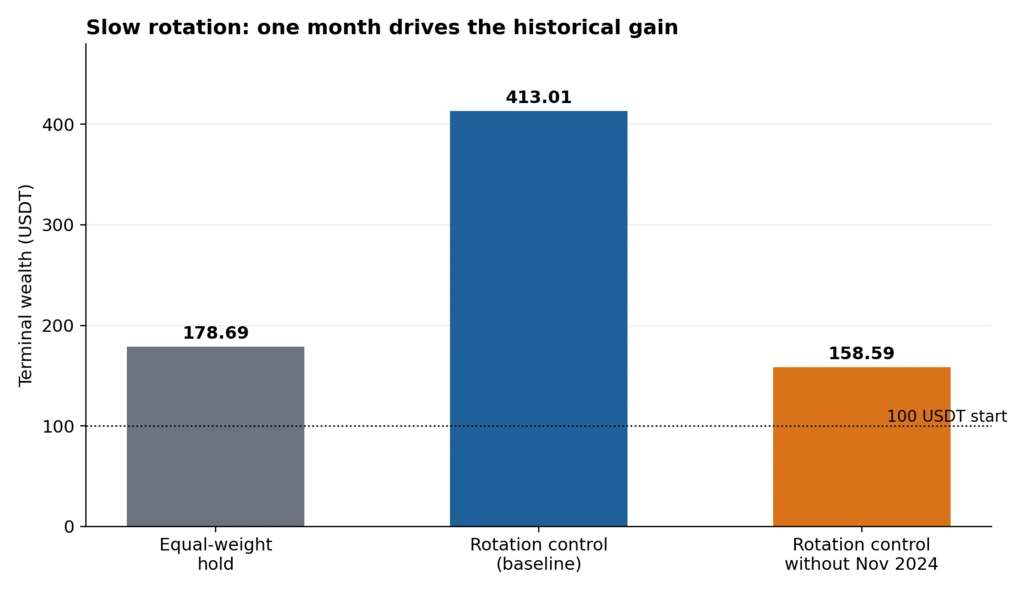
A monthly rotation control across ten pairs returned +313.01% over 45 months versus +78.69% for equal-weight holding, but every date had already served research. November 2024 supplied 67.48% of net log gain; removing the month cut terminal wealth from 413.01 to 158.59 USDT. The audit classifies the result as descriptive, not deployable. Maximum drawdown reached −48.38%.
Why machine learning rankings fail as trading signals
Jadouli attributes the gap to predict-then-optimize misalignment. An extremum label rewards identifying a bar near a completed low or high. Trade value depends on the next executable open, the target-stop-timeout path and costs per cycle. Mandatory daily selection removes abstention, forcing trades with negative expected value.
Jadouli also downgraded an earlier One4All 30-day holdout to an invalidated diagnostic: its dates had informed architecture choices, four-hour label horizons were not purged at split boundaries, entries filled at the same close, and raw result directories were missing.
AI agents in the OpenAI Codex environment handled literature retrieval, critique, artifact reconciliation and packaging. Scripted fixed-seed runs and deterministic simulators produced every number, and no agent made trading decisions. Agent review exposed errors in the earlier draft, including the overstated holdout label.
Samples are small: 19, 9, 15 and 7 cycles. Many models ran with one seed, no multiple-testing correction was applied, and candles hide intrabar order, so simulators apply a stop-first rule. Spread, slippage and latency are excluded. Jadouli proposes pre-registered policy-conditioned targets, a cash action, point-in-time universes, full-horizon purges and a prospective window.
FAQ
Is machine learning crypto trading profitable after costs?
Not in the tested protocols. ROC AUC measures event ranking, not trade value. Models with AUC near 0.97 still produced negative net returns after a 31-basis-point cost per completed cycle, because entry timing, target-stop paths and average precision at low prevalence determine results.
What costs did the audit assume for Binance Spot?
The audit assumed round-trip costs of 21, 31 and 51 basis points, with 31 as the primary case. Binance lists 0.100% per side for regular users, so 21 basis points approximates two 10-basis-point sides plus a 1-basis-point buffer. Values are assumptions, not measured fees.
Why does mandatory daily selection reduce returns?
A rule requiring one pair every day cannot abstain when expected value is negative. The ten-pair selector lost 6.72% over 19 cycles, with 16 losing cycles and a −36.40 basis-point mean net result.
Is the positive slow-rotation result usable?
No. The +313.01% result covers consumed historical data, and November 2024 supplies 67.48% of net log gain. Removing the month lowers terminal wealth to 158.59 USDT, and no prospective evaluation exists.
What role did AI play in the research?
AI agents supported literature review, critique, artifact reconciliation and packaging. Scripted runs and deterministic simulators generated all numerical results, and no agent produced trading decisions.

Isai Alexei is a journalist and financial analyst covering cryptocurrency markets and traditional securities for Blockchaindose. He has spent ten years analyzing digital assets, trading activity, and market structure.