Chain abstraction protocols route cross-chain actions through solver networks instead of manual bridging. A user signs one intent describing the desired outcome, and a solver selects the route, pays gas on the destination chain and collects a fee. The Ethereum Foundation, Hyperlane and Bootnode co-led the Open Intents Framework, and Coinbase Payments joined as a core contributor in September 2025. Developers adopt the model to remove network selection, bridge approvals and gas-token purchases from the user flow.
From Seven Manual Steps to One Signature
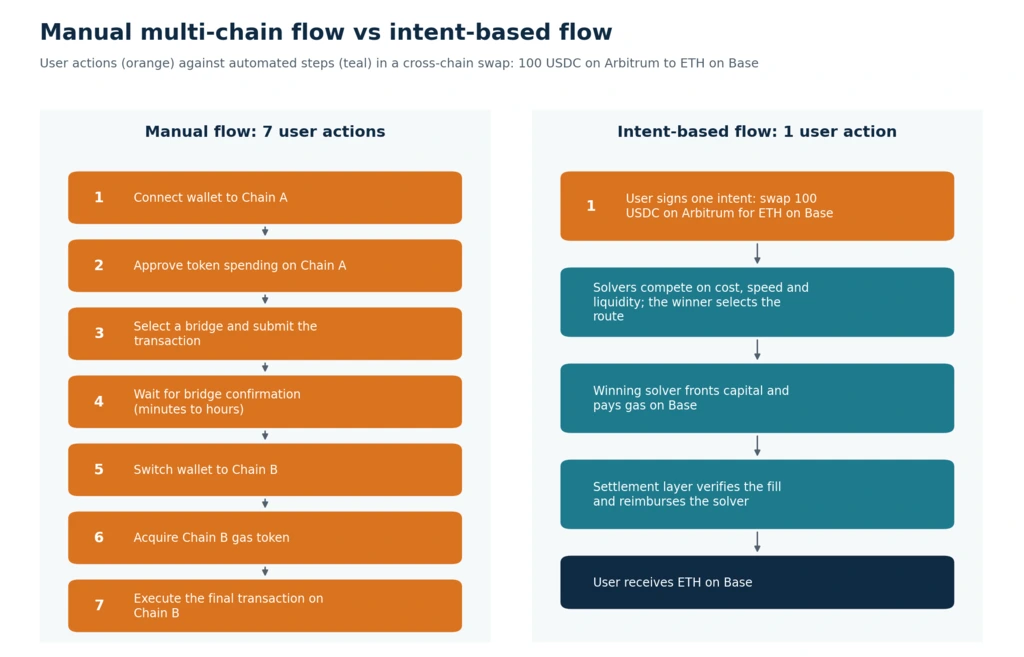
A manual cross-chain swap requires seven actions: wallet connection, token approval, bridge selection, confirmation wait, network switch, gas-token purchase and final execution. An intent-based flow reduces user input to one signature. The solver completes the remaining steps and delivers the asset on the destination chain, for example ETH on Base after a USDC order on Arbitrum. Competition between solvers lowers fees. Each solver compares cost, speed and liquidity across chains and submits the best bid.
How the Four-Layer Stack Works
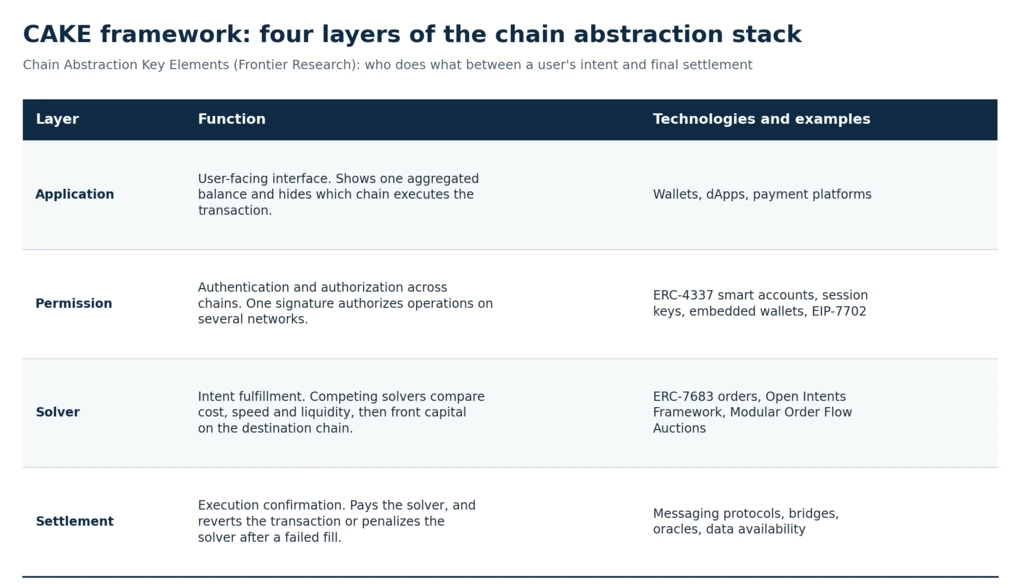
Frontier Research organizes the CAKE framework into application, permission, solver and settlement layers. The permission layer handles authorization through ERC-4337 smart accounts, session keys and EIP-7702, which Ethereum activated with the Pectra upgrade on May 7, 2025. In the solver layer, competing solvers front capital on the destination chain. The settlement layer uses messaging protocols, oracles and proofs to confirm delivery, and it reverts the transaction or penalizes the solver for a failed fill.
Standards and Account Models
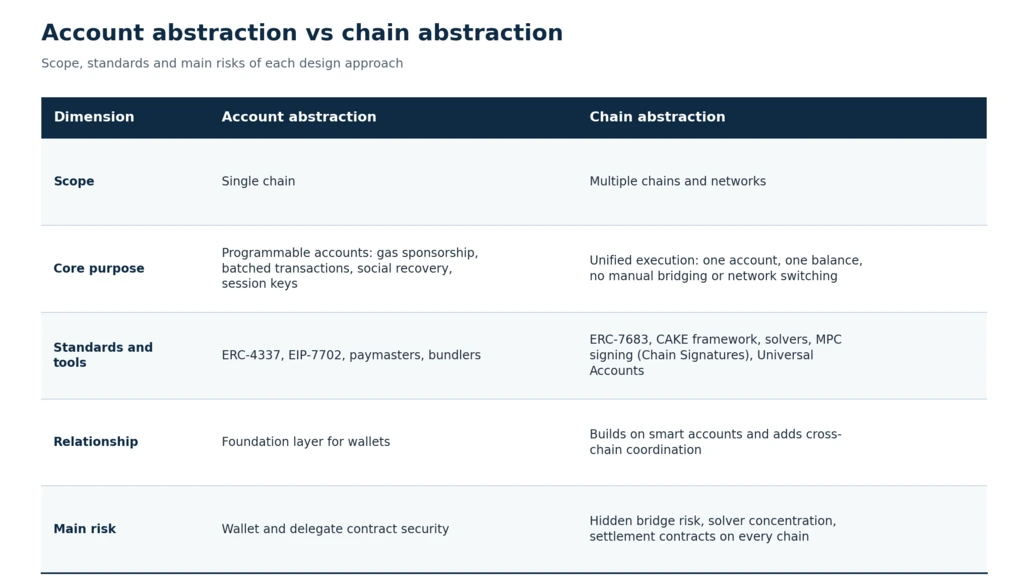
ERC-7683 remains a draft. Its revised text defines a resolver contract, which translates a protocol-specific order into steps, variables and payments. Solvers vet resolvers and skip protocol-by-protocol integration. Account abstraction under ERC-4337 covers a single chain with paymasters, batched transactions and social recovery. Chain abstraction adds coordination across chains. Particle Network’s Universal Accounts give users an owner address, an EVM address and a Solana address with a unified balance at the SDK level.
NEAR’s Chain Signatures use a multi-party computation network to sign transactions for Bitcoin, Ethereum and other chains from one NEAR account. Socket runs Modular Order Flow Auctions, where agents compete to execute cross-chain requests.
Bridge Losses Raise Security Questions
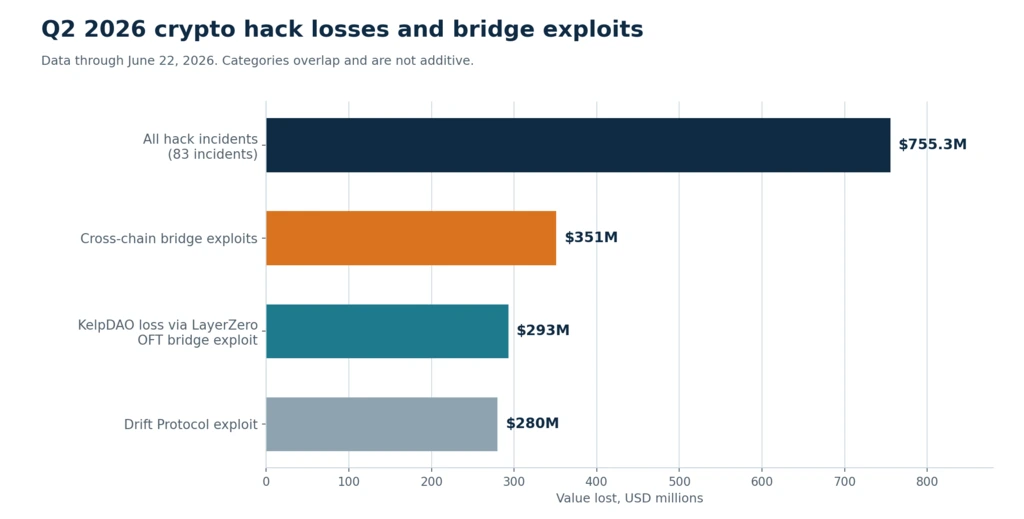
An Unfolded analysis of DefiLlama data, reported by Cointelegraph, counted 83 incidents and $755.3 million in losses during the second quarter of 2026 as of June 22. Bridge exploits caused $351 million of the total. A LayerZero OFT bridge exploit drove the $293 million KelpDAO loss, which represents more than 38% of the quarter’s stolen value. Chain abstraction hides bridge risk from users without removing it. Settlement depends on messaging protocols, validator sets or cryptographic proofs. Each supported chain adds a settlement contract, and a flaw in one deployment can expose funds across the system.
Verification and Solver Concentration
Optimistic systems open a challenge window for fraud, zero-knowledge systems add computation and latency, and validator committees reintroduce a degree of centralization. Solver concentration creates a second exposure: a small group of solvers can front-run intents, extract MEV or refuse selected orders. The ERC-7683 draft requires resolvers to list the conditions they cannot verify as named assumptions, and solvers must validate each one before filling an order.
Checks for Developers and Users
Developers who integrate cross-chain intents should document the verification model, count the independent solvers and audit the settlement contract on every chain. Users should confirm the loss policy for routes failing midway. Diagnosing a failure requires tooling to separate solver, bridge and destination-chain faults. Bitcoin needs a separate approach: the network lacks native smart contract wallets or programmable gas tokens, and projects rely on MPC signing or layer-2 designs.
FAQ
What is chain abstraction in blockchain?
Chain abstraction is a design approach in which applications hide network selection, bridging and gas payment from users. The user states an outcome, and a stack of smart accounts, solvers and settlement contracts executes the required steps across chains.
How does chain abstraction differ from account abstraction?
Account abstraction under ERC-4337 changes how accounts operate on one chain, adding paymasters, batched transactions, session keys and social recovery. Chain abstraction extends the experience across networks and relies on smart accounts for permissions.
What do solvers do in an intent-based system?
Solvers compete to fulfill a signed intent. Each solver evaluates cost, speed and liquidity, fronts capital on the destination chain, and receives reimbursement and a fee through the settlement layer.
Does chain abstraction remove bridge risk?
No. Chain abstraction moves bridge risk to the backend. Settlement still depends on messaging protocols, validator sets or proofs, and bridge exploits caused $351 million in losses during the second quarter of 2026 as of June 22, according to DefiLlama data reported by Cointelegraph.
What does ERC-7683 standardize?
ERC-7683 is a draft standard for intent protocols. The current text defines a solver-facing resolver interface, which converts protocol-specific orders into steps, variables and payments. Each protocol keeps control of escrow, settlement and pricing design.

Isai Alexei is a journalist and financial analyst covering cryptocurrency markets and traditional securities for Blockchaindose. He has spent ten years analyzing digital assets, trading activity, and market structure.