Blockchain networks determine the sequence of pending operations through transaction ordering, the process of selecting which transactions enter the next block and in which position. Block producers hold authority over sequence, and position affects execution price, liquidation outcomes and arbitrage profit. Validators on proof-of-stake networks and miners on proof-of-work networks select transactions from the mempool, the public holding area for unconfirmed operations, without any obligation to follow arrival time.
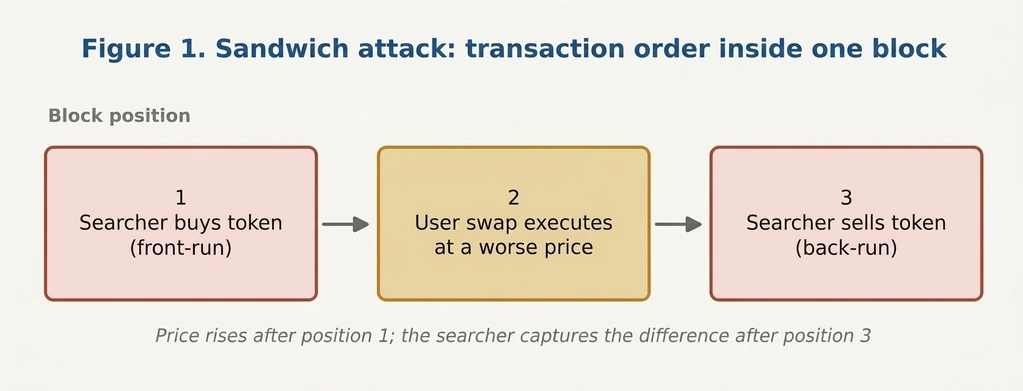
A liquidity pool prices tokens by formula, and each purchase raises the price for the next buyer. Two traders who buy the same token from one pool receive different prices, because the first execution changes the pool balance before the second begins. The price gap between first and second position ranges from small amounts to large sums, depending on trade size and pool depth. Traditional exchanges apply strict time priority, while blockchains allow producers to rearrange transactions as long as each one remains valid against the state created by earlier entries.
Users submitted a bid, and producers sorted the mempool from highest to lowest based on gas price. Bots pursuing arbitrage and liquidation profit raised bids against each other in priority gas auctions, filled blocks with competing transactions and increased fees for ordinary transfers. Fee level alone determined order completely, and submission time carried no weight.
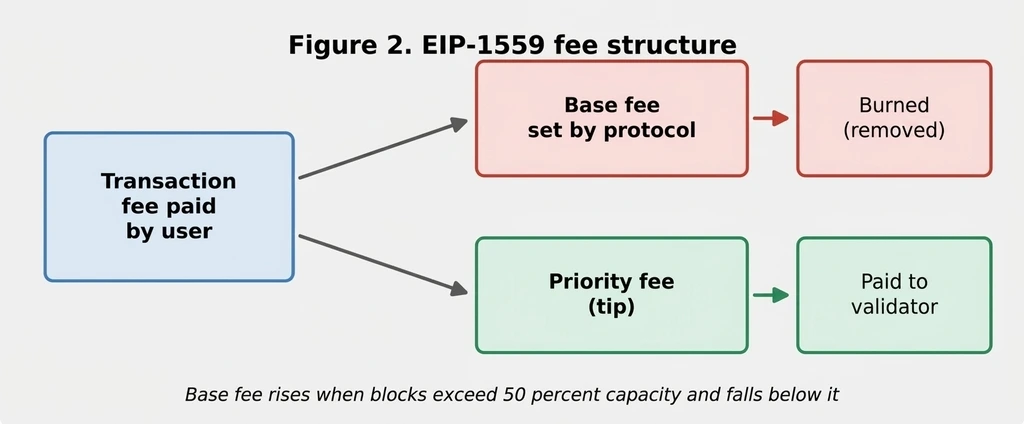
The EIP-1559 upgrade, activated in August 2021, split the fee into a base fee and a priority fee. The protocol adjusts the base fee algorithmically according to the fullness of the previous block: the fee rises when blocks exceed 50 percent capacity and falls when they stay under it. The protocol burns the base fee, and validators do not receive it. Users pay the priority fee directly to the validator, and a higher tip raises the probability of earlier inclusion. Fee predictability improved and bidding wars lost some force, but producers kept control over transaction sequence.
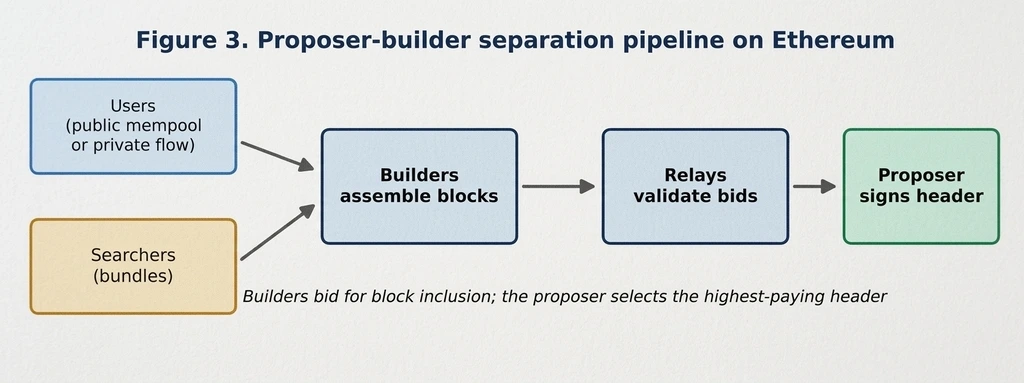
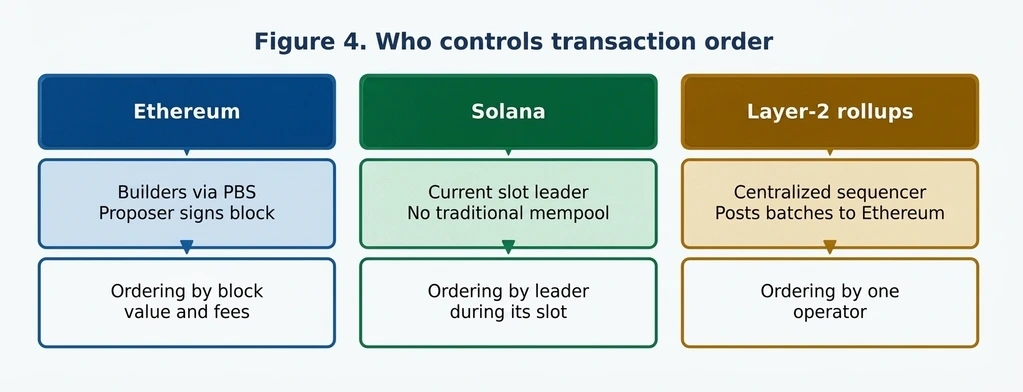
Ethereum currently relies on proposer-builder separation (PBS), implemented through MEV-Boost. Builders assemble full blocks from public mempool transactions, private submissions and bundles, which are ordered transaction groups searchers design to capture arbitrage, liquidations or sandwich trades. Builders submit blocks as bids to relays, relays validate them, and the proposer signs the highest-paying header. Most Ethereum blocks follow the pipeline, and a small group of builders produces the largest share, which raises centralization concerns.
Services including Flashbots Protect and MEV Blocker, which are private order streams, route transactions directly to builders, and searchers cannot see pending orders and cannot execute front-running or sandwich attacks against them. Builders with exclusive access to private flow assemble more valuable blocks, which concentrates block production among firms holding the strongest order-flow relationships.
Solana has no traditional mempool: clients send transactions to the current slot leader, and the Gulf Stream protocol forwards them to upcoming leaders. The leader controls sequence during its slot. Most layer-2 rollups, including Arbitrum, Base and Optimism, rely on a centralized sequencer to order transactions before posting batches to Ethereum. Sequencer designs reduce some reordering MEV, yet they concentrate trust in one operator. Shared sequencing networks and rotation mechanisms are under development.
Users limit financial exposure by routing transactions through private channels and by setting tight slippage tolerance, which caps sandwich profit. Research on fair ordering and encrypted mempools aims to protect users without closing network access. Ordering and finality remain separate properties: ordering fixes position inside a block, while finality determines when a block becomes irreversible, and a chain reorganization can still remove or reorder transactions before finality.
FAQ
What is transaction ordering in a blockchain?
Transaction ordering is the process by which a block producer selects pending transactions and arranges them inside a block. The sequence determines execution outcomes, including price, liquidation results and arbitrage profit.
Does a higher priority fee guarantee earlier inclusion?
No. A higher priority fee raises the probability of earlier inclusion, but builders optimize the total value of the block. A bundle with a larger combined payment can outrank a single transaction with a higher individual tip.
How does transaction ordering create MEV?
Producers can reorder, insert or exclude transactions, which allows searchers to capture value from pending orders. Maximal extractable value (MEV) includes arbitrage, liquidations and sandwich attacks.
Do layer-2 rollups eliminate MEV?
No. Centralized sequencers reduce some reordering MEV, but a single operator controls sequence, and other forms of extraction remain possible. Sequencer decentralization remains an active research area.
How can users protect transactions from harmful ordering?
Users can send transactions through private order flow services and set tight slippage tolerance. Research on encrypted mempools and fair ordering targets protection at the protocol level.

Isai Alexei is a journalist and financial analyst covering cryptocurrency markets and traditional securities for Blockchaindose. He has spent ten years analyzing digital assets, trading activity, and market structure.