
Cross-chain Maximal Extractable Value (MEV) has transitioned from a theoretical concern to a systematically quantified economic leakage across blockchain interoperability protocols. Researchers from Flashbots and the Technical University of Munich conducted the first large-scale empirical study of executed cross-chain arbitrage, identifying 242,535 executed cross-chain arbitrages totaling $868.64 million in volume and generating $8.65 million in net profit across nine blockchains over a one-year period from September 2023 to August 2024.
The study observed a 5.5x increase in average daily arbitrage volume during the period, with a notable surge following Ethereum’s Dencun upgrade due to reduced Layer-2 fees.
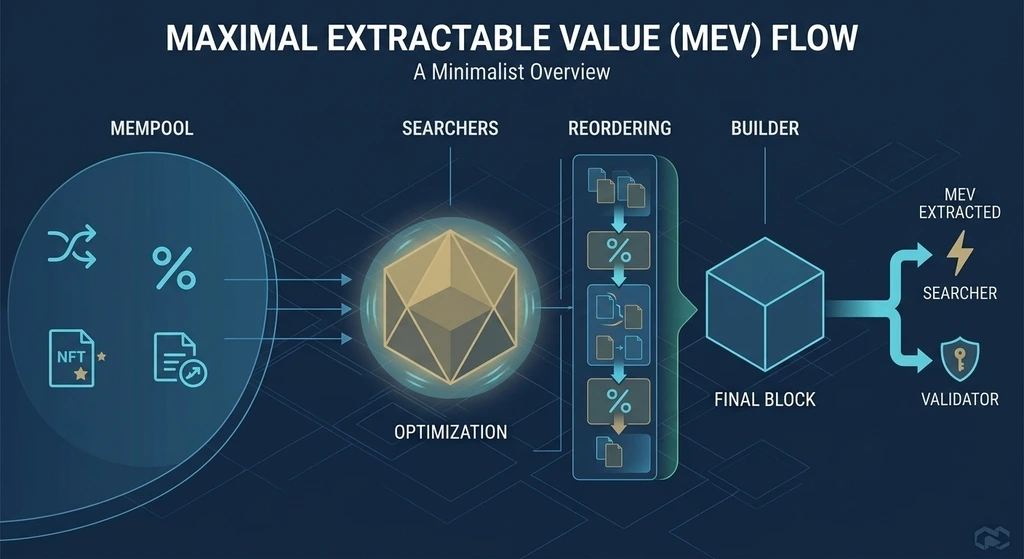
Total MEV extracted across all chains in 2026 is estimated at $2.5 billion annually on Ethereum, $800 million on Solana, and $300 million on Layer-2 networks. Cross-chain arbitrage constitutes a substantial portion of this extraction, with non-atomic MEV accounting for approximately 30% of DEX volume. The searcher landscape has professionalized, with the top 10 searchers capturing approximately 40% of all MEV, deploying sophisticated algorithms and custom low-latency infrastructure.
Structural Vulnerabilities and Quantified Exploit Vectors
Stargate, built on LayerZero’s infrastructure, operates an overcollateralized external verification model requiring staked assets to exceed individual transfer values. This model contains a fundamental economic flaw: the one-time profit from an MEV attack on a large transfer can permanently exceed a validator’s staked collateral, making rational defection a persistent threat.
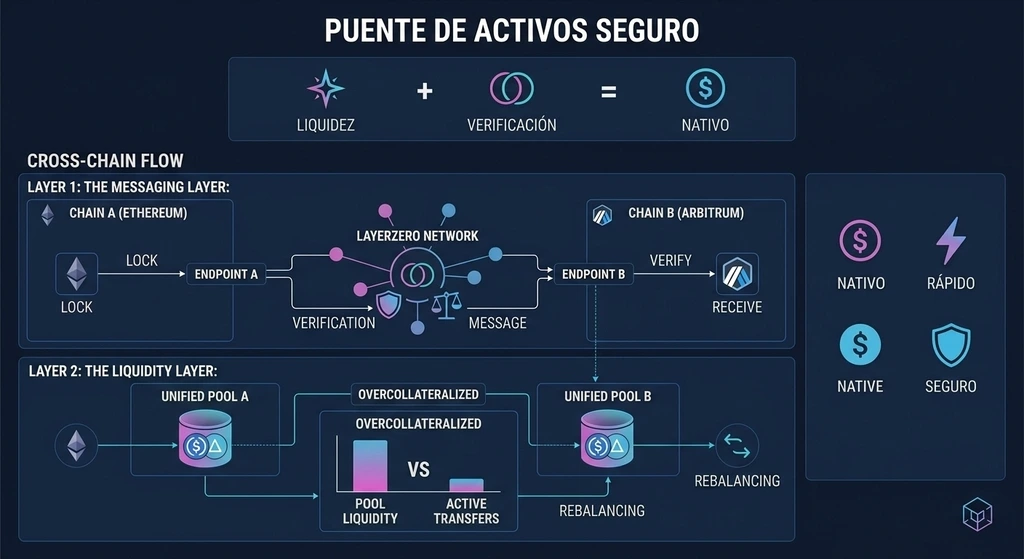
Confirmed attack vectors include:
The MPT validation vulnerability in LayerZero’s original code lacked pointer restrictions within proofBytes length, enabling attackers to forge hashRoots and pass fraudulent transaction receipts through MPT validation. While patched, this vulnerability demonstrated the architectural fragility of the verification model.
The validator staking double-deduction vulnerability allows specific operation sequences to deduct user delegated stakes twice from the validator’s total, artificially depressing validator stake quantities and inflating reward calculations for all remaining delegators on that validator.
The unclaimed earnings theft vulnerability, arising from incorrect cycle range calculations and lack of per-user effective stake tracking, permits exited delegators to steal VTHO rewards from active delegators.
The claim period boundary error in _claimableDelegationPeriods() returns upper limits beyond the delegation record’s endPeriod.
The reward compounding sandwich attack enables MEV bots to extract accrued rewards to near-zero value through the StargateStrategy.compound function, which lacks slippage controls during swap execution.
In March 2025, attackers exploited the Magic Internet Money (MIM) lending protocol on Arbitrum, draining 6,260 ETH and routing the stolen funds through Stargate bridge to Ethereum mainnet for laundering. Stargate held $160 million in available liquidity at the time of this exploit.
Time-based finality risks present a critical attack surface. Protocols like Stargate that treat certain states as “finalized” enable attackers to deposit funds on the source chain, receive bridged assets, and then force a reorg on the source chain to erase the original deposit, executing a double-spend. Validators with sufficient stake can privately construct longer chains to steal assets after they are deemed “final”.
Calldata Validation Gaps and Fixed Slashing Inadequacy
Synapse employs a fixed-value slashing mechanism described by security researchers as “economically naive”. Its security model depends on bonded liquidity providers, yet LP rewards and validator staking rewards draw from the same fee pool, creating direct capital competition.
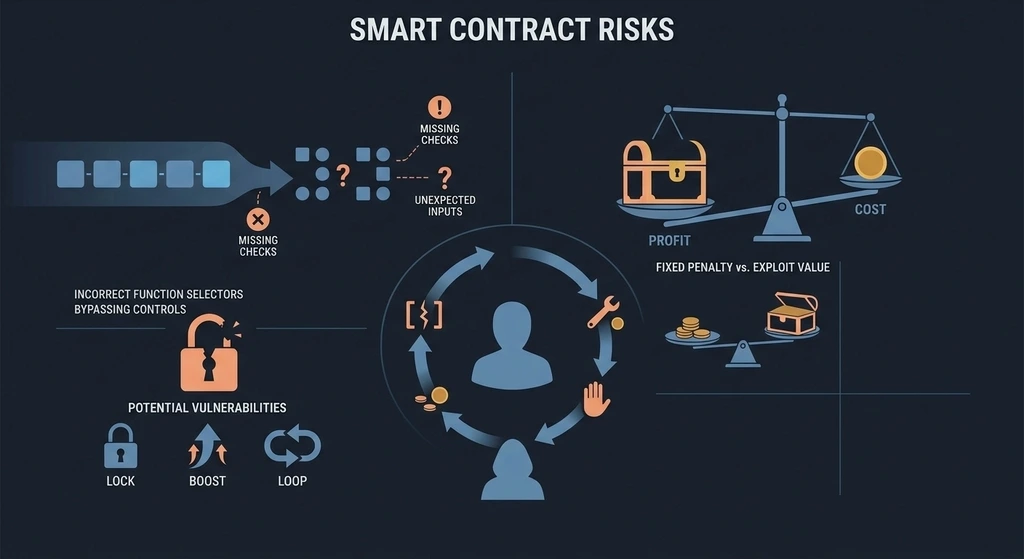
Identified vulnerabilities:
The calldata validation absence allows malicious actors to bridge funds stored on HardenedTopupProxy because the bridge’s call function accepts user-supplied calldata without any validation.
The hardcoded 5% slippage tolerance creates “quite juicy MEV opportunities” according to security audits.
The nUSD Metapool virtual price manipulation attack in November 2021 resulted in an $8 million near-loss, demonstrating the exploitability of Synapse’s forked Saddle Finance codebase.
Relayer-to-relayer MEV competition enables relayers to use MEV tools to steal from each other. If relayer Alice submits a message for relay by Bob, Alice can wait for Bob to complete the payment on the destination chain before executing an attack.
Over 80% of cross-chain DEX swaps via Stargate or Synapse have identifiable function signatures (e.g., swap(), addLiquidity()), making them trivial to fingerprint and exploit by generalized searchers.
Liquidity Pool as Price Oracle
Both Stargate and Synapse use on-chain AMM pools as the sole price source for transactions, creating a circular dependency ripe for manipulation. The bridge’s exchange rate equals the pool’s spot price. A MEV bot can drain one side of the pool (e.g., USDC/WETH) before the bridge transaction, skewing the price. The bridge user receives far less value than intended, with the bot profiting on the rebalancing arbitrage. Typical slippage ranges from 5-10%, with minimum profit per attack of $50,000.
Bridges like Stargate and Synapse rely on on-chain liquidity for instant transfers, creating a predictable price lag between source and destination chains that arbitrage bots exploit. Bots from Flashbots and EigenPhi monitor price discrepancies across chains, front-running settlement transactions to extract value from the liquidity pool before the user’s swap finalizes. This latency arbitrage functions as a structural subsidy — the profit for bots constitutes a direct loss for liquidity providers.
Validator Exposure: Economic Misalignment and Systemic Risk
Validator stake is typically 10-100 times smaller than the TVL it secures. If the exceeds slashing losses, rational actors can collude to steal funds. Social consensus slashing operates slower than code execution and remains susceptible to governance capture.
Slashing mechanisms fail for cross-chain security due to jurisdictional arbitrage. A validator’s stake on Chain A cannot be seized for misbehavior on Chain B, creating a fundamental security gap. The $10 million slashing stake securing a $100 million bridge is economically trivial — rational validators may collude for a one-time payoff exceeding their bonded value. Profit from theft exceeds profit from honesty, and slashing becomes a cost of business rather than a credible threat.
Destination chains like Avalanche and Polygon have zero obligation to honor slashing judgments from a foreign validator set, breaking the unified security model assumed by bridges. Security is only as strong as the most corruptible chain in the pathway.
Time-bandit attacks exploit weak finality to rewrite settled blockchain history for MEV extraction. A validator with >33% stake can privately construct a longer alternative chain to reverse a cross-chain transaction after assets are released on the destination chain. Typical MEV profit per block ranges from $5,000 to $50,000.
Bridges like LayerZero and Wormhole with optimistic verification are vulnerable, as a reorg can invalidate a supposedly finalized message. Ethereum has experienced 7-block reorgs, and a 51% attack on a mid-tier L2 or alt-L1 is economically trivial, invalidating all “finalized” cross-chain messages in flight.
The top five addresses execute over half of all trades and control half of the total volume, indicating barriers to entry. Inventory-based arbitrage is significantly more prevalent (66.96% of trades) and faster (median 9 seconds settlement) than bridge-based arbitrage (median 242 seconds), highlighting current bridging latency as a major bottleneck.
In August 2025, LayerZero acquired Stargate for $110 million, dissolving the Stargate DAO. In August 2026, Wyoming’s Stable Token Commission deprecated the LayerZero bridge (Stargate) and migrated the Frontier Stable Token to Chainlink CCIP following the 116,500 rsETH exploit (approximately $292 million) suffered by Kelp DAO on its LayerZero-based bridge.
Market data shows protocols including Solv Protocol, Re, and Kraken have gradually shifted interoperability toward Chainlink. In early August 2026, custodian BitGo selected CCIP to back $7.7 billion in Wrapped Bitcoin, bringing total migrated volume to approximately $15 billion in digital assets.
Cross-chain MEV extraction represents a structural feature of current bridge architectures rather than an incidental vulnerability. Stargate and Synapse, as representative liquidity pool bridges, create predictable, high-value extraction targets through their design choices.
FAQ
What is the total annual cross-chain MEV extraction volume?
Total MEV extracted across all chains in 2026 is estimated at approximately $2.5 billion on Ethereum, $800 million on Solana, and $300 million on Layer-2 networks. Cross-chain arbitrage constitutes a substantial portion, with researchers identifying $868.64 million in annual volume and $8.65 million in net profit from executed cross-chain arbitrages across nine blockchains.
What are the primary exploit vectors for Stargate and Synapse?
Stargate’s primary vulnerabilities include MPT validation flaws, validator staking double-deduction, unclaimed earnings theft, and reward compounding sandwich attacks. Synapse’s key vulnerabilities include calldata validation absence, hardcoded 5% slippage creating MEV opportunities, and relayer-to-relayer MEV competition. Both protocols use on-chain AMM pools as the sole price source, enabling pool draining attacks that extract 5-10% slippage per transaction.
Why do slashing mechanisms fail to secure cross-chain bridges?
Slashing fails because validator stake on Chain A cannot be seized for misbehavior on Chain B, creating a jurisdictional enforcement gap. The slashing stake is typically 10-100 times smaller than the TVL it secures. Profit from theft exceeds profit from honesty, and destination chains have zero obligation to honor slashing judgments from foreign validator sets.
How do time-bandit attacks affect cross-chain bridges?
Time-bandit attacks exploit weak finality by allowing validators with >33% stake to privately construct longer chains and reverse transactions after assets are released on destination chains. Bridges with optimistic verification windows like Stargate and LayerZero are vulnerable, as a reorg can invalidate finalized messages. Typical MEV profit per block ranges from $5,000 to $50,000.
What real-world incidents demonstrate cross-chain MEV risks?
In March 2025, attackers exploited the MIM lending protocol, draining 6,260 ETH and routing funds through Stargate. In August 2026, Wyoming deprecated LayerZero for Chainlink following the $292 million Kelp DAO exploit. In 2021, Synapse nearly lost $8 million through virtual price manipulation. Researchers have identified a single cross-chain MEV opportunity between Ethereum and Avalanche extracting over $3 million.

Isai Alexei is a journalist and financial analyst covering cryptocurrency markets and traditional securities for Blockchaindose. He has spent ten years analyzing digital assets, trading activity, and market structure.