Key Takeaways
- The NFT gaming market is valued at around $6.1 billion in 2025 and growing
- Blockchain adds true asset ownership, verifiable scarcity, and player-driven economies – but only when the underlying game is worth playing in the first place.
- Choosing the right blockchain – Polygon, Immutable X, or Solana for most new projects – directly impacts NFT game development cost, user experience, and long-term scalability.
- Smart contract audits are non-negotiable: unaudited contracts have cost the blockchain gaming industry hundreds of millions of dollars in hacks and exploits.
- The community backlash of 2021-2023 has cooled into cautious curiosity – player sentiment is now neutral to slightly positive, but only for games that lead with fun and treat blockchain as a layer, not the whole product.
NFT game development sits at an uncomfortable intersection: a real technology with genuine potential, surrounded by a history of hype, scams, and half-finished projects that pushed players away. If you are building an NFT game in 2026 – or seriously thinking about it – the landscape looks meaningfully different from what it did two or three years ago. The speculative gold rush has largely faded, and what remains is a smaller, more serious group of developers trying to figure out how to actually make blockchain mechanics add value to a game rather than just add complexity.
The NFT gaming market was valued at approximately $6.1 billion in 2025 according to Fortune Business Insights, with projections pointing toward $45.88 billion by 2034. Gaming NFTs currently account for roughly 25% of total NFT trading volume in 2025, according to Coinlaw, making it one of the largest use-case categories in the entire NFT ecosystem. The audience is real: daily active wallets in blockchain gaming reached approximately 4.66 million in Q3 2025 – though that figure represents a slight decline from the prior quarter, pointing to the ongoing challenge of player retention.
This guide covers what NFT game development actually involves in 2026 – from choosing a blockchain to designing tokenomics that do not collapse within six months – and addresses the honest questions that serious developers and aspiring builders are still asking: Is this worth doing? What does it cost? What does it require technically? And critically, what mistakes keep killing projects that had real potential?
What NFT Game Development Actually Means in 2026
NFT game development is the process of building a video game that uses blockchain technology to enable players to own, trade, and monetize in-game assets. Those assets – characters, weapons, skins, virtual land, collectibles – are stored as non-fungible tokens (NFTs) on a blockchain, giving each item a verifiable, unique identity that exists independently of any single game server.
In traditional games, a player who spends $100 on in-game items owns nothing in any legally or technically meaningful sense. The developer controls those assets entirely and can modify, delete, or devalue them at any time. In an NFT game, the ownership record lives on a decentralized ledger. Players can sell their items on secondary markets, transfer them between wallets, and in some cases carry them across compatible games. That is the genuine value proposition – not the speculative price appreciation that defined the 2021 boom, but the structural shift in who controls digital assets.
The category has also evolved significantly in terms of what gets built. Early NFT games (2018-2022) were often DeFi mechanisms dressed up in basic game interfaces – simple clicking mechanics layered over complex token economies. The 2025 wave is different: developers with backgrounds at traditional AAA studios are entering the space, bringing higher-quality mechanics, real narrative design, and graphics that can compete with non-blockchain titles. Games like Off The Grid (built in Unreal Engine 5) and Illuvium represent the new benchmark – games that would be worth playing with blockchain integration stripped out, but that use NFTs to give players genuine ownership and economic participation.
What Blockchain Actually Adds – and What It Does Not
This is where it is worth being direct. A database can replicate most things a blockchain does for in-game item tracking. Game history, item provenance, player progression records – none of those technically require a decentralized ledger. The real value of blockchain in gaming is economic, not purely technical: it enables trustless ownership records, secondary market trading without developer mediation, and transparent smart contract logic that players can audit independently.
The Reddit community around NFT game development has been pointing this out for years. As one commenter put it, blockchain does not make the task of tracking item history easier – a normal database is enough in 99% of cases. What blockchain genuinely solves is the ownership and interoperability problem – the ability for players to hold assets that exist outside of any single developer’s control. Whether that matters enough to justify the added complexity depends entirely on what you are building and for whom.
The 2026 Market Reality: Opportunity With Honest Caveats
Where the Market Actually Stands
The NFT gaming sector spent 2024 and early 2025 going through what GAMES.GG’s analysis describes as a “year of cleansing.” Studios shut down, token values declined, and venture capital funding for blockchain gaming fell sharply to around $293 million in 2025 – a roughly 71% year-on-year decline according to market data reported by Market Reports World. That contraction sounds alarming until you consider what drove the previous boom: speculative money chasing hype, not viable games.
What remains is more durable. Player sentiment toward gaming NFTs has shifted from negative to approximately neutral, according to GAMES.GG’s 2025 analysis, with collections tied to ongoing product development and genuine utility holding value better than pure speculative assets. The structural fundamentals – mobile platforms capturing 55.2% of blockchain gaming market share, Asia-Pacific growing at a projected 16.98% CAGR, and active wallet users across Web3 gaming reaching roughly 102 million in 2025 – point to real, sustained demand. The problem was never the audience; it was the product quality.
Who Is Playing NFT Games in 2026
Around 71% of active Web3 gamers are aged 18 to 34 (Market Reports World, 2025), a demographic that already understands crypto wallets and digital asset ownership. The United States represents roughly 37.4% of the global P2E market, with approximately 82% of U.S. blockchain gamers expressing interest in in-game token usage. Southeast Asia and South Asia remain critical growth regions, where play-to-earn models have genuine economic significance for players whose in-game earnings can supplement real income.
The harder truth is that player retention remains a structural problem. Approximately 52% of blockchain gamers remained active 90 days after onboarding in 2025, according to Market Reports World – a retention rate that falls significantly short of what top traditional games achieve. Token inflation models are a major culprit: player drop-off increases by roughly 18% when token distribution is aggressive and unsustainable. Fixing this is fundamentally a game design challenge, not a blockchain one.
NFT Gaming Market at a Glance (2025)
| Metric | Figure | Source |
|---|---|---|
| NFT gaming market size (2025) | $6.1 billion | Fortune Business Insights |
| Daily active wallets (Q3 2025) | ~4.66 million | Market Reports World |
| Gaming NFTs share of total NFT volume | ~25% | Coinlaw |
| Blockchain gaming VC funding (2025) | ~$293M (-71% YoY) | Market Reports World |
| Mobile share of blockchain gaming | ~55.2% | Market Reports World |
| 90-day player retention rate | ~52% | Market Reports World |
Choosing Your Blockchain: The Most Consequential Early Decision in NFT Game Development
Your blockchain selection affects transaction speed, gas fees, developer tooling, the size of your potential player base, and your smart contract audit costs. Getting this wrong early is expensive to fix. Here is how the main options break down for game developers specifically in 2026.
| Blockchain | Best For | Key Strengths | Key Weaknesses |
|---|---|---|---|
| Ethereum | High-value NFT games, prestige projects | Largest ecosystem, maximum security, brand trust | High gas fees, slower throughput |
| Polygon (PoS) | Most new mid-tier projects | Low fees, EVM-compatible, largest active wallet base (~48M) | Relies on Ethereum’s security model |
| Immutable X | NFT-core games, card games | Zero gas fees for NFT minting, built-in marketplace | Narrower ecosystem than Ethereum/Polygon |
| Solana | Fast-paced, high-frequency games | Very fast, ultra-low fees | Network outage history; Rust auditors scarcer and more expensive |
| BNB Chain | Cost-sensitive projects, emerging markets | Large gaming community, low fees | More centralized; perception issues among some players |
| Ronin | Games within the Axie ecosystem | Optimized for high-frequency gaming transactions | Less flexible outside of the Axie Infinity ecosystem |
Over 65% of new smart contracts in 2025 were deployed on Layer 2 chains, with Polygon capturing the largest share of gaming deployments (The Block Opedia, 2025). For most developers starting out today, Polygon or Immutable X represents the lowest-friction path to market, while Solana is the better fit if your game genuinely requires high-speed, low-cost transactions at the core of its gameplay loop.
The Technical Stack: What NFT Game Development Actually Requires
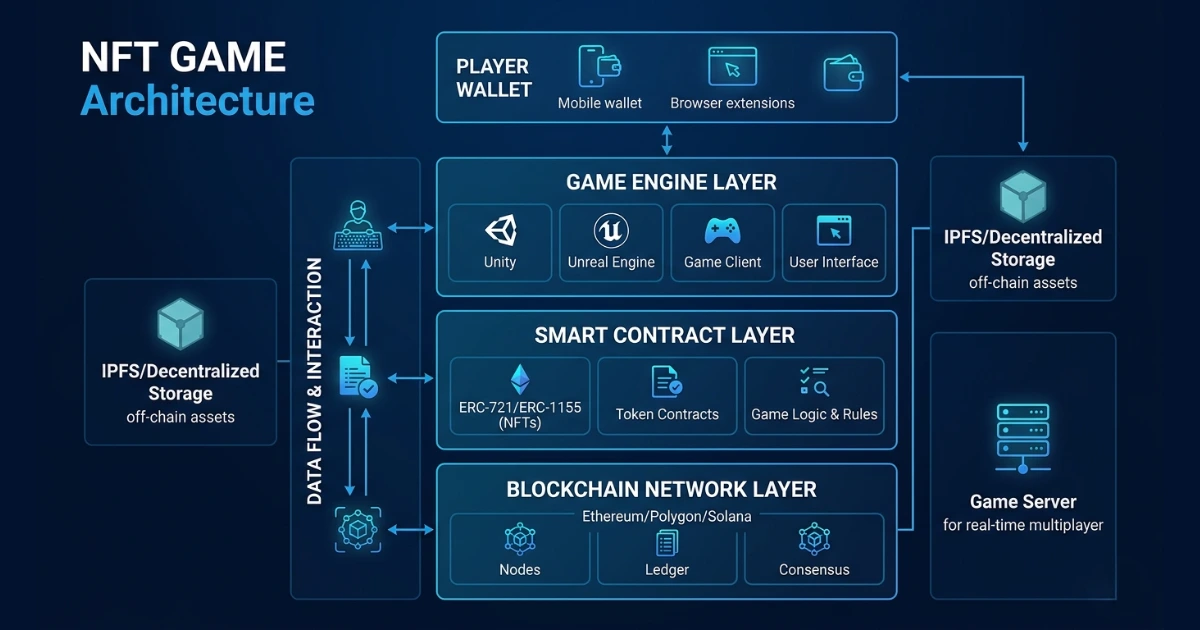
Building an NFT game is not one job – it is three disciplines that must work together: traditional game engineering, blockchain and smart contract development, and economic design. Most projects that fail do so because at least one of these three is either missing or subordinated to the others.
Game Engine and Frontend
The game engine choice follows the same logic as any conventional game project. Unity and Unreal Engine remain the dominant choices for 2D and 3D games respectively. Both have available Web3 SDKs and wallet integration plugins, though the blockchain layer is always an addition to the game, not a replacement for solid engine-level work. For browser-based or lightweight games, HTML5 and JavaScript remain viable.
Smart Contract Development
Smart contracts are the economic logic layer of your NFT game – they govern asset ownership, marketplace transactions, token distribution, staking rewards, and governance. The primary language for Ethereum-compatible chains is Solidity; Solana uses Rust; newer chains like Aptos and SUI use Move. NFT standards you will commonly work with include ERC-721 (unique individual assets) and ERC-1155 (batch assets, more gas-efficient for games with large item sets).
The most critical rule in smart contract development for games: smart contracts cannot be patched like regular software once deployed. Logic errors, economic exploits, and security vulnerabilities are permanent unless you have built in upgrade mechanisms from the start. OpenZeppelin’s audited contract templates provide a battle-tested starting point; building custom contract logic from scratch without security expertise is how games lose their entire treasury in a single exploit.
Wallet Integration and Player Onboarding
This is where most NFT games lose casual players before they even start. Requiring a user to set up a non-custodial wallet, understand seed phrases, and manually approve every in-game transaction is a guaranteed way to cap your audience at crypto-native early adopters only. The better approach, which is becoming standard in 2026, is to abstract the blockchain layer from the player experience – using custodial or semi-custodial wallet solutions for new users that allow them to play first and engage with the underlying blockchain optionally. MetaMask, WalletConnect, and Phantom (Solana) remain the standards for crypto-native players; embedded wallet solutions are the path for mainstream onboarding.
Backend and Off-Chain Storage
Not everything belongs on-chain. Game state, player progression, non-critical metadata, and real-time multiplayer logic all belong off-chain – processed via traditional backend infrastructure (Node.js, Python, or Go) and stored in databases like PostgreSQL, MongoDB, or Redis. On-chain operations should be reserved for asset ownership changes, token transfers, and economic events that genuinely require immutable records. NFT metadata and game assets are typically stored on IPFS (decentralized) or traditional content delivery networks, depending on your decentralization philosophy and cost constraints.
Tokenomics: The Design Layer That Kills More Games Than Bad Gameplay
If there is one lesson that stands out from the first generation of NFT games, it is that poor tokenomics kills games that might otherwise have succeeded. The Axie Infinity collapse, the play-to-earn bubble of 2021-2022, the endless parade of games that launched with aggressive token emission and watched their economies implode within months – all of these trace back to the same root problem: unsustainable economic design.
Roughly 70% of P2E tokens lose the majority of their value within a year of launch (Ptolemay, Messari Gaming Report 2025). This is not primarily a crypto market problem – it is a supply and demand problem. When a game mints tokens as rewards faster than it creates genuine demand for those tokens, inflation sets in and the value collapses. Players who entered early to earn exit, the price drops, newer players see no reason to join, and the game dies.
Core Tokenomics Principles for 2026
Dual-token models (a governance token and a utility token) have become the standard approach for more complex games. The utility token handles in-game transactions and rewards; the governance token gives holders voting rights on NFT game development decisions and is typically harder to earn. Separating these functions reduces the pressure on any single token to serve incompatible economic roles.
Token sinks – mechanisms that remove tokens from circulation – are as important as emission rates. Crafting costs, upgrade fees, marketplace transaction fees, and competitive entry fees all serve as sinks that prevent inflation. A game that emits tokens without adequate sinks is always moving toward zero.
Vesting schedules and emission curves determine how new tokens enter circulation over time. Front-loaded emission rewards early players at the expense of later ones – this is the structure that creates Ponzi-like dynamics. Conservative emission that grows gradually with the player base is harder to market at launch but produces more durable economies.
Transparency is now expected. Players in 2026 routinely ask to see total token supply, mint schedules, team allocation percentages, and vesting timelines before committing to a game. Projects that hide these numbers or make them difficult to find are treated with justified suspicion.
Smart Contract Security: The Expense You Cannot Afford to Skip
Smart contract security is the single most underbudgeted item in NFT game development. The numbers make the case plainly: the Ronin Network hack cost $625 million in 2022; the Wormhole bridge exploit cost $320 million the same year; and smaller gaming contract exploits have drained projects throughout 2023-2025. According to The Block Opedia, hacks drained approximately $250 million from blockchain games in 2024 alone (citing DappRadar). Unaudited contracts are not just a risk – they are a statement to players and investors that the project is not serious.
What a Smart Contract Audit Costs
| Audit Type | Scope | Estimated Cost |
|---|---|---|
| Basic audit | Simple minting or staking contracts, single auditor | $5,000 – $15,000 |
| Mid-complexity audit | Multi-contract game economy, specialist firm | $15,000 – $50,000 |
| Complex / AAA audit | Full protocol, multiple firms, formal verification, bug bounty | $50,000 – $500,000+ |
Beyond the initial audit, serious projects implement ongoing security practices: internal testing, static analysis tools like MythX, bug bounty programs that pay researchers to find vulnerabilities before bad actors do, and on-chain monitoring to detect anomalies in token flows post-launch. Chainlink VRF (Verifiable Random Function) is the standard for randomness in NFT games – using pseudo-random functions for loot drops or matchmaking destroys player trust the moment someone figures out the exploit, and they will.
Development Cost: What to Budget Realistically
NFT game development costs vary by a factor of 20 or more depending on scope, and many projects dramatically underestimate what it will cost to build something competitive. Here is an honest breakdown:
| Project Tier | What It Includes | Estimated Range |
|---|---|---|
| Proof of concept / Indie | Simple game loop, basic NFT minting, minimal tokenomics, no complex marketplace | $30,000 – $80,000 |
| Mid-tier funded project | Custom smart contract architecture, P2E mechanics, NFT marketplace, multiplayer, mobile + web | $100,000 – $500,000 |
| AAA / Metaverse-scale | Full 3D, metaverse integration, complex dual-token economy, cross-chain features, major audit | $500,000 – $2M+ |
These figures frequently exclude several hidden cost categories that catch developers by surprise: smart contract audit fees ($5,000-$500,000+ depending on complexity), ongoing gas fees, tokenomics modeling and rebalancing, post-launch legal compliance, marketing and NFT community management, and anti-cheat and bot detection systems. A full MVP with wallet login, NFT trading, and basic compliance realistically runs $50,000-$200,000 minimum for a studio with experience in both blockchain and NFT game development. Trying to build at the lower end of those ranges by cutting security corners almost always results in either a hack or a broken economy – often both.
On staffing: smart contract developers focused on gaming earn a median of $6,000-$14,000 per month in 2025 (CB Insights 2025, cited by Ptolemay), and Web3 game job listings have grown 19% year over year. Demand for proven talent exceeds supply, which means the best blockchain game developers are expensive. Offshore teams (India, Vietnam) typically charge $25-$50/hour; Eastern European teams $50-$100/hour; US/UK specialists $120-$200/hour. Location is the most controllable cost variable, but experience is non-negotiable when it comes to smart contract work.
The Gameplay-First Rule: The Lesson the Industry Had to Learn the Hard Way
One of the most repeated observations from game developers who have worked in the NFT space is also the simplest: if the game is not fun without the blockchain, adding blockchain will not make it fun. This might seem obvious, but the NFT game development priorities of the 2021-2023 era consistently inverted this logic. Projects spent the majority of their communication talking about token economics and earning potential, and a small fraction talking about actual gameplay. Players noticed.
A useful test from the Reddit developer community, and one that has aged well: would you want to play this game if you removed all the NFT mechanics? If the honest answer is no, the game will attract people who want to speculate, not people who want to play. Speculation-driven player bases evaporate the moment token prices drop. Genuine player bases persist through market cycles because they are there for the game, not the earning opportunity.
The 2025 consensus among serious builders is that blockchain should function as a layer, not the foundation. The game mechanics, narrative, and user experience should work independently. The blockchain layer then adds ownership, verifiable scarcity, and economic participation on top of a game that already deserves to be played. This is also the practical path to reaching non-crypto audiences – players who do not care about NFTs but will accept them as long as they do not make the game worse.
What Modern Players Actually Want
Community feedback from developers and players active in this space consistently highlights the same priorities. Players want true ownership of in-game assets – not as a financial vehicle, but as a genuine extension of the time and money they invest. They want fair competitive mechanics where NFTs do not create pay-to-win advantages that break game balance. They want transparent economies – visible token supply, clear mint schedules, and honest communication about how the project’s economics work. And increasingly, they want cross-game interoperability – the ability to use assets across multiple titles rather than having them trapped in a single ecosystem.
Strong community features – guilds, competitive leagues, social mechanics, DAO governance that gives players a real voice in development – consistently separate games with durable player bases from those that collapse after the initial mint.
Legal and Regulatory Considerations in NFT Game Development
Regulatory clarity around NFTs and in-game tokens remains fragmented across jurisdictions in 2026, but the direction of travel is toward greater oversight rather than less. Approximately 28% of blockchain gamers report regulatory uncertainty as a barrier to entry (Market Reports World, 2025). In markets with unclear regulation, revenue growth for P2E titles slowed by an estimated 10-12% in 2025.
Key legal questions every NFT game developer needs to address before launch:
- Securities classification: Do your tokens constitute investment contracts under local law? This is the question that has forced several projects to restructure or shut down. The Howey Test (US) and equivalent frameworks in other jurisdictions are the starting point, but legal opinion specific to your project and target markets is essential.
- KYC/AML compliance: If your game allows players to convert in-game earnings to fiat currency or major cryptocurrencies, you may be operating as a financial service in many jurisdictions, with corresponding compliance requirements.
- App store policies: Steam still bans blockchain games with tradeable NFTs. Apple’s App Store and Google Play have restrictions on crypto and NFT monetization. Approximately 30% fewer blockchain games were approved on major app stores in Q4 2025 compared to 2024. Distribution strategy has to account for these restrictions.
- Intellectual property: NFT art and character designs require clear IP ownership. Fan-generated NFTs and user-created content create additional complexity when built on licensed IP.
Jurisdictions with the most progressive and clear frameworks for NFT game development in 2026 include Japan, Singapore, and the UAE. South Korea’s rating board approved several NFT titles in 2024-2025, opening significant market access. Developers targeting global audiences should build compliance-first architectures from the start rather than retrofitting legal requirements onto a launched product.
Finding Publishers, Funding, and Partners
For developers without marketing resources or capital – a situation many technically skilled builders face – finding a publishing or funding partner is a legitimate path. The landscape for this in 2026 is more structured than it was during the speculative boom, though also more selective.
Major players in the space include Animoca Brands and Gala Games, both of which have a history of funding independent blockchain projects. Furthermore, individual networks like Polygon, Immutable, and Solana run specialized grant programs for NFT game development within their ecosystems. these programs often provide low-to-mid five-figure funding for early-stage projects that can demonstrate a solid proof of concept.
The key insight from developers who have successfully found partners: a publisher’s incentive structure needs to align with yours. In a fully on-chain game where revenue is generated by the smart contract, a traditional publishing model (where the publisher controls the client distribution) breaks down. The value proposition for a potential partner needs to be clearly defined – whether that is a revenue share baked into the smart contract, a token allocation, or a service-for-equity arrangement.
One warning from multiple developers in the space: avoid arrangements where your team is expected to work primarily for token or NFT compensation rather than fiat salaries. The 2021–2023 era produced too many cases of developers accepting crypto compensation that became worthless before projects shipped. Navigating the financial side of NFT game development requires prioritizing stability; working for equity in a speculative asset is a high-risk position that experienced builders increasingly decline.
Why Most NFT Games Fail: The Honest Breakdown
Understanding what kills projects during NFT game development is as useful as understanding what makes them work. The most common failure modes in 2026, in rough order of frequency:
1. Unsustainable token economics. Aggressive emission without adequate sinks inflates supply, collapses token price, and sends players to the exit. This is the most predictable and preventable failure in the entire space.
2. Gameplay that is not fun. No tokenomics system can retain players who do not enjoy the core game loop. The correlation between player retention and actual game quality in blockchain gaming is identical to conventional gaming.
3. Unaudited or poorly designed smart contracts. Security exploits at scale destroy community trust instantly. A single hack can end a project that took years to build.
4. Onboarding friction. Requiring new players to navigate wallets, gas fees, and crypto purchases before they can play a single minute of the game caps the audience to crypto natives only.
5. Leading with tokenomics in communications. Projects that spend 90% of their marketing talking about earning potential and token price attract speculators, not players. When the speculation ends, the community disappears.
6. Centralized team token allocations. Large founder or team token reserves with short vesting periods signal extraction intent rather than long-term commitment. The community has learned to read these structures and react accordingly.
Avoiding these pitfalls requires a shift in mindset: successful NFT game development must prioritize sustainable engineering and player experience over short-term speculative hype.
Frequently Asked Questions
It depends entirely on what you are building and why. If the core game is genuinely engaging and blockchain mechanics add real value – true ownership, player-driven economies, cross-game interoperability – then yes, the market is real and growing. If the game exists primarily to sell tokens, the answer is no, and the market has become sophisticated enough to recognize the difference.
No. An NFT game can use only NFTs for asset ownership without introducing a native token at all. Introducing a token is a significant commitment that creates ongoing regulatory questions, tokenomics management requirements, and community expectations. Many developers in 2025 recommend delaying token introduction until the game has a proven player base, rather than using it to fund development before the product exists.
For most new developers, Polygon or Immutable X are the most practical starting points. Both offer low or zero gas fees for NFT transactions, strong developer tooling, EVM compatibility (meaning your Solidity knowledge transfers), and an established player ecosystem. Ethereum is excellent for security and prestige but cost-prohibitive for high-frequency in-game transactions. Solana is fast and cheap but requires Rust and has a less mature gaming developer ecosystem.
A basic proof-of-concept NFT game with functional blockchain integration can take 3-6 months for a small experienced team. A mid-tier funded project with full P2E mechanics, a marketplace, and multiplayer typically requires 12-18 months minimum. AAA-quality games take 3+ years. Rushing development to capitalize on market timing is one of the most documented paths to failure in the space.
Some are, some are not. Games like Axie Infinity, CryptoKitties, and Decentraland generated significant revenue for their developers. However, the majority of NFT game projects did not reach sustainability, particularly those launched during the speculative boom. Profitability in 2025 is most reliably built on genuine player retention and sustainable token economics – not on initial NFT sale volume, which can evaporate when market sentiment shifts.
Third-party smart contract audits are the foundation. Beyond that: use audited contract templates from OpenZeppelin rather than writing custom logic from scratch; implement Chainlink VRF for all randomness; run ongoing on-chain monitoring for anomalous token flows; maintain a bug bounty program; and keep a treasury reserve for incident response. Never deploy to mainnet an unaudited contract that handles real player funds.

Stefan is the founder of Blockchaindose and a long-time tech enthusiast who first dove into crypto back in 2012, starting out by mining his first coins on graphics cards. Over the years, he shifted gears into active trading and investing. Today, his main focus is driving the platform forward and showing people how crypto can actually be used in the real world—beyond just the speculation.
That blend of early-adopter roots, hands-on market experience, and a practical vision makes his perspective a solid anchor for the team.