Every few months, a new headline tells us stablecoins are taking over payments. Salaries, remittances, supplier invoices, all moving on-chain. Some of that is true. But one number, buried in a research note from the Andersen Institute for Finance and Economics, tells a quieter story. About $76 billion of stablecoins were sitting on centralized exchanges on July 28, 2026.
That is not a payment. That is a trader’s bankroll, waiting for an order.
This piece tests one simple idea: stablecoins are still mostly trading liquidity. We will check it against the data, keep the numbers plain, and see where the idea holds up and where it does not.
The number nobody puts in the headline
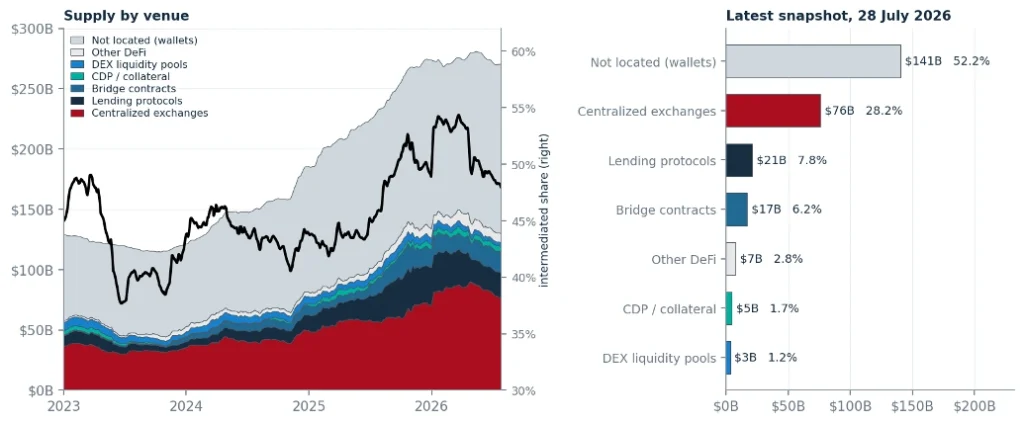
The Andersen Institute counted $76.0 billion across identified centralized exchanges. That equals 28.2% of the $269.4 billion in reserve-backed dollar stablecoins it measured.
Who owns that pile? Mostly Tether.
- USDT: $61.5 billion
- USDC: $10.1 billion
- Everything else: the remainder
So is it “nearly 30%”? Fairly, yes. But precision matters. The 28.2% applies to the stablecoins Andersen measured, not to every stablecoin in existence. And the researchers call it a lower bound, because some exchange wallets cannot be identified. The real figure could be higher.
It is not a one-off
A single snapshot can mislead. So here is what other data providers found.
CryptoQuant tracked a record $68 billion of USDT and USDC on exchanges on August 22, 2025. That beat the previous high from February 2022. USDT made up $53 billion of it, and USDC $13 billion.
By late December 2025, CryptoQuant put exchange balances at $69 billion, about 22% of a record $314 billion supply.
The percentages differ (22% versus 28%). That is normal. Each firm uses a different list of coins and a different way of labeling exchange wallets. But the story is the same: roughly one in four to one in five stablecoins is parked on an exchange, not being spent.
One more data point: a Range study of about $180 billion in stablecoins on Ethereum and Solana found 57% of the supply it could classify sat on centralized exchanges. That sample is narrower, but it points the same way.
Two coins, two jobs
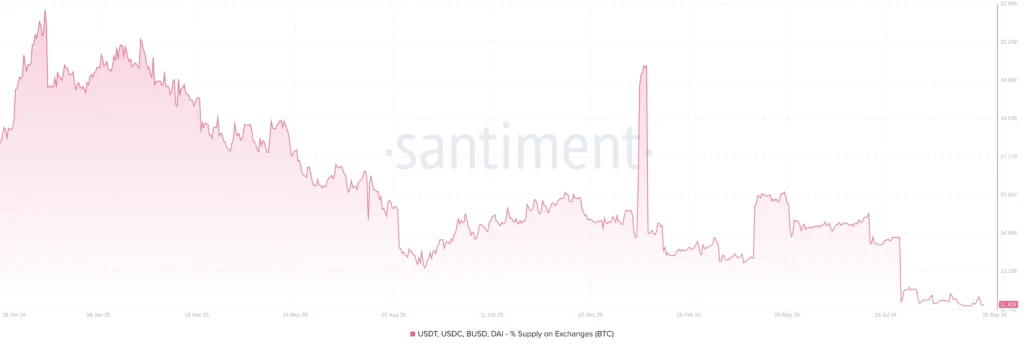
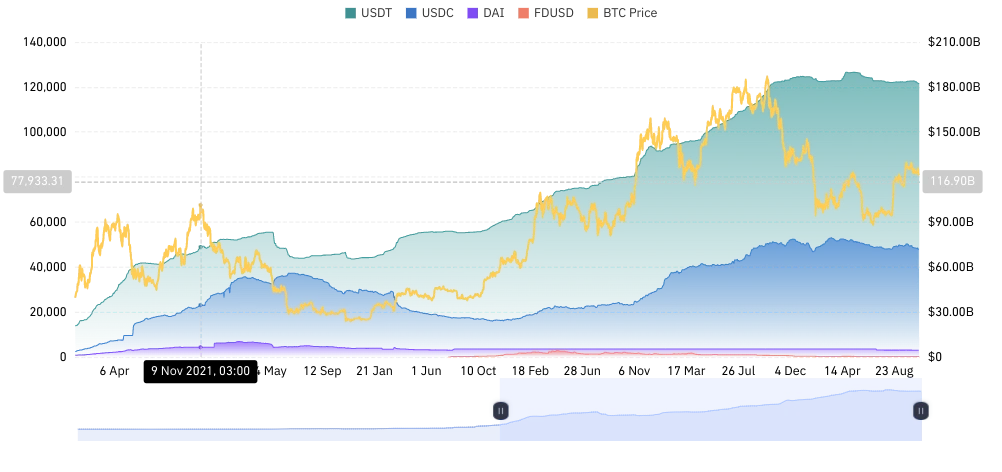
The Santiment data as shown above displays the peformance of stablecoins including the two major ones like USDC and USDT. Here is where the thesis gets interesting. Tether and USDC are both dollar coins. They do very different work.
- Tether (USDT) holds about 59% of stablecoin supply, but about 74% of stablecoin trading volume on centralized exchanges.
- USDC leads on-chain transaction volume: $18.3 trillion in 2025, versus $13.3 trillion for USDT.
A quick caution on the 74%. It describes centralized-exchange trading, not all on-chain activity. Mixing those up is the easiest mistake to make with this stat.
The simple reading: USDT is the exchange coin. Traders use it to move between positions. USDC is more often the settlement coin used on-chain. Tether’s share of trading is even bigger than its share of supply, which is exactly what you would expect from a trading tool.
One dollar, very few issuers
Now zoom out to the whole market.
- Global stablecoin supply was about $303.8 billion on September 2, 2026.
- 99.87% of it traces back to just 28 issuers, according to Axis Intelligence, which builds on DeFiLlama data.
- More than 99% of supply is USD-denominated, according to Visa.
Put those together and you get a market that is, in effect, a private, on-chain extension of dollar liquidity. It is not a basket of world currencies. It is the dollar, issued by a short list of companies.
The exchange side is just as concentrated. In December 2025, CryptoQuant found Binance held about $49 billion, roughly 71% of all exchange-held stablecoin buying power. The top three exchanges held about 94%. Binance alone sat on close to 15% of the entire global stablecoin supply.
So it is not only a few issuers. It is also a few venues.
The counter-argument: payments are real
A fair test must also look for evidence against the thesis. And there is some.
Stablecoin transfer volume is enormous. Visa’s on-chain dashboard showed $75.7 trillion in total volume over the 12 months to May 7, 2026. But strip out bots, internal transfers and exchange shuffling, and the “adjusted” figure drops to $12.9 trillion. That is only about 17% of the headline.
It gets sharper when you isolate actual payments. McKinsey and Artemis Analytics studied 2025 and found:
- About $35 trillion in total stablecoin volume
- Only about $390 billion of it was real payments, roughly 1%
- That is about 0.02% of global payments volume
- B2B payments were the biggest piece at $226 billion, about 60% of the total, and grew 733% year over year
- Real payments more than doubled from 2024
Two things are true at once. The vast majority of stablecoin activity is trading and internal movement. But the small payments slice is growing fast, led by businesses paying other businesses.
A warning on the numbers: estimates vary widely. Some analysts put “organic” volume at $9 to $11 trillion a year, while McKinsey’s strict payments count is $390 billion. The gap is mostly about definitions. Always check what a source means by “payments.”
The verdict
The thesis holds, with one edit. Stablecoins are still mainly trading and settlement liquidity, concentrated in a few issuers and a few exchanges. But they are no longer only that. Payments are a small, fast-growing second job.
It tells you what a stablecoin is really doing today. If a quarter of supply sits on exchanges, then stablecoin growth is closely tied to crypto trading demand, not just to payments adoption. And because so much sits with a few issuers and one dominant exchange, a problem at any of them could ripple through the whole market. Knowing this helps you read the “stablecoins are the future of payments” headlines with the right sense of scale.

Dan is a seasoned crypto writer for Blockchaindose who got his start in the space back in 2019. Over the past four years, he’s built a solid grasp of how the industry moves, focusing heavily on DeFi, NFTs, GameFi, and promising new projects.
Off the clock, you’ll usually find him buried in a good book or kicking back with a movie. His blend of hands-on market experience and straightforward commentary makes him a clear, trusted voice across the platform.