Researchers at Matter Labs, the University of Toronto, Télécom Paris and Imperial College London mapped in 2023 how decentralized sequencers reshape transaction ordering on Ethereum rollups. Their framework links shared sequencing to maximal extractable value (MEV) and transaction privacy, the two factors that decide who controls order and who profits from it. It defines seven property groups, from liveness to interoperability, and reviews eight design components.
Centralized Sequencers Concentrate Ordering Power
Most rollups run one centralized sequencer, and the operator selects transactions and fixes their order. An outage halts liveness. A profit-seeking operator can censor users or capture MEV. L2BEAT data show weaknesses in 2023: zkSync Era’s forced exit required sequencer approval, and replacing Arbitrum’s sequencer took nearly a week. Forced exits cover withdrawals, but funds locked inside rollup contracts remain exposed.
Sequencers Order Transactions Without Reading Them
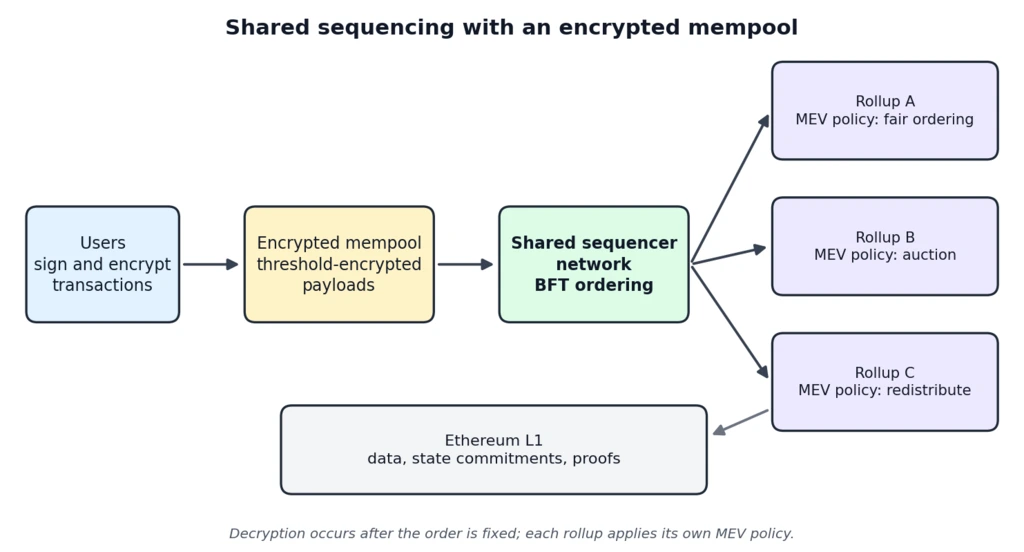
The executor builds blocks, the submitter posts state differences to Ethereum, and the prover generates validity proofs. Because a sequencer can order encrypted payloads without reading them, role separation supports transaction privacy and lowers latency. Hardware needs also favor separation: ordering requires low latency, state updates demand CPU-heavy Merkle tree computation, and proof generation typically uses GPUs.
Sequencing Policy Defines MEV Exposure
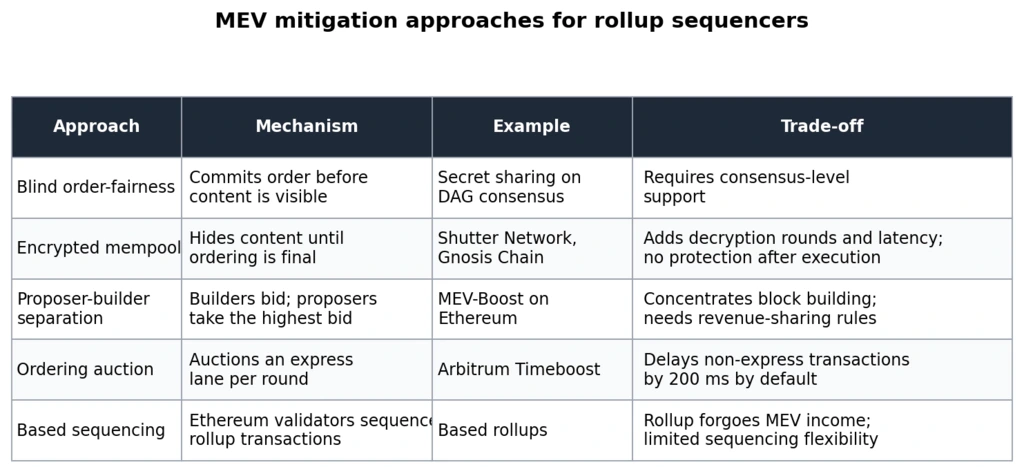
Ordering rules set MEV exposure, and the sequencing policy sets the rules. MEV is the profit from including, excluding or reordering transactions within a block. First-come-first-served (FCFS) ordering invites latency competition: traders place servers near the sequencer to obtain earlier timestamps. On rollups with block times between 200 milliseconds and two seconds, MEV extraction becomes a contest to reach the sequencer first. Arbitrum Timeboost auctions a 60-second express lane through a sealed-bid, second-price auction and delays other transactions by 200 milliseconds by default. Random or secret proposer selection limits bribery and denial-of-service attacks against the current leader.
Shared Sequencing Orders Transactions Across Rollups
Rollups gain lower infrastructure costs, cross-rollup inclusion and unified fees. Inclusion places a user’s transactions on several chains in one ordering round; atomic execution across chains remains unsolved. Rollups lose sovereignty over ordering policy and share capacity with other chains. MEV creates a harder problem: one rollup may maximize it, another may minimize it, and one network must serve both.
Flashbots Collective states that revenue allocation lacks a deterministic formula, because MEV depends on private information revealed only in auctions. Based rollups hand sequencing to Ethereum validators: MEV goes to the base layer, and the rollup forgoes the income.
Fair Ordering, PBS and Encrypted Mempools Mitigate MEV
The first enforces fair ordering: blind order-fairness commits transactions to a sequence before validators see content, using secret sharing or threshold encryption. The second redistributes value: proposer-builder separation (PBS) lets builders bid for block-proposal rights, and proposers share the proceeds. An encrypted mempool hides content until ordering finalizes; Shutter Network runs threshold encryption on Gnosis Chain. Threshold schemes add communication rounds for decryption, while secret sharing cuts the overhead and integrates with DAG-based consensus.
Open Questions for Rollup Designers
Twelve research questions remain open, including how a shared sequencer can respect differing rollup policies and whether sequencer and prover pools should overlap. No deployed design satisfies every property the framework defines. Timeboost and Shutter show that ordering policy and mempool privacy already reach production, while cross-rollup MEV accounting stays unresolved.
Rollup teams evaluating shared sequencing face three decisions: MEV policy, revenue sharing and mempool privacy. Each decision affects user cost, censorship resistance and rollup autonomy.
FAQ
What is shared sequencing?
Shared sequencing assigns transaction ordering for several rollups to one decentralized network of sequencers. Each rollup keeps its own execution and state, and the network supplies ordering and, in some designs, data availability.
How does shared sequencing affect MEV?
One network observes order flow from several rollups, which creates cross-rollup MEV opportunities. Each rollup may follow a different MEV policy; the network needs rules for ordering and revenue allocation.
What is the difference between a shared sequencer and a based rollup?
A shared sequencer is an external network with its own validators. A based rollup delegates sequencing to Ethereum validators, which sends MEV to the base layer and removes the rollup’s MEV income
How does an encrypted mempool protect rollup users?
An encrypted mempool hides transaction content until the order is fixed. Searchers cannot front-run or sandwich pending trades. Threshold decryption adds latency, and the scheme offers no protection after execution.
Why do rollups need decentralized sequencers?
A single operator creates liveness, censorship and MEV risks. Decentralized sequencers distribute ordering across a committee, which prevents one outage or one operator’s decision from halting or filtering the chain.

Isai Alexei is a journalist and financial analyst covering cryptocurrency markets and traditional securities for Blockchaindose. He has spent ten years analyzing digital assets, trading activity, and market structure.