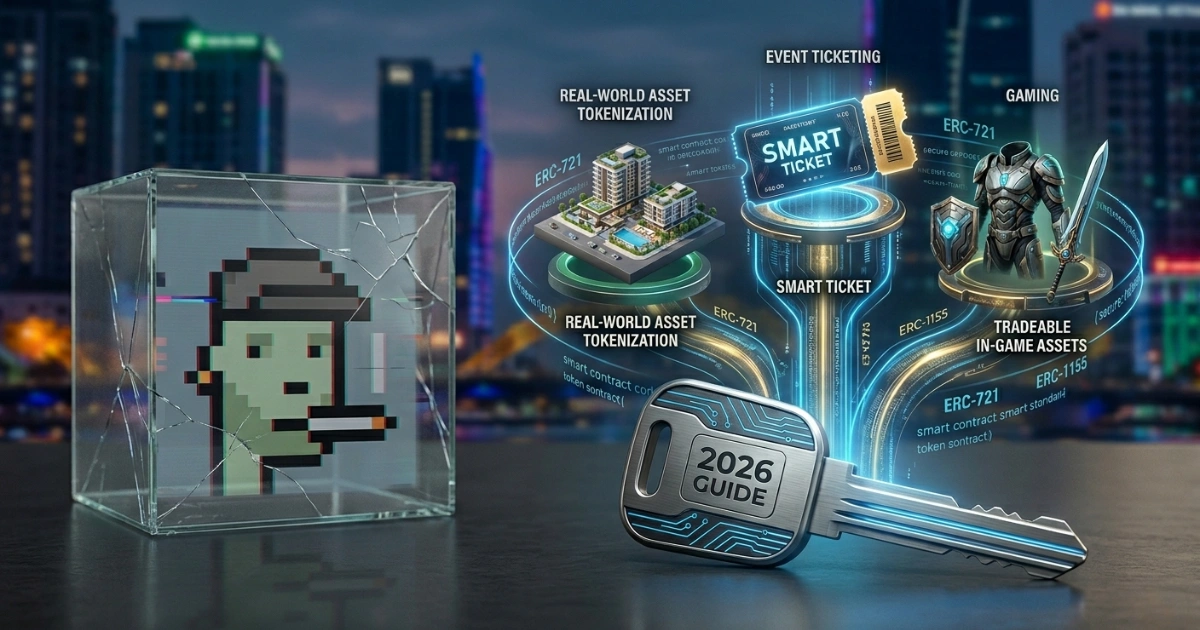
NFT development in 2026 looks significantly different from the static image collections that defined the 2021 hype cycle. The developers and companies building in this space today are focused on utility – tokens that do something, represent something real, or unlock something tangible. The technology did not fail. Most of what was built on top of it during the peak simply had no reason to hold value once attention moved elsewhere, as one engineer who spent four years at an NFT tech company noted in a community discussion.
Key Takeaways
- NFT development covers the full technical stack: smart contracts, token standards, marketplace integration, metadata storage, and wallet connectivity – not just minting digital images.
- The global NFT market is projected to reach $86.23 billion in 2026 at a 41.8% CAGR, driven by gaming, real-world asset tokenization, and phygital products rather than speculative art (Business Research Company, 2025).
- The two foundational token standards are ERC-721 for unique one-of-one assets and ERC-1155 for multi-type collections – choosing the wrong one early creates expensive technical debt.
- NFT development costs in 2026 range from $10,000 for a white-label collection launch to $500,000+ for a fully custom marketplace – the biggest cost driver is custom smart contract complexity, not frontend design.
- The NFT projects that failed in 2021-2022 shared one trait: they built around speculation rather than utility – the projects succeeding in 2026 connect tokens to real-world value through gaming, ticketing, membership, or asset ownership.
The market reflects this maturation. According to Business Research Company’s 2025 report, the global NFT market was valued at $60.82 billion in 2025 and is projected to reach $86.23 billion in 2026. Gaming NFTs alone account for roughly 25% of total NFT trading volume. Real-world asset (RWA) NFTs represent 11% of market share and growing. The infrastructure being built now – smart contracts, minting systems, marketplace platforms, and token standards – is the foundation that these use cases run on.
This guide covers everything a builder, brand, or developer needs to understand about NFT development in 2026: what the process actually involves, which token standards apply to which use cases, how much it costs and why, what the tech stack looks like, and where the real opportunities are. For a deeper technical breakdown of how NFT smart contracts work and where royalties break down, see our guide to NFT smart contracts.
What NFT Development Actually Covers
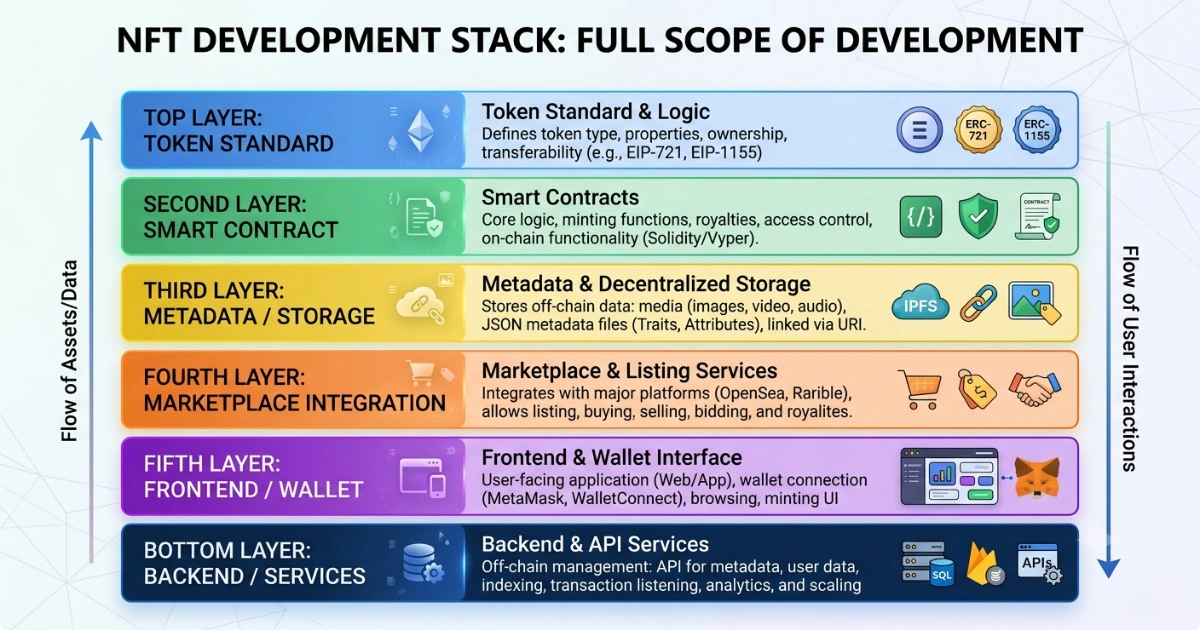
NFT development is a broad term that gets used loosely. In practice it refers to several distinct layers of work, and most projects require all of them operating together:
- Token development: Creating the NFT itself – defining its standard, properties, metadata structure, and minting rules in a smart contract.
- Smart contract development: Writing, testing, auditing, and deploying the blockchain programs that govern minting, transfers, royalties, and any custom logic your project requires.
- Metadata and storage: Defining what information is attached to each token and where it lives – typically on IPFS, Arweave, or on-chain depending on permanence requirements.
- Marketplace integration: Making your NFTs discoverable, tradeable, and compatible with existing platforms like OpenSea, Magic Eden, or a custom-built marketplace.
- Frontend and wallet connectivity: Building the user-facing application that lets people mint, view, transfer, and interact with NFTs through their wallets.
- Backend infrastructure: APIs, indexers, notification systems, and databases that support the application layer without putting everything on-chain.
A simple NFT art collection might only require the first three layers plus basic marketplace listing. A gaming economy with tradeable in-game assets, crafting mechanics, and staking requires all six, plus integration with game engines. A real-world asset tokenization project adds legal and compliance infrastructure on top of the technical stack. Understanding which layers your project needs is the first architectural decision.
NFT Token Standards: Choosing the Right Foundation
The token standard you build on determines what your NFT can do, how much it costs to deploy and interact with, and which platforms and wallets support it. Choosing the wrong standard early is one of the most expensive mistakes in NFT development because migrating later requires redeployment and user migration.
ERC-721: The One-of-One Standard
ERC-721 is the original NFT standard on Ethereum, introduced in 2018. Every token minted under ERC-721 has a unique ID and its own metadata – no two tokens are interchangeable. This makes it the right choice for one-of-one digital art, certificates of authenticity, individual real estate deeds, and any asset where each token must be completely distinct.
The drawback is efficiency: each transfer or interaction is a separate transaction, meaning gas costs scale directly with volume. For a project deploying 10,000 individual tokens with different metadata, ERC-721 works well. For a gaming project needing to transfer hundreds of items in a single session, the gas costs become prohibitive.
ERC-1155: Multi-Token Efficiency
ERC-1155, developed by Enjin, allows a single contract to manage multiple token types simultaneously – fungible tokens, non-fungible tokens, and semi-fungible tokens all within one deployment. Batch transfers let you move multiple different items in a single transaction, dramatically reducing gas costs for high-volume operations.
This makes ERC-1155 the dominant standard for gaming projects, edition-based art (where multiple copies of the same work exist), event tickets issued at scale, and any collection managing mixed asset types. The trade-off is that all assets share the same contract, so a vulnerability in the contract logic could affect every token type stored there.
ERC-6551: Token-Bound Accounts
ERC-6551 is a newer standard that allows an NFT to have its own crypto wallet. An NFT using this standard can hold other tokens, own other NFTs, and interact with dApps directly. This unlocks use cases where a digital character can own its own in-game items, or where a phygital product NFT can accumulate provenance records over time. Dynamic NFTs for gaming and metaverse applications are increasingly built on ERC-6551.
Solana: Metaplex Core
On Solana, NFT development uses the Metaplex framework rather than Ethereum token standards. Metaplex Core, launched in 2024 and now the dominant standard for new Solana projects, uses a single-account design that reduces minting costs to approximately 0.0029 SOL per token compared to 0.022 SOL under the previous standard – an over 80% cost reduction. Solana’s transaction speed and low fees make it the preferred chain for mobile-first marketplaces and gaming projects with high transaction frequency. In 2026, Solana hosts a significant share of NFT gaming activity, particularly for casual and mobile games where Ethereum gas fees would make micro-transactions impractical.
Blockchain Comparison for NFT Development
| Blockchain | NFT Standard | Avg. Mint Cost | Best For | Market Share |
| Ethereum | ERC-721 / ERC-1155 | Variable (L2: <$0.10) | Art, RWA, DeFi NFTs | ~62% |
| Solana | Metaplex Core | ~$0.001 | Gaming, mobile apps | ~18% |
| Polygon | ERC-721 / ERC-1155 | <$0.01 | High-volume collections | ~11% |
| BNB Chain | BEP-721 / BEP-1155 | <$0.05 | Cost-sensitive projects | ~6% |
Source: CoinLaw NFT Market Growth Statistics, February 2026.
The NFT Development Process: From Concept to Launch
NFT development follows a structured sequence regardless of project type. Skipping or compressing stages – particularly smart contract auditing and testnet deployment – is the most common cause of costly failures post-launch.
Stage 1: Project Definition and Architecture
Before writing a single line of code, the most important decisions happen at the architectural level. What does this NFT represent and what should it do? Which blockchain best fits the use case, user base, and transaction volume? What token standard does the project need? Will metadata be static or dynamic? Will royalties be enforced on-chain or at the marketplace level? These choices determine the entire development path and cannot easily be changed later.
Projects that failed during the 2021-2022 hype cycle largely skipped this stage. Collections were cloned from existing templates, launched quickly, and positioned around floor price speculation with no underlying system. The engineer who spent four years at an NFT company described watching leadership chase trends and glaze over speculative collections while their most viable product – an NFT ticketing platform with genuine utility – was written off as a cost center. Utility-first architecture is now the baseline for projects that attract serious development investment.
Stage 2: Smart Contract Development
Smart contract development is the core technical layer of any NFT project. The contract defines what the NFT is, who can mint it, how many can exist, what royalties apply and how they are calculated, and what transfer rules govern the token.
Key decisions at this stage include whether to build from scratch or inherit from audited libraries like OpenZeppelin, how to handle minting access (public, whitelist, or gated), whether to implement a reveal mechanic that hides metadata until after mint, and what royalty enforcement model to use. ERC-2981 is the most widely supported royalty standard but only signals intent to marketplaces rather than enforcing payment at the contract level. ERC-721C and similar enforcement-first standards restrict which platforms can interact with the token, providing stronger royalty protection at the cost of marketplace compatibility.
Stage 3: Metadata and Storage Design
Every NFT token points to metadata that describes it – name, description, image, and attributes. Where and how this metadata is stored determines how permanent and trustless the NFT actually is.
IPFS (InterPlanetary File System) is the most commonly used decentralized storage option. Files stored on IPFS are addressed by content hash, meaning the metadata cannot be changed without changing the hash the contract points to. However, files are only available as long as at least one node is pinning them – for long-term projects, a pinning service like Pinata or Filebase is necessary.
Arweave offers permanent storage backed by a one-time fee and an endowment model designed to keep data available for at least 200 years. For projects where permanence is critical – provenance records, real-world asset certificates, identity credentials – Arweave is the more reliable choice despite its higher upfront cost.
On-chain storage puts the metadata directly in the smart contract or its calldata. This is the most permanent option but also the most expensive, typically reserved for small or highly valuable collections where the cost is justified.
Stage 4: Testnet Deployment and Auditing
Before any mainnet deployment, smart contracts must be thoroughly tested on a testnet – a live blockchain environment that uses valueless tokens. Testing should cover every user flow: successful mints, failed mints, transfers, royalty calculations, edge cases like zero-price transfers, and high-traffic simulations.
Smart contract auditing by an independent security firm is not optional for any project holding real value. Unaudited contracts are the primary attack surface in NFT hacks and exploits. Reputable audit firms include Certik, Trail of Bits, OpenZeppelin’s audit service, and Halborn. For projects using standard OpenZeppelin base contracts, the core contract code has already been audited – custom logic added on top requires its own review.
Stage 5: Frontend and Wallet Integration
The user-facing application connects wallets, displays the collection, handles the minting flow, and manages post-mint interactions. Standard frontend frameworks (React, Next.js) are used alongside web3-specific libraries: ethers.js or web3.js for Ethereum interaction, WalletConnect for multi-wallet support, and RainbowKit or ConnectKit for a polished wallet connection UI.
Wallet integration is where most usability problems occur. The minting experience – from wallet connection to confirmed transaction – needs to handle failed transactions gracefully, show meaningful error messages, and work reliably across MetaMask, Coinbase Wallet, Phantom (on Solana), and mobile wallet apps. Projects that launch with a broken or confusing minting flow lose a significant portion of their potential buyers at the critical launch moment.
Stage 6: Marketplace Listing and Launch
Once contracts are deployed and the frontend is live, the project needs to be listed on relevant marketplaces. On Ethereum, OpenSea remains the dominant platform by volume but Magic Eden has grown substantially across chains. Blur appeals to high-frequency traders. Niche marketplaces like Foundation, SuperRare, and Manifold cater to specific art audiences.
For projects building their own marketplace rather than listing on existing platforms, the architectural and cost considerations are substantially more complex – the top 25 NFT marketplace development companies details what to look for in a development partner for that scope of work.
NFT Development Costs in 2026
Cost estimates in NFT development vary enormously depending on scope, blockchain, customization level, and team location. The ranges below reflect 2026 market data across multiple verified sources.
| Project Type | Cost Range (2026) | Timeline | Key Variables |
| Basic NFT collection (white-label) | $10,000 – $50,000 | 4 – 12 weeks | Art generation, chain choice |
| Custom NFT collection (from scratch) | $30,000 – $120,000 | 8 – 16 weeks | Contract complexity, audit |
| Basic NFT marketplace | $50,000 – $150,000 | 3 – 6 months | Features, chain integrations |
| Custom enterprise NFT platform | $150,000 – $500,000+ | 6 – 18 months | Compliance, custom logic |
| NFT gaming economy | $80,000 – $350,000+ | 4 – 12 months | Game engine integration, scale |
Sources: Business Research Company 2025, Antier Solutions 2026, The Block Opedia 2026.
The largest cost drivers are not the ones most first-time projects expect. Smart contract development and auditing typically represent 30-40% of total project cost for custom builds – audits from reputable firms alone run $15,000 to $50,000 depending on contract complexity. Frontend design, which most projects overemphasize, is usually a smaller portion of total spend.
Team location is also a significant variable. US-based senior blockchain developers earn $146,000 to $200,000+ annually. Eastern European and Southeast Asian development teams offer comparable technical quality at 40-60% lower day rates, which is why many projects use hybrid teams with a senior technical lead in a higher-cost market and execution capacity offshore.
NFT Development Use Cases: Where the Real Opportunity Is in 2026
The Reddit community discussion that framed this article made an important point: the problem in 2021 was not the technology, it was the use case. Static images with no system behind them had no reason to hold value once the speculative wave receded. The use cases generating real development activity in 2026 are different in kind, not just in quality.
NFT Gaming – The Largest Active Sector
Gaming NFTs account for approximately 25% of total NFT trading volume and represent the sector with the most active development pipelines. The shift from play-to-earn models – which created unsustainable token economies – to play-and-own models, where in-game assets have genuine utility within enjoyable games, is the defining architectural change. Ubisoft’s Champions Tactics, built on Immutable’s zkEVM stack, is a live example of a major studio treating NFTs as tradeable seasonal items rather than speculative assets.
For NFT game development specifically – the architecture, economics, and technical requirements of building NFT-native games – the NFT game development guide covers the complete builder’s framework. It functions as a direct sub-pillar of NFT development with its own technical depth.
Metaverse and Virtual Worlds
Metaverse development is the other major sub-pillar of NFT development. Virtual land parcels, wearables, avatar components, and in-world objects are all NFTs at the infrastructure level. The connection between NFT development and metaverse development is direct: the smart contracts, token standards, and storage architectures that power NFT collections are the same ones powering metaverse economies.
Event Ticketing
NFT ticketing was identified as one of the most viable utility use cases by developers who watched the 2021 hype cycle fail. The problem it solves is genuine: approximately 12% of concert ticket buyers have been scammed by fake tickets according to verified industry data. NFT tickets are verifiable on a public ledger, cannot be counterfeited, enable royalties on secondary sales back to artists, and can include post-event collectible value.
Ticketmaster has supported NFT add-ons for sports and concert events at scale. NFT ticketing captures 5.3% of the global event ticketing market as of 2026 according to CoinLaw’s market report. The development architecture uses ERC-721 for individual unique tickets or ERC-1155 for tiered event access, with smart contract rules limiting resale prices or enabling artist royalties on secondary transactions.
Real-World Asset Tokenization
Real estate NFTs grew 32% year-over-year, reaching a $1.4 billion market in 2026 according to Colexion’s market data. Physical trading cards with vaulted physical custody (Courtyard), luxury goods authentication (Louis Vuitton’s VIA program), and property deed tokenization are all live implementations. The NFT development challenge here extends beyond blockchain: the token is only as legally valid as the contract that ties it to the physical world, which means RWA NFT development requires legal architecture alongside technical architecture.
Phygital Products
Phygital NFTs – tokens tied to both a physical product and a digital representation – saw 60% transaction volume growth in 2026 according to Colexion market data. Luxury brands are leading: limited-edition sneakers that come with digital counterparts wearable in metaverse environments, luxury watches with blockchain-based certificates of authenticity, and fashion items with embedded chips linked to NFT ownership records. The development requirement here includes hardware integration (NFC chips or QR codes linking physical items to on-chain records) alongside standard NFT infrastructure.
Music Royalties and Creator Economy
Music NFTs generated over $520 million in revenue through streaming tokens and artist royalties in 2026 according to Colexion market data. The rapper Nas issued three tiers of NFTs for two of his songs, entitling holders to a percentage of royalty based on streaming volume plus real-world benefits. This model – programmable royalty splits enforced in smart contracts – is the most direct application of blockchain’s core value proposition to the creative economy. The development complexity involves integrating streaming platform data with on-chain royalty distribution through oracle networks.
Dynamic NFTs: The Next Development Layer
Static NFTs – tokens whose metadata never changes after minting – were the dominant model in 2021. Dynamic NFTs (dNFTs) update their metadata in response to real-world events, game state changes, or time-based conditions. They represent the next significant layer of NFT development complexity.
Dynamic NFTs are typically built using ERC-1155 or ERC-6551 standards. They rely on oracle networks – primarily Chainlink – to bring real-world data onto the blockchain in a trustless way. An insurance policy NFT that triggers a payout when a weather oracle reports a specific condition. A gaming character whose attributes update after each match. A loyalty card NFT that upgrades tier automatically based on verified purchase history.
The development overhead for dynamic NFTs is substantially higher than static ones: oracle integration, state management, and the logic governing when and how metadata updates all require additional smart contract complexity. They also introduce ongoing operational requirements – oracle feeds must be maintained and funded.
Building vs. Buying: When to Use a White-Label Solution
Not every NFT project requires custom development from scratch. The decision between white-label and custom development should be based on what the project genuinely needs to differentiate, not on a preference for building.
When White-Label Makes Sense
White-label NFT platforms – NiftyKit, Manifold, Thirdweb – allow creators to deploy audited contracts, set up minting pages, and list on marketplaces without writing Solidity. Cost: $10,000 to $50,000, live in 4 to 12 weeks. This path makes sense for art collections, limited edition drops, membership passes, and ticketing implementations where the differentiator is the asset or brand, not the technical implementation.
The validated approach for any project with genuine commercial uncertainty is to launch with white-label first. If the market responds, the project then has real transaction data to justify investment in custom development. Building custom infrastructure before proving demand is one of the most common and expensive mistakes in NFT development.
When Custom Development Is Necessary
Custom NFT development is necessary when the project requires logic that off-the-shelf platforms cannot provide: complex gaming economies with crafting, staking, and breeding mechanics; RWA tokenization with legal compliance requirements baked into contract logic; marketplace platforms serving a specific niche with custom discovery, curation, or royalty models; or enterprise deployments with permissioned access and compliance requirements.
Custom development also becomes necessary when a project has validated demand and needs to own its infrastructure rather than depend on a third-party platform.
NFT Development and Web3: The Bigger Picture
NFT development does not exist in isolation. Every NFT project is built on top of a broader Web3 infrastructure stack: the blockchain itself, wallet infrastructure, oracle networks, storage systems, and increasingly AI tools for generative asset creation and dynamic metadata.
AI-powered NFTs are projected to account for 30% of all new NFT project developments in 2026 according to Colexion market data. Generative AI for asset creation, AI-driven dynamic metadata that responds to holder behavior, and on-chain attribution systems for AI-generated work are all active development areas.
For developers approaching NFT development as a career path rather than a product build, the web3 development guide covers the skills, salaries, and learning path in detail. Solidity for Ethereum development, Rust for Solana, and a strong foundation in web development before either – this is the sequence the developer community consistently recommends.
Frequently Asked Questions
What is NFT development?
NFT development is the process of building the technical infrastructure that creates, manages, and enables the trading of non-fungible tokens. It covers smart contract development (the blockchain programs that define what the NFT is and how it behaves), token standards (ERC-721, ERC-1155, Metaplex Core), metadata storage (IPFS, Arweave), marketplace integration, and the frontend applications that users interact with. A complete NFT project requires all of these layers working together.
How much does it cost to develop an NFT project in 2026?
Costs range from $10,000 to $50,000 for a white-label collection launch using existing platforms, to $50,000 to $150,000 for a basic custom marketplace, to $500,000 or more for enterprise-grade platforms with complex compliance requirements. The largest cost driver is custom smart contract development and security auditing, not frontend design. Team location also significantly affects cost: US-based senior blockchain developers command $150,000 to $200,000+ annually, while equivalent teams in lower-cost regions run 40-60% less.
What is the difference between ERC-721 and ERC-1155 for NFT development?
ERC-721 creates one unique token per ID – every token is completely distinct. It is the standard for one-of-one art, individual certificates, and unique real-world asset representations. ERC-1155 manages multiple token types in a single contract and supports batch transfers, making it significantly more gas-efficient for gaming projects, edition-based collections, and ticketing at scale. Choosing the wrong standard requires redeployment, so this decision must be made correctly upfront.
Which blockchain is best for NFT development in 2026?
Ethereum (including Layer 2 networks like Polygon, Arbitrum, and Base) is best for projects where security, ecosystem breadth, and institutional credibility matter most – art, RWA tokenization, and DeFi-integrated NFTs. Solana is the preferred choice for gaming, mobile-first applications, and any project where transaction speed and low fees are primary requirements. Polygon specifically suits high-volume collections where Ethereum security is needed but mainnet gas fees would be prohibitive.
Do NFT smart contracts need to be audited?
Yes, for any project holding real monetary value. Unaudited smart contracts are the primary attack surface in NFT exploits and hacks. Audits from reputable firms (Certik, Trail of Bits, OpenZeppelin, Halborn) typically cost $15,000 to $50,000 depending on complexity. Projects using standard OpenZeppelin base contracts benefit from the fact that the core code has already been audited – but any custom logic added on top requires its own security review.
What are dynamic NFTs and how are they built?
Dynamic NFTs are tokens whose metadata updates in response to real-world events, game state changes, or time-based conditions. They are built using ERC-1155 or ERC-6551 standards and rely on oracle networks (primarily Chainlink) to bring external data onto the blockchain. Use cases include gaming characters whose stats update after matches, insurance policies that trigger payouts automatically, and loyalty tokens that change tier based on verified purchase history. Development complexity and ongoing operational costs are substantially higher than for static NFTs.
What are the best NFT use cases in 2026?
The use cases with the most active development and verified market traction in 2026 are gaming (25% of NFT trading volume), real-world asset tokenization (32% year-over-year growth, $1.4 billion market), event ticketing (5.3% of global event ticketing market), phygital luxury goods (60% transaction volume growth), and music royalty tokenization ($520 million in revenue). Speculative art collections without underlying utility are the category that contracted most significantly since 2022.