
For years, exchange reserves was one of crypto’s simplest signals. If Bitcoin leaves exchanges, holders are hoarding. If it flows in, they’re getting ready to sell.
That rule of thumb is breaking down, and the clearest evidence is the divide between the two biggest names on the list: Coinbase and Binance.
Two giants, 60% Share
Start with the concentration. In a July 19 snapshot of 10 tracked exchanges, about 2.51 million BTC sat on exchange wallets. Coinbase held 850,800 BTC (33.9%) and Binance held 649,300 BTC (25.9%). Add Bitfinex at 417,000 BTC (16.6%) and three venues control roughly 76% of the visible supply.
Coinbase and Binance alone account for nearly 60% of it. That is what “exchange reserve fragmentation” means in practice. Bitcoin isn’t spread evenly across the industry. It is piling up in a few places, and those places are starting to behave differently.
A “US bloc” and a “global bloc”
The popular theory has two parts:
- Coinbase is the regulated, US-facing venue and the custodian behind most American spot Bitcoin ETFs.
- Binance is the offshore trading hub where international traders and market makers park coins.
There is real data behind this, especially on Coinbase’s side. But the thesis gets shakier the closer you look.
Claim 1: “Coinbase’s balance reflects US institutions.” Mostly true
Coinbase’s balance isn’t typical exchange inventory. Independent estimates suggest Coinbase Custody holds about 80% to 84% of US spot Bitcoin ETF assets, which is around $74 billion to $77 billion. When an ETF’s coins move from a Coinbase trading wallet to a Coinbase custody wallet, analytics tools might record it as an “outflow,” even though the coins haven’t left Coinbase’s system.
Therefore, Coinbase’s small 30-day change of about -651 BTC doesn’t tell us much about whether retail investors are selling or buying. It’s a mix of customer coins, ETF settlements, and internal wallet movements.
The data itself can also be unreliable. One snapshot in July showed Coinbase with nearly 850,800 BTC, while a different tracker this week lists Coinbase at 991,512 BTC. Different providers tag different wallets, and this discrepancy alone shows how fragmented the measurement is.
The claim is largely correct, but it makes Coinbase’s reserve number less useful as a sign of demand, not more.
Claim 2: “Binance exchange reserves is where global money accumulates.” Only half true.
Binance’s numbers are striking. Its balance grew from about 616,000 BTC in late April to around 702,900 BTC by September, the highest it had been in 2026. This suggests Binance is becoming a growing hub for liquidity.
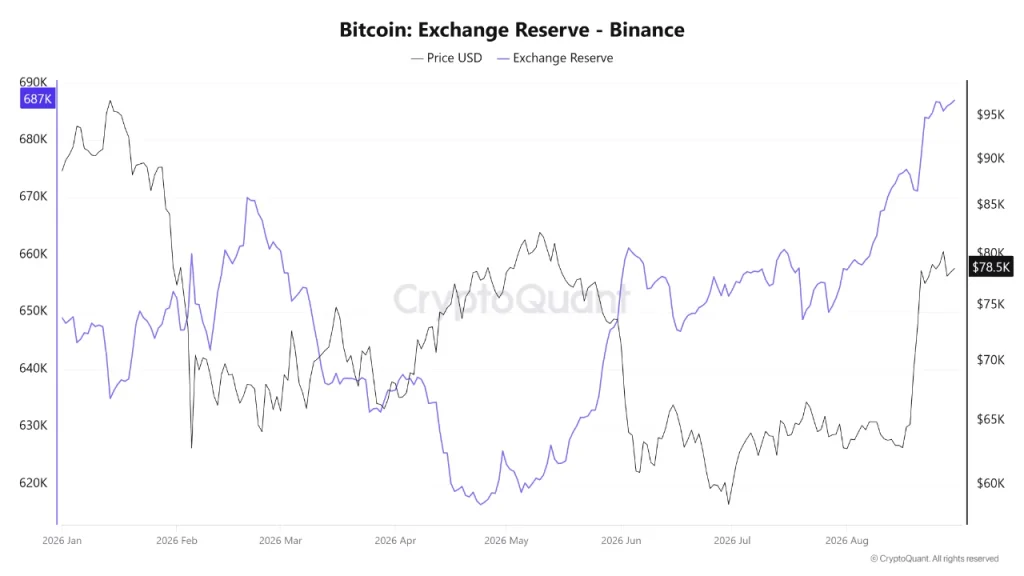
However, the trend then reversed. CryptoQuant data shows reserves dropping from 705,000 to 685,000 BTC over four days, a decrease of about 2.8%. This happened quickly: over 13,800 BTC left in a single day, the largest daily outflow since 2023. At about $84,000 per coin, that single day’s outflow was worth roughly $1.16 billion.
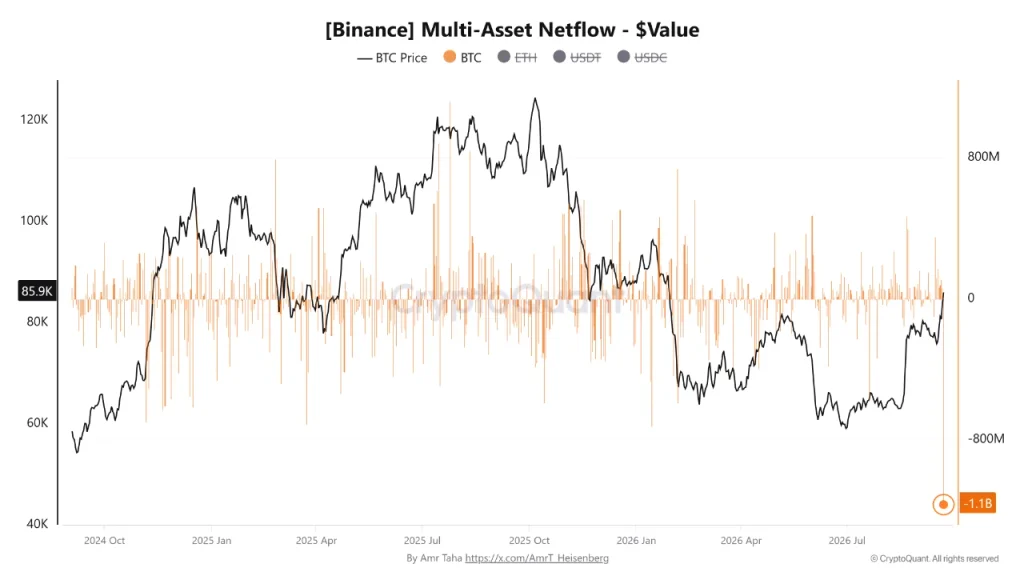
Binance is also large enough for this to be significant. One analyst estimates it holds about 30% of all Bitcoin available on exchanges. But assuming “Binance users accumulated” is just speculation, not a confirmed finding. Those same coins could have been moved to cold storage, custody services, over-the-counter desks, other exchanges, or collateral wallets.
Verdict: Binance is clearly a liquidity hub. Whether its outflows indicate global investors buying is not proven.
Claim 3: “The two blocs move in opposite directions.” Debunked.
This is where the simple explanation falls apart. If Coinbase and Binance were truly separate groups, you would expect their movements to be different during major market shifts. They were not.
From September 22 to 24, about $2.52 billion worth of Bitcoin left major exchanges, the biggest multi-day outflow since 2023. Binance saw the largest outflow, but other exchanges also experienced significant withdrawals. On September 22, Binance’s outflow was $1.19 billion, Coinbase’s was $286 million, Kraken’s was $55 million, and Bitfinex’s was $43 million.
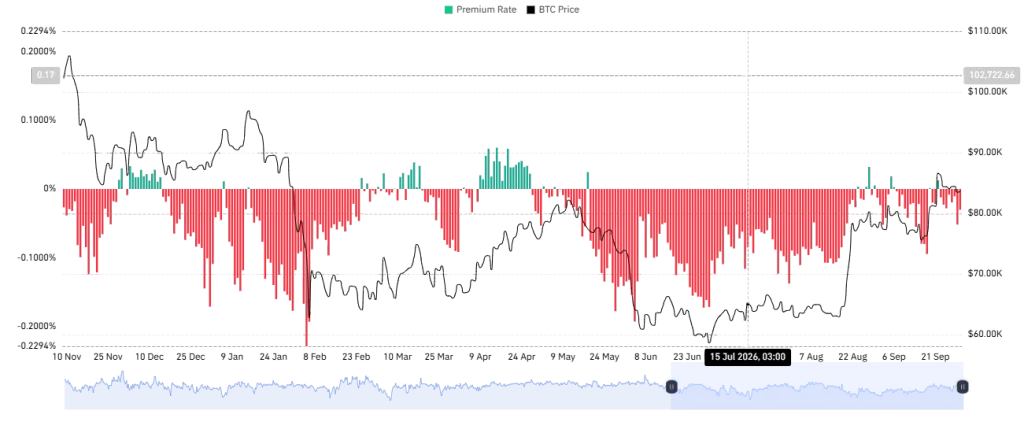
Coinbase also saw coins leave on the very same day. Meanwhile, the Coinbase Premium, which is the price difference between Coinbase and global markets, remained slightly negative (between -0.01% and -0.03%) during those days. If there was a consistent buying bloc from the US, this number would likely be positive. It was not.
Aggregate data also cuts against a “split.” The July snapshot showed total 30-day flow at about +5,077 BTC, a neutral reading. Some venues were gaining while others lost, so coins are being redistributed, not abandoning exchanges.
Verdict: debunked in its strong form. The venues diverge in structure but often move together in a shock.
Claim 4: “The USDT outflow proves OTC whales are buying.” Not proven
In March, about $2.27 billion of USDT left exchanges, and some analysts read that as whales buying Bitcoin off-exchange. But stablecoins leaving an exchange could equally mean DeFi deployment, treasury management, market-maker rebalancing or a transfer to another venue. Without matching wallet data, it stays a hypothesis.
Where ETFs fit in
ETF flows are the strongest evidence that reserve data now needs a “custody adjustment.” US spot Bitcoin ETFs pulled in about $999 million on September 21, the strongest day since October 2025. Inflows cooled to about $191 million by September 24. Across September 21 to 25, weekly inflows came to roughly $2.39 billion.
That matters because ETF demand can pull Bitcoin off exchanges without any retail investor withdrawing a coin. The buying is real, but the exchange-reserve chart may show it as an ordinary outflow.

Dan is a seasoned crypto writer for Blockchaindose who got his start in the space back in 2019. Over the past four years, he’s built a solid grasp of how the industry moves, focusing heavily on DeFi, NFTs, GameFi, and promising new projects.
Off the clock, you’ll usually find him buried in a good book or kicking back with a movie. His blend of hands-on market experience and straightforward commentary makes him a clear, trusted voice across the platform.