

Atomic swaps enable trustless peer-to-peer cryptocurrency exchanges across different blockchains. The protocol guarantees a binary outcome: either both parties receive their assets or both receive refunds. Three distinct mechanisms have emerged in this domain: Hash Time-Locked Contracts (HTLCs), Point Time-Locked Contracts (PTLCs), and Taproot-enabled PTLCs. Each represents a successive layer of cryptographic optimization, moving contract logic from on-chain scripts to off-chain signature protocols.
HTLC: The Foundational Mechanism
Hash Time-Locked Contracts constitute the original atomic swap implementation. HTLCs operate through two fundamental clauses: a payment clause secured by a hash lock and a refund clause secured by a time lock. The receiver must reveal a preimage—the original input to a hash function—to claim the funds. The contract encodes a specific hash digest, typically a 256-bit SHA256 output derived from a 32-byte preimage.
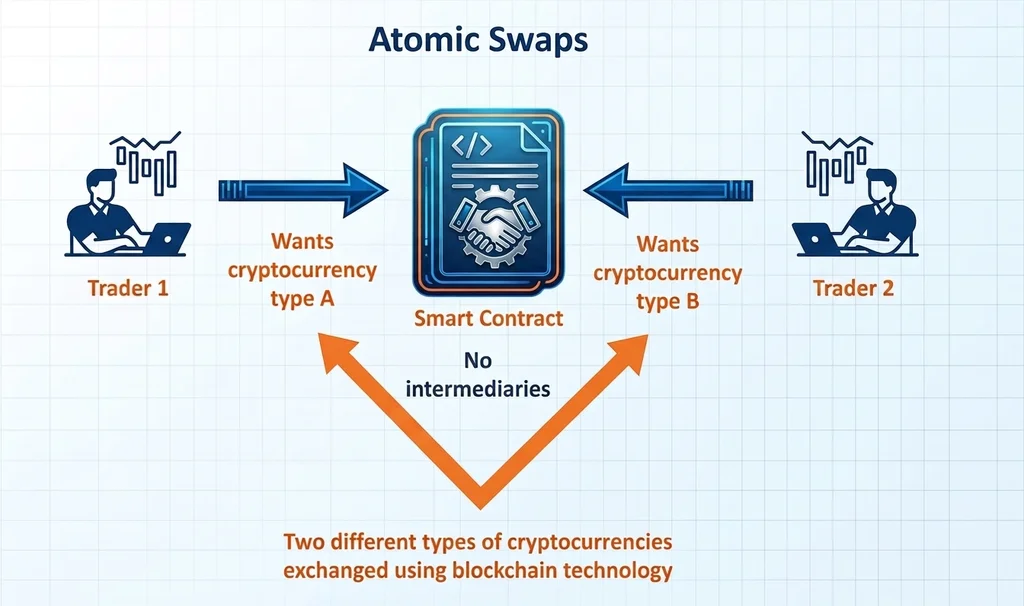
The trustlessness of HTLCs derives from cryptographic primitives rather than third-party intermediaries. Neither party can cheat: the payer cannot reclaim funds without the preimage, and the receiver cannot claim funds without revealing it. This atomicity eliminates counterparty risk.
When securing multiple payments in a routed transaction or atomic swap, all payments use the same preimage and hash lock. This creates a link between payments when published on-chain or routed through surveillance nodes. The exposed hash conditions facilitate channel probing and enable correlation analysis across multi-hop routes. HTLC script forms remain easily identifiable and censorable. Successful swaps require extended timeout periods, sometimes taking up to 60 minutes.
PTLC: Cryptographic Refinement
Point Time-Locked Contracts replace hash preimage conditions with elliptic curve point conditions. PTLCs use Schnorr adaptor signatures: a mechanism that pre-signs transactions with a hidden adaptor component. The locking mechanism shifts from hash values to curve points Y = y·G, coupling conditions off-chain via adaptor signatures.
PTLC point locks require a public key and unlock through a corresponding signature from a satisfied signature adaptor. For a Schnorr signature construction, the key requires 32 bytes and the signature 64 bytes.
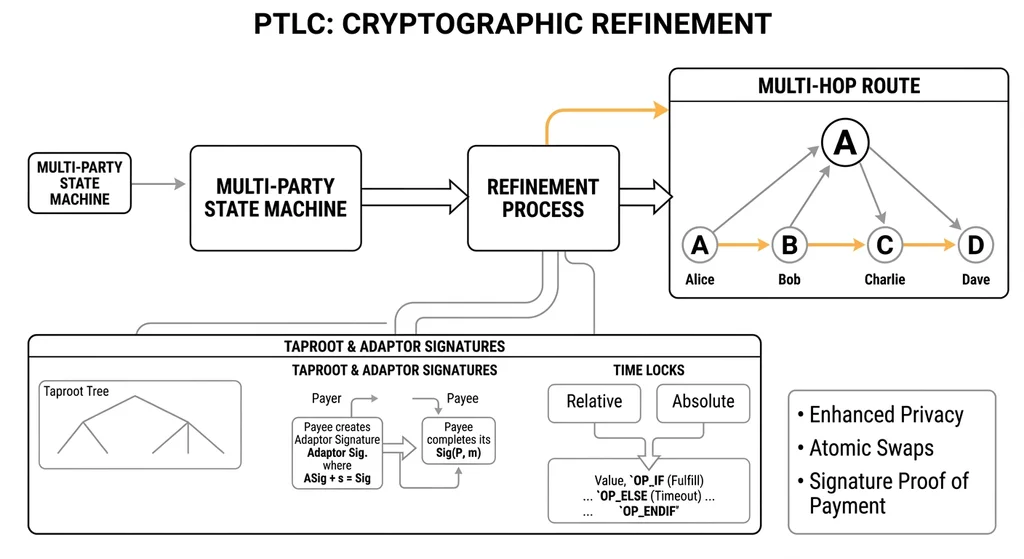
PTLCs address HTLC privacy deficiencies through uncorrelated payments. Each point lock uses different keys and signatures, eliminating on-chain or off-chain correlation between payments. PTLCs use less block space than HTLCs. Through multiparty ECDSA or Schnorr key aggregation, point locks can combine with other keys and signatures, allowing point locks to use zero bytes of distinct block space.
PTLC implementation requires signature adaptors. While technically possible with ECDSA, implementation requires either slow algorithms, additional security assumptions, or OP_CHECKMULTISIG constructions that reduce block space savings.
Taproot-Enabled PTLCs: Full Protocol Realization
Bitcoin’s Taproot upgrade (activated November 2021) and Schnorr signatures (BIP-340) enable PTLCs to achieve their full potential. Taproot introduces Pay-to-Taproot (P2TR) outputs combining key-path and script-path spending.
Taproot-enabled PTLCs implement scriptless scripts, the linearity of Schnorr signatures allows embedding conditions off-chain, enabling the final signature to complete when external conditions are met. The Taproot structure comprises an internal key (single key or MuSig2 aggregated key) with an optional commitment tree including refund leaves.
Key-path spends appear as conventional payments, showing only (R, s). Schnorr signatures on P2TR inputs are 11% smaller than previous signature schemes. Taprootized Atomic Swaps (TAS) hide swap transactions under regular payments using Schnorr signatures, Taproot technology, and zero-knowledge proofs.
MuSig2 integration enables complex routing and payment splitting. The protocol supports atomic multi-path payments where each path uses a different point, eliminating correlation. Taproot channels represent a local upgrade, while PTLCs constitute a structural change to payment channel architectures.
Trustlessness Analysis
All three mechanisms achieve cryptographic trustlessness. No trusted third party participates in the settlement process. However, the security models differ in material aspects. The payer commits to a hash digest; the receiver reveals the preimage to claim funds. This model introduces exposure to chain reorganization attacks and finality delays. All payments share a single preimage, creating a single point of failure across multi-hop routes.
PTLCs improve the security model by replacing hash preimages with digital signatures. The conditional disclosure mechanism ties signature completion to secret revelation. Adaptor signatures consist of three components: a witness, a pre-signature, and a valid signature. Any party holding the witness can complete the pre-signature to form a valid signature. Once the valid signature publishes on-chain, the secret reveals automatically.
Taproot-enabled PTLCs enhance security further. The protocol eliminates hash collision risks inherent in HTLCs. The scriptless script approach removes complex on-chain behavior. The Taproot key-path spend requires only a regular signature, indistinguishable from conventional payments. This construction reduces the attack surface by minimizing on-chain conditional logic.
Latency Analysis
Latency constitutes the most significant differentiator across the three mechanisms.
HTLC latency ranges from 20 to 60 minutes. The extended timeout periods enable accurate pricing for atomic swap spreads. Each chain typically requires six confirmations, contributing to the total duration.
PTLC latency offers theoretical improvements over HTLCs. The elimination of hash lock wait times reduces the period assets remain locked. ECDSA-based adaptor signature implementations demonstrate 60% reduction in online pre-signing time compared to previous implementations.
Taproot-enabled PTLCs achieve near-instant transaction times, the protocol reduces Bitcoin-Ethereum swap times to approximately 15 seconds for market makers. The pre-signing process enables market makers to prepare incomplete Bitcoin transactions using Schnorr signatures. The linear structure of Schnorr signatures allows both parties to compute partial signatures without immutably locking resources before conditions satisfy.
Latency improvements derive from moving the conditional logic off-chain. The protocol structures the swap so one party initiates and confirms first, shifting execution authority and minimizing risk. Multiple nonces may generate and share in advance to improve latency.
Comparative Summary
The evolution from HTLC to Taproot-enabled PTLC represents a fundamental architectural shift. HTLCs place contract logic on-chain—public, resource-intensive, and time-consuming. Taproot-enabled PTLCs move logic off-chain into cryptographic protocols—private, efficient, and near-instant.
| Parameter | HTLC | PTLC | Taproot-Enabled PTLC |
|---|---|---|---|
| Lock Mechanism | Hash digest + preimage | Public key + adaptor signature | Public key + adaptor signature |
| On-Chain Footprint | Full script | Reduced script | Key-path spend (zero distinct script) |
| Payment Correlation | High (shared preimage) | None (unique keys per hop) | None |
| Transaction Latency | 20–60 minutes | Theoretical improvement | ~15 seconds |
| Blockchain Requirement | SHA256 support | Schnorr or ECDSA adaptors | Taproot + Schnorr |
The transition enables high-frequency trading in decentralized finance. Market makers can price spreads accurately with sub-minute settlement. Privacy enhancements improve Bitcoin fungibility. Block space efficiency reduces transaction fees and network congestion.
FAQ
Why does HTLC use a shared hash preimage across multiple hops?
HTLCs require all participants in a routed payment or atomic swap to use the same hash preimage to maintain atomicity. The preimage serves as the cryptographic secret that unlocks each successive contract. This design choice, while ensuring atomic execution, creates correlation vectors that compromise privacy.
How does Taproot enable PTLCs to use zero bytes of distinct block space?
Does PTLC maintain the same trustlessness guarantees as HTLC?
PTLCs maintain cryptographic trustlessness equivalent to HTLCs. The security model differs: PTLCs rely on adaptor signatures and discrete logarithm assumptions rather than hash preimages. PTLCs eliminate hash collision risks and reduce exposure to chain reorganization attacks.
What prevents a party from refusing to complete a PTLC swap?
Can PTLCs operate on blockchains without Schnorr signatures?

Isai Alexei is a journalist and financial analyst covering cryptocurrency markets and traditional securities for Blockchaindose. He has spent ten years analyzing digital assets, trading activity, and market structure.